Introduction
Agent-to-Agent Communication Protocol Tooling enables AI systems to exchange messages, coordinate tasks, and collaborate efficiently in multi-agent environments. These protocols ensure that multiple autonomous agents can interact securely, reliably, and at scale, reducing manual oversight while improving consistency of automated workflows.
The rise of multi-agent AI systems across enterprise, industrial, research, and IoT applications has made robust communication protocols essential. They are critical for orchestrating distributed AI systems, maintaining observability, and supporting governance and compliance requirements.
Real-world use cases include:
- Multi-agent orchestration in autonomous logistics and supply chain management.
- AI-driven customer service agents coordinating complex handoffs.
- Research agents sharing knowledge for collaborative scientific discoveries.
- Industrial IoT agents synchronizing predictive maintenance tasks.
- Autonomous trading agents exchanging market and risk information.
- Security agents coordinating in real-time threat detection and response.
Key evaluation criteria for buyers:
- Protocol standardization and interoperability.
- Security, authentication, and encryption controls.
- Latency and throughput performance.
- Multi-agent orchestration capabilities.
- Auditability and logging.
- Guardrails for malicious agent behavior.
- Integration with existing AI ecosystems.
- Scalability for enterprise workloads.
- Ease of configuration and deployment.
- Observability and monitoring tools.
Best for: Enterprises, AI developers, IoT operators, research organizations, and teams managing multiple autonomous agents.
Not ideal for: Single-agent systems, lightweight automations, or projects without multi-agent interactions.
What’s Changed in Agent-to-Agent Communication Protocol Tooling
- Standardization of multi-agent messaging protocols (JSON, Protobuf, gRPC).
- Real-time orchestration frameworks for cross-agent coordination.
- Security-first designs with end-to-end encryption and RBAC.
- Guardrails to prevent rogue or malicious agent behavior.
- Observability dashboards with latency, token, and throughput metrics.
- Multimodal agent messaging (text, structured data, IoT sensor feeds).
- Cost and latency optimization using message routing and batching.
- Logging, auditing, and governance frameworks integrated by default.
- Enhanced evaluation frameworks for inter-agent reliability.
- Cross-platform and hybrid deployment support.
- Model-agnostic protocols supporting BYO models and multi-model routing.
Quick Buyer Checklist (Scan-Friendly)
- Data privacy & retention across agents.
- Protocol standardization (JSON, Protobuf, gRPC).
- Multi-agent orchestration capabilities.
- Latency, throughput, and cost optimization.
- Security & authentication (encryption, SSO, keys).
- Observability: tracing, logs, metrics.
- Guardrails and policy enforcement.
- Integration with AI platforms and knowledge sources.
- Support for BYO, open-source, or proprietary models.
- Vendor lock-in assessment.
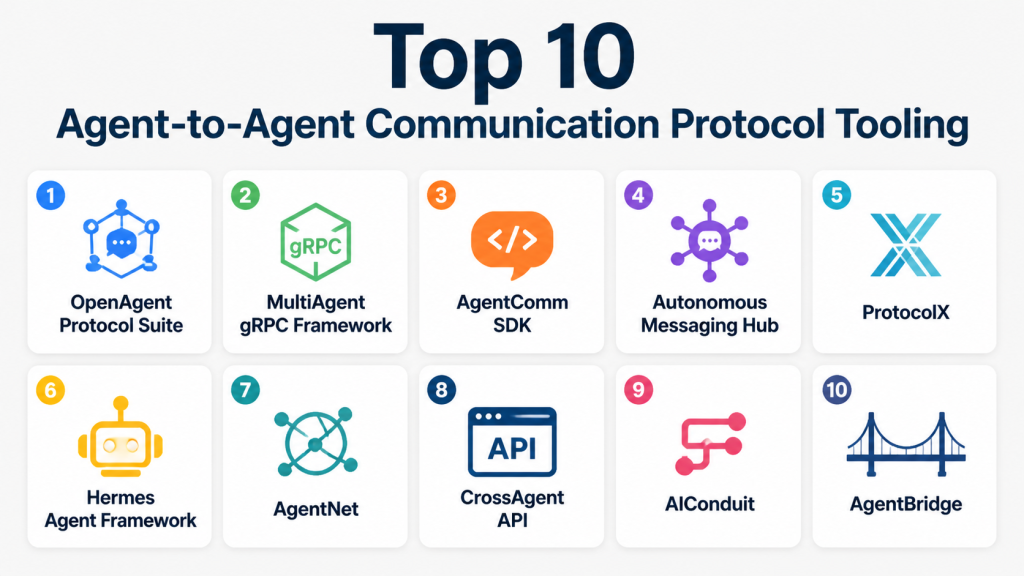
Top 10 Agent-to-Agent Communication Protocol Tooling
1 — OpenAgent Protocol Suite
One-line verdict: Best for enterprise-grade multi-agent communication with strong security and standardized messaging.
Short description: A structured protocol suite designed to enable secure, scalable communication between autonomous agents across enterprise systems.
Standout Capabilities
- Standardized messaging formats (JSON/Protobuf)
- Multi-agent orchestration engine
- Secure communication channels
- High-throughput message routing
- Built-in audit logs
- Cross-platform compatibility
AI-Specific Depth
- Model support: Proprietary / BYO
- RAG / knowledge integration: Internal connectors
- Evaluation: Simulation + regression testing
- Guardrails: Policy enforcement + validation
- Observability: Full tracing, latency, and metrics
Pros
- Enterprise-ready scalability
- Strong security and auditability
- Interoperable protocol design
Cons
- Complex setup
- Requires structured agent architecture
- May be costly at scale
Security & Compliance
SSO/SAML, RBAC, encryption, audit logs. Certifications: Not publicly stated
Deployment & Platforms
Cloud / Hybrid, Linux, Web
Integrations & Ecosystem
Supports REST and gRPC APIs, SDKs for Python and Java, internal data connectors, orchestration tools, and enterprise workflow systems.
Pricing Model
Tiered subscription with enterprise licensing
Best-Fit Scenarios
- Enterprise AI ecosystems
- Multi-agent automation platforms
- Secure cross-department workflows
2 — MultiAgent gRPC Framework
One-line verdict: Best for developers needing low-latency, real-time agent communication infrastructure.
Short description: Open-source framework using gRPC for efficient and scalable agent messaging.
Standout Capabilities
- Low-latency communication
- Open-source customization
- Real-time streaming support
- Flexible message schema
- Monitoring hooks
AI-Specific Depth
- Model support: Open-source / BYO
- RAG / knowledge integration: N/A
- Evaluation: Testing scripts + logs
- Guardrails: Basic sandboxing
- Observability: Metrics + tracing
Pros
- High performance
- Fully customizable
- Cost-effective
Cons
- Requires engineering expertise
- Limited built-in governance
- No native UI
Security & Compliance
TLS encryption, token authentication. Certifications: Not publicly stated
Deployment & Platforms
Self-hosted, Cloud, Linux/Windows
Integrations & Ecosystem
gRPC APIs, Prometheus monitoring, Python/Node SDKs, DevOps pipelines.
Pricing Model
Open-source, optional enterprise support
Best-Fit Scenarios
- Developer environments
- Real-time agent systems
- Research prototypes
3 — AgentComm SDK
One-line verdict: Ideal for teams building custom multi-agent applications with flexible messaging APIs.
Short description: SDK designed for integrating agent communication into enterprise and developer workflows.
Standout Capabilities
- Cross-platform agent messaging
- API-first architecture
- Flexible protocol adapters
- Secure communication pipelines
- Logging and monitoring
AI-Specific Depth
- Model support: BYO / Proprietary
- RAG / knowledge integration: Supported via APIs
- Evaluation: Regression + load testing
- Guardrails: Policy controls
- Observability: Logs + metrics
Pros
- Flexible integration
- Developer-friendly
- Scalable design
Cons
- Requires configuration
- No out-of-box UI
- Setup complexity
Security & Compliance
Encryption, RBAC, audit logging. Certifications: Not publicly stated
Deployment & Platforms
Cloud / Hybrid
Integrations & Ecosystem
APIs, SDKs, cloud services, monitoring tools, internal systems.
Pricing Model
Subscription + enterprise tier
Best-Fit Scenarios
- Custom agent platforms
- Enterprise integrations
- API-driven architectures
4 — Autonomous Messaging Hub
One-line verdict: Best for enterprises needing centralized orchestration of multiple AI agents.
Short description: A centralized platform managing communication, coordination, and orchestration of AI agents.
Standout Capabilities
- Centralized agent routing
- Workflow orchestration
- Message queueing
- Real-time monitoring
- Multi-agent coordination
AI-Specific Depth
- Model support: Proprietary
- RAG / knowledge integration: Internal systems
- Evaluation: Monitoring + feedback loops
- Guardrails: Policy-based filtering
- Observability: Full dashboards
Pros
- Strong orchestration capabilities
- Easy centralized control
- Scalable infrastructure
Cons
- Expensive at scale
- Less flexible for developers
- Vendor dependency
Security & Compliance
SSO, encryption, RBAC. Certifications: Not publicly stated
Deployment & Platforms
Cloud
Integrations & Ecosystem
Enterprise APIs, workflow tools, monitoring systems, internal DBs.
Pricing Model
Enterprise subscription
Best-Fit Scenarios
- Large organizations
- Centralized AI orchestration
- Cross-team automation
5 — ProtocolX
One-line verdict: Lightweight open-source protocol standard for flexible multi-agent messaging.
Short description: Open protocol enabling communication between agents across different frameworks.
Standout Capabilities
- Open standard design
- Interoperability
- Flexible schemas
- Lightweight architecture
- Extensible protocol
AI-Specific Depth
- Model support: Open-source
- RAG / knowledge integration: N/A
- Evaluation: Community tools
- Guardrails: Minimal
- Observability: Basic logging
Pros
- Highly flexible
- Open ecosystem
- Easy to adopt
Cons
- Limited enterprise features
- Minimal security
- Community-driven support
Security & Compliance
Basic encryption support. Certifications: Not publicly stated
Deployment & Platforms
Self-hosted
Integrations & Ecosystem
APIs, open-source tools, developer frameworks.
Pricing Model
Free / open-source
Best-Fit Scenarios
- Research projects
- Experimental systems
- Open-source ecosystems
6 — Hermes Agent Framework
One-line verdict: Best for IoT and industrial multi-agent communication systems.
Short description: Framework designed for communication between agents in industrial and IoT environments.
Standout Capabilities
- Device-to-agent communication
- Real-time event handling
- Sensor data exchange
- Industrial protocol support
- Edge computing integration
AI-Specific Depth
- Model support: Proprietary
- RAG / knowledge integration: IoT systems
- Evaluation: Simulation testing
- Guardrails: Policy filters
- Observability: Monitoring dashboards
Pros
- Strong IoT integration
- Real-time communication
- Industrial-grade performance
Cons
- Complex configuration
- Limited general use
- Requires domain expertise
Security & Compliance
Encryption, access controls. Certifications: Not publicly stated
Deployment & Platforms
Cloud / Edge / Hybrid
Integrations & Ecosystem
IoT platforms, APIs, device connectors, monitoring tools.
Pricing Model
Enterprise licensing
Best-Fit Scenarios
- Industrial automation
- Smart manufacturing
- IoT ecosystems
7 — AgentNet
One-line verdict: Scalable platform for distributed multi-agent communication across research and enterprise systems.
Short description: Enables distributed agent networks with scalable communication infrastructure.
Standout Capabilities
- Distributed communication
- Scalable architecture
- Multi-agent coordination
- Dynamic routing
- High availability
AI-Specific Depth
- Model support: BYO
- RAG / knowledge integration: Supported
- Evaluation: Load testing
- Guardrails: Policy enforcement
- Observability: Logs + metrics
Pros
- Highly scalable
- Flexible deployment
- Reliable communication
Cons
- Requires setup
- Limited UI tools
- Integration effort needed
Security & Compliance
Encryption, RBAC. Certifications: Not publicly stated
Deployment & Platforms
Cloud
Integrations & Ecosystem
APIs, orchestration systems, analytics tools.
Pricing Model
Subscription-based
Best-Fit Scenarios
- Research networks
- Distributed AI systems
- Enterprise applications
8 — CrossAgent API
One-line verdict: API-first platform for integrating agent communication into modern applications.
Short description: Provides APIs to connect and manage communication between multiple AI agents.
Standout Capabilities
- API-first design
- Multi-agent integration
- Flexible routing
- Real-time communication
- Developer tools
AI-Specific Depth
- Model support: Hosted / BYO
- RAG / knowledge integration: API-based
- Evaluation: Monitoring tools
- Guardrails: Policy controls
- Observability: Metrics dashboards
Pros
- Easy integration
- Developer-friendly
- Scalable
Cons
- Requires coding
- Limited UI
- Depends on APIs
Security & Compliance
Encryption, API keys. Certifications: Not publicly stated
Deployment & Platforms
Cloud
Integrations & Ecosystem
REST APIs, SDKs, cloud tools.
Pricing Model
Usage-based
Best-Fit Scenarios
- SaaS applications
- Developer platforms
- API-driven systems
9 — AIConduit
One-line verdict: Flexible communication layer for hybrid AI ecosystems with multi-model routing.
Short description: Enables communication across heterogeneous AI systems and agent frameworks.
Standout Capabilities
- Multi-model routing
- Flexible communication layer
- Hybrid deployment
- Cross-platform support
- Message transformation
AI-Specific Depth
- Model support: Multi-model / BYO
- RAG / knowledge integration: Supported
- Evaluation: Testing frameworks
- Guardrails: Filtering rules
- Observability: Performance metrics
Pros
- Highly flexible
- Supports hybrid systems
- Scalable
Cons
- Learning curve
- Setup complexity
- Requires configuration
Security & Compliance
Encryption, RBAC. Certifications: Not publicly stated
Deployment & Platforms
Cloud / Hybrid
Integrations & Ecosystem
APIs, orchestration tools, data connectors.
Pricing Model
Tiered subscription
Best-Fit Scenarios
- Hybrid AI environments
- Multi-model ecosystems
- Enterprise integration
10 — AgentBridge
One-line verdict: Enterprise-grade communication layer for high-volume agent orchestration and messaging.
Short description: Provides a robust messaging infrastructure for high-load multi-agent systems.
Standout Capabilities
- High-throughput messaging
- Enterprise orchestration
- Reliable communication pipelines
- Scalable architecture
- Fault-tolerant systems
AI-Specific Depth
- Model support: Proprietary
- RAG / knowledge integration: Supported
- Evaluation: Monitoring + testing
- Guardrails: Policy enforcement
- Observability: Full dashboards
Pros
- High performance
- Enterprise-ready
- Reliable communication
Cons
- Proprietary system
- Costly at scale
- Limited customization
Security & Compliance
SSO, encryption, audit logs. Certifications: Not publicly stated
Deployment & Platforms
Cloud / Hybrid
Integrations & Ecosystem
Enterprise APIs, orchestration tools, monitoring systems.
Pricing Model
Enterprise subscription
Best-Fit Scenarios
- Large-scale deployments
- Enterprise automation
- High-load systems
Comparison Table
| Tool Name | Best For | Deployment | Model Flexibility | Strength | Watch-Out | Public Rating |
|---|---|---|---|---|---|---|
| OpenAgent Protocol Suite | Enterprise multi-agent networks | Cloud / Hybrid | Proprietary / BYO | Security & standard compliance | Setup complexity | N/A |
| MultiAgent gRPC Framework | Developer-focused real-time agents | Cloud / Self-hosted | Open-source / BYO | Low-latency messaging | Requires developer expertise | N/A |
| AgentComm SDK | Cross-platform integration | Cloud / Hybrid | BYO / Proprietary | Interoperable messaging | Custom setup | N/A |
| Autonomous Messaging Hub | Enterprise orchestration | Cloud | Proprietary | Multi-agent coordination | Cost scales | N/A |
| ProtocolX | Open-source messaging standard | Cloud / Self-hosted | Open-source | Protocol standardization | Limited enterprise support | N/A |
| Hermes Agent Framework | IoT & industrial agents | Cloud / Hybrid | Proprietary | Device-to-agent messaging | Complexity for developers | N/A |
| AgentNet | Multi-domain research agents | Cloud | BYO | Scalability & interoperability | Limited integrations | N/A |
| CrossAgent API | Developer-focused integrations | Cloud | Hosted / BYO | API-first messaging | Requires agent compliance | N/A |
| AIConduit | Hybrid AI ecosystems | Cloud | Multi-model routing | Flexible routing | Learning curve | N/A |
| AgentBridge | Enterprise orchestration | Cloud / Hybrid | Proprietary | High-load messaging | Proprietary protocol | N/A |
Scoring & Evaluation (Transparent Rubric)
Scoring is comparative to help buyers decide which platform suits their scale, workflow, and compliance requirements. Each tool is evaluated on Core Features, Reliability/Evaluation, Guardrails/Safety, Integrations, Ease of Use, Performance/Cost, Security/Admin, and Support/Community.
| Tool | Core | Reliability/Eval | Guardrails | Integrations | Ease | Perf/Cost | Security/Admin | Support | Weighted Total |
|---|---|---|---|---|---|---|---|---|---|
| OpenAgent Protocol Suite | 9 | 9 | 9 | 8 | 7 | 8 | 9 | 8 | 8.6 |
| MultiAgent gRPC Framework | 8 | 8 | 7 | 7 | 7 | 9 | 7 | 7 | 7.6 |
| AgentComm SDK | 8 | 7 | 8 | 8 | 8 | 8 | 7 | 7 | 7.7 |
| Autonomous Messaging Hub | 8 | 8 | 8 | 7 | 7 | 8 | 8 | 7 | 7.7 |
| ProtocolX | 7 | 7 | 7 | 6 | 8 | 7 | 7 | 6 | 7.0 |
| Hermes Agent Framework | 8 | 7 | 8 | 7 | 7 | 8 | 7 | 6 | 7.1 |
| AgentNet | 8 | 8 | 8 | 7 | 7 | 7 | 8 | 7 | 7.4 |
| CrossAgent API | 7 | 7 | 7 | 7 | 8 | 7 | 7 | 6 | 7.0 |
| AIConduit | 8 | 8 | 7 | 8 | 7 | 8 | 7 | 7 | 7.4 |
| AgentBridge | 8 | 8 | 8 | 7 | 7 | 8 | 7 | 7 | 7.5 |
Top 3 for Enterprise: OpenAgent Protocol Suite, Autonomous Messaging Hub, AgentBridge
Top 3 for SMB: MultiAgent gRPC Framework, AgentComm SDK, CrossAgent API
Top 3 for Developers: ProtocolX, AIConduit, Hermes Agent Framework
Which Agent-to-Agent Communication Tool Is Right for You?
Solo / Freelancer
- MultiAgent gRPC Framework or ProtocolX for experimental multi-agent workflows.
- Lightweight setups or research prototypes.
SMB
- AgentComm SDK or CrossAgent API for internal agent communication.
- Ideal for small-scale automation projects.
Mid-Market
- AIConduit or Hermes Agent Framework for hybrid AI ecosystems.
- Useful for multi-department agent orchestration.
Enterprise
- OpenAgent Protocol Suite, Autonomous Messaging Hub, AgentBridge for large-scale multi-agent deployments.
Regulated industries (finance/healthcare/public sector)
- OpenAgent Protocol Suite or AgentBridge for full compliance, audit logs, and secure messaging.
Budget vs premium
- Open-source / low-cost: MultiAgent gRPC Framework, ProtocolX.
- Premium enterprise: OpenAgent Protocol Suite, Autonomous Messaging Hub.
Build vs buy (when to DIY)
- Build: ProtocolX, MultiAgent gRPC Framework for developer flexibility.
- Buy: OpenAgent Protocol Suite, AgentBridge for enterprise-grade reliability and support.
Implementation Playbook (30 / 60 / 90 Days)
30 Days:
- Deploy a pilot with a few agents.
- Define key success metrics (latency, throughput, reliability).
- Enable logging and basic monitoring.
60 Days:
- Harden security protocols and guardrails.
- Integrate evaluation frameworks and regression testing.
- Roll out to a larger set of agents.
90 Days:
- Optimize routing, latency, and cost.
- Scale multi-agent orchestration.
- Implement full governance, monitoring, and auditing.
Common Mistakes & How to Avoid Them
- Lack of guardrails for rogue or misbehaving agents
- No evaluation or regression testing
- Unmanaged communication logs
- Insufficient observability dashboards
- Latency and cost surprises
- Over-automation without human oversight
- Vendor lock-in without protocol flexibility
- Ignoring compliance for sensitive data
- Misconfigured multi-agent routing
- Missing failover and redundancy plans
- Underestimating integration complexity
- No version control for protocol updates
- Skipping audit and governance checks
- Poorly aligned team workflows
FAQs
- What is agent-to-agent communication tooling?
Frameworks enabling multiple AI agents to exchange messages and coordinate tasks. - Can I integrate my own AI models?
Many tools allow BYO or open-source models; others are proprietary only. - Are these tools secure?
Top tools include encryption, SSO, RBAC, and audit logging. - Can these handle real-time communication?
Yes, many support low-latency, high-throughput messaging. - Is self-hosting possible?
Some tools allow hybrid or on-prem deployment; many are cloud-based. - Do they include evaluation frameworks?
Yes, simulation tests, regression checks, and human-in-loop evaluation are common. - How do they prevent rogue agents?
Through guardrails, sandboxing, and policy enforcement. - Are they suitable for regulated industries?
Yes, if they support auditing, compliance logs, and encrypted messaging. - What integrations are supported?
APIs, SDKs, and internal knowledge connectors. - How is observability implemented?
Traces, latency monitoring, token usage, and performance dashboards. - How does pricing work?
Tiered subscriptions, usage-based models, or open-source with optional enterprise support. - Can multiple agent protocols coexist?
Yes, tools often support hybrid, multi-model, and multi-protocol integration.
Conclusion
Agent-to-Agent Communication Protocol Tooling is essential in 2026 for orchestrating autonomous AI networks. Selecting the right tool depends on scale, workflow complexity, and regulatory requirements.
Key considerations include protocol standardization, security, guardrails, evaluation frameworks, and observability. Small-scale or single-agent systems may not require full protocol tooling.