Introduction
Edge LLM Deployment Toolkits are software frameworks and libraries that allow developers and enterprises to deploy large language models (LLMs) efficiently on edge devices such as smartphones, industrial PCs, gateways, embedded systems, and edge servers. Unlike traditional cloud‑centric AI deployment, edge toolkits focus on running LLM inference close to where data is generated, reducing latency, increasing privacy, and lowering dependency on network connectivity.
As AI becomes pervasive in mobile apps, industrial automation, robotics, and IoT ecosystems, deploying LLMs at the edge has moved from experimental to mission‑critical. Edge deployments empower real‑time assistant features, on‑device reasoning, contextual analytics, and private inference where cloud connectivity is limited or not acceptable.
Real-world use cases include:
- Autonomous machines and robotics using language understanding at the edge
- On-device assistants in smart appliances and mobile platforms
- Real‑time language translation and transcription without cloud dependency
- Industrial AI analytics for anomaly detection and predictive maintenance
- Edge conversational agents in retail kiosks and customer support
What buyers should evaluate:
- Supported device architectures and OS platforms
- Model format compatibility and optimization support
- Latency performance and memory efficiency
- Tools for quantization, pruning, and model conversion
- Integration with hardware accelerators like GPUs, NPUs, and TPUs
- Developer tooling and deployment automation
- Security, privacy, and safe inference on edge devices
- Monitoring, logging, and performance profiling
- Scalability from prototype to production fleets
- Licensing, support, and community ecosystem
Best for: AI engineers, edge architects, mobile developers, robotics teams, and enterprises deploying AI outside centralized cloud infrastructure.
Not ideal for: Teams focused purely on cloud inference without hardware constraints, or those with minimal edge deployment needs.
Key Trends in Edge LLM Deployment Toolkits
- Quantization and Compression: INT8, INT4, and lower‑bit techniques to fit models on constrained hardware
- Hardware Acceleration: Support for GPUs, NPUs, DSPs, and dedicated AI accelerators
- Cross‑Platform Support: Unified runtimes for Android, iOS, Linux, embedded Linux, and RTOS
- Auto‑Optimization Pipelines: One‑click transforms for models to edge formats
- Federated and On‑Device Learning: Enabling updates without centralized data collection
- Security and Privacy Controls: On‑device encryption, secure enclaves, and isolated inference
- Edge Orchestration: Tools for managing model versions and telemetry across fleets
- Open‑Source Toolchains: Community‑driven SDKs with transparent development
- Observability and Analytics: Monitoring edge AI performance and drift
- Zero‑Trust Deployment Models: Ensuring hardened edge inference hygiene
How We Selected These Tools (Methodology)
- Device Compatibility: Support across a variety of edge platforms
- Performance Optimization: Built‑in quantization, pruning, acceleration support
- Integration Stack: APIs and SDKs enabling end‑to‑end deployment
- Security Posture: Ability to deploy safely on hardened devices
- Developer Experience: Documentation, tooling, and ease of onboarding
- Scalability: Management of model lifecycle on multiple edge nodes
- Monitoring & Profiling: Support for performance tracking and logs
- Open Options vs Proprietary: Balanced mix of open‑source and commercial toolkits
- Hardware Partnerships: Alignment with silicon vendors
- Community Strength: Developer activity and ecosystem adoption
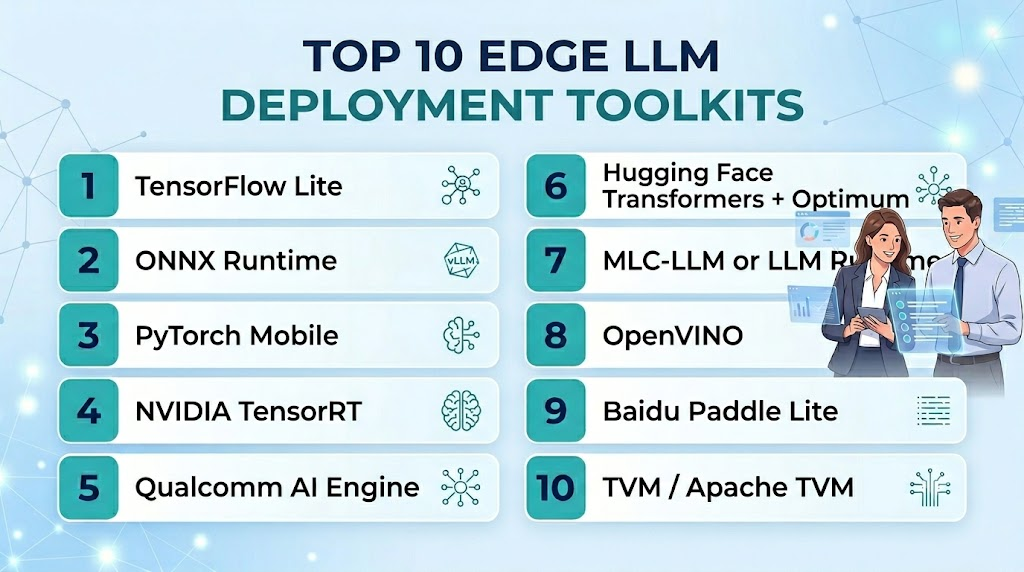
Top 10 Edge LLM Deployment Toolkits
1- TensorFlow Lite
Short description: Lightweight deployment toolkit enabling optimized LLM inference on mobile and embedded devices through model conversion and runtime acceleration.
Key Features
- Support for quantized and optimized models
- Hardware acceleration via NNAPI and GPU delegates
- Model conversion from standard formats
- Cross‑platform compatibility
- Performance profiling tools
- Support for custom operators
- Clear deployment pipelines
Pros
- Mature ecosystem and widespread adoption
- Broad device and OS support
- Good profiling and optimization workflows
Cons
- Not exclusively designed for large LLMs
- Requires conversion and tuning
Platforms / Deployment
- Android, iOS, Linux, Embedded Linux
- Local/Edge
Security & Compliance
Not publicly stated
Integrations & Ecosystem
A flexible SDK integrates with multiple hardware paths and development pipelines:
- Mobile and embedded APIs
- Integration with hardware delegates
- Tooling for conversion and profiling
Support & Community
- Extensive documentation
- Community support forums
- Examples and tutorials
2- ONNX Runtime
Short description: Cross‑platform runtime designed to execute optimized models on edge devices, supporting acceleration and quantized inference.
Key Features
- ONNX model support
- Cross‑architecture optimization
- GPU and accelerator support
- Quantized precision executions
- Low‑latency inference
- Model caching and dispatch
- Runtime configuration options
Pros
- Broad format support
- Portable across platforms
- Community and hardware vendor backing
Cons
- Requires model conversion to ONNX
- Setup complexity varies by target device
Platforms / Deployment
- Android, iOS, Linux, Windows
- Local/Edge
Security & Compliance
Not publicly stated
Integrations & Ecosystem
- Runtime APIs for multiple languages
- Integration with custom delegates
- Profiling and performance tools
Support & Community
- Official documentation
- Community contributions
- Support channels
3- PyTorch Mobile
Short description: Edge deployment variant of PyTorch optimized for on‑device inference with LLM support via quantization and scripting.
Key Features
- TorchScript export for edge models
- Quantization support
- Android and iOS integration
- GPU and accelerated delegates
- Debugging and profiling tools
- Model packaging workflows
Pros
- PyTorch ecosystem familiarity
- Flexible deployment options
- Good for research‑to‑production workflows
Cons
- Requires code adaptation and scripts
- Performance tuning necessary
Platforms / Deployment
- Android, iOS
- Local/Edge
Security & Compliance
Not publicly stated
Integrations & Ecosystem
- APIs for mobile and edge
- Integration with native apps
- Conversion tools for quantization
Support & Community
- Extensive PyTorch docs
- Community forums
- Developer discussions
4- NVIDIA TensorRT
Short description: High‑performance inference toolkit tailored for accelerating LLMs and models on NVIDIA GPUs at the edge.
Key Features
- Ultra‑low latency GPU acceleration
- Precision optimizations (FP16, INT8)
- Model calibration and tuning
- Edge container runtimes
- Profiling and metrics
- Support for large LLM inference
Pros
- Exceptional performance on supported hardware
- Highly optimized for GPU pipelines
Cons
- Limited to NVIDIA ecosystem
- Requires specialized hardware knowledge
Platforms / Deployment
- Linux edge devices with NVIDIA GPUs
- Local/Edge
Security & Compliance
Not publicly stated
Integrations & Ecosystem
- CUDA‑based acceleration
- Optimized inference pipelines
- Monitoring tools
Support & Community
- Technical documentation
- Developer forums
- Vendor support
5- Qualcomm AI Engine
Short description: Toolkit enabling optimized LLM inference on Snapdragon‑based devices using dedicated AI accelerators.
Key Features
- Hardware acceleration on NPUs
- Cross‑platform SDKs
- Quantized model optimization
- Performance profiling
- On‑device runtime management
Pros
- Strong edge performance on mobile and embedded
- Accelerator utilization
Cons
- Hardware‑specific optimization required
- Framework support varies
Platforms / Deployment
- Android and Snapdragon‑powered devices
- Local/Edge
Security & Compliance
Not publicly stated
Integrations & Ecosystem
- SDKs tailored to hardware
- Profiling and debugging tools
- Integration with mobile apps
Support & Community
- Documentation
- Developer forums
- Hardware vendor support
6- Hugging Face Transformers + Optimum
Short description: Toolkit optimizing transformer models for edge devices with quantization and acceleration support.
Key Features
- Model optimization pipelines
- Support for multiple hardware backends
- Quantized and pruned model builds
- Edge‑friendly runtimes
- API access for deployment workflows
Pros
- Strong optimization tools
- Compatible with multiple frameworks
Cons
- Requires conversion and tuning
- Not a standalone runtime
Platforms / Deployment
- Linux, Android, iOS
- Local/Edge
Security & Compliance
Not publicly stated
Integrations & Ecosystem
- Compatibility with popular LLM formats
- Integration into deployment and CI pipelines
- Tooling for quantization
Support & Community
- Documentation
- Community forums
- Git‑style support
7- MLC‑LLM or LLM Runtimes
Short description: Open‑source runtime optimized for on‑device model inference and edge‑friendly operations.
Key Features
- Efficient quantized inference
- Support for multiple LLM formats
- Cross‑platform capabilities
- Low‑resource footprint
- CLI tools for deployment
Pros
- Lightweight and flexible
- Community contributions
Cons
- Still evolving
- Integration requires expert knowledge
Platforms / Deployment
- Linux, macOS, Windows, Android, iOS
- Local/Edge
Security & Compliance
Not publicly stated
Integrations & Ecosystem
- CLI and bindings
- Community tool extensions
- Deployment helpers
Support & Community
- OSS documentation
- Community discussions
8- OpenVINO
Short description: Toolkit focused on optimizing deep learning models for inference across heterogeneous compute (CPU, GPU, VPU) at the edge.
Key Features
- Model optimization pipelines
- Support for various device architectures
- Quantization support
- Runtime acceleration
- Profiling and analytics
Pros
- Multi‑architecture support
- Good optimization ecosystem
Cons
- Best suited for computer vision toolchains
- LLM support improving
Platforms / Deployment
- Linux, Windows, edge boards
- Local/Edge
Security & Compliance
Not publicly stated
Integrations & Ecosystem
- APIs for runtime invocations
- Device profiling tools
- Conversion pipelines
Support & Community
- Documentation
- Community forums
- Tutorials
9- Baidu Paddle Lite
Short description: Lightweight deployment toolkit for AI models on edge devices with optimization and quantization.
Key Features
- Model compression and optimization
- Cross‑platform support
- NPU acceleration integration
- Runtime deployment APIs
- Profiling tools
Pros
- Flexible deployment targets
- Supports hardware acceleration
Cons
- Ecosystem primarily in specific regions
- LLM support requires extra tooling
Platforms / Deployment
- Android, iOS, Linux
- Local/Edge
Security & Compliance
Not publicly stated
Integrations & Ecosystem
- Binding APIs
- Compression utilities
- Profiling dashboards
Support & Community
- Documentation
- Developer community
10- TVM / Apache TVM
Short description: Open‑source compiler and runtime stack to compile and optimize AI models for heterogeneous edge targets.
Key Features
- Model compilation for diverse backends
- Auto‑tuning performance pipelines
- Support for accelerators
- Quantization support
- Runtime execution for edge
Pros
- Highly flexible and powerful
- Good community support
Cons
- Steeper learning curve
- Requires deep optimization expertise
Platforms / Deployment
- Linux, Windows, embedded
- Local/Edge
Security & Compliance
Not publicly stated
Integrations & Ecosystem
- Multiple backend targets
- CLI and APIs
- Integration with CI/CD
Support & Community
- Open‑source docs
- Community contributions
Comparison Table (Top 10)
| Tool Name | Best For | Platform(s) Supported | Deployment | Standout Feature | Public Rating |
|---|---|---|---|---|---|
| TensorFlow Lite | Mobile & embedded | Android, iOS, Linux | Local/Edge | Broad mobile optimization | N/A |
| ONNX Runtime | Cross‑platform | Android, iOS, Windows | Local/Edge | ONNX model support | N/A |
| PyTorch Mobile | PyTorch edge workflows | Android, iOS | Local/Edge | TorchScript inference | N/A |
| NVIDIA TensorRT | GPU edge acceleration | Linux with hardware | Local/Edge | High‑performance GPU | N/A |
| Qualcomm AI Engine | Smartphone & IPC | Android | Local/Edge | NPU acceleration | N/A |
| Hugging Face + Optimum | Model optimization | Linux, mobile | Local/Edge | Flexible model tuning | N/A |
| MLC‑LLM Runtimes | Lightweight edge | Multi‑OS | Local/Edge | Efficient quantized inference | N/A |
| OpenVINO | Heterogeneous compute | Linux, Windows | Local/Edge | Multi‑architecture optimization | N/A |
| Paddle Lite | Flexible deployment | Android, iOS, Linux | Local/Edge | Cross‑platform support | N/A |
| Apache TVM | Custom edge builds | Linux, embedded | Local/Edge | Backend compilation | N/A |
Evaluation & Scoring
| Tool Name | Core (25%) | Ease (15%) | Integrations (15%) | Security (10%) | Performance (10%) | Support (10%) | Value (15%) | Weighted Total |
|---|---|---|---|---|---|---|---|---|
| TensorFlow Lite | 8 | 8 | 8 | 7 | 8 | 8 | 8 | 7.8 |
| ONNX Runtime | 8 | 7 | 8 | 7 | 8 | 7 | 8 | 7.7 |
| PyTorch Mobile | 7 | 8 | 7 | 7 | 7 | 7 | 8 | 7.4 |
| NVIDIA TensorRT | 9 | 7 | 8 | 7 | 9 | 8 | 7 | 8.1 |
| Qualcomm AI Engine | 8 | 7 | 7 | 7 | 8 | 7 | 8 | 7.7 |
| Hugging Face + Optimum | 8 | 8 | 8 | 7 | 8 | 7 | 8 | 7.8 |
| MLC‑LLM Runtimes | 7 | 7 | 7 | 7 | 7 | 7 | 8 | 7.4 |
| OpenVINO | 7 | 7 | 7 | 7 | 7 | 7 | 7 | 7.1 |
| Paddle Lite | 7 | 7 | 7 | 7 | 7 | 7 | 7 | 7.0 |
| Apache TVM | 9 | 6 | 8 | 7 | 9 | 7 | 8 | 7.9 |
Which Edge LLM Deployment Toolkit Is Right for You?
Solo / Freelancer
If you are exploring edge AI prototypes, TensorFlow Lite, ONNX Runtime, or MLC‑LLM Runtimes provide lightweight, flexible deployments.
SMB
Teams building mobile/embedded AI apps should consider TensorFlow Lite, PyTorch Mobile, or Hugging Face + Optimum for ease and optimization.
Mid‑Market
Organizations needing confident performance across devices should evaluate ONNX Runtime, Hugging Face + Optimum, and Qualcomm AI Engine.
Enterprise
Large deployments requiring hardware acceleration and optimization should lean on NVIDIA TensorRT, Apache TVM, or OpenVINO for scale and performance.
Budget vs Premium
- Budget: TensorFlow Lite, MLC‑LLM Runtimes, ONNX Runtime
- Premium: NVIDIA TensorRT, Apache TVM
Feature Depth vs Ease of Use
- Runtimes like TensorFlow Lite balance usability and performance, while Apache TVM or TensorRT deliver deeper optimization with higher complexity.
Integrations & Scalability
- Choose frameworks linking to your existing pipelines for large‑scale deployment and model lifecycle automation.
Security & Compliance Needs
- For sensitive data at the edge, validate encryption, role‑based access, and secure boot mechanisms in your device stack.
Frequently Asked Questions (FAQs)
1- What pricing models exist?
Most toolkits are open‑source or included with hardware SDKs; some enterprise versions may use subscription or service fees.
2- Do these toolkits need model conversion?
Yes — many require converting models into optimized formats for edge inference.
3- What hardware accelerators are supported?
NPUs, GPUs, DSPs, and custom AI accelerators are supported depending on platform and toolkit.
4- Can I optimize LLMs for low‑resource devices?
Yes — through quantization, pruning, and precision reduction.
5- Are edge deployments private?
On‑device inference keeps data local, enhancing privacy compared to cloud inference.
6- How long does it take to deploy?
Simple applications can be deployed quickly; complex optimization and tuning may take more time.
7- Are monitoring tools included?
Many toolkits offer profiling and logs, but deployment monitoring often requires additional orchestration layers.
8- Can I update models remotely?
Model updates may need custom OTA mechanisms or orchestration support.
9- Is developer expertise required?
Intermediate knowledge of optimization and hardware targets improves outcomes.
10- Which toolkit fits mobile apps best?
TensorFlow Lite and PyTorch Mobile provide user‑friendly paths for Android and iOS.
Conclusion
Edge LLM Deployment Toolkits make it possible to leverage powerful language models on devices with limited connectivity, latency needs, and privacy constraints. From lightweight mobile runtimes to GPU‑accelerated edge pipelines, the right toolkit depends on hardware targets, optimization needs, and deployment scale. Shortlist a few that match your hardware profile, run performance tests, and validate integration patterns before full adoption.
Excellent comparison! The article provides a clear overview of leading edge LLM deployment toolkits, making it easier to evaluate the right solution for different AI deployment needs.
One aspect that deserves more attention is deployment in disconnected or low-connectivity environments. Many edge LLM initiatives assume periodic cloud access for updates and monitoring, but real-world deployments often operate with limited network availability. The ability to manage model updates, diagnostics, and recovery offline can be just as important as inference performance.