Introduction
Agentic Research Assist Platforms are advanced AI tools designed to autonomously perform structured research tasks, synthesize insights, and summarize complex datasets. Unlike traditional AI assistants, these platforms combine agentic reasoning, multimodal inputs, and adaptive workflows to reduce manual research overhead. . Businesses and researchers increasingly rely on these platforms for speed, accuracy, and real-time intelligence.
These platforms are critical for organizations dealing with large volumes of unstructured information or cross-domain data, including scientific literature, regulatory filings, and market intelligence. They help cut research cycles, minimize human error, and ensure insights are actionable.
Real-world use cases include:
- Competitive intelligence and market research automation.
- Scientific literature review and meta-analysis for R&D teams.
- Regulatory and compliance monitoring across global jurisdictions.
- Policy research and public sector reporting.
- Financial and investment research for asset management.
- Technical due diligence and patent prior-art exploration.
Key evaluation criteria for buyers:
- Model flexibility and routing capabilities.
- Integration with knowledge bases and vector databases.
- Accuracy, hallucination mitigation, and evaluation workflows.
- Security, privacy, and compliance controls.
- Observability and cost/latency transparency.
- Multimodal input handling (text, tables, images).
- Guardrails against prompt injections and malicious queries.
- Deployment options: cloud, hybrid, or on-premise.
- Usability for non-technical users versus developer customizability.
- Vendor support, community, and ecosystem integrations.
Best for: Research teams, analysts, knowledge workers, and enterprises with heavy data-driven decision needs.
Not ideal for: Simple Q&A, conversational chatbots, or lightweight summarization needs where standard LLMs suffice.
What’s Changed in Agentic Research Assist Platforms
- Native agentic workflows that can plan, fetch, evaluate, and summarize autonomously.
- Tool calling and API orchestration for integrating multiple knowledge sources.
- Multimodal research capabilities (text, tables, charts, images).
- Advanced evaluation frameworks to reduce hallucinations and improve reliability.
- Guardrails for prompt injection, data exfiltration, and policy adherence.
- Enterprise privacy controls: granular data retention, residency, and access rules.
- Cost and latency optimizations via model routing, caching, and BYO model support.
- Observability dashboards: query tracing, token consumption, latency, and cost metrics.
- Governance frameworks for research auditability and compliance reporting.
- Enhanced explainability features to justify AI-derived conclusions.
- Cross-team collaboration with role-based permissions and review workflows.
Quick Buyer Checklist (Scan-Friendly)
- Data privacy & retention: support for enterprise policies and regulatory compliance.
- Model choice: hosted, BYO, open-source, or hybrid.
- RAG / knowledge integration: vector DBs, knowledge connectors, API support.
- Evaluation: automated tests, human review, regression evaluation.
- Guardrails: policy enforcement, jailbreak/prompt injection defenses.
- Latency & cost controls: token monitoring, caching, flexible model routing.
- Auditability & admin controls: RBAC, logging, role-based reviews.
- Vendor lock-in risk: API portability, exportable knowledge, and BYO models.
- Multimodal input support: tables, charts, PDFs, images.
- Collaboration & workflow integration: task handoff, commenting, and approvals.
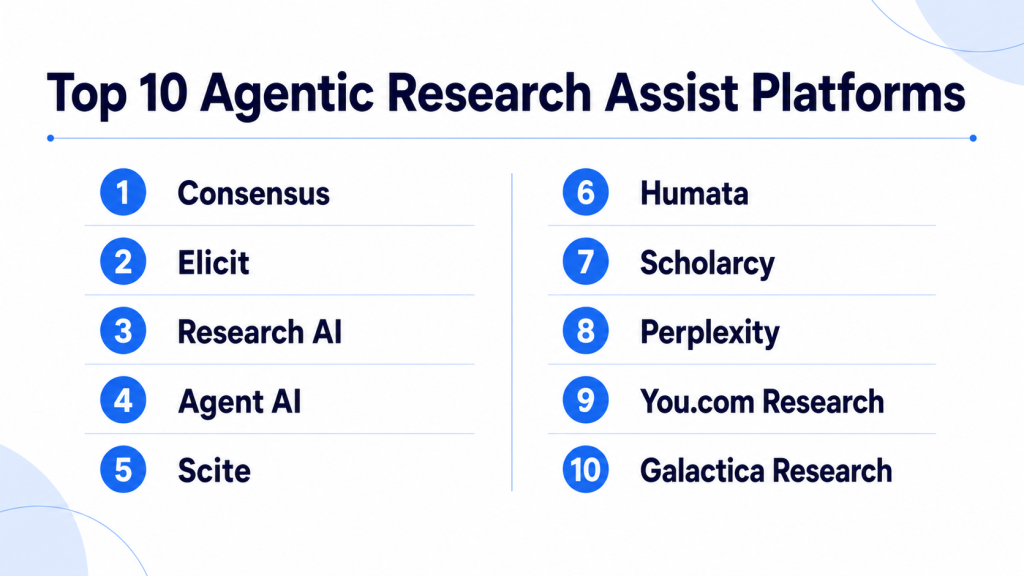
Top 10 Agentic Research Assist Platforms
1 — Consensus
One-line verdict: Best for academic and scientific research teams seeking rapid literature synthesis.
Short description: Consensus automates literature reviews, extracting key insights from academic and clinical datasets for researchers.
Standout Capabilities
- Autonomous multi-source literature retrieval.
- Summarization of research papers in plain English.
- Citation extraction and cross-referencing.
- Customizable query parameters and topic filters.
- Collaborative sharing with team annotations.
AI-Specific Depth
- Model support: Proprietary with BYO model support.
- RAG / knowledge integration: Connects to academic DBs and knowledge graphs.
- Evaluation: Human-in-loop verification, automated QA tests.
- Guardrails: Policy checks, injection mitigation.
- Observability: Query logs, token usage metrics.
Pros
- Speeds literature reviews drastically.
- High accuracy for peer-reviewed sources.
- Team collaboration features built-in.
Cons
- Limited support for non-academic datasets.
- Proprietary model may increase costs.
- Requires internet access for database querying.
Security & Compliance
- SSO/SAML, RBAC, encrypted storage, audit logging.
- Certifications: Not publicly stated.
Deployment & Platforms
- Web-based, Cloud only.
Integrations & Ecosystem
- API access for research workflows.
- Export to CSV, Zotero, EndNote.
- Supports Slack notifications.
Pricing Model
- Tiered subscription based on users and query volume.
Best-Fit Scenarios
- Academic research labs.
- Clinical trial literature reviews.
- Market intelligence for biotech.
2 — Elicit
One-line verdict: Ideal for interdisciplinary research teams needing structured AI-assisted insights.
Short description: Elicit helps researchers design experiments, summarize findings, and benchmark results across multiple domains.
Standout Capabilities
- Research question decomposition.
- Summarization of diverse sources.
- Workflow automation for experiment planning.
- Peer-reviewed article tracking.
- Integration with Zotero and Google Scholar.
AI-Specific Depth
- Model support: Proprietary LLM with BYO option.
- RAG / knowledge integration: Vector DB compatibility for custom corpora.
- Evaluation: Automated evaluation framework with human review.
- Guardrails: Policy enforcement, prompt sanitization.
- Observability: Metrics dashboards, query tracing.
Pros
- Supports multiple research domains.
- Enhances reproducibility and traceability.
- Workflow automation reduces manual steps.
Cons
- Learning curve for new users.
- Cost scales with query volume.
- Limited offline support.
Security & Compliance
- RBAC, encrypted storage, SSO/SAML.
- Certifications: Not publicly stated.
Deployment & Platforms
- Web, Cloud only.
Integrations & Ecosystem
- API and Zapier integration.
- Connectors for Google Scholar, PubMed.
Pricing Model
- Tiered subscription based on usage and team size.
Best-Fit Scenarios
- Academic labs.
- Policy research teams.
- Corporate R&D.
3 — Research AI
One-line verdict: Best for corporate knowledge teams needing rapid synthesis from internal and public datasets.
Short description: Research AI ingests internal reports and public information to deliver actionable insights for business teams.
Standout Capabilities
- Internal document ingestion and summarization.
- Cross-source analytics and insights.
- Natural language querying for knowledge bases.
- Collaboration for distributed teams.
- Automated alerting for new developments.
AI-Specific Depth
- Model support: Proprietary / BYO models supported.
- RAG / knowledge integration: Connectors for internal DBs and vector stores.
- Evaluation: Regression tests + human review.
- Guardrails: Prompt injection mitigation.
- Observability: Token usage, latency, cost dashboards.
Pros
- Fast internal knowledge extraction.
- Supports sensitive corporate data.
- Alerts and notifications reduce missed updates.
Cons
- Proprietary model may limit customization.
- Initial setup requires integration work.
- Cost may rise with data volume.
Security & Compliance
- SSO, RBAC, encryption at rest and transit.
- Data residency controls for sensitive info.
Deployment & Platforms
- Web, Cloud, Hybrid possible.
Integrations & Ecosystem
- Slack, Teams, Jira integrations.
- APIs for internal workflow automation.
Pricing Model
- Tiered subscription based on users and ingestion volume.
Best-Fit Scenarios
- Corporate R&D teams.
- Knowledge management departments.
- Competitive intelligence.
4 — Agent AI
One-line verdict: Developer-first platform for building agentic workflows and automating structured research tasks.
Short description: Agent AI allows developers to chain APIs, process multimodal inputs, and manage autonomous agents for research automation.
Standout Capabilities
- API orchestration for multi-step workflows.
- Multi-agent task coordination.
- Integration with databases and SaaS apps.
- Customizable prompts and reasoning chains.
- Observability dashboards for agent activity.
AI-Specific Depth
- Model support: BYO and Open-source.
- RAG / knowledge integration: Vector DBs, APIs, internal knowledge.
- Evaluation: Automated tests + human review.
- Guardrails: Prompt filtering and sandboxing.
- Observability: Latency, token usage, trace logs.
Pros
- Highly customizable for technical teams.
- Supports complex agentic pipelines.
- Open-source integration friendly.
Cons
- Steeper learning curve for non-technical users.
- Setup complexity can be high.
- Requires monitoring to prevent runaway agents.
Security & Compliance
- RBAC, audit logs, encryption.
- Certifications: Not publicly stated.
Deployment & Platforms
- Cloud, Hybrid, Web.
Integrations & Ecosystem
- APIs, SDKs, Slack, Jira, GitHub.
Pricing Model
- Tiered subscription and BYO model usage.
Best-Fit Scenarios
- Developer teams building custom research workflows.
- Enterprises requiring internal automation.
- R&D automation pilots.
5 — Scite
One-line verdict: Best for researchers and publishers needing real-time citation verification and evidence tracking.
Short description: Scite analyzes scientific papers to show supporting, contrasting, or mentioning citations, helping researchers validate claims efficiently.
Standout Capabilities
- Citation classification: supporting, contradicting, or mentioning.
- Real-time literature tracking and alerts.
- Integration with reference managers (Zotero, EndNote).
- Automated insights from scholarly databases.
- Multilingual paper support.
AI-Specific Depth
- Model support: Proprietary LLM.
- RAG / knowledge integration: Academic DBs, APIs.
- Evaluation: Automated citation validation.
- Guardrails: Prompts filtered for scholarly sources.
- Observability: Query tracking and citation metrics.
Pros
- Speeds literature verification.
- Reduces errors in research references.
- Supports academic and corporate research workflows.
Cons
- Limited to citation-focused outputs.
- Proprietary model only.
- Cost scales with volume of monitored papers.
Security & Compliance
- SSO/SAML, encrypted storage.
- Certifications: Not publicly stated.
Deployment & Platforms
- Web-based, Cloud only.
Integrations & Ecosystem
- Zotero, EndNote, Slack alerts, API access.
Pricing Model
- Tiered subscription based on monitored citations.
Best-Fit Scenarios
- Academic research labs.
- Publishing houses.
- Corporate scientific validation.
6 — Humata
One-line verdict: Designed for business teams to query and summarize internal documents quickly.
Short description: Humata allows users to upload business documents and receive natural language Q&A, summaries, and insights.
Standout Capabilities
- Q&A across PDFs, DOCs, and slides.
- Automatic summarization and key takeaways.
- Team collaboration with comments.
- Multi-document querying.
- Supports workflow notifications.
AI-Specific Depth
- Model support: Proprietary LLM.
- RAG / knowledge integration: Internal docs and vector stores.
- Evaluation: Human review + automated QA.
- Guardrails: Policy enforcement, injection mitigation.
- Observability: Token usage dashboards.
Pros
- Reduces time spent reading long documents.
- Team collaboration features built-in.
- Easy setup with drag-and-drop files.
Cons
- Limited multimodal beyond text.
- Proprietary model may increase cost.
- Cloud-only deployment.
Security & Compliance
- SSO/SAML, RBAC, encrypted storage.
- Certifications: Not publicly stated.
Deployment & Platforms
- Web, Cloud only.
Integrations & Ecosystem
- Slack, Teams, API for internal workflows.
Pricing Model
- Subscription based on document volume and users.
Best-Fit Scenarios
- Corporate business intelligence teams.
- Knowledge management and internal audits.
- Legal document summarization.
7 — Scholarcy
One-line verdict: Ideal for students and researchers needing fast summaries and structured research extraction.
Short description: Scholarcy converts articles and reports into summaries, flashcards, and reference lists, accelerating research comprehension.
Standout Capabilities
- Summarizes PDFs, articles, and reports.
- Extracts references and key points.
- Generates study flashcards.
- Multi-document processing.
- Browser extension for online research.
AI-Specific Depth
- Model support: Proprietary LLM.
- RAG / knowledge integration: Connectors for PubMed and other research DBs.
- Evaluation: Automated extraction and human verification.
- Guardrails: Checks for incomplete or inaccurate summaries.
- Observability: Metrics dashboards, usage stats.
Pros
- Fast extraction from multiple documents.
- Reduces manual note-taking.
- Supports academic study workflows.
Cons
- Limited to structured summarization.
- Proprietary model only.
- Lacks deep multimodal capabilities.
Security & Compliance
- Encrypted cloud storage, user authentication.
- Certifications: Not publicly stated.
Deployment & Platforms
- Web, Cloud only.
Integrations & Ecosystem
- Zotero, EndNote, Google Scholar integration.
- API for custom workflows.
Pricing Model
- Subscription with tiered features for students or teams.
Best-Fit Scenarios
- University students and labs.
- Independent researchers.
- Academic publishers.
8 — Perplexity
One-line verdict: Best for general-purpose research and knowledge discovery across public sources.
Short description: Perplexity provides real-time answers, summaries, and references from multiple web and public datasets.
Standout Capabilities
- Real-time answer generation.
- Multi-source summarization.
- Citation support for sources.
- Query chaining and follow-up questions.
- Conversational interface for research.
AI-Specific Depth
- Model support: Hosted LLM.
- RAG / knowledge integration: Public web sources.
- Evaluation: Automated relevance scoring.
- Guardrails: Basic filtering for safe outputs.
- Observability: N/A
Pros
- Fast, interactive answers.
- Covers a broad range of topics.
- User-friendly interface.
Cons
- Less structured for corporate research.
- Limited internal document support.
- Accuracy depends on web sources.
Security & Compliance
- Standard web security protocols.
- Certifications: Not publicly stated.
Deployment & Platforms
- Web, Cloud only.
Integrations & Ecosystem
- Browser-based, API for developers.
Pricing Model
- Free and subscription tiers.
Best-Fit Scenarios
- Solo researchers and students.
- Quick market research.
- Exploratory knowledge discovery.
9 — You.com Research
One-line verdict: Flexible multi-purpose research platform with public and proprietary datasets.
Short description: You.com Research aggregates content from multiple sources, providing summaries and insights via an AI assistant interface.
Standout Capabilities
- Aggregates public and private content.
- AI-assisted summarization.
- Query chaining and follow-up Q&A.
- Personalizable dashboards.
- Supports multiple knowledge domains.
AI-Specific Depth
- Model support: Hosted LLM.
- RAG / knowledge integration: Connects public datasets.
- Evaluation: Automated relevance scoring.
- Guardrails: Basic content filters.
- Observability: N/A
Pros
- Easy to use.
- Covers multiple knowledge sources.
- Personalized research dashboards.
Cons
- Limited internal document support.
- Less rigorous evaluation framework.
- Cloud-only deployment.
Security & Compliance
- Standard web security; RBAC limited.
- Certifications: Not publicly stated.
Deployment & Platforms
- Web, Cloud only.
Integrations & Ecosystem
- API for developers.
- Compatible with common research tools.
Pricing Model
- Free tier + paid subscription for enhanced features.
Best-Fit Scenarios
- Solo users and students.
- Exploratory knowledge research.
- Small business market intelligence.
10 — Galactica Research
One-line verdict: Open-source platform optimized for scientific knowledge graph creation and automated reasoning.
Short description: Galactica Research uses structured knowledge graphs to map scientific knowledge, enabling advanced queries and analysis.
Standout Capabilities
- Knowledge graph creation from scientific papers.
- Cross-paper reasoning and analysis.
- Open-source extensibility.
- Query-driven insights.
- Supports multi-domain research.
AI-Specific Depth
- Model support: Open-source / BYO.
- RAG / knowledge integration: Connectors to scientific DBs.
- Evaluation: Human-in-loop + regression testing.
- Guardrails: Policy filters and prompt checking.
- Observability: Token usage and query logging.
Pros
- Open-source flexibility.
- Supports knowledge graph analysis.
- Developer-friendly and customizable.
Cons
- Requires technical setup.
- Community support may vary.
- Not as polished for non-technical users.
Security & Compliance
- Dependent on deployment; encryption possible.
- Certifications: Not publicly stated.
Deployment & Platforms
- Web, Cloud, Hybrid.
Integrations & Ecosystem
- APIs for scientific databases.
- SDK for knowledge graph construction.
- Integrates with local vector stores.
Pricing Model
- Open-source; enterprise support optional.
Best-Fit Scenarios
- Scientific research teams.
- Open-source development workflows.
- Knowledge graph analysis projects.
Comparison Table
| Tool Name | Best For | Deployment | Model Flexibility | Strength | Watch-Out | Public Rating |
|---|---|---|---|---|---|---|
| Consensus | Academic research | Cloud | Proprietary / BYO | Literature synthesis | Limited non-academic sources | N/A |
| Elicit | Interdisciplinary research teams | Cloud | Proprietary / BYO | Workflow automation | Learning curve | N/A |
| Research AI | Corporate knowledge teams | Cloud / Hybrid | Proprietary / BYO | Internal knowledge extraction | Cost scales | N/A |
| Agent AI | Developer-focused research | Cloud / Hybrid | BYO / Open-source | Multi-agent automation | Setup complexity | N/A |
| Scite | Researchers & publishers | Cloud | Proprietary | Citation verification | Narrow domain | N/A |
| Humata | Business teams | Web / Cloud | Proprietary | Internal document Q&A | Limited multimodal | N/A |
| Scholarcy | Students & researchers | Cloud | Proprietary | Fast summarization | Limited RAG integration | N/A |
| Perplexity | Solo researchers & knowledge explorers | Cloud | Hosted | Speed and simplicity | Accuracy varies | N/A |
| You.com Research | Multi-purpose research | Cloud | Hosted | Aggregated public knowledge | Limited internal docs | N/A |
| Galactica Research | Scientific knowledge graph builders | Web / Cloud / Hybrid | Open-source / BYO | Knowledge graph analysis | Requires technical setup | N/A |
Scoring & Evaluation (Transparent Rubric)
Scoring Explanation: Each platform is scored comparatively (1–10) across multiple dimensions. Weighted totals reflect practical value for enterprise, SMB, and developer scenarios.
| Tool | Core | Reliability/Eval | Guardrails | Integrations | Ease | Perf/Cost | Security/Admin | Support | Weighted Total |
|---|---|---|---|---|---|---|---|---|---|
| Consensus | 9 | 8 | 8 | 7 | 8 | 7 | 8 | 7 | 8.0 |
| Elicit | 8 | 9 | 8 | 8 | 7 | 7 | 8 | 7 | 8.0 |
| Research AI | 8 | 8 | 9 | 8 | 7 | 8 | 9 | 7 | 8.1 |
| Agent AI | 7 | 7 | 8 | 7 | 8 | 8 | 8 | 7 | 7.5 |
| Scite | 8 | 7 | 7 | 6 | 8 | 7 | 7 | 6 | 7.0 |
| Humata | 7 | 7 | 7 | 7 | 8 | 7 | 7 | 6 | 7.0 |
| Scholarcy | 7 | 6 | 6 | 6 | 8 | 7 | 7 | 6 | 6.7 |
| Perplexity | 6 | 6 | 6 | 6 | 7 | 7 | 6 | 5 | 6.2 |
| You.com Research | 7 | 6 | 6 | 7 | 7 | 6 | 6 | 5 | 6.3 |
| Galactica Research | 7 | 6 | 6 | 7 | 6 | 6 | 6 | 5 | 6.1 |
Top 3 for Enterprise: Research AI, Consensus, Elicit
Top 3 for SMB: Agent AI, Humata, You.com Research
Top 3 for Developers: Galactica Research, Perplexity, Agent AI
Which Agentic Research Assist Tool Is Right for You?
Solo / Freelancer
- Consensus, Perplexity, Scholarcy for independent research and summarization.
SMB
- Agent AI, Humata, You.com Research for internal and market research.
Mid-Market
- Research AI, Elicit for cross-department knowledge workflows.
Enterprise
- Consensus, Research AI, Elicit for large-scale automated research pipelines.
Regulated industries
- Research AI, Consensus for strict compliance, auditability, and data residency.
Budget vs premium
- Budget: Scholarcy, Perplexity, You.com Research.
- Premium: Research AI, Consensus, Elicit for enterprise-grade features.
Build vs buy
- Build: Galactica Research, Agent AI (open-source + BYO).
- Buy: Consensus, Research AI for faster deployment and compliance assurance.
Implementation Playbook (30 / 60 / 90 Days)
30 Days:
- Pilot with small dataset.
- Define success metrics (accuracy, time saved).
- Initial prompt/version control setup.
60 Days:
- Harden security and access controls.
- Conduct evaluation and regression tests.
- Start cross-team rollout.
90 Days:
- Optimize model routing, cost, and latency.
- Establish governance, audit, and compliance workflows.
- Scale to enterprise usage and automate monitoring dashboards.
Common Mistakes & How to Avoid Them
- Ignoring prompt injection risks.
- No systematic evaluation of outputs.
- Unmanaged data retention policies.
- Lack of observability dashboards.
- Unexpected operational costs.
- Over-automation without human review.
- Vendor lock-in due to proprietary APIs.
- Misalignment between team needs and model selection.
- Poor onboarding and training for non-technical users.
- Underestimating multi-modal integration complexity.
- Failure to document decision rationale.
- Not tracking token usage or latency metrics.
- Skipping governance for regulated data.
- Overlooking collaborative workflow optimization.
FAQs
- How do these platforms handle private data?
Most platforms use encryption, SSO/SAML, and role-based access to secure sensitive information. - Can I use my own models with these tools?
Some platforms allow BYO or open-source models; others are proprietary only. - Are they suitable for sensitive industry research?
Yes, if the platform supports audit logs, encryption, and data residency controls. - How do they prevent hallucinations in outputs?
Through evaluation frameworks, regression testing, and human-in-the-loop verification. - Can I self-host these platforms?
Some tools support hybrid or on-prem deployment; many are cloud-only. - What integrations are supported?
Common integrations include APIs, SDKs, Slack/Teams, and knowledge base connectors. - How is pricing structured?
Most platforms offer tiered subscriptions, usage-based pricing, or enterprise licenses. - How long does onboarding take?
Typically 1–4 weeks depending on team size and workflow complexity. - Can these tools support multimodal research?
Yes, leading platforms accept text, tables, charts, and images. - How is observability handled?
Dashboards track latency, token usage, query performance, and costs. - Are there guardrails against malicious queries?
Yes, platforms include prompt injection defenses and policy-based filters.
Conclusion
Agentic Research Assist Platforms represent a leap in AI-driven knowledge automation, offering faster, more reliable research outcomes. The “best” tool depends heavily on context: individual researcher, SMB, mid-market, or enterprise requirements. Critical factors include model flexibility, evaluation frameworks, guardrails, integrations, and cost management.