Introduction
In the modern digital economy, the demand for DevOps professionals has skyrocketed, making “Best DevOps Salary” one of the most searched terms among IT professionals. As businesses shift toward cloud-native architectures, the ability to bridge the gap between development and operations has become a premium skill. Companies are no longer just looking for people who can manage servers; they are looking for engineers who can architect complex automation, ensure 99.99% uptime, and optimize cloud infrastructure costs. This shift explains why DevOps salaries continue to trend upward across the globe. However, a higher paycheck is rarely given for just “knowing” a tool. It is reserved for those who can solve complex problems using CI/CD pipelines, Terraform, and Kubernetes. Whether you are an entry-level developer or a seasoned sysadmin, understanding the salary landscape is your first step toward career advancement. This guide provides a transparent, reality-based look at what drives DevOps compensation. We will break down how roles, certifications, and specific technical skills contribute to your market value, helping you map out a path to top-tier earnings.
Why DevOps Salaries Are Growing
The surge in DevOps compensation is driven by the fundamental transformation of how software is delivered. Key trends include:
- Cloud Adoption: Organizations are moving away from on-premises data centers to AWS, Azure, and GCP, creating a massive need for experts who can manage these environments.
- Kubernetes Dominance: As the industry standard for container orchestration, Kubernetes knowledge is now a high-premium skill.
- Infrastructure as Code (IaC): Companies value engineers who can automate infrastructure provisioning through tools like Terraform, reducing manual errors.
- SRE and Platform Engineering: Businesses are prioritizing system reliability. Professionals who can build self-service platforms for developers are among the highest-paid in the industry.
- Shortage of Talent: While many claim to have DevOps skills, there is a genuine scarcity of engineers who truly understand distributed systems and end-to-end automation.
Factors Affecting DevOps Salary
Salary is rarely static. Several variables influence your earning potential:
- Experience Level: Hands-on experience with production systems is the biggest multiplier.
- Cloud Expertise: Deep knowledge of AWS, Azure, or Google Cloud.
- Kubernetes Knowledge: Mastery of K8s architecture and troubleshooting.
- Automation Skills: Proficiency in scripting (Python/Go) and CI/CD tools.
- Location: Local cost of living and global demand for remote talent.
- Industry Type: Finance and tech-heavy sectors usually pay more than retail or manufacturing.
DevOps Salary by Experience Level
Fresher DevOps Engineer
Entry-level positions focus on learning the stack. Salaries at this stage are competitive but reflect a “learning investment.” The focus here should be on gaining fundamental skills in Linux, Git, and CI/CD basics.
Mid-Level DevOps Engineer
At this stage, you are expected to handle complex pipelines and manage containerized applications. Expertise in Terraform and Kubernetes often leads to significant salary jumps.
Senior DevOps Engineer
Senior roles involve architectural decisions. You are expected to design for scale, security, and cost-efficiency. Leadership, mentoring, and incident management become core responsibilities here.
DevOps Salary by Role
| Role | Focus | Salary Potential |
| DevOps Engineer | CI/CD & Automation | High |
| Cloud Engineer | Infrastructure & Cloud | High |
| Kubernetes Engineer | Container Orchestration | Very High |
| Site Reliability Engineer (SRE) | System Reliability & Scale | Highest |
| DevSecOps Engineer | Security Automation | Very High |
| Platform Engineer | Developer Productivity | Very High |
DevOps Salary by Country
Salaries vary significantly due to economic factors and market demand. In the United States, the demand for specialized cloud architecture drives salaries to the top of the scale. In India, the ecosystem is rapidly maturing, with a high demand for DevOps professionals in the Global Capability Centers (GCCs). Germany, the UK, and Australia also maintain strong salary bands for those with proven experience in cloud automation and security.
DevOps Salary by Cloud Platform
- AWS: As the market leader, AWS remains the most requested skill, leading to consistent demand and salary stability.
- Azure: Popular in enterprise environments; certification in Azure DevOps often leads to high-paying positions within large, legacy-to-cloud migrating firms.
- Google Cloud (GCP): Often associated with data-heavy and AI-driven companies, GCP expertise is highly valued, particularly for those working on complex, large-scale systems.
Highest-Paying DevOps Skills
To command the best salaries, focus on:
- Kubernetes: The undisputed king of modern orchestration.
- Terraform: Essential for infrastructure provisioning.
- Go/Python: Scripting languages used to build custom automation.
- Observability: Proficiency with Prometheus, Grafana, and ELK.
- Security Automation: Integrating security into the pipeline (DevSecOps).
Certifications That Increase Salary
Certifications act as a stamp of credibility. The most impactful include:
- Certified Kubernetes Administrator (CKA): Highly respected for its practical, hands-on exam format.
- AWS Certified DevOps Engineer – Professional: Validates deep cloud proficiency.
- HashiCorp Terraform Associate: Demonstrates IaC expertise.
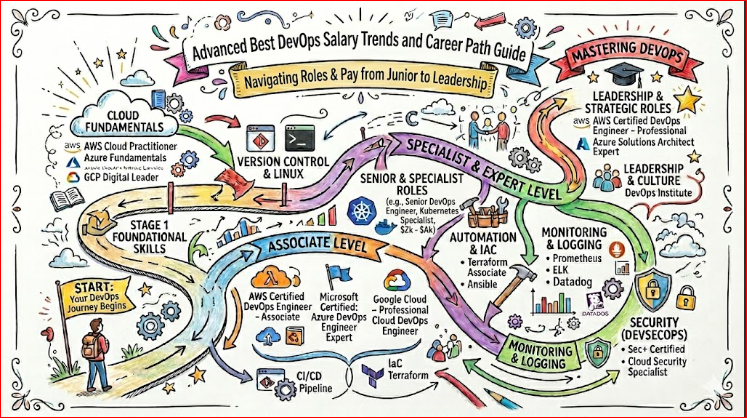
DevOps Career Roadmap for Higher Salary
- Beginner Path: Focus on Linux fundamentals, networking, Git version control, and basic shell scripting.
- Intermediate Path: Learn Docker, CI/CD tools (Jenkins/GitHub Actions), and basic cloud services.
- Advanced Path: Master Kubernetes, Terraform, and cloud-native monitoring/observability tools.
- Specialized Path: Dive into SRE practices, FinOps (Cloud cost optimization), and GitOps.
Real-World Career Scenarios
- The Developer Transition: A developer learning Kubernetes can move into a DevOps role, often doubling their previous salary.
- The SysAdmin Shift: A traditional administrator mastering IaC becomes an Infrastructure Engineer, moving into a much higher compensation bracket.
Common Mistakes Affecting Salary Growth
- Ignoring Linux Fundamentals: You cannot automate what you do not understand.
- Only Collecting Certs: Theory without projects is easily spotted in interviews.
- Lack of Networking Knowledge: Modern cloud architecture relies heavily on understanding subnets, VPCs, and DNS.
- Avoiding Automation: If you do it manually twice, automate it the third time.
Hands-On Skills Employers Want
Employers look for engineers who can build:
- CI/CD Pipelines: Automated build and deployment workflows.
- Containerized Environments: Dockerized applications running on K8s clusters.
- IaC Templates: Terraform modules that are reusable and clean.
- Monitoring Dashboards: Proactive alerting systems that prevent downtime.
FAQs
- What is the average DevOps engineer salary?
Salaries vary based on location and experience. It is best to check regional reports, as there is no single global figure.
2. Which DevOps role pays the highest salary?
Site Reliability Engineer (SRE) and Platform Engineer roles often command the highest pay due to their impact on system reliability and developer productivity.
3. Is Kubernetes good for salary growth?
Yes, Kubernetes is currently one of the most in-demand skills in the DevOps space.
4. Which cloud platform pays the highest salary?
All major platforms (AWS, Azure, GCP) pay well for those with senior-level architecture experience.
5. Do DevOps certifications increase salary?
Yes, they act as a filter for recruiters and validate your expertise.
6. Is AWS or Azure better for DevOps careers?
Both are excellent. Choose based on the market demand in your target industry or region.
7. Which DevOps skill is most in demand?
Automation skills, specifically Infrastructure as Code (Terraform) and Kubernetes, are universally in demand.
8. Is DevOps a high-paying career?
Yes, because it requires a rare mix of development, operations, and security skills.
9. Can beginners get high DevOps salaries?
Beginners usually start at a lower base, but salary growth is fast for those who learn quickly and build real projects.
10. How long does it take to become a high-paid DevOps engineer?
It depends on your dedication. Focused, hands-on learning can lead to significant salary growth within 2-3 years.
Final Recommendation
To secure the best DevOps salary, prioritize practical experience over theory. Build your own projects, master Kubernetes, and understand the “why” behind the tools you use. Continuous learning is the only way to stay ahead in this fast-evolving field. Focus on building a strong portfolio of automation scripts and infrastructure projects, and your career will naturally gravitate toward higher compensation.
Very insightful article. It clearly explains how DevOps skills, certifications, and real-world experience can impact long-term career growth and salary potential.
Well-written and insightful! The article does a great job of helping readers understand how certifications, cloud expertise, and automation skills can influence career advancement and compensation.
The insights into DevOps salary trends and career progression are highly valuable for professionals looking to plan their next career move.