Introduction
AI Model Marketplace Platforms are centralized hubs that allow organizations and developers to discover, evaluate, and deploy machine learning models efficiently. These marketplaces provide access to pre-trained models from a variety of sources, including proprietary vendors, open-source communities, and user-generated contributions, enabling companies to accelerate AI initiatives without building everything from scratch. In the growing adoption of multimodal AI, agentic workflows, and large language models has made these marketplaces indispensable for enterprises seeking both speed and compliance in AI deployment.
Real-world use cases include:
- Rapid prototyping of AI applications across NLP, computer vision, and speech recognition.
- Integrating third-party models into enterprise pipelines for predictive analytics and forecasting.
- Combining multiple models for multimodal insights in finance, healthcare, and e-commerce.
- Experimenting with specialized AI for research or academic projects without heavy infrastructure investment.
- Leveraging pre-vetted models with governance and compliance built-in for regulated industries.
- Rapidly deploying customer-facing AI features, such as chatbots or recommendation systems, across cloud platforms.
Evaluation criteria for buyers:
- Model variety and availability (proprietary, open-source, BYO)
- Integration support with existing tools and data pipelines
- AI-specific testing and evaluation capabilities
- Guardrails and prompt-injection defense
- Data privacy, residency, and retention controls
- Observability and monitoring features
- Cost and latency optimization
- Security, compliance, and auditability
- Vendor lock-in risks
- User experience and ease of deployment
- Support, community, and documentation quality
- Multi-modal and multi-agent support
Best for: AI engineers, ML teams, data scientists, and CTOs in enterprises, mid-market, and startups requiring rapid model deployment and experimentation.
Not ideal for: organizations with minimal AI needs, those relying solely on internal model development, or teams with fixed single-vendor ecosystems.
What’s Changed in AI Model Marketplace Platforms in 2026+
- Widespread adoption of agentic workflows with multi-model orchestration.
- Native tool calling and workflow automation integrated into marketplace models.
- Support for multimodal inputs including text, images, video, and structured data.
- Advanced evaluation & testing pipelines for hallucinations, reliability, and regression.
- Built-in guardrails to prevent prompt injection and enforce policy compliance.
- Enterprise-grade privacy with configurable data residency, retention, and encryption controls.
- Optimized cost and latency routing for cloud-hosted or hybrid deployments.
- Flexible BYO model support and multi-model routing for experimentation.
- Real-time observability for usage, token consumption, latency, and errors.
- Governance and compliance expectations increasingly enforced via platform features.
- Standardized security practices including RBAC, SSO, and audit logging.
- Stronger integration with RAG frameworks and vector databases for knowledge-intensive applications.
Quick Buyer Checklist
- Ensure data privacy & retention policies align with enterprise requirements.
- Confirm model choice flexibility (hosted, BYO, open-source, multi-model routing).
- Check RAG / knowledge connectors if augmenting models with external data.
- Evaluate AI testing capabilities: hallucination detection, regression, human review.
- Verify guardrails: prompt injection, policy enforcement, and moderation.
- Assess latency & cost control features for predictable operations.
- Review auditability & admin controls: logging, RBAC, and compliance reporting.
- Evaluate vendor lock-in risks and exportability of models/data.
- Confirm integration ecosystem: APIs, SDKs, workflow connectors.
- Check support and community strength for guidance and troubleshooting.
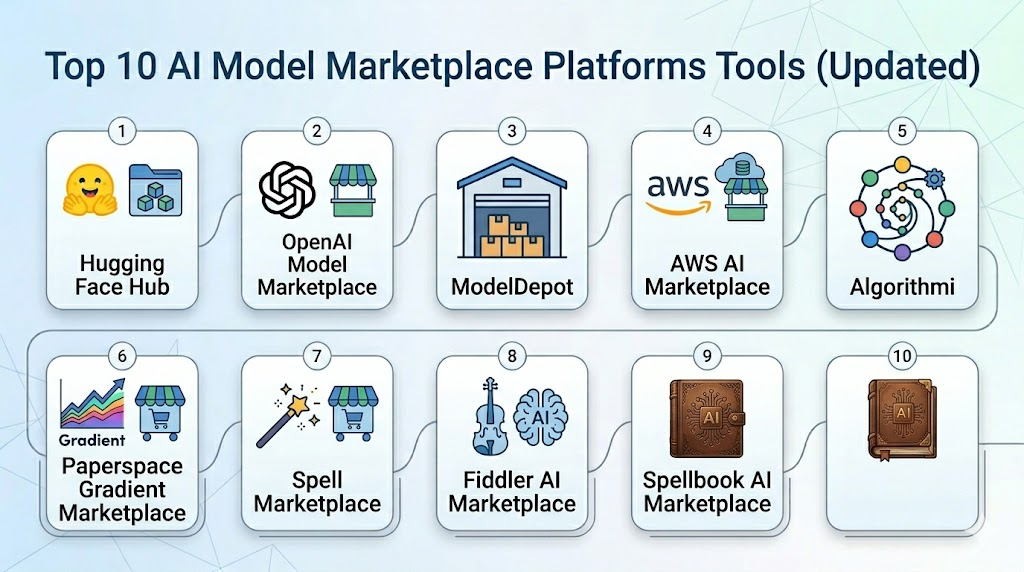
Top 10 AI Model Marketplace Platforms Tools (Updated)
1- Hugging Face Hub
One-line verdict: Best for developers and researchers seeking open-source and community-driven AI models with robust integrations.
Short description: Hugging Face Hub offers a comprehensive library of NLP, CV, and multimodal models. Popular among developers, researchers, and enterprises for prototyping and production AI workflows.
Standout Capabilities
- Access to thousands of pre-trained models across domains.
- Easy integration with Python and popular ML frameworks.
- Supports multi-modal workflows (text, image, audio).
- Community-driven model vetting and documentation.
- Auto-model evaluation and benchmarking.
- Model versioning and governance features.
- Hugging Face Spaces for deploying demo applications.
- Integration with MLOps pipelines.
AI-Specific Depth
- Model support: open-source, proprietary, BYO
- RAG / knowledge integration: vector DB connectors, embeddings
- Evaluation: model cards, metrics, benchmark datasets
- Guardrails: content moderation and API rate limits
- Observability: usage stats, latency, token metrics
Pros
- Wide range of community and enterprise models.
- Excellent developer ecosystem and documentation.
- Strong support for experimentation and deployment.
Cons
- Limited enterprise-grade governance for highly regulated use cases.
- Some advanced features require paid tiers.
- Large-scale deployment may need additional infrastructure.
Security & Compliance
- SSO/SAML: Not publicly stated
- RBAC: Varies / N/A
- Audit logs: Varies / N/A
- Encryption / residency: Varies / N/A
Deployment & Platforms
- Web, Linux, Windows, macOS, Cloud
- Cloud-hosted with APIs; self-hosted options via Transformers library
Integrations & Ecosystem
Hugging Face integrates across ML frameworks and deployment pipelines.
- Transformers library
- Datasets library
- AutoTrain
- Spaces deployment
- API access
- Python SDK
- Community tools for evaluation
Pricing Model
- Free community tier, enterprise subscription for advanced features
- Usage-based API for inference
Best-Fit Scenarios
- Rapid AI prototyping
- Academic or research projects
- Small-to-medium enterprise AI deployment
2- OpenAI Model Marketplace
One-line verdict: Ideal for enterprises and developers seeking curated commercial AI models with enterprise support.
Short description: OpenAI’s marketplace provides access to GPT models, embeddings, and multi-modal capabilities, supporting enterprise deployments and compliance-focused AI workflows.
Standout Capabilities
- Curated commercial AI models with SLAs.
- Multi-modal support: text, image, audio.
- Enterprise-grade security and compliance controls.
- Built-in evaluation tools for reliability.
- API-first access for rapid integration.
- Usage tracking, token metrics, and cost insights.
- Fine-tuning capabilities for enterprise models.
- Governance support and prompt safety measures.
AI-Specific Depth
- Model support: proprietary, BYO
- RAG / knowledge integration: vector DB connectors, retrieval tools
- Evaluation: prompt testing, reliability evaluation
- Guardrails: content safety, prompt injection defenses
- Observability: token usage, latency, audit logs
Pros
- High-quality, commercially supported models.
- Strong observability and compliance support.
- Extensive API and integration ecosystem.
Cons
- Cost can be high for heavy usage.
- Limited open-source model support.
- Fine-tuning options may require enterprise subscription.
Security & Compliance
- SSO/SAML: Not publicly stated
- RBAC: Not publicly stated
- Audit logs: Provided
- Encryption / residency: Not publicly stated
Deployment & Platforms
- Web, Cloud APIs
- Cloud-hosted
Integrations & Ecosystem
- API-first
- SDKs for Python
- Integration with RAG and vector DBs
- Fine-tuning endpoints
Pricing Model
- Subscription and usage-based pricing
- Enterprise SLA options
Best-Fit Scenarios
- Enterprise AI with compliance requirements
- High-volume API usage
- Multi-modal AI workflows
3- ModelDepot
One-line verdict: Developer-friendly marketplace offering pre-trained models across NLP, CV, and audio with flexible licensing.
Short description: ModelDepot aggregates models from open-source contributors and commercial vendors, emphasizing discovery and licensing clarity for enterprise and individual developers.
Standout Capabilities
- Unified catalog of open-source and commercial models.
- License and usage details per model.
- Easy deployment via APIs or containers.
- Metadata-driven search and filtering.
- Community reviews and ratings.
- Exportable models for self-hosting.
- Supports multimodal AI pipelines.
- Version control and updates.
AI-Specific Depth
- Model support: open-source, BYO
- RAG / knowledge integration: N/A
- Evaluation: Community metrics, benchmark datasets
- Guardrails: Varies / N/A
- Observability: Usage metrics, latency
Pros
- Transparent licensing for commercial use.
- Wide variety of models.
- Developer-focused discovery experience.
Cons
- Limited enterprise-grade security controls.
- Smaller community than Hugging Face.
- Governance tools are basic.
Security & Compliance
- SSO/SAML: Varies / N/A
- RBAC: Varies / N/A
- Audit logs: Not publicly stated
- Encryption / residency: Varies / N/A
Deployment & Platforms
- Web, Linux, macOS
- Cloud and self-hosted options
Integrations & Ecosystem
- REST API access
- Dockerized deployments
- Python SDK
- Model export for pipelines
Pricing Model
- Free for open-source
- Commercial license tiers vary
Best-Fit Scenarios
- Developers seeking licensing clarity
- Rapid experimentation
- Multimodal AI prototype pipelines
4- AWS AI Marketplace
One-line verdict: Enterprise-grade marketplace integrated with AWS ecosystem for production-ready AI models and datasets.
Short description: AWS AI Marketplace provides pre-trained AI models, algorithms, and datasets ready for deployment in AWS environments, supporting scalability and security.
Standout Capabilities
- Deep integration with AWS services (S3, Lambda, SageMaker).
- Enterprise-grade compliance and security controls.
- Ready-to-deploy ML models and algorithms.
- Supports both inference and training workloads.
- Cost and performance monitoring tools.
- Marketplace for datasets as well as models.
- Access to containerized deployment options.
- Governance and usage reporting.
AI-Specific Depth
- Model support: proprietary, BYO, open-source
- RAG / knowledge integration: Vector DB connectors, SageMaker integration
- Evaluation: Built-in evaluation tools, benchmarking
- Guardrails: Security policies, content moderation
- Observability: CloudWatch metrics, latency, cost reporting
Pros
- Tight integration with AWS stack.
- Enterprise compliance and security.
- Extensive deployment and scaling options.
Cons
- Lock-in to AWS ecosystem.
- Complexity for non-AWS users.
- Costs may scale with usage.
Security & Compliance
- SSO/SAML: Supported
- RBAC: Supported
- Audit logs: Supported
- Encryption / residency: Configurable
Deployment & Platforms
- Cloud (AWS)
- Web-based dashboards
- APIs for Linux, Windows, macOS clients
Integrations & Ecosystem
- AWS SDKs and APIs
- Lambda, SageMaker, S3, EC2
- Monitoring and observability tools
- Third-party API connectors
Pricing Model
- Usage-based, pay-as-you-go
- Enterprise agreements available
Best-Fit Scenarios
- Enterprise AI deployments
- Data-sensitive workloads
- Production-grade ML pipelines
5- Algorithmia
One-line verdict: Developer-first marketplace for production-ready APIs and models with a focus on operational AI.
Short description: Algorithmia provides a model hosting and deployment platform enabling developers to access, integrate, and monitor AI models via APIs in production systems.
Standout Capabilities
- Hosted model serving and APIs.
- Auto-scaling and deployment pipelines.
- Monitoring and observability for models.
- Multi-language support.
- Marketplace for curated AI algorithms.
- Access controls and usage analytics.
- Version control for models.
- Integration with CI/CD pipelines.
AI-Specific Depth
- Model support: proprietary, BYO
- RAG / knowledge integration: N/A
- Evaluation: Varies / N/A
- Guardrails: Security policies, rate limits
- Observability: Latency, token usage, API metrics
Pros
- Operational focus for production AI.
- Flexible deployment and scaling.
- API-first for developers.
Cons
- Less community-driven model availability.
- Enterprise governance features limited.
- Costs can grow with scale.
Security & Compliance
- SSO/SAML: Not publicly stated
- RBAC: Supported
- Audit logs: Varies / N/A
- Encryption / residency: Varies / N/A
Deployment & Platforms
- Web, Cloud
- APIs for integration
Integrations & Ecosystem
- REST APIs
- SDKs for Python, Java, Go
- CI/CD connectors
- Observability integrations
Pricing Model
- Usage-based and subscription tiers
Best-Fit Scenarios
- Production API deployments
- Rapid operationalization
- Enterprise developers needing APIs
6- Paperspace Gradient Marketplace
One-line verdict: Ideal for AI researchers and small teams leveraging cloud GPU infrastructure for model experimentation and deployment.
Short description: Paperspace Gradient Marketplace provides GPU-backed cloud environments with a curated library of ML models ready for experimentation, fine-tuning, and deployment.
Standout Capabilities
- Cloud GPU support with easy model deployment.
- Pre-configured ML environments.
- Access to pre-trained models for vision, NLP.
- Collaborative notebooks for teams.
- Integration with cloud storage.
- Support for fine-tuning and custom models.
- Observability tools for usage and performance.
- Security features for enterprise projects.
AI-Specific Depth
- Model support: open-source, BYO
- RAG / knowledge integration: Varies / N/A
- Evaluation: Model metrics and logs
- Guardrails: Varies / N/A
- Observability: Usage, GPU metrics
Pros
- GPU-backed experimentation environment.
- Easy collaboration and prototyping.
- Cloud-native and flexible.
Cons
- Enterprise-grade governance limited.
- Cost can escalate for heavy GPU usage.
- Model marketplace smaller than competitors.
Security & Compliance
- SSO/SAML: Not publicly stated
- RBAC: Varies / N/A
- Audit logs: Varies / N/A
- Encryption / residency: Varies / N/A
Deployment & Platforms
- Cloud, Web notebooks
- Windows, Linux, macOS (via cloud)
Integrations & Ecosystem
- Python SDK
- Notebook integrations
- Cloud storage connectors
- Experiment tracking tools
Pricing Model
- Pay-as-you-go GPU usage
- Subscription tiers for teams
Best-Fit Scenarios
- AI research prototypes
- GPU-intensive model training
- Team collaboration on models
7- Spell Marketplace
One-line verdict: Developer-focused marketplace for scalable deployment and experimentation with modern ML models.
Short description: Spell Marketplace allows teams to discover, train, and deploy models in managed cloud environments with monitoring, collaboration, and automation features.
Standout Capabilities
- Managed cloud infrastructure for AI experiments.
- Marketplace for pre-trained models.
- One-click deployment pipelines.
- Multi-language SDK support.
- Observability dashboards.
- Team collaboration features.
- Support for containerized deployments.
- Versioning and rollback support.
AI-Specific Depth
- Model support: BYO, open-source
- RAG / knowledge integration: Varies / N/A
- Evaluation: Regression and offline tests
- Guardrails: Basic policy enforcement
- Observability: Latency, token, cost metrics
Pros
- Easy cloud deployment.
- Developer-friendly tools.
- Monitoring and observability included.
Cons
- Limited enterprise compliance controls.
- Smaller model catalog.
- Costs can grow for large workloads.
Security & Compliance
- SSO/SAML: Varies / N/A
- RBAC: Varies / N/A
- Audit logs: Varies / N/A
- Encryption / residency: Varies / N/A
Deployment & Platforms
- Web, Cloud APIs
- Windows, Linux, macOS clients
Integrations & Ecosystem
- SDKs, APIs
- Containerized model deployment
- CI/CD integrations
- Experiment tracking
Pricing Model
- Usage-based
- Team subscriptions
Best-Fit Scenarios
- Cloud-based experimentation
- Developer-first AI deployment
- Rapid prototyping for small teams
8- Fiddler AI Marketplace
One-line verdict: Suitable for enterprises prioritizing AI model explainability and monitoring alongside marketplace access.
Short description: Fiddler AI Marketplace combines pre-trained models with explainability, monitoring, and evaluation tools for regulated AI deployments and risk management.
Standout Capabilities
- Explainable AI monitoring.
- Model performance tracking.
- Marketplace with curated models.
- Bias detection and fairness tools.
- Integration with data pipelines.
- Observability dashboards.
- Compliance reporting features.
- Multi-model evaluation support.
AI-Specific Depth
- Model support: BYO, open-source
- RAG / knowledge integration: N/A
- Evaluation: Bias, fairness, regression tests
- Guardrails: Policy enforcement
- Observability: Token, latency, fairness metrics
Pros
- Strong focus on explainability.
- Enterprise monitoring and observability.
- Risk-aware deployment.
Cons
- Smaller marketplace catalog.
- Limited multimodal support.
- May require additional integration for some workflows.
Security & Compliance
- SSO/SAML: Not publicly stated
- RBAC: Not publicly stated
- Audit logs: Provided
- Encryption / residency: Not publicly stated
Deployment & Platforms
- Web-based, Cloud APIs
- Varies / N/A
Integrations & Ecosystem
- Python SDK
- Enterprise data pipeline integration
- Dashboard and visualization tools
- API access for monitoring
Pricing Model
- Subscription-based enterprise licensing
- Usage-based add-ons
Best-Fit Scenarios
- Regulated industries
- Explainable AI deployments
- Risk-aware AI operations
9- Spellbook AI Marketplace
One-line verdict: Optimized for AI researchers and mid-market companies needing multi-model experimentation and collaboration.
Short description: Spellbook offers a curated marketplace of pre-trained AI models with collaboration, versioning, and deployment tools for research and mid-market AI teams.
Standout Capabilities
- Model versioning and collaboration.
- Multi-modal support: text, image, audio.
- Curated marketplace for rapid experimentation.
- Fine-tuning pipelines and templates.
- Observability dashboards for latency and usage.
- Deployment automation for cloud environments.
- Team collaboration features.
- Integration with CI/CD workflows.
AI-Specific Depth
- Model support: BYO, open-source
- RAG / knowledge integration: N/A
- Evaluation: Regression and offline testing
- Guardrails: Varies / N/A
- Observability: Metrics dashboards, latency, token usage
Pros
- Team-focused collaboration.
- Multi-model experimentation.
- Deployment automation.
Cons
- Smaller marketplace than major players.
- Limited enterprise governance.
- Costs vary with compute usage.
Security & Compliance
- SSO/SAML: Not publicly stated
- RBAC: Not publicly stated
- Audit logs: Varies / N/A
- Encryption / residency: Varies / N/A
Deployment & Platforms
- Cloud-native
- Web and APIs
Integrations & Ecosystem
- Python SDK
- Deployment automation tools
- CI/CD pipelines
- Observability dashboards
Pricing Model
- Subscription tiers
- Usage-based compute
Best-Fit Scenarios
- Research and development teams
- Multi-model experimentation
- Mid-market AI deployments
10- Weights & Biases Model Hub
One-line verdict: Best for enterprises and researchers seeking model versioning, monitoring, and collaborative marketplace access.
Short description: Weights & Biases Model Hub integrates model versioning, experiment tracking, and monitoring into a marketplace of pre-trained AI models.
Standout Capabilities
- Experiment tracking and model versioning.
- Marketplace for pre-trained and community models.
- Observability dashboards and metrics tracking.
- Collaboration tools for teams.
- Integration with CI/CD pipelines.
- Model lineage and auditability.
- Multi-modal support.
- Fine-tuning and training tracking.
AI-Specific Depth
- Model support: BYO, open-source
- RAG / knowledge integration: N/A
- Evaluation: Experiment metrics, regression tests
- Guardrails: Varies / N/A
- Observability: Token usage, latency, performance metrics
Pros
- Strong focus on experiment tracking.
- Collaboration and governance support.
- Integration with ML pipelines.
Cons
- Smaller curated marketplace.
- Limited compliance certifications.
- Premium features require enterprise tier.
Security & Compliance
- SSO/SAML: Not publicly stated
- RBAC: Varies / N/A
- Audit logs: Available
- Encryption / residency: Varies / N/A
Deployment & Platforms
- Web, Cloud APIs
- Cloud-hosted
Integrations & Ecosystem
- Python SDK
- CI/CD integrations
- Experiment tracking tools
- Team collaboration
Pricing Model
- Subscription tiers
- Usage-based add-ons
Best-Fit Scenarios
- Enterprise model governance
- Collaborative AI research
- Multi-modal experimentation
Comparison Table (Top 10)
| Tool Name | Best For | Deployment | Model Flexibility | Strength | Watch-Out | Public Rating |
|---|---|---|---|---|---|---|
| Hugging Face Hub | Developers, researchers | Cloud / Self-hosted | Open-source / BYO | Community-driven models | Limited enterprise controls | N/A |
| OpenAI Model Marketplace | Enterprise, devs | Cloud | Proprietary / BYO | High-quality, curated models | Costly at scale | N/A |
| ModelDepot | Developers, SMEs | Cloud / Self-hosted | Open-source / BYO | Licensing clarity | Smaller ecosystem | N/A |
| AWS AI Marketplace | Enterprise | Cloud | BYO / Open-source / Proprietary | AWS integration, compliance | AWS lock-in | N/A |
| Algorithmia | Devs, ops teams | Cloud | Proprietary / BYO | Production API focus | Limited community models | N/A |
| Paperspace Gradient | Researchers, teams | Cloud | Open-source / BYO | GPU-backed experimentation | Small marketplace | N/A |
| Spell Marketplace | Developers, teams | Cloud | BYO / Open-source | Cloud deployment & collaboration | Limited governance | N/A |
| Fiddler AI Marketplace | Enterprise, regulated | Cloud | BYO / Open-source | Explainable AI monitoring | Smaller model catalog | N/A |
| Spellbook AI Marketplace | Mid-market, research | Cloud | BYO / Open-source | Team collaboration | Smaller marketplace | N/A |
| Weights & Biases Model Hub | Enterprise, research | Cloud | BYO / Open-source | Experiment tracking & governance | Limited curated models | N/A |
Scoring & Evaluation
Scoring is comparative to highlight relative strengths, not absolute ratings. Scores reflect a combination of core features, AI reliability, integrations, and enterprise suitability.
| Tool | Core | Reliability/Eval | Guardrails | Integrations | Ease | Perf/Cost | Security/Admin | Support | Weighted Total |
|---|---|---|---|---|---|---|---|---|---|
| Hugging Face Hub | 9 | 8 | 6 | 8 | 9 | 7 | 6 | 8 | 7.7 |
| OpenAI Model Marketplace | 8 | 9 | 8 | 9 | 8 | 8 | 7 | 9 | 8.4 |
| ModelDepot | 7 | 7 | 5 | 7 | 8 | 7 | 6 | 7 | 6.9 |
| AWS AI Marketplace | 9 | 8 | 8 | 9 | 7 | 8 | 9 | 8 | 8.4 |
| Algorithmia | 7 | 7 | 6 | 8 | 8 | 7 | 6 | 7 | 7.0 |
| Paperspace Gradient | 7 | 7 | 5 | 7 | 8 | 7 | 6 | 6 | 6.8 |
| Spell Marketplace | 7 | 6 | 6 | 7 | 8 | 7 | 6 | 6 | 6.7 |
| Fiddler AI Marketplace | 8 | 8 | 8 | 7 | 7 | 7 | 7 | 7 | 7.5 |
| Spellbook AI Marketplace | 7 | 7 | 6 | 7 | 8 | 7 | 6 | 6 | 6.8 |
| Weights & Biases Model Hub | 8 | 8 | 7 | 7 | 7 | 7 | 7 | 7 | 7.3 |
Top 3 for Enterprise: OpenAI, AWS, Fiddler
Top 3 for SMB: Hugging Face, Algorithmia, ModelDepot
Top 3 for Developers: Hugging Face, Spell, Paperspace
Which AI Model Marketplace Tool Is Right for You?
Solo / Freelancer
Choose developer-first platforms like Hugging Face Hub or ModelDepot for experimentation and prototyping.
SMB
OpenAI Model Marketplace or Algorithmia provides managed APIs and curated models for small teams without heavy infrastructure.
Mid-Market
Spellbook or Paperspace Gradient supports collaboration and GPU-backed workflows for teams scaling AI projects.
Enterprise
AWS AI Marketplace or Fiddler AI Marketplace offers enterprise-grade governance, security, and compliance for production deployments.
Regulated industries (finance/healthcare/public sector)
Prioritize Fiddler AI Marketplace or AWS AI Marketplace for explainability, monitoring, and governance features.
Budget vs premium
Open-source marketplaces like Hugging Face Hub minimize costs; premium options like OpenAI or AWS provide SLAs and enterprise support.
Build vs buy (when to DIY)
- DIY internal model hosting if compliance is strict or proprietary expertise exists.
- Buy marketplace solutions for speed, multi-modal capabilities, and operational support.
Implementation Playbook (30 / 60 / 90 Days)
- 30 days: Pilot selected models; define success metrics; test integration pipelines; evaluate guardrails and prompt safety.
- 60 days: Harden security controls; implement evaluation framework; enforce policy compliance; start production rollout.
- 90 days: Optimize cost and latency; finalize governance policies; scale usage across teams; perform model version control and red-teaming exercises.
Common Mistakes & How to Avoid Them
- Ignoring prompt injection vulnerabilities.
- Skipping rigorous model evaluation before deployment.
- Unmanaged data retention and privacy policies.
- Lack of observability, leading to hidden latency or cost spikes.
- Over-automation without human review.
- Vendor lock-in without abstraction layers.
- Failing to monitor performance and cost metrics.
- Underestimating multi-modal integration complexity.
- Ignoring governance and compliance requirements.
- No incident handling or red-teaming plan.
- Overlooking model versioning and reproducibility.
- Neglecting guardrails for AI safety.
- Insufficient team collaboration workflows.
FAQs
1- What is an AI Model Marketplace?
AI Model Marketplaces provide centralized access to pre-trained models, allowing developers and enterprises to discover, evaluate, and deploy AI solutions rapidly.
2- Can I host my own models?
Most platforms support BYO (bring-your-own) models alongside hosted or open-source options, depending on the marketplace.
3- How do marketplaces handle sensitive data?
Enterprise platforms often include data residency, retention policies, and encryption; specifics vary by vendor.
4- What evaluation tools are included?
Many marketplaces offer regression testing, benchmark metrics, hallucination detection, and human-in-the-loop reviews.
5- Are there guardrails against prompt injection?
Yes, platforms implement content moderation, policy enforcement, and prompt safety measures to mitigate risks.
6- How does pricing work?
Pricing models are typically usage-based, subscription tiers, or API calls; open-source marketplaces may be free for certain uses.
7- Can I integrate with existing workflows?
Most marketplaces provide APIs, SDKs, and connectors for CI/CD, RAG frameworks, and vector databases.
8- How do I avoid vendor lock-in?
Choose marketplaces supporting BYO models, open-source, and exportable models to maintain flexibility.
9- Is multi-modal AI supported?
Leading marketplaces increasingly support multi-modal models combining text, image, audio, and structured data.
10- How secure are these platforms?
Security features vary; enterprise-grade marketplaces provide RBAC, SSO/SAML, audit logging, and encryption.
11- Can I monitor cost and latency?
Yes, observability dashboards track token usage, inference latency, and operational costs in real-time.
12- Which marketplace is best for research?
Hugging Face Hub, Paperspace Gradient, and Spellbook are ideal for research, experimentation, and collaboration.
Conclusion
AI Model Marketplace Platforms accelerate model discovery, experimentation, and deployment across enterprises, mid-market, and developer teams. The “best” platform depends on your organization’s size, security and compliance requirements, AI maturity, and budget. In key considerations include multi-modal support, evaluation pipelines, guardrails, observability, and governance features.