Introduction
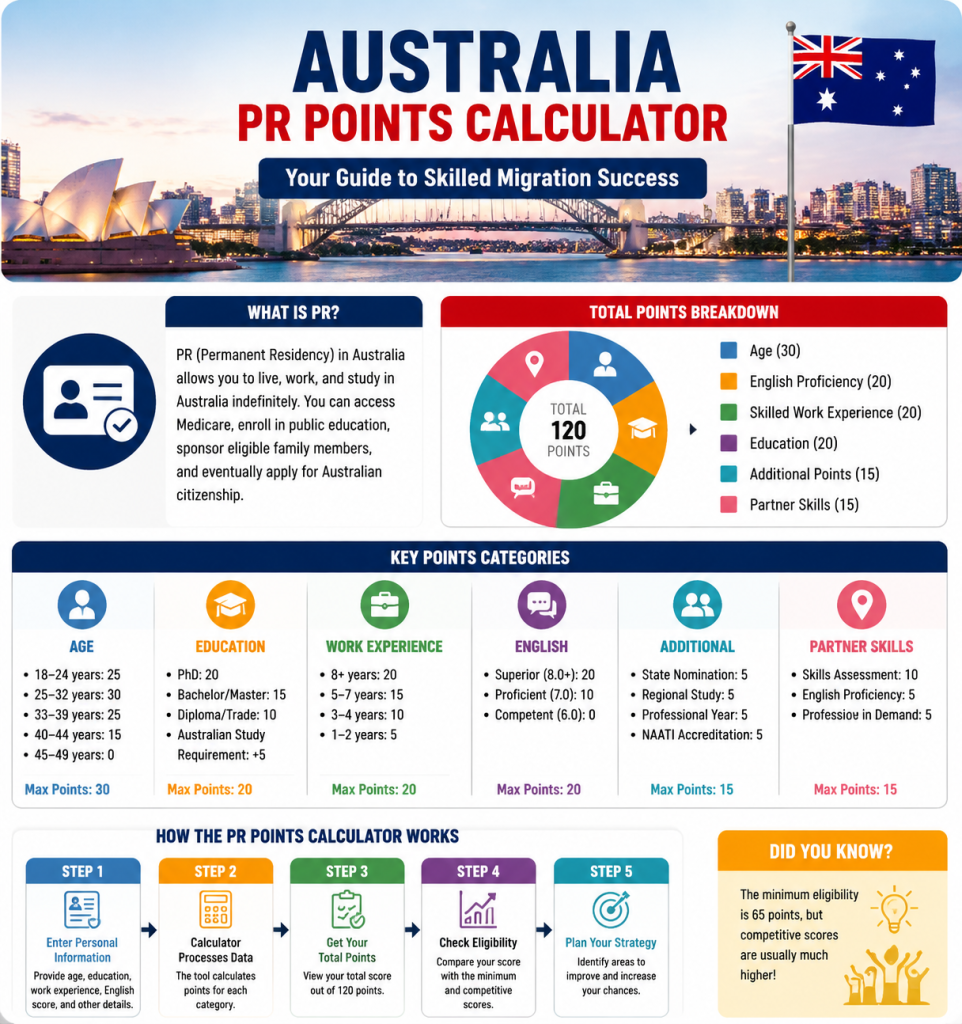
Planning to migrate to Australia? Wondering if you’re eligible for permanent residency (PR)? Many skilled professionals dream of living and working in Australia, but navigating the PR process can be confusing without understanding the points system. This is where the Australia PR Points Calculator becomes invaluable. It’s an online tool designed to estimate your eligibility by converting your personal profile into points.
The calculator considers factors like age, English proficiency, educational qualifications, work experience, partner skills, and state or regional nomination. The total points determine whether you can lodge an Expression of Interest (EOI) and eventually receive an invitation for PR.
Why use this tool? Many applicants waste time applying for PR without knowing if they meet eligibility criteria. Using a calculator avoids mistakes and helps plan a strategy to improve your points. For example, boosting your IELTS score or completing additional work experience can make the difference between qualifying and being rejected.
This guide will walk you through the Australia PR Points Calculator step-by-step. You’ll understand each category of points, learn strategies to improve your score, explore visa types, and see real-life examples. By the end, you’ll know exactly where you stand and how to maximize your chances for a PR invitation.
Short anecdote: Priya, a software engineer from India, used the PR Points Calculator to realize she needed a higher English score. After improving her IELTS results and applying strategically, she received a Subclass 189 invitation. This illustrates how calculating points in advance can directly impact your PR journey.
What is Australia PR Points Calculator
Permanent Residency (PR) in Australia is a legal status that allows a non-citizen to live, work, and study in the country indefinitely. PR holders can enjoy most of the benefits that Australian citizens have, such as full-time employment, access to public healthcare through Medicare, and studying at domestic tuition rates. They can also sponsor eligible family members for permanent residency and, after meeting residency requirements, apply for Australian citizenship. However, PR holders cannot vote in federal elections until they become citizens. In skilled migration, PR eligibility is determined through a points-based system, which evaluates factors like age, education, English proficiency, work experience, and other criteria. Using tools like the Australia PR Points Calculator helps applicants understand their eligibility and plan strategies to maximize their points and chances of receiving an invitation for PR.
Overview of Australia PR Points System
Australia uses a points-based skilled migration system to evaluate applicants. Each skilled visa has a minimum threshold, and competitive scoring is crucial for receiving an invitation.
Key Visa Categories
| Visa Type | Description | Points Advantage |
|---|---|---|
| Subclass 189 | Skilled Independent Visa — no sponsorship required | Highest competition; strong points profile required |
| Subclass 190 | Skilled Nominated Visa — requires state/territory sponsorship | +5 points from nomination improves chances |
| Subclass 491 | Skilled Work Regional Visa — temporary pathway to PR | +15 points for regional nomination increases total points |
Points Allocation Overview
| Factor | Max Points |
|---|---|
| Age | 30 |
| English Language Ability | 20 |
| Skilled Employment | 15–20 |
| Educational Qualifications | 20 |
| Additional Points (Partner, Nomination, Regional) | 10–15 |
Importance: Your total score from all categories determines whether you meet the minimum requirement (65 points) and whether you are competitive for the current rounds of invitation.
Tip: While 65 points is the minimum, most applicants need 80–95 points to get invited, depending on their occupation’s demand.
Detailed Breakdown of Points Categories
A. Age
Your age plays a critical role in point allocation. Australia rewards applicants in their prime working years.
| Age Bracket | Points |
|---|---|
| 18–24 | 25 |
| 25–32 | 30 |
| 33–39 | 25 |
| 40–44 | 15 |
| 45+ | 0 |
Tips to Optimize Age Points
- Apply early if you’re under 32 to maximize points.
- Be aware that points decrease gradually after 32.
- Consider applying before reaching 40 to retain significant points.
Example Scenario:
Rahul is 29 years old. He receives 30 points for age, which is the maximum possible.
B. English Proficiency
English proficiency is evaluated through IELTS, PTE, TOEFL, or OET. Strong language skills can boost your points significantly, especially for higher-scoring bands.
| English Test | Band / Score | Points |
|---|---|---|
| IELTS / PTE | Superior (IELTS 8+, PTE 79+) | 20 |
| IELTS / PTE | Proficient (IELTS 7+, PTE 65+) | 10 |
| Competent | Minimum requirement, no extra points | 0 |
Tips to Improve English Points
- Aim for Superior English to gain maximum points.
- Retake tests if your score is below 8 in IELTS or 79 in PTE.
- Even small improvements in test scores can add 10–20 points, making you more competitive.
Example:
Priya scored PTE 79, giving her 20 points, which helped her move into the competitive range.
C. Skilled Work Experience
Australia differentiates between overseas and Australian work experience. Australian work experience is generally more valuable.
| Years of Experience | Overseas | Australian |
|---|---|---|
| 3–4 | 5 | 10 |
| 5–7 | 10 | 15 |
| 8+ | 15 | 20 |
Tips to Boost Work Experience Points
- Australian work experience is more valuable; even short-term contracts matter.
- Combine overseas and Australian experience for higher cumulative points.
- Keep detailed work references; you’ll need them for your visa application.
Example:
Anil has 6 years overseas and 2 years in Australia. He earns 10 + 5 = 15 points for work experience.
D. Educational Qualifications
Points vary by level of education:
| Qualification | Points |
|---|---|
| Diploma / Trade Certificate | 10 |
| Bachelor’s Degree | 15 |
| Master’s Degree | 20 |
| PhD / STEM Specialist | 20–25 |
Bonus Points
- Studying in Australia for 2+ academic years → +5 points
- Completing a Professional Year Program → +5 points
Tips:
- Choose Australian study programs in STEM or high-demand fields to gain extra points.
- Consider professional year programs if you need additional points to reach competitive thresholds.
E. Additional Points
Applicants can earn bonus points for factors beyond core eligibility:
| Factor | Points |
|---|---|
| Partner skills | 5 |
| State nomination (Subclass 190) | 5 |
| Regional sponsorship (Subclass 491) | 15 |
| NAATI / Community Language | 5 |
| Australian study / professional year | 5–10 |
Tips to Maximize Extra Points
- Include your partner’s skills if eligible.
- Explore state or regional nominations for bonus points.
- Consider learning a recognized community language for extra NAATI points.
Example:
Rahul has a spouse with proficient skills (+5 points) and applies for regional nomination (+15 points), boosting his total from 80 to 100.
Step-by-Step Guide to Using the Australia PR Points Calculator
- Gather Personal Info: Age, work experience, education, English test results, partner details.
- Input Data into Calculator: Enter all required information accurately.
- Understand Total Points: Review how many points you have in each category.
- Interpret Results: Compare total points with minimum and competitive thresholds.
Examples:
- Single applicant: 5 years overseas, Bachelor’s, IELTS 7 → 75 points
- Married applicant: above + partner skills → 80 points
- Regional nomination applicant: above + regional bonus → 95 points
Minimum & Competitive Points Explained
While the minimum eligibility for Australia PR is 65 points, real-world applications often require much higher scores to get an invitation. The exact competitive score depends on the visa type and the occupation’s demand.
Minimum vs Competitive Points
| Visa Type | Minimum Points | Typical Competitive Range |
|---|---|---|
| Subclass 189 | 65 | 80–95+ |
| Subclass 190 | 65 | 75–90+ |
| Subclass 491 | 65 | 85–100 |
Tips to Improve Competitiveness
- Boost English proficiency: Higher IELTS/PTE bands add substantial points.
- Gain more skilled work experience: Even 1–2 additional years can increase points.
- Pursue Australian education or professional year: Adds 5–10 points.
- Consider partner skills: If your spouse meets eligibility, points increase.
- State or regional nomination: Adds 5–15 points depending on visa.
Example Scenario:
Priya has 75 points, enough to meet the minimum. By improving her English to Superior (+10 points) and applying for state nomination (+5 points), she reaches 90 points, placing her in the competitive range for a Subclass 190 invitation.
6. How to Maximize Your Points
Here’s a detailed guide to increasing your total PR points:
| Strategy | How It Works | Points Boost |
|---|---|---|
| Improve English Score | Retake IELTS, PTE, or OET for higher band | +10–20 |
| Gain More Work Experience | Additional overseas or Australian skilled employment | +5–20 |
| Education Pathways | Master’s or PhD, professional year, or Australian degree | +5–10 |
| Regional/State Nomination | Apply for 190 or 491 visas through nominated state/territory | +5–15 |
| Partner Skills | Include partner’s qualifications and English proficiency | +5 |
| Community Language / NAATI | Credentialed in a recognized language | +5 |
Tips Table for Quick Reference
- Take English tests early and plan for reattempts if needed.
- Gain relevant skilled work experience, especially in Australia.
- Pursue Australian degrees or professional year programs if you are close to competitive thresholds.
- Check state nomination eligibility — it can be a game-changer.
- Include partner skills whenever possible.
7. Common Mistakes & Pitfalls
Many applicants fail to maximize their PR points due to avoidable mistakes:
1. Misinterpreting Scoring Rules
- Some applicants assume minimum points guarantee an invitation.
- Reality: Higher points are usually required for competitive visas.
2. Using Outdated Calculators
- Immigration rules update frequently.
- Always use the latest official PR Points Calculator to ensure accuracy.
3. Ignoring Spouse/Partner Points
- If your partner is eligible, their skills and English proficiency can add up to 5 points.
- Tip: Include them in your profile to boost the total score.
4. Not Considering Bonus Points
- Australian study, professional year programs, state or regional nomination, and NAATI certification are often overlooked.
“Don’t Do This” Checklist
- Don’t assume 65 points is sufficient.
- Don’t skip skills assessment or required documentation.
- Don’t ignore partner or bonus points opportunities.
- Don’t delay planning your points improvement.
8. Case Studies & Real Examples
Profile 1 – Single Applicant
| Factor | Points |
|---|---|
| Age (29) | 30 |
| English (IELTS 7) | 10 |
| Work Experience (5 years overseas) | 10 |
| Education (Bachelor’s) | 15 |
| Additional Points | 0 |
| Total | 65 |
- Result: Eligible to lodge EOI but may not be competitive for 189 invitations.
Profile 2 – Married Applicant
| Factor | Points |
|---|---|
| Age (33) | 25 |
| English (PTE 79) | 20 |
| Work Experience (3 years Australia + 3 years overseas) | 15 |
| Education (Master’s) | 20 |
| Partner Skills | 5 |
| Total | 85 |
- Result: Strong candidate, likely to receive 190 invitation with state nomination.
Profile 3 – Regional Nomination Applicant
| Factor | Points |
|---|---|
| Age (31) | 30 |
| English (IELTS 8) | 20 |
| Work Experience (2 years Australia + 5 years overseas) | 15 |
| Education (Bachelor’s) | 15 |
| Regional Nomination | 15 |
| Total | 95 |
- Result: Competitive for Subclass 491 and on track for PR.
9. Visa Type Comparisons & Bonus Points
| Visa | Description | Base Points | Nomination / Regional Bonus | Max Points |
|---|---|---|---|---|
| 189 | Skilled Independent | 65 | 0 | 90 |
| 190 | Skilled Nominated | 65 | +5 | 95 |
| 491 | Skilled Regional | 65 | +15 | 100 |
Key Takeaways:
- Subclass 189 is highly competitive but flexible (no nomination).
- Subclass 190 offers extra points through state sponsorship, improving your chance of invitation.
- Subclass 491 provides the largest bonus for regional migration, leading to PR after 3 years of work.
FAQs
- What is Australia PR Points Calculator?
- A tool to estimate PR eligibility based on points from age, education, work experience, English, partner skills, and bonus categories.
- How accurate is it?
- Gives a realistic estimate, but final assessment is by the Department of Home Affairs.
- Minimum points for Subclass 189, 190, 491?
- 65 points minimum; competitive thresholds are usually 80–95.
- Can I recalculate after improving scores?
- Yes, you can update your profile to see changes in your total points.
- Do spouse points count?
- Yes, if spouse meets English and skills criteria.
- Which factors can I influence?
- English scores, work experience, education, partner skills, state/regional nominations.
- Does Australian study help?
- Yes, 2+ years study or professional year can add 5–10 points.
- How long is PR processing?
- Typically 8–12 months for skilled migration visas after application.
- What is a competitive score?
- For 189: ~85–95, 190: ~80–90, 491: ~90–100.
- Can I combine overseas and Australian experience?
- Yes, total points are cumulative.
Conclusion
Calculating your Australia PR points accurately is the first and most important step toward achieving skilled migration success. By using the PR Points Calculator, you gain a clear understanding of where you currently stand, which factors strengthen your profile, and which areas need improvement — whether it’s boosting your English score, gaining more work experience, pursuing an Australian degree or professional year, or exploring state and regional nominations. Planning strategically with this insight allows you to maximize your points, improve competitiveness, and increase your chances of receiving an invitation for permanent residency. Remember, small improvements in key areas can make a significant difference, and taking informed action today will bring you closer to living and working in Australia confidently, efficiently, and with peace of mind.
This article provides a clear explanation of how the Australia PR points calculator helps assess skilled migration eligibility. The step-by-step breakdown makes the entire points evaluation process much easier to understand.
Very helpful and professionally written content! The step-by-step explanation of PR eligibility criteria makes the process much less confusing for applicants.
Useful guide for understanding Australia PR points and skilled migration eligibility. The article clearly explains the scoring system, visa factors, and application process in a simple way.
Informative and well-structured content. It helps applicants understand how to evaluate their eligibility and improve their PR chances.