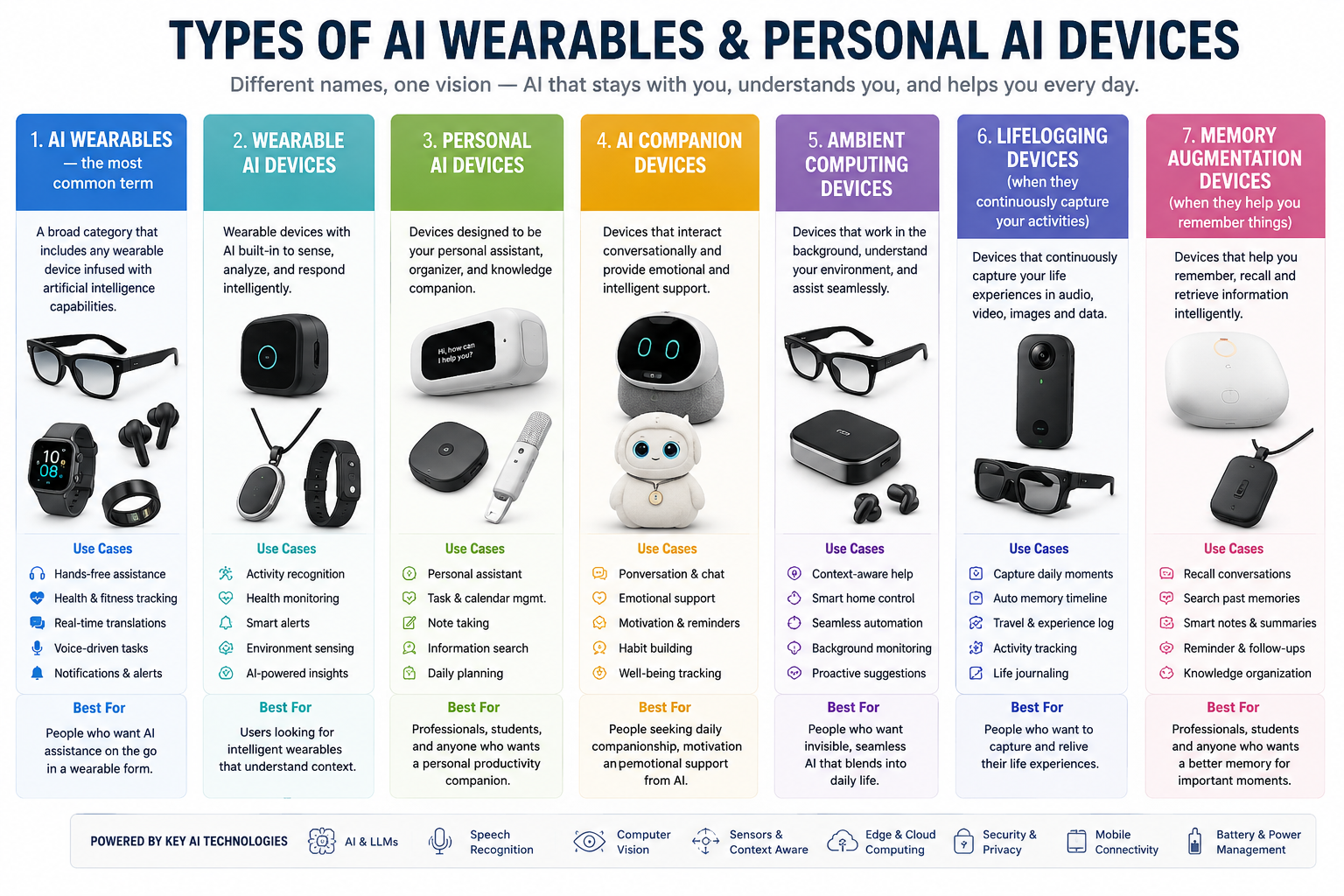
How AI Is Empowering AI Wearables, Personal AI Devices, AI Companion Devices, Ambient Computing, Lifelogging Devices, and Memory Augmentation Technology
Introduction
Artificial Intelligence is no longer limited to chatbots, mobile apps, websites, and enterprise software. It is now entering the physical world through a new generation of devices that people can wear, carry, talk to, and interact with throughout the day.
These products are commonly called AI Wearables, but the same technology movement also includes Wearable AI Devices, Personal AI Devices, AI Companion Devices, Ambient Computing Devices, Lifelogging Devices, and Memory Augmentation Devices.
What makes these devices powerful is not just the hardware. A small camera, microphone, speaker, sensor, or display is not new. What is new is the intelligence behind them. AI gives these devices the ability to understand context, recognize speech, process images, summarize conversations, detect patterns, personalize responses, and assist users in real time.
In simple words, AI is turning ordinary wearable devices into smart personal assistants.
What Makes AI So Important for These Devices?
Traditional wearables mostly collected data. A fitness band could count steps. A smartwatch could show notifications. A camera could record videos. A voice recorder could save audio.
But AI changes the purpose of these devices.
Now, devices can:
- Understand what they capture
- Convert speech into text
- Summarize long conversations
- Recognize people, objects, and scenes
- Translate languages in real time
- Detect user habits and routines
- Provide personalized suggestions
- Create reminders automatically
- Search memories using natural language
- Generate reports, journals, notes, and insights
This is the real transformation. AI is not just adding one feature. It is becoming the brain of the device.
1. How AI Empowers AI Wearables
AI Wearables are the broadest category. They include smart glasses, AI pendants, AI rings, AI watches, AI earbuds, AI pins, and wearable cameras.
AI empowers these devices by making them more intelligent, contextual, and useful.
Key AI Capabilities in AI Wearables
1. Voice Understanding
AI wearables can understand spoken commands. Users can ask questions, set reminders, take notes, start recordings, translate speech, or search information without touching a phone.
For example, a user can say:
“Remind me to call the client when I reach office.”
The device can understand the request, identify the task, and create a reminder.
2. Context Awareness
AI helps wearables understand the situation. The device may know whether the user is walking, driving, attending a meeting, exercising, traveling, or resting.
This allows the device to provide more relevant help.
For example:
- During a meeting, it can summarize discussion points.
- During travel, it can translate signs.
- During exercise, it can provide health feedback.
- During work, it can capture action items.
3. Personalization
AI can learn user preferences over time. It can understand what type of reminders, summaries, notifications, or suggestions the user prefers.
This makes the device feel more personal and less generic.
4. Predictive Assistance
AI can predict what the user may need next.
For example:
- Suggest leaving early for a meeting based on traffic
- Remind the user about a follow-up email
- Detect stress patterns and suggest a break
- Recommend sleep improvement habits
- Highlight missed commitments from conversations
Why This Matters
AI wearables are becoming useful because they are moving from “data collection” to “intelligent assistance.”
Earlier, a wearable could tell you what happened. Now, AI wearables can help you decide what to do next.
2. How AI Empowers Wearable AI Devices
Wearable AI Devices are devices worn on the body that use artificial intelligence as their core function. These devices may include cameras, microphones, health sensors, GPS, motion sensors, and speakers.
AI makes wearable devices smarter by processing data from the real world.
AI Capabilities in Wearable AI Devices
1. Speech-to-Text
AI converts spoken conversations into written text. This is one of the most useful features for professionals, students, journalists, and researchers.
Instead of manually writing notes, users can record a conversation and get a transcript.
2. Summarization
AI can take a long transcript and generate a short summary.
For example, a one-hour meeting can be converted into:
- Key discussion points
- Decisions made
- Action items
- Deadlines
- Follow-up tasks
This saves time and improves productivity.
3. Sensor Data Analysis
Wearable devices collect health and activity data. AI can analyze this data to detect useful patterns.
For example:
- Sleep quality trends
- Stress levels
- Recovery score
- Heart rate changes
- Exercise performance
- Daily activity habits
4. Image and Scene Recognition
AI-powered cameras can understand what they see. This is important for smart glasses and lifelogging cameras.
They can identify:
- Objects
- Text
- Food
- Places
- People
- Documents
- Screens
- Road signs
- Products
Why This Matters
Wearable AI devices are powerful because they can understand both the user and the environment. This makes them useful in personal life, work, healthcare, education, travel, and accessibility.
3. How AI Empowers Personal AI Devices
Personal AI Devices are designed to act like personal assistants. They may be wearable, handheld, or pocket-sized. Their purpose is to help users with tasks, information, communication, memory, and automation.
AI is the main engine behind these devices.
AI Capabilities in Personal AI Devices
1. Natural Conversation
Personal AI devices allow users to interact through natural language. Users do not need to learn commands or menus.
They can simply ask:
- “What did I discuss with Ravi yesterday?”
- “Summarize my meeting notes.”
- “Translate this sentence.”
- “Create a task from this conversation.”
- “What should I focus on today?”
2. Personal Knowledge Management
AI can organize personal information from notes, recordings, emails, conversations, calendars, and reminders.
It can become a personal knowledge system that helps the user remember and retrieve information.
3. Task Automation
Personal AI devices can help automate small daily tasks.
Examples:
- Create reminders
- Draft messages
- Summarize documents
- Prepare meeting notes
- Track commitments
- Organize ideas
- Search past conversations
- Suggest next actions
4. Multimodal Understanding
Modern AI can understand text, voice, images, and sometimes video. This allows personal AI devices to process many types of information.
For example, a user can show an object to the device and ask, “What is this?” or “Translate this label.”
Why This Matters
Personal AI devices are trying to become the next interface after smartphones. Instead of opening many apps, users may interact with one personal AI layer that understands their needs.
4. How AI Empowers AI Companion Devices
AI Companion Devices are designed to provide emotional interaction, personal conversation, and a sense of companionship.
These devices are different from productivity-first AI tools. Their main focus is human-like interaction.
AI Capabilities in AI Companion Devices
1. Conversational Memory
AI companion devices can remember past conversations and use that memory to make future interactions feel more personal.
For example, if a user talks about a stressful day, the device may later ask how that situation went.
2. Emotional Tone Detection
AI can analyze language, voice tone, and conversation patterns to estimate mood or emotional state.
It may detect whether the user sounds happy, tired, anxious, frustrated, or excited.
3. Personalized Responses
AI can generate responses based on the user’s personality, habits, preferences, and emotional needs.
This makes the device feel less like a machine and more like a companion.
4. Daily Check-ins
AI companion devices can ask questions such as:
- “How was your day?”
- “Did you complete your goal?”
- “You sounded stressed earlier. Are you feeling better?”
- “Do you want to reflect on today?”
Why This Matters
AI companion devices may help people with reflection, journaling, motivation, and emotional awareness.
However, this category must be handled carefully. AI companions should support human well-being, not replace real human relationships, professional therapy, or medical care.
5. How AI Empowers Ambient Computing Devices
Ambient Computing Devices work quietly in the background. The user does not need to actively control them all the time.
AI is the main reason ambient computing is becoming possible.
AI Capabilities in Ambient Computing Devices
1. Always-Available Assistance
AI allows devices to stay ready in the background. The device can listen for commands, detect context, or provide help when needed.
2. Contextual Intelligence
Ambient devices use AI to understand what is happening around the user.
For example:
- Is the user in a meeting?
- Is the user driving?
- Is the user walking?
- Is the user at home?
- Is the user working?
- Is the user talking to someone?
- Is there an important task being discussed?
3. Automatic Capture
AI can automatically capture important information without requiring the user to press a button every time.
For example:
- Meeting highlights
- Action items
- Reminders
- Important names
- Locations
- Decisions
- Follow-ups
4. Smart Filtering
One of the biggest problems with always-on devices is information overload. AI helps filter what matters.
Instead of storing everything equally, AI can identify what is important.
Why This Matters
Ambient computing is powerful because it makes technology less intrusive. The best ambient AI devices will help users without constantly demanding attention.
This could become a major shift from screen-based computing to environment-based computing.
6. How AI Empowers Lifelogging Devices
Lifelogging Devices capture parts of a user’s life through photos, videos, audio, location, or activity data.
AI gives lifelogging devices real value because it can understand and organize captured memories.
AI Capabilities in Lifelogging Devices
1. Automatic Moment Detection
AI can detect interesting moments from long recordings.
For example:
- A smile
- A conversation
- A meal
- A landmark
- A pet interaction
- A family event
- A travel scene
- A celebration
Instead of forcing users to manually review hours of footage, AI can pick highlights.
2. Memory Search
AI allows users to search memories using natural language.
Examples:
- “Show me the restaurant I visited last week.”
- “Find the video where I was walking near the beach.”
- “Show moments with my dog.”
- “What did I eat yesterday?”
- “When did I meet that person?”
3. AI-Generated Stories
AI can convert raw photos and videos into:
- Daily journals
- Short vlogs
- Travel summaries
- Memory timelines
- Social media clips
- Personal albums
- Visual stories
4. Object and Face Recognition
AI can identify objects, people, places, and activities in captured media.
This makes lifelogging data searchable and meaningful.
Why This Matters
Without AI, lifelogging creates too much raw data. With AI, lifelogging becomes useful because the device can organize, summarize, and retrieve memories.
The biggest challenge is privacy. These devices must be designed responsibly because they can capture other people and private environments.
7. How AI Empowers Memory Augmentation Devices
Memory Augmentation Devices help users remember conversations, tasks, decisions, and experiences.
This is one of the most practical categories in AI hardware.
AI Capabilities in Memory Augmentation Devices
1. Conversation Recall
AI can record and process conversations so users can search them later.
For example:
- “What did my manager say about the project deadline?”
- “What action items came from yesterday’s meeting?”
- “Who mentioned the deployment issue?”
- “What did the client ask for last week?”
2. Automatic Summaries
AI can summarize conversations into structured notes.
A good memory device can produce:
- Summary
- Key points
- Decisions
- Risks
- Open questions
- Action items
- Deadlines
- People responsible
3. Action Item Extraction
AI can detect tasks from natural conversations.
For example, if someone says, “Rajesh, please check this by Monday,” the device can identify this as an action item.
4. Personal Search Engine
Memory augmentation devices can become a personal search engine for real-life conversations.
Instead of searching only files or emails, users can search spoken discussions, meetings, calls, and personal notes.
5. Long-Term Knowledge Building
Over time, these devices can build a personal knowledge base from daily interactions.
This can be useful for:
- Work
- Learning
- Relationships
- Projects
- Research
- Health tracking
- Personal planning
Why This Matters
Human memory is limited. People forget names, deadlines, tasks, decisions, and details. AI memory devices can reduce this problem by creating a searchable second brain.
For professionals, this can be extremely valuable.
How AI Technologies Work Inside These Devices
1. Natural Language Processing
Natural Language Processing helps devices understand human language. It powers transcription, summarization, translation, intent detection, and conversation.
2. Computer Vision
Computer vision helps devices understand images and videos. It powers object recognition, face detection, text reading, scene understanding, and visual search.
3. Speech Recognition
Speech recognition converts voice into text. It is essential for meeting notes, voice commands, translation, and memory devices.
4. Generative AI
Generative AI creates summaries, responses, stories, captions, reminders, emails, journals, and reports.
5. Machine Learning
Machine learning helps devices detect patterns in user behavior, health data, activity, and preferences.
6. Edge AI
Edge AI means AI processing happens directly on the device instead of only in the cloud. This can improve privacy, speed, and offline performance.
7. Multimodal AI
Multimodal AI can understand multiple types of input, such as text, voice, image, video, and sensor data.
This is very important for AI wearables because real life is not only text. Real life includes speech, movement, visuals, places, sounds, and behavior.
Benefits of AI-Powered Wearable and Personal Devices
1. Better Productivity
AI can reduce manual note-taking, organize meetings, create action items, and remind users about important tasks.
2. Better Memory
Users can search past conversations, events, and experiences.
3. Better Communication
AI can translate languages, summarize conversations, and help users respond faster.
4. Better Content Creation
Wearable cameras and smart glasses can capture hands-free content and use AI to create videos, captions, and stories.
5. Better Health Insights
AI can analyze sleep, stress, recovery, heart rate, activity, and wellness patterns.
6. Better Accessibility
AI wearables can help people with visual, hearing, speech, mobility, or memory challenges.
7. Better Personalization
AI can learn user habits and provide customized support.
8. Better Decision Support
AI can help users remember context, compare information, and make more informed decisions.
Real-World Examples of AI Empowerment
In Meetings
AI wearable devices can record meetings, transcribe discussions, summarize key points, and create action items.
In Travel
AI smart glasses or earbuds can translate conversations, read signs, provide navigation, and capture travel memories.
In Education
Students can record lectures, summarize lessons, create study notes, and ask follow-up questions.
In Healthcare
Wearable AI devices can monitor health signals, detect patterns, and support early warning systems.
In Fitness
AI can analyze activity, recovery, sleep, and performance to provide personalized coaching.
In Content Creation
Creators can capture natural point-of-view videos and let AI generate clips, captions, and highlights.
In Daily Life
AI can remember conversations, track habits, create reminders, and summarize the day.
Risks and Challenges
AI-powered wearables also create serious challenges.
1. Privacy Risk
Many devices capture audio, video, location, and personal behavior. Users must understand what data is collected and how it is stored.
2. Consent Issues
If a device records other people, it may create social and legal problems.
3. Data Security
Personal memories, conversations, and health data must be strongly protected.
4. AI Mistakes
AI can misunderstand speech, summarize incorrectly, or create false memories.
5. Overdependence
Users may become too dependent on AI for memory, emotional support, or decision-making.
6. Battery and Hardware Limits
Small devices have limited battery, storage, and processing power.
7. Social Acceptance
Some people may feel uncomfortable around cameras, microphones, or always-on devices.
The Future of AI-Powered Wearables
The future of AI wearables will be shaped by five major trends.
1. More Natural Interaction
Users will interact through voice, gesture, eye movement, touch, and context instead of keyboards and screens.
2. More Personal Memory
Devices will become better at remembering user conversations, preferences, routines, tasks, and experiences.
3. More On-Device AI
More processing will happen locally on the device, improving privacy and speed.
4. Better Integration
AI wearables will connect with calendars, email, maps, messaging apps, health platforms, enterprise tools, and smart homes.
5. Smaller and More Stylish Hardware
For mass adoption, devices must look normal, feel comfortable, and fit naturally into daily life.
Final Thoughts
AI is empowering a new generation of devices that can be worn, carried, and used throughout daily life.
These include AI Wearables, Wearable AI Devices, Personal AI Devices, AI Companion Devices, Ambient Computing Devices, Lifelogging Devices, and Memory Augmentation Devices.
The real value is not only in the device itself. The real value comes from AI’s ability to understand context, remember information, summarize conversations, recognize visuals, translate language, personalize assistance, and help users take action.
This market is still young, but it has huge potential. The most successful products will be the ones that solve real problems: saving time, improving memory, supporting health, increasing productivity, helping communication, and making technology feel more natural.
In the future, AI may not only live inside apps and websites. It may live around us, on us, and with us — helping us remember better, work smarter, communicate faster, and understand the world more clearly.