Introduction
Model Fine-Tuning Platforms enable developers, data scientists, and enterprises to adapt pre-trained AI models to specific tasks, domains, or datasets. They accelerate AI adoption by reducing the time, cost, and expertise needed to build high-performance models from scratch. Fine-tuning is critical in 2026 as AI models grow in size and complexity, and domain-specific adaptation is increasingly required to achieve reliable and safe outputs.
Real-world use cases include:
- Adapting LLMs for industry-specific knowledge (finance, healthcare, legal)
- Customizing vision models for specialized image recognition tasks
- Enhancing speech models for regional accents or languages
- Optimizing recommendation systems for proprietary datasets
- Fine-tuning multimodal models for text-image or video understanding
- Rapid prototyping for research and experimentation
What buyers should evaluate:
- Model variety (NLP, CV, multimodal)
- Dataset support and preprocessing tools
- Integration with pre-trained model hubs
- BYO (Bring Your Own) model support
- Guardrails and output safety
- Observability, logging, and evaluation metrics
- Deployment flexibility (cloud/self-hosted/hybrid)
- Cost and latency optimization
- Security, privacy, and compliance
- API and SDK support
- Version control and experiment tracking
- Community and support ecosystem
Best for: AI engineers, ML ops teams, research labs, and enterprises requiring task-specific model adaptation.
Not ideal for: Teams with no AI expertise, very small datasets, or projects better served by fully managed proprietary models.
What’s Changed in Model Fine-Tuning Platforms
- Native support for parameter-efficient fine-tuning (LoRA, adapters)
- Multimodal fine-tuning capabilities for text, image, and audio
- Integration with RAG pipelines and vector databases
- Advanced evaluation pipelines for hallucination and bias detection
- Built-in guardrails against unsafe outputs and prompt injection
- Observability dashboards with token metrics, latency, and cost insights
- Deployment flexibility: cloud, on-prem, hybrid, and edge
- Experiment tracking and versioning for reproducibility
- Cost and latency optimization for large models
- Support for BYO pre-trained models
- Governance and compliance tools for enterprise use
- Community and marketplace for pre-trained fine-tuned models
Quick Buyer Checklist
- Parameter-efficient tuning options
- Dataset preprocessing and augmentation support
- Model choice: hosted, BYO, or open-source
- Integration with RAG/knowledge bases
- Guardrails for output safety
- Observability, token, and cost monitoring
- Deployment options: cloud, hybrid, on-prem
- Security, compliance, and auditability
- API/SDK support for development pipelines
- Version control and experiment tracking
- Community and enterprise support
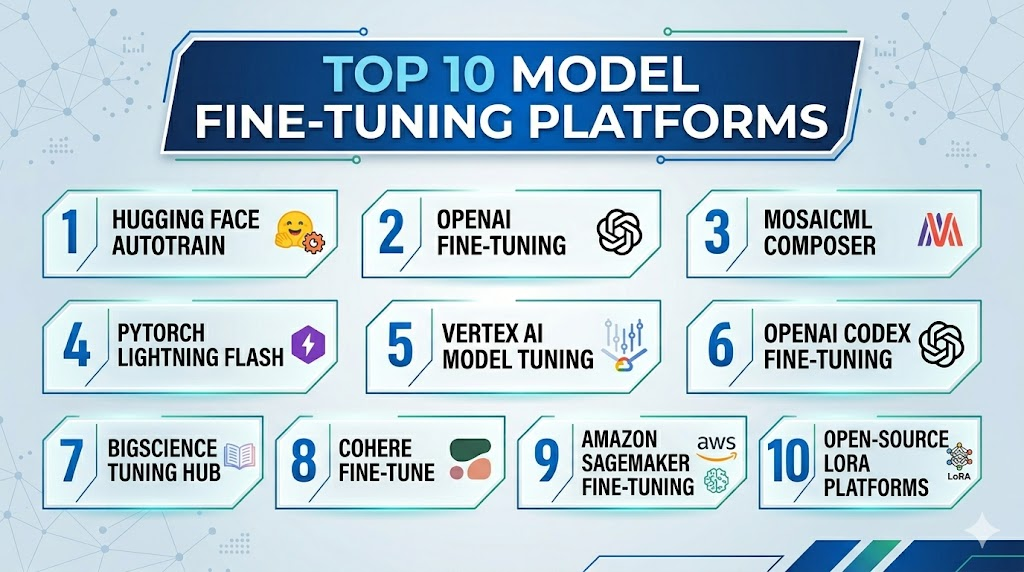
Top 10 Model Fine-Tuning Platforms
1- Hugging Face AutoTrain
One-line verdict: Easy-to-use platform for quickly fine-tuning NLP and multimodal models with minimal coding.
Short description: Provides an automated pipeline to fine-tune models using your dataset, ideal for developers and enterprises.
Standout Capabilities
- AutoML pipeline for fine-tuning
- Preprocessing and dataset management
- Supports NLP, CV, and multimodal models
- Training on cloud GPUs
- Built-in evaluation metrics
- Versioned experiments
- Model sharing and deployment
AI-Specific Depth
- Model support: Open-source / BYO / pre-trained
- RAG / knowledge integration: Vector DB compatible
- Evaluation: Automatic metrics and benchmark testing
- Guardrails: Basic safety and validation
- Observability: Training logs, token usage
Pros
- Minimal setup for developers
- Automated training pipelines
- Supports multiple modalities
Cons
- Limited custom training configurations
- Cloud-only by default
- Advanced tuning may require paid tier
Deployment & Platforms
- Web-based, Linux, Windows, macOS
- Cloud / Hybrid
Integrations & Ecosystem
- Python API, SDKs
- Hugging Face Hub integration
- CI/CD deployment pipelines
- Model registry support
Pricing Model
Open-source with optional enterprise plan
Best-Fit Scenarios
- Rapid prototyping
- Domain-specific NLP fine-tuning
- Multimodal experimentation
2- OpenAI Fine-Tuning
One-line verdict: Hosted fine-tuning for GPT-family models with managed infrastructure and enterprise support.
Short description: Allows enterprises to fine-tune LLMs on proprietary datasets with API-based deployment.
Standout Capabilities
- Hosted infrastructure for GPT models
- Easy dataset upload and validation
- Supports prompt/response tuning
- Automatic evaluation metrics
- Deployment-ready endpoints
- Managed experiment tracking
- Enterprise compliance features
AI-Specific Depth
- Model support: Hosted / GPT / BYO limited
- RAG / knowledge integration: Connectors via API
- Evaluation: Regression testing, human evaluation
- Guardrails: Policy checks, prompt safety
- Observability: Token usage, latency metrics
Pros
- Fully managed hosting
- Scales automatically
- Enterprise-grade support
Cons
- Cost can be high for large datasets
- Limited framework flexibility
- No edge deployment
Deployment & Platforms
- Web/API-based
- Cloud only
Integrations & Ecosystem
- API SDKs
- Integration with vector DBs
- Experiment versioning
Pricing Model
Usage-based API pricing
Best-Fit Scenarios
- Enterprise LLM customization
- Domain-specific chatbot tuning
- Prompt-response optimization
3- MosaicML Composer
One-line verdict: Enterprise and research platform for fine-tuning large models efficiently and reproducibly.
Short description: Composer provides pipelines for parameter-efficient tuning, reproducibility, and scalable training.
Standout Capabilities
- LoRA and adapters for parameter-efficient tuning
- Supports NLP, CV, multimodal
- Cloud and on-prem GPU training
- Experiment tracking and reproducibility
- Evaluation metrics built-in
- Multi-model support
- Integration with Hugging Face Hub
AI-Specific Depth
- Model support: Open-source / BYO / Multi-model
- RAG / knowledge integration: Vector DB compatible
- Evaluation: Benchmarking and regression tests
- Guardrails: Policy enforcement
- Observability: Token and cost monitoring
Pros
- Efficient for large models
- Flexible deployment
- Supports multimodal fine-tuning
Cons
- Requires GPU resources
- Smaller community than Hugging Face
- Steeper learning curve
Deployment & Platforms
- Linux, macOS
- Cloud / On-prem / Hybrid
Integrations & Ecosystem
- Python SDK, APIs
- Hugging Face integration
- MLflow/Kubeflow connectors
Pricing Model
Open-source + optional enterprise tier
Best-Fit Scenarios
- Enterprise LLM projects
- Multimodal fine-tuning
- Research-scale experimentation
4- PyTorch Lightning Flash
One-line verdict: Simplifies fine-tuning for PyTorch models with reusable pipelines and training utilities.
Short description: Provides modular components and pre-built workflows for fine-tuning and experiment tracking.
Standout Capabilities
- Modular pipelines for NLP, CV, audio
- Pre-built trainers and metrics
- Versioning and reproducibility
- Supports GPU/TPU training
- Flexible dataset handling
- Integrates with PyTorch ecosystem
AI-Specific Depth
- Model support: PyTorch / Open-source
- RAG / knowledge integration: N/A
- Evaluation: Metrics included
- Guardrails: Varies / N/A
- Observability: Training logs and profiling
Pros
- Modular and flexible
- PyTorch-native
- Easy integration with pipelines
Cons
- Limited non-PyTorch support
- Requires Python expertise
- Less managed infrastructure
Deployment & Platforms
- Linux, macOS, Windows
- Cloud / On-prem / Hybrid
Integrations & Ecosystem
- PyTorch, TorchServe
- MLflow integration
- CI/CD pipelines
Pricing Model
Open-source
Best-Fit Scenarios
- Research prototypes
- CV/NLP experimentation
- GPU training pipelines
5- Vertex AI Model Tuning
One-line verdict: Managed platform for fine-tuning models with enterprise-grade tools and monitoring.
Short description: Offers scalable model fine-tuning with experiment tracking, monitoring, and deployment endpoints.
Standout Capabilities
- Managed LLM and ML model tuning
- Automatic hyperparameter optimization
- Cloud GPU/TPU support
- Experiment tracking dashboards
- Deployment-ready endpoints
- Built-in metrics and logs
- Integration with RAG workflows
AI-Specific Depth
- Model support: Hosted / BYO / Multi-model
- RAG / knowledge integration: Vector DB compatible
- Evaluation: Metrics, regression tests
- Guardrails: Policy and safety checks
- Observability: Token, latency, cost
Pros
- Fully managed cloud solution
- Scales easily
- Experiment tracking built-in
Cons
- Cloud-only
- Cost depends on GPU usage
- Limited framework flexibility
Deployment & Platforms
- Cloud
- Linux, macOS
Integrations & Ecosystem
- Python API
- Vector DBs, RAG pipelines
- Experiment tracking
Pricing Model
Usage-based
Best-Fit Scenarios
- Enterprise ML pipelines
- LLM fine-tuning at scale
- Rapid deployment
6- OpenAI Codex Fine-Tuning
One-line verdict: Fine-tunes code-generation models for development and automation tasks.
Short description: Allows developers to adapt Codex models for domain-specific code completion and automation workflows.
Standout Capabilities
- Code-domain adaptation
- Prompt-response optimization
- Hosted infrastructure
- Evaluation pipelines for code quality
- Deployment-ready API endpoints
AI-Specific Depth
- Model support: Hosted GPT-Codex / BYO limited
- RAG / knowledge integration: N/A
- Evaluation: Test code quality, benchmarks
- Guardrails: Policy checks
- Observability: API usage metrics
Pros
- Rapid fine-tuning for code tasks
- Hosted and managed
- Easy API integration
Cons
- Limited to Codex
- Cloud-only
- Paid service
Deployment & Platforms
- Cloud
- Web / Linux / macOS
Integrations & Ecosystem
- API SDK
- GitHub and CI/CD pipelines
Pricing Model
Usage-based
Best-Fit Scenarios
- Code-generation tuning
- Automation tasks
- Developer productivity
7- BigScience Tuning Hub
One-line verdict: Collaborative platform for multilingual LLM fine-tuning and research.
Short description: Provides open-source checkpoints with reproducibility and community evaluation tools.
Standout Capabilities
- Multilingual LLM fine-tuning
- Community benchmarks and datasets
- Versioned checkpoints
- Experiment reproducibility
- Evaluation scripts included
AI-Specific Depth
- Model support: Open-source / BYO
- RAG / knowledge integration: N/A
- Evaluation: Benchmark datasets, human evaluation
- Guardrails: Varies / N/A
- Observability: Varies / N/A
Pros
- Community-driven
- Multilingual support
- Transparent reproducibility
Cons
- Minimal enterprise features
- Limited deployment
- Requires research expertise
Deployment & Platforms
- Linux, macOS
- Cloud / On-prem
Integrations & Ecosystem
- Python SDKs
- Benchmarking scripts
Pricing Model
Open-source
Best-Fit Scenarios
- Research labs
- Multilingual projects
- Academic experimentation
8- Cohere Fine-Tune
One-line verdict: API-first platform for fine-tuning LLMs with easy integration.
Short description: Offers hosted models with customization APIs for NLP tasks and enterprise use.
Standout Capabilities
- API-first fine-tuning
- Pre-trained LLMs
- Multilingual adaptation
- Monitoring dashboards
- Experiment tracking
AI-Specific Depth
- Model support: Hosted / Open-source / BYO
- RAG / knowledge integration: Vector DB compatible
- Evaluation: Metrics, regression testing
- Guardrails: Safety checks
- Observability: Token metrics
Pros
- Developer-friendly
- Hosted infrastructure
- Multilingual support
Cons
- Paid tiers for advanced features
- Limited BYO flexibility
- Cloud-only
Deployment & Platforms
- Cloud
- Linux, macOS
Integrations & Ecosystem
- Python SDK, REST APIs
- Vector DB connectors
Pricing Model
Usage-based
Best-Fit Scenarios
- Enterprise NLP
- Chatbots
- RAG pipelines
9- Amazon SageMaker Fine-Tuning
One-line verdict: Enterprise platform for model fine-tuning with full MLOps support.
Short description: Provides scalable infrastructure, hyperparameter optimization, and deployment-ready endpoints for fine-tuned models.
Standout Capabilities
- GPU/TPU cloud training
- Hyperparameter optimization
- Experiment tracking
- Deployment endpoints
- Integration with RAG pipelines
AI-Specific Depth
- Model support: BYO / Multi-model
- RAG / knowledge integration: Vector DB compatible
- Evaluation: Metrics, regression tests
- Guardrails: Policy enforcement
- Observability: Token and cost metrics
Pros
- Enterprise-grade
- Full MLOps pipeline
- Scales automatically
Cons
- Cloud-only
- Paid service
- Complexity for small teams
Deployment & Platforms
- Cloud
- Linux, macOS
Integrations & Ecosystem
- Python SDK, APIs
- RAG and vector DB integration
Pricing Model
Usage-based
Best-Fit Scenarios
- Enterprise NLP
- LLM fine-tuning
- MLOps pipelines
10- Open-Source LoRA Platforms
One-line verdict: Ideal for parameter-efficient fine-tuning of large LLMs on custom datasets.
Short description: Focuses on low-rank adaptation techniques to fine-tune large models efficiently.
Standout Capabilities
- LoRA parameter-efficient tuning
- Minimal GPU memory usage
- Multimodal support
- Fine-tuning scripts included
- Integration with Hugging Face and PyTorch
AI-Specific Depth
- Model support: Open-source / BYO / Multi-model
- RAG / knowledge integration: N/A
- Evaluation: Benchmark testing
- Guardrails: Varies / N/A
- Observability: Training logs
Pros
- Efficient for large models
- Reduces compute cost
- Open-source flexibility
Cons
- Requires technical expertise
- Limited enterprise tooling
- Smaller community
Deployment & Platforms
- Linux, macOS, Windows
- Cloud / On-prem / Hybrid
Integrations & Ecosystem
- Hugging Face, PyTorch
- Python SDKs
Pricing Model
Open-source
Best-Fit Scenarios
- Parameter-efficient tuning
- LLM research
- Multimodal fine-tuning
Comparison Table (Top 10)
| Tool Name | Best For | Deployment | Model Flexibility | Strength | Watch-Out | Public Rating |
|---|---|---|---|---|---|---|
| Hugging Face AutoTrain | NLP & multimodal | Cloud / Hybrid | Open-source / BYO | Automated fine-tuning | Limited custom configs | N/A |
| OpenAI Fine-Tuning | GPT models | Cloud | Hosted / BYO | Managed infrastructure | Costly for large datasets | N/A |
| MosaicML Composer | Enterprise LLM | Cloud / On-prem | Open-source / BYO / Multi-model | Efficient LLM fine-tuning | Steep learning curve | N/A |
| PyTorch Lightning Flash | PyTorch models | Cloud / On-prem / Hybrid | PyTorch / Open-source | Modular pipelines | Limited non-PyTorch | N/A |
| Vertex AI Model Tuning | Enterprise ML | Cloud | Hosted / BYO / Multi-model | Managed scaling | Cloud-only | N/A |
| OpenAI Codex Fine-Tuning | Code models | Cloud | Hosted | Code-generation tasks | Limited to Codex | N/A |
| BigScience Tuning Hub | Research labs | Cloud / On-prem | Open-source / BYO | Multilingual LLMs | Enterprise features minimal | N/A |
| Cohere Fine-Tune | Enterprise NLP | Cloud | Hosted / BYO | API-first, multilingual | Paid tiers for advanced features | N/A |
| Amazon SageMaker Fine-Tuning | Enterprise ML | Cloud | BYO / Multi-model | Scalable MLOps | Cloud-only | N/A |
| Open-Source LoRA Platforms | Efficient LLM tuning | Cloud / On-prem / Hybrid | Open-source / BYO / Multi-model | Low compute cost | Technical expertise required | N/A |
Conclusion
Model Fine-Tuning Platforms empower organizations to adapt AI models for domain-specific applications, reducing cost and improving performance. Selection depends on scale, framework, deployment needs, and governance requirements. Piloting models and verifying compliance ensures successful AI adoption.
