Top 10 LLM Evaluation Harnesses: Features, Pros, Cons & Comparison
Introduction
LLM Evaluation Harnesses are specialized platforms designed to systematically evaluate large language models (LLMs) across multiple dimensions such as accuracy, reasoning, factuality, safety, and latency. Simply put, these tools act as a structured testing framework, allowing teams to run automated or semi-automated evaluations on LLMs to understand strengths, weaknesses, and potential deployment risks.
With the explosion of AI agents and multimodal models, organizations increasingly require reliable evaluation pipelines before deploying LLMs in production, particularly for high-stakes domains like finance, healthcare, and legal automation.
Real-world use cases include:
- Benchmarking LLMs for customer service automation and chatbots.
- Testing LLMs for summarization, code generation, and content writing tasks.
- Detecting hallucinations, unsafe outputs, or bias in deployed LLMs.
- Evaluating reasoning, logic, and problem-solving across domains.
- Regression testing after model fine-tuning or prompt adjustments.
- Comparing proprietary, open-source, and BYO LLMs for vendor or internal selection.
Evaluation Criteria for Buyers:
- Coverage of reasoning, factuality, and safety metrics
- Ease of running large-scale automated tests
- Guardrails and safety monitoring for prompts
- Support for open-source, proprietary, and BYO LLMs
- Integration with retrieval-augmented generation (RAG) pipelines
- Observability, token tracking, and latency reporting
- Security and privacy controls for sensitive prompts/data
- Scalability for multi-model testing
- Flexibility for custom evaluation scenarios
- Ease of integration with CI/CD or MLOps pipelines
Best for: ML engineers, AI researchers, LLM deployment teams, regulated industry AI projects.
Not ideal for: Casual experimentation, very small teams, or one-off LLM tests where manual evaluation suffices.
What’s Changed in LLM Evaluation Harnesses
- Native support for multimodal inputs (text, images, audio).
- Integration with agentic workflows and multi-step evaluation pipelines.
- Advanced hallucination detection metrics and factuality scoring.
- Automated guardrails and prompt-injection defense.
- Enterprise privacy: configurable prompt logging, retention, and data residency.
- Cost and latency optimization for cloud or hybrid deployments.
- Observability dashboards with token-level tracking, usage, and costs.
- Continuous regression testing for fine-tuned or retrained models.
- Plug-and-play connectors for vector databases and RAG pipelines.
- Metrics for bias, fairness, and reasoning quality.
- API and SDK support for custom evaluation harnesses.
- Integration with CI/CD and MLOps pipelines for automated LLM testing.
Quick Buyer Checklist (Scan-Friendly)
- ✅ Data privacy and retention for sensitive prompts
- ✅ Supports hosted, BYO, or open-source LLMs
- ✅ RAG / vector database integrations
- ✅ Automated and human-in-loop evaluation
- ✅ Guardrails for unsafe outputs
- ✅ Observability: latency, token usage, cost metrics
- ✅ Auditability and admin controls (SSO/SAML, RBAC)
- ✅ Scalability for multi-model benchmarking
- ✅ Support for multimodal and multi-turn evaluation
- ✅ Cost and performance optimization tools
- ✅ Easy integration with MLOps or CI/CD
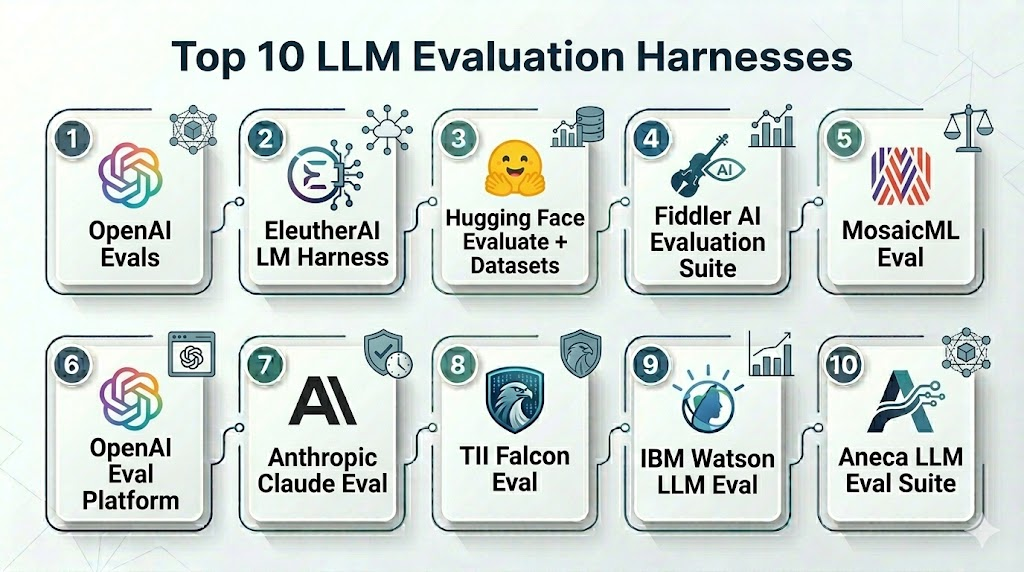
Top 10 LLM Evaluation Harnesses
#1 — OpenAI Evals
One-line verdict: Streamlined evaluation suite optimized for OpenAI LLMs including GPT series and multimodal models.
Short description: OpenAI Evals enables automated prompt testing, hallucination detection, and safety evaluation for GPT models, widely used by AI research teams and enterprises.
Standout Capabilities
- Prebuilt evaluation templates for reasoning, summarization, and coding
- Hallucination and factuality testing
- Multimodal input support
- Human-in-loop evaluation pipelines
- Token usage and cost tracking
- Regression testing for model updates
AI-Specific Depth
- Model support: Hosted OpenAI models
- RAG / knowledge integration: Varies / N/A
- Evaluation: Prompt tests, regression, human review
- Guardrails: Policy enforcement, injection defense
- Observability: Token usage, latency, cost
Pros
- Optimized for OpenAI LLMs
- Safety-focused evaluation
- Prebuilt evaluation templates
Cons
- Limited to OpenAI models
- Vendor lock-in risk
- Pricing details not public
Security & Compliance
- Varies / N/A
Deployment & Platforms
- Cloud, Web
Integrations & Ecosystem
- API and Python SDK
- Monitoring dashboards
- CI/CD hooks
Pricing Model
- Not publicly stated
Best-Fit Scenarios
- OpenAI GPT evaluation
- Internal LLM safety testing
- Multi-turn chatbot evaluation
#2 — EleutherAI LM Harness
One-line verdict: Open-source evaluation harness for benchmarking open-source LLMs across diverse tasks and datasets.
Short description: Provides flexible pipelines for reasoning, summarization, and factuality evaluation of open-source LLMs.
Standout Capabilities
- Open-source, community-maintained evaluation scripts
- Support for multilingual and multimodal benchmarks
- Reproducible datasets
- Regression testing for fine-tuned models
- Leaderboard support for research collaboration
AI-Specific Depth
- Model support: Open-source, BYO
- RAG / knowledge integration: N/A
- Evaluation: Automated prompts, offline metrics
- Guardrails: Varies / N/A
- Observability: Logs, metrics
Pros
- Open-source and flexible
- Reproducible and transparent
- Supports multi-task evaluation
Cons
- Limited enterprise support
- Requires custom infrastructure
- No built-in guardrails
Security & Compliance
- Varies / N/A
Deployment & Platforms
- Linux, Cloud optional
Integrations & Ecosystem
- Python SDK
- Dataset connectors
- CI/CD integration
Pricing Model
- Free
Best-Fit Scenarios
- Academic benchmarking
- Open-source LLM evaluation
- Multi-task research
#3 — Hugging Face Evaluate + Datasets
One-line verdict: Lightweight evaluation harness for transformers and LLMs with easy integration into NLP workflows.
Short description: Provides prebuilt metrics and datasets for LLM evaluation with easy reproducibility.
Standout Capabilities
- Standardized metrics for reasoning and summarization
- Integration with Transformers library
- Dataset versioning for reproducibility
- Custom metric support
- Community-maintained
AI-Specific Depth
- Model support: Open-source, BYO
- RAG / knowledge integration: N/A
- Evaluation: Offline metrics, regression testing
- Guardrails: Varies / N/A
- Observability: Metrics dashboards
Pros
- Open-source and free
- Easy integration
- Supports reproducibility
Cons
- Limited enterprise features
- No multimodal evaluation by default
- Guardrails not included
Security & Compliance
- Varies / N/A
Deployment & Platforms
- Python, Linux, Cloud optional
Integrations & Ecosystem
- Hugging Face Hub
- Transformers library
- Python SDK
Pricing Model
- Free
Best-Fit Scenarios
- NLP evaluation
- Academic research
- Open-source LLM comparison
#4 — Fiddler AI Evaluation Suite
One-line verdict: Enterprise-grade harness focusing on production LLM reliability, fairness, and explainability.
Short description: Continuous monitoring and evaluation for deployed LLMs, including bias detection and drift monitoring.
Standout Capabilities
- Real-time monitoring
- Bias, fairness, and drift detection
- Explainability dashboards
- Model version comparisons
- Integration with vector DBs for RAG
- Enterprise compliance features
AI-Specific Depth
- Model support: Multi-model, BYO, hosted
- RAG / knowledge integration: Vector DB connectors
- Evaluation: Automated and human-in-loop
- Guardrails: Policy-based alerts, injection detection
- Observability: Token usage, latency, cost
Pros
- Enterprise-grade compliance
- Continuous monitoring
- Explainability-focused
Cons
- Complex setup
- Pricing not public
- Limited open-source support
Security & Compliance
- SSO/SAML, RBAC, audit logs
Deployment & Platforms
- Web, Cloud, Hybrid
Integrations & Ecosystem
- Python SDK, APIs, MLOps pipelines, CI/CD integration
Pricing Model
- Tiered subscription; Not publicly stated
Best-Fit Scenarios
- Production LLM monitoring
- Regulated industries
- Multi-model evaluation
#5 — MosaicML Eval
One-line verdict: Scalable evaluation harness for high-performance LLMs in cloud and on-prem environments.
Short description: Optimized for distributed evaluation, latency, and throughput metrics for large LLMs.
Standout Capabilities
- Distributed benchmarking
- Performance, throughput, latency tracking
- Supports large-scale LLMs
- Regression evaluation
- Cost and token metrics
AI-Specific Depth
- Model support: BYO, multi-model
- RAG / knowledge integration: Varies / N/A
- Evaluation: Offline and automated
- Guardrails: Varies / N/A
- Observability: Latency and cost
Pros
- High scalability
- Accurate performance metrics
- Supports enterprise deployments
Cons
- Requires GPU infrastructure
- Limited community support
- Setup complexity
Security & Compliance
- Varies / N/A
Deployment & Platforms
- Cloud, On-prem Linux
Integrations & Ecosystem
- Python SDK, ML pipelines
Pricing Model
- Not publicly stated
Best-Fit Scenarios
- Large LLM benchmarking
- Distributed evaluation
- Enterprise AI ops
#6 — OpenAI Eval Platform
One-line verdict: Streamlined harness for OpenAI LLMs including GPT and multimodal agents.
Short description: Provides automated prompt evaluation, hallucination detection, and safety checks.
Standout Capabilities
- Prebuilt evaluation templates
- Safety and hallucination detection
- Multimodal input testing
- Regression tracking
- Cost and token monitoring
AI-Specific Depth
- Model support: Hosted OpenAI
- RAG / knowledge integration: Varies / N/A
- Evaluation: Prompt tests, regression, human review
- Guardrails: Injection defense
- Observability: Token usage, latency, cost
Pros
- Optimized for OpenAI models
- Safety-focused
- Easy integration
Cons
- OpenAI only
- Vendor lock-in
- Pricing not public
Security & Compliance
- Not publicly stated
Deployment & Platforms
- Cloud, Web
Integrations & Ecosystem
- API, Python SDK, dashboards
Pricing Model
- Not publicly stated
Best-Fit Scenarios
- OpenAI LLM evaluation
- Safety testing
- Chatbot benchmarks
#7 — Anthropic Claude Eval
One-line verdict: Evaluation harness optimized for Anthropic LLMs with alignment and safety testing.
Short description: Automated prompt evaluation with safety, alignment, and reasoning quality metrics.
Standout Capabilities
- Alignment scoring
- Hallucination detection
- Multi-turn prompt evaluation
- Regression tracking
- Token/cost analytics
AI-Specific Depth
- Model support: Hosted Anthropic LLMs
- RAG / knowledge integration: N/A
- Evaluation: Prompt regression, alignment tests
- Guardrails: Safety checks, injection defense
- Observability: Token and latency metrics
Pros
- Safety-focused
- Optimized for Anthropic models
- Multi-turn evaluation
Cons
- Anthropic-only
- Limited flexibility
- Pricing: Not public
Security & Compliance
- Varies / N/A
Deployment & Platforms
- Cloud, Web
Integrations & Ecosystem
- API and SDK
Pricing Model
- Not publicly stated
Best-Fit Scenarios
- Anthropic LLM evaluation
- Safety compliance
- Research alignment testing
#8 — TII Falcon Eval
One-line verdict: Open-source harness for multilingual and multimodal LLMs with reproducible datasets.
Short description: Evaluates LLMs across multiple languages and tasks with community-driven benchmarks.
Standout Capabilities
- Multilingual datasets
- Multimodal evaluation
- Reproducible metrics
- Community leaderboards
- Regression testing
AI-Specific Depth
- Model support: Open-source, BYO
- RAG / knowledge integration: N/A
- Evaluation: Automated and offline
- Guardrails: Varies / N/A
- Observability: Metrics dashboards
Pros
- Open-source
- Multimodal and multilingual
- Transparent metrics
Cons
- Enterprise support limited
- Cloud deployment optional
- Small community
Security & Compliance
- Varies / N/A
Deployment & Platforms
- Linux, Cloud optional
Integrations & Ecosystem
- Python APIs, Hugging Face Hub
Pricing Model
- Free
Best-Fit Scenarios
- Academic benchmarking
- Multilingual evaluation
- Research tasks
#9 — IBM Watson LLM Eval
One-line verdict: Enterprise harness for evaluating Watson LLMs with monitoring, governance, and compliance metrics.
Short description: Combines production monitoring with reasoning, bias, and safety evaluation.
Standout Capabilities
- Drift detection
- Bias and fairness metrics
- Automated evaluation pipelines
- Governance dashboards
- Integration with IBM Cloud
AI-Specific Depth
- Model support: Hosted / BYO
- RAG / knowledge integration: IBM connectors
- Evaluation: Automated metrics, regression
- Guardrails: Policy enforcement
- Observability: Token and latency metrics
Pros
- Enterprise-grade
- Production-ready monitoring
- Governance features
Cons
- Complexity for small teams
- Multi-cloud limited
- Limited open-source support
Security & Compliance
- SSO/SAML, RBAC, audit logs, encryption
Deployment & Platforms
- Cloud, On-prem, Hybrid
Integrations & Ecosystem
- IBM Cloud services, APIs, Python SDK
Pricing Model
- Tiered subscription; Not publicly stated
Best-Fit Scenarios
- Production LLM monitoring
- Regulated industries
- IBM ecosystem users
#10 — Aneca LLM Eval Suite
One-line verdict: Flexible evaluation harness for multi-framework, multimodal, BYO LLMs.
Short description: Supports diverse LLM benchmarking with automated evaluation, guardrails, and token observability.
Standout Capabilities
- Multi-framework support
- Multimodal evaluation
- Cost and latency tracking
- Guardrails for unsafe outputs
- Versioning and CI/CD integration
AI-Specific Depth
- Model support: BYO, Multi-model, Open-source
- RAG / knowledge integration: Vector DB connectors
- Evaluation: Automated and human review
- Guardrails: Injection defense
- Observability: Token, latency, cost metrics
Pros
- Flexible
- Enterprise-grade observability
- CI/CD friendly
Cons
- Smaller community
- Setup complexity
- Pricing not public
Security & Compliance
- Varies / N/A
Deployment & Platforms
- Cloud, Web, Linux, macOS
Integrations & Ecosystem
- Python, APIs, Vector DB connectors, CI/CD
Pricing Model
- Usage-based or subscription; Not publicly stated
Best-Fit Scenarios
- Multi-framework evaluation
- Enterprise benchmarking
- Multimodal LLM research
Comparison Table (Top 10 LLM Evaluation Harnesses)
| Tool Name | Best For | Deployment | Model Flexibility | Strength | Watch-Out | Public Rating |
|---|---|---|---|---|---|---|
| OpenAI Evals | OpenAI models | Cloud | Hosted | Safety & prompt eval | OpenAI-only | N/A |
| EleutherAI LM Harness | Open-source | Linux / Cloud | BYO | Flexible & reproducible | Limited enterprise | N/A |
| Hugging Face Evaluate | NLP / Transformers | Cloud / Linux | Open-source / BYO | Prebuilt metrics | Enterprise features limited | N/A |
| Fiddler AI Evaluation | Enterprise / regulated | Cloud / Hybrid | Multi-model | Observability & compliance | Complex setup | N/A |
| MosaicML Eval | Large-scale ML | Cloud / On-prem | BYO / Multi-model | Distributed performance | GPU required | N/A |
| OpenAI Eval Platform | OpenAI models | Cloud | Hosted | Prompt regression & safety | OpenAI-only | N/A |
| Anthropic Claude Eval | Anthropic LLMs | Cloud | Hosted | Alignment & safety | Anthropic-only | N/A |
| TII Falcon Eval | Multilingual / multimodal | Linux / Cloud | Open-source / BYO | Multilingual & multimodal | Small community | N/A |
| IBM Watson LLM Eval | Enterprise / regulated | Cloud / Hybrid | Hosted / BYO | Production monitoring | Complexity | N/A |
| Aneca LLM Eval Suite | Multi-framework AI | Cloud / Linux / Web | BYO / Multi-model | Flexible & extensible | Smaller community | N/A |
Scoring & Evaluation
| Tool | Core | Reliability/Eval | Guardrails | Integrations | Ease | Perf/Cost | Security/Admin | Support | Weighted Total |
|---|---|---|---|---|---|---|---|---|---|
| OpenAI Evals | 8 | 8 | 7 | 7 | 7 | 7 | 5 | 6 | 7.1 |
| EleutherAI LM Harness | 7 | 6 | 5 | 6 | 7 | 6 | 5 | 6 | 6.2 |
| Hugging Face Evaluate | 7 | 6 | 5 | 7 | 7 | 6 | 5 | 6 | 6.4 |
| Fiddler AI Evaluation | 8 | 8 | 8 | 8 | 7 | 8 | 8 | 7 | 7.9 |
| MosaicML Eval | 8 | 7 | 6 | 7 | 6 | 8 | 6 | 6 | 7.0 |
| OpenAI Eval Platform | 7 | 7 | 7 | 6 | 7 | 7 | 5 | 6 | 6.7 |
| Anthropic Claude Eval | 7 | 7 | 7 | 6 | 6 | 7 | 5 | 6 | 6.6 |
| TII Falcon Eval | 7 | 6 | 5 | 6 | 6 | 6 | 5 | 6 | 6.0 |
| IBM Watson LLM Eval | 8 | 7 | 7 | 8 | 6 | 7 | 8 | 7 | 7.4 |
| Aneca LLM Eval Suite | 8 | 7 | 7 | 7 | 6 | 7 | 6 | 6 | 7.0 |
Top 3 for Enterprise: Fiddler AI Evaluation, IBM Watson LLM Eval, OpenAI Evals
Top 3 for SMB: MosaicML Eval, Aneca LLM Eval Suite, Hugging Face Evaluate
Top 3 for Developers: EleutherAI LM Harness, TII Falcon Eval, Hugging Face Evaluate
Which LLM Evaluation Harness Is Right for You?
Solo / Freelancer
Use open-source tools like Hugging Face Evaluate or EleutherAI LM Harness for experimentation and flexible evaluation.
SMB
MosaicML Eval or Aneca LLM Eval Suite provide dashboards, observability, and moderate enterprise-grade evaluation.
Mid-Market
Fiddler AI Evaluation or OpenAI Evals balance scalability, safety, and multi-model monitoring.
Enterprise
IBM Watson LLM Eval and Fiddler AI Evaluation provide compliance, governance, and production monitoring.
Regulated industries
Fiddler AI Evaluation or IBM Watson LLM Eval ensure audit-ready compliance, safety, and governance.
Budget vs premium
Open-source suites are cost-effective; premium platforms provide comprehensive evaluation, monitoring, and guardrails.
Build vs buy
DIY with EleutherAI LM Harness or Hugging Face Evaluate is feasible for research; enterprise-scale deployments often require full harness platforms.
Implementation Playbook (30 / 60 / 90 Days)
- 30 days: Pilot evaluation on a small LLM dataset; define metrics, run automated prompts, record results.
- 60 days: Harden guardrails, integrate CI/CD evaluation, implement drift detection, human-in-loop review, and safety tests.
- 90 days: Optimize latency, cost, observability dashboards, governance processes, and scale across multiple LLMs.
AI-specific tasks: evaluation harness for regression, prompt/version control, red-teaming, incident handling.
Common Mistakes & How to Avoid Them
- Ignoring prompt injection vulnerabilities
- Failing to evaluate hallucinations and reasoning
- Unmanaged sensitive prompts and data retention
- Lack of observability over tokens, latency, and costs
- Skipping regression evaluation after fine-tuning
- Over-automation without human review
- Vendor lock-in without abstraction layers
- Not testing multimodal or BYO LLMs
- Using inconsistent evaluation metrics
- Overlooking enterprise compliance requirements
- Ignoring alignment or bias checks
- Not integrating evaluation into CI/CD pipelines
- Relying solely on vendor-reported metrics
FAQs
H3: What is an LLM Evaluation Harness?
A framework to systematically benchmark large language models for accuracy, safety, reasoning, hallucinations, and latency.
H3: Can open-source and proprietary LLMs be evaluated together?
Yes, most harnesses support BYO models, enabling side-by-side evaluation of open-source and hosted LLMs.
H3: How is data privacy handled?
Enterprise harnesses provide configurable prompt logging, retention, and anonymization; open-source tools rely on local control.
H3: Are these tools suitable for multimodal LLMs?
Many modern harnesses support text, images, audio, and multimodal evaluation.
H3: How do guardrails function?
They detect unsafe outputs, policy violations, or prompt injection, alerting teams for corrective action.
H3: Can I monitor LLM drift in production?
Yes, enterprise platforms like Fiddler AI or IBM Watson Eval provide drift detection and ongoing monitoring.
H3: What is the cost model?
Open-source harnesses are free; enterprise suites are subscription or usage-based with non-public pricing.
H3: Do they integrate with CI/CD pipelines?
Yes, APIs, SDKs, and hooks allow integration into automated evaluation pipelines.
H3: Can I run evaluations offline?
Some harnesses allow offline evaluation; others, especially cloud-hosted, may require internet access.
H3: Are human reviews necessary?
Best practice combines automated evaluation with human-in-loop for critical tasks.
H3: Can BYO models be benchmarked?
Yes, most harnesses support BYO for proprietary or open-source LLMs.
H3: How do I avoid vendor lock-in?
Maintain local evaluation scripts and abstract pipelines to remain flexible across platforms.
Conclusion
LLM Evaluation Harnesses are vital for teams deploying AI responsibly and effectively. Tool choice depends on model types, enterprise requirements, compliance, and budget. Open-source tools are ideal for experimentation; enterprise-grade harnesses provide governance, monitoring, and safety oversight.Pros