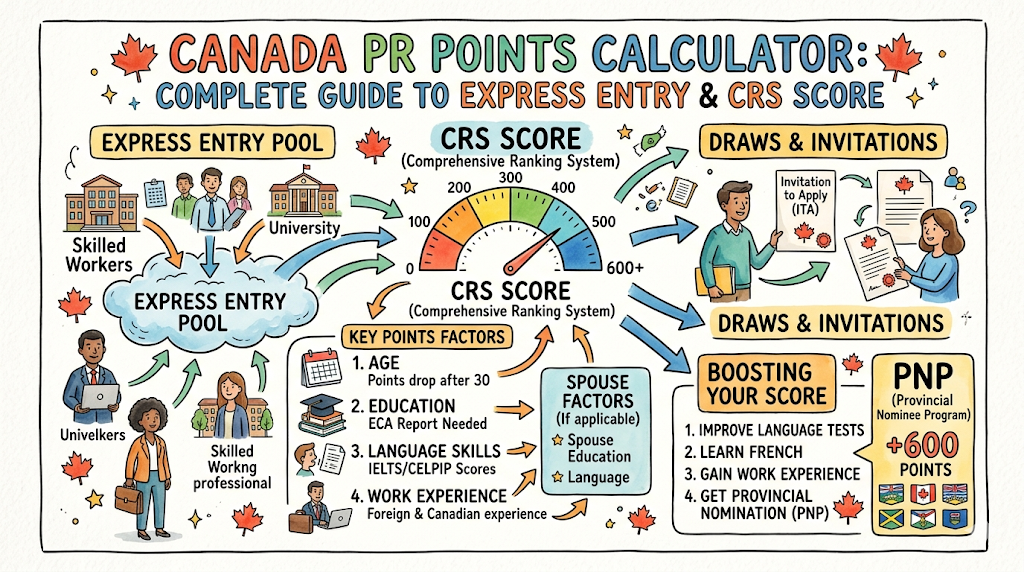
Moving to a new country is a massive, life-changing decision. For thousands of skilled workers, tech professionals, and healthcare specialists worldwide, Canada represents the ultimate dream. It offers a stable economy, high quality of life, excellent healthcare, and a safe environment to raise a family. However, the path to obtaining a Canadian Permanent Residency (PR) can feel overwhelming due to the complex immigration rules and paperwork. The journey begins with understanding your points. Canada manages its economic immigration through a highly competitive, points-based selection system. If you want to move to Canada through the popular Express Entry pathway, your passport to success is your Comprehensive Ranking System (CRS) score. Knowing your score before you apply saves you time, money, and unnecessary stress. This complete guide breaks down the official points system into simple terms. Whether you are a software engineer checking your eligibility, a student planning your future, or a family looking to migrate, this guide will show you exactly how to use a Canada PR Points Calculator to plan your path to success.
What Is Canada PR Points Calculator?
A Canada PR Points Calculator is an online tool designed to estimate your immigration score based on the official guidelines set by Immigration, Refugees and Citizenship Canada (IRCC). The calculator evaluates your profile and gives you a score out of 1,200 points.
To understand how it works, you need to understand the difference between the two different point systems used by Canada:
- The 67-Points Eligibility Filter: This is a preliminary check for the Federal Skilled Worker Program (FSWP). You must score at least 67 out of 100 points based on age, education, work experience, and language skills just to enter the application pool.
- The CRS Invitation Score: Once you pass the entry filter and enter the Express Entry pool, you are ranked against other candidates using a 1,200-point scale. This is your Comprehensive Ranking System (CRS) score. IRCC holds regular draws and invites the top-ranking candidates to apply for PR.
Think of the 67-point system as an entrance exam to qualify for an auction, while the CRS score is your bidding power inside the auction room.
A Quick Example
Let’s look at two friends, Amit and Rahul, who are both 28-year-old software engineers applying from outside Canada:
- Amit has a bachelor’s degree, three years of experience, and decent IELTS scores (CLB 7). His estimated CRS score is around 380.
- Rahul has the same profile but worked hard to get a master’s degree and top IELTS scores (CLB 9). His estimated CRS score jumps past 470.
Because Rahul focused on the key areas evaluated by the Canada PR score calculator, he stands a much better chance of receiving an invitation from the Canadian government.
How Canada PR Points System Works
The Comprehensive Ranking System breaks your profile down into specific categories. Let’s examine exactly how the Canada immigration points calculator awards points for each major factor.
1. Age Points (Maximum 110 Points)
Canada prefers young, skilled workers who can contribute to the economy for a long time. Points for age peak between 20 and 29 years old. After age 30, the points begin to drop every year.
| Age | Points (With Spouse) | Points (Without Spouse) |
| 18 to 20 years | 90 | 95 |
| 20 to 29 years | 100 | 110 |
| 30 years | 95 | 105 |
| 35 years | 70 | 75 |
| 40 years | 45 | 50 |
| 45 years or more | 0 | 0 |
2. Education Points (Maximum 150 Points)
To claim points for education completed outside Canada, you must obtain an Educational Credential Assessment (ECA) from an approved body like WES. This report proves your degree matches Canadian education standards.
- Ph.D. / Doctoral level: 140 points (with spouse) | 150 points (without spouse)
- Master’s degree or professional degree (like Medicine/Law): 126 points (with spouse) | 135 points (without spouse)
- Two or more post-secondary credentials (one must be at least 3 years long): 119 points (with spouse) | 128 points (without spouse)
- Bachelor’s degree (3 years or more): 112 points (with spouse) | 120 points (without spouse)
3. Language Proficiency (Maximum 136 Points)
Language skills are one of the most effective ways to boost your score on the Canada Express Entry points system. You can take tests like IELTS or CELPIP for English, and TEF or TCF for French. IRCC maps your test results to a standardized level called Canadian Language Benchmark (CLB).
To get maximum points, aim for CLB 9, which requires the following scores in IELTS General Training:
- Listening: 8.0
- Reading: 7.0
- Writing: 7.0
- Speaking: 7.0
4. Work Experience (Skill Transferability Combo)
Foreign work experience doesn’t give you direct points on its own in the core capital section, but it combines with your language scores and education under the Skill Transferability section to add up to 100 extra points.
- 1 year of foreign experience + CLB 9: Generates high bonus points.
- 3 or more years of foreign experience + CLB 9: Maxes out the bonus points category.
5. Additional Points (Maximum 600 Points)
You can pick up substantial bonus points if you satisfy specific conditions:
- Provincial Nomination (PNP): 600 points (An absolute guarantee of an invitation)
- Valid Canadian Job Offer (NOC TEER 0/1/2/3): 50 or 200 points
- Sibling living in Canada (Citizen or PR): 15 points
- French language skills (Proven via TEF/TCF): 50 points
- Canadian Education (1-2 year program): 15 to 30 points
Canada Express Entry System Explained
The Express Entry system is an online application management portal used by the Canadian government. It handles applications for three major federal economic immigration programs:
Federal Skilled Worker Program (FSWP)
This program is designed for skilled professionals living outside Canada who have relevant work experience, university degrees, and strong language skills. This is the pathway used by most global IT, finance, and engineering professionals.
Canadian Experience Class (CEC)
This stream targets individuals who already have at least one year of skilled full-time work experience inside Canada. International students working on a Post-Graduation Work Permit (PGWP) or foreign temporary workers usually apply through the CEC.
Federal Trades Program (FSTP)
This pathway is tailored for qualified tradespeople with experience in specific technical occupations, such as industrial electricians, aircraft mechanics, plumbers, and carpenters.
Provincial Nominee Program (PNP)
Canadian provinces run their own immigration streams based on local labor market shortages. Many of these provinces link directly with the Express Entry system. If a province selects your profile from the Express Entry pool, they award you 600 additional CRS points, guaranteeing you an invitation in the next official draw.
CRS Score Breakdown
The Comprehensive Ranking System divides the 1,200 available points into four main structural blocks.
| Core Component | Maximum Points (With Spouse) | Maximum Points (Without Spouse) |
| A. Core Human Capital Factors (Age, Education, Languages, Canadian Experience) | 460 | 500 |
| B. Spouse / Common-Law Partner Factors (Education, Language, Experience) | 40 | 0 |
| C. Skill Transferability Factors (Combinations of Education, Experience, and Languages) | 100 | 100 |
| D. Additional Factors (PNP, Job Offer, French, Siblings, Canadian Study) | 600 | 600 |
| Total Maximum Points | 1,200 | 1,200 |
Step-by-Step Example Calculation
To demonstrate how the points accumulate, let’s calculate the score for a realistic candidate named Vikram.
Vikram’s Profile:
- Age: 29 years old
- Marital Status: Single
- Education: Master’s Degree (with ECA)
- Foreign Work Experience: 3 Years as a Software Engineer
- Canadian Experience: None
- IELTS Score: Listening 8.0, Reading 7.5, Writing 7.0, Speaking 7.5 (All CLB 9)
The Point Breakdown:
- Age Component: Being 29 gives Vikram the absolute maximum of 110 points.
- Education Component: A verified Master’s degree earns him 135 points.
- Language Component: Scoring CLB 9 across all four language abilities grants him 124 points (31 points per section).
- Skill Transferability (Education + Language): A Master’s degree combined with CLB 9 language skills unlocks a bonus of 50 points.
- Skill Transferability (Work Experience + Language): Having 3 years of foreign experience combined with CLB 9 language skills unlocks another bonus of 50 points.
- Additional Factors: Vikram has no sibling in Canada, no job offer, and no PNP nomination, scoring 0 points here.
Total Estimated CRS Score: 110 + 135 + 124 + 50 + 50 = 469 Points.
With a score of 469, Vikram has a strong baseline profile, putting him in a good position for targeted draws or potential provincial selection.
How to Improve CRS Score
If your initial run through a Canada PR eligibility calculator reveals a low score, there is no need to worry. Your Express Entry profile is dynamic, meaning you can update it with new information to raise your score while sitting in the pool.
- Retake Your Language Tests: This is the fastest and most reliable way to boost your score. Moving your IELTS score from a CLB 8 to a CLB 9 can add up to 30 to 40 points across your core and transferability factors.
- Learn French: Canada has placed a high priority on francophone immigration. Demonstrating strong French language skills can award you up to 50 additional points, and opens doors to exclusive French-targeted Express Entry draws.
- Gain More Work Experience: If you currently have less than three years of skilled work experience, continuing to work in your home country will maximize your points under the skill transferability factors.
- Pursue Higher Education: Adding a one-year post-graduate diploma or certificate on top of your existing bachelor’s degree moves you into the “Two or more credentials” category, yielding extra points.
Provincial Nominee Programs (PNPs)
When your standalone CRS score falls short of the cutoff trends, obtaining a Provincial Nomination becomes your best alternative strategy.
Provinces regularly review the Express Entry pool to find candidates whose occupations match local skill shortages. If they select your profile, they issue a nomination certificate. Accepting this nomination adds 600 points directly to your profile, ensuring you receive an invitation to apply for permanent residency in the very next draw.
Key Provincial Streams:
- Ontario Immigrant Nominee Program (OINP): Frequently holds targeted Human Capital draws for IT professionals, tech workers, and healthcare staff.
- Alberta Advantage Immigration Program (AAIP): Offers dedicated pathways for tech workers and professionals with family connections in the province.
- Saskatchewan Immigrant Nominee Program (SINP): Utilizes an In-Demand Occupation list to target skilled workers worldwide.
- British Columbia PNP (BC PNP): Runs targeted weekly draws for tech fields, healthcare practitioners, and early childhood educators.
Documents Required for Canada PR Application
Before you check your score or submit an online profile, gather these foundational documents. You cannot enter the Express Entry pool without them:
- Valid International Passport: Must be valid for travel.
- Language Test Results: Your IELTS, CELPIP, PTE, or TEF certificates (must be less than 2 years old).
- Educational Credential Assessment (ECA): The official verification report from an agency like WES confirming your international degree value.
- Provincial Nomination Certificate: If you have been selected by a province.
- Written Job Offer: A valid, LMIA-supported employment offer from a Canadian business, if applicable.
Once you receive an Invitation to Apply (ITA), you will need additional documentation, including employment reference letters, bank proof of funds statements, police clearance certificates, and official medical exam clear records.
Processing Time & PR Process
The journey from setting up your profile to landing in Canada follows a structured timeline:
Once your application is approved, IRCC issues your Confirmation of Permanent Residence (COPR) visa, allowing you to move to Canada and begin your new life.
Common Mistakes to Avoid
A single error on your application can lead to a refusal or a multi-year ban for misrepresentation. Watch out for these common pitfalls:
- Inflating Your Calculations: Do not claim points for a Master’s degree or language level before you hold the official ECA report or test certificate numbers in hand.
- Using Expired Test Results: Language test results expire exactly two years from the test date. If they expire while you are in the pool, your profile becomes invalid.
- Choosing the Wrong National Occupational Classification (NOC) Code: Make sure your selected NOC code matches the actual everyday duties listed in your reference letters, rather than just matching your job title.
- Forgetting to Track Work Experience Gaps: Ensure all listed employment periods are accurate, verifiable, and backed up with reference letters, tax documents, and pay slips.
Real-Life Case Studies
Case Study 1: The Young Tech Professional
- The Applicant: Ananya, a 26-year-old single software engineer living in Mumbai.
- Initial Profile: Bachelor’s degree, 2 years of work experience, IELTS scores equivalent to CLB 8.
- Initial CRS Score: 395 points (Too low for general draws).
- Improvement Strategy: Ananya studied for six weeks and retook her IELTS, achieving a CLB 9 across all sections. She also completed her third year of continuous employment.
- Final Result: Her score jumped to 465 points, and she received an Invitation to Apply (ITA) during a subsequent targeted STEM Express Entry draw.
Case Study 2: The Married Couple Strategy
- The Applicants: Vikram (Primary Applicant, Age 32) and his wife Priya.
- Initial Profile: Vikram holds a Master’s degree and 4 years of experience, with an IELTS CLB 9. Priya holds a Bachelor’s degree but did not take a language test.
- Initial CRS Score: 440 points.
- Improvement Strategy: They updated their profile by having Priya complete an ECA for her Bachelor’s degree and take the IELTS test, where she earned a CLB 7.
- Final Result: Priya’s credentials added 18 points to the profile, pushing their combined score to 458 points and securing their path to an invitation.
Case Study 3: The Healthcare Worker PNP Pathway
- The Applicant: John, a 36-year-old nurse working in Dubai.
- Initial Profile: Bachelor’s degree, 5 years of experience, IELTS CLB 8.
- Initial CRS Score: 410 points (Low due to age factor deductions).
- Improvement Strategy: John entered the Express Entry pool and submitted an expression of interest to the Ontario Immigrant Nominee Program (OINP) Healthcare stream.
- Final Result: Ontario selected John’s profile, awarding him 600 bonus points. His score skyrocketed to 1,010 points, guaranteeing an ITA in the next draw.
Frequently Asked Questions
What is a good CRS score for Canada PR?
A good score depends on current draw trends. Generally, scores above 470-490 are competitive for general draws. However, if your occupation qualifies for targeted categories like STEM, Healthcare, or Trades, you can receive invitations with lower scores.
How many points are needed to qualify for Canada PR?
You need at least 67 out of 100 points to qualify under the Federal Skilled Worker Program filter. Once you are inside the Express Entry pool, there is no fixed passing score; you simply need to score high enough to match or beat the cutoff score of a given draw.
Can I apply for Canada PR without a job offer?
Yes, a job offer is not mandatory for Express Entry. Most applicants who receive an invitation do so based entirely on their education, age, language skills, and work experience, without an offer from a Canadian employer.
Does my age affect my Canada PR points score?
Yes, age significantly impacts your score. You receive maximum points between the ages of 20 and 29. Starting on your 30th birthday, your core human capital points drop slightly every year until they reach zero at age 45.
Is taking an IELTS language test mandatory?
Yes, proving language proficiency is mandatory. You cannot submit an Express Entry profile without entering valid test results from an approved language testing system like IELTS or CELPIP.
Can a spouse increase my overall CRS score?
Yes. A spouse can contribute up to 40 points to your profile by completing an ECA for their university degrees, earning high scores on their language tests, or gaining skilled Canadian work experience.
Which Canadian province is easiest to get PR?
There is no single easiest province, as each targets different skills. Ontario is popular for IT professionals, Alberta is great for tech and engineering, Saskatchewan suits agricultural and trade professionals, and Nova Scotia favors healthcare workers.
What is an Educational Credential Assessment (ECA)?
An ECA is an official evaluation report from an approved body (like WES) that verifies your international degree, diploma, or certificate is genuine and matches Canadian educational standards.
How long does a profile remain active in the Express Entry pool?
Your profile stays active in the Express Entry pool for exactly 12 months from the day you submit it. If you do not receive an invitation within that year, you can recreate and resubmit your profile.
What is a Category-Based Express Entry draw?
These are targeted draws where IRCC invites candidates with specific in-demand skills or language abilities, such as French speakers, healthcare workers, STEM professionals, tradespeople, or transport workers, often at lower CRS scores.
Can I claim points for work experience gained during university?
You cannot claim points for co-op or internships under the Canadian Experience Class if you were a full-time student in Canada. However, continuous, paid skilled work experience gained abroad while studying can count toward the Federal Skilled Worker Program.
What happens if I turn a year older while in the pool?
The Express Entry system automatically updates your profile and reduces your score on your birthday. If you receive an ITA before your birthday, IRCC usually waives the age-based score drop while your PR application is processing.
Conclusion
Navigating the Canada PR points system requires time, strategy, and careful planning. Your CRS score is not a fixed number; it is a tool you can improve by earning higher language test scores, upgrading your education, or securing a provincial nomination.
Using a Canada PR Points Calculator gives you a clear look at your immigration prospects, showing you exactly where you stand and what you need to improve. Approach the process step by step, organize your documents early, and keep working to boost your score. Canada is looking for skilled talents worldwide, and proper preparation is your key to making that dream a reality.
Helpful guide for understanding Canada PR CRS scores and Express Entry eligibility. The explanation of points calculation and ranking factors is simple, clear, and easy to follow.
Very useful guide for Canada immigration aspirants. It clearly explains how different factors impact your overall CRS score.
Great content! The step-by-step explanation of Canada’s PR points system makes this a valuable resource for anyone planning their immigration journey.
Great content! The step-by-step explanation of CRS factors, eligibility requirements, and score improvement strategies adds tremendous value for aspiring immigrants.