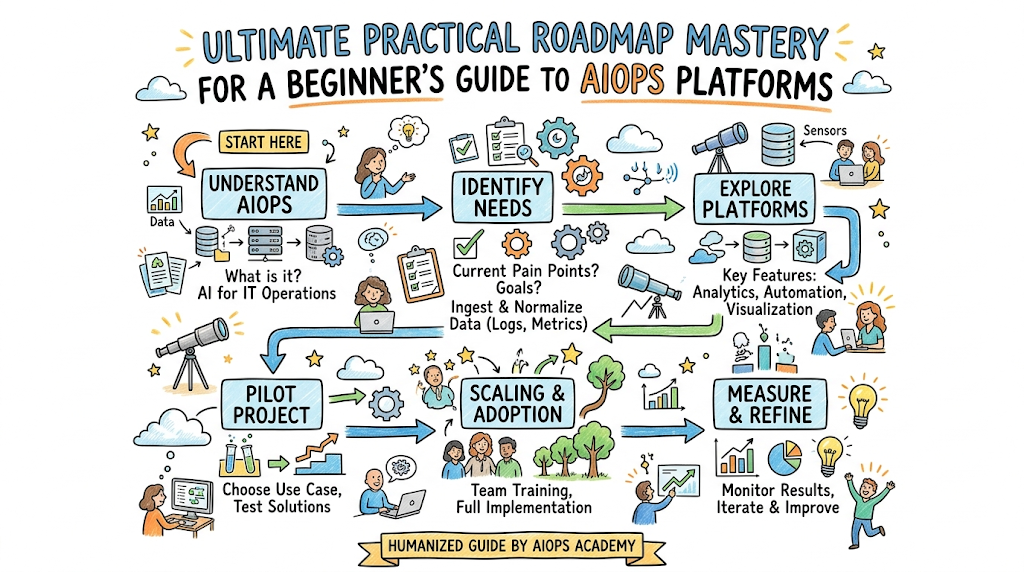
Traditional monitoring setups simply flag when something goes wrong, leaving human engineers to manually sift through logs and piece together the puzzle under intense pressure. AIOps platforms combine big data, machine learning, and advanced analytics to transform how organizations manage their digital infrastructure. Instead of waiting for a system to crash, these platforms constantly analyze system behavior to find patterns, isolate anomalies, and fix operational issues automatically. In simple terms, it means moving away from chaotic firefighting and shifting toward a controlled, intelligent environment. Enterprises utilize these intelligent platforms to gain deep operational intelligence and scale their automation efforts across complex hybrid clouds. By collecting information from every corner of the infrastructure, these systems help teams understand exactly how applications behave and where bottlenecks form. This comprehensive guide will teach you the core principles, architectural layers, practical career steps, and tools required to master modern operational analytics. If you want to accelerate your professional journey and gain hands-on expertise in automated system management, explore the structured educational programs available at AIOpsSchool.
The Origin of AIOps Platforms
The Growing Complexity of Traditional IT Operations
Modern distributed environments move incredibly fast, making older infrastructure monitoring techniques obsolete. When applications lived on single physical servers, tracking system health was relatively straightforward for a small team of administrators. Today, enterprise software runs across multi-cloud environments, thousands of microservices, and constantly changing container systems.
This massive scale makes it nearly impossible for humans to track system dependencies manually. A single user transaction might travel through dozens of microservices, third-party APIs, and distributed databases before completing. When a latency spike happens, finding the exact point of failure feels like searching for a needle in a digital haystack.
The Shift from Reactive Monitoring to Intelligent Operations
Traditional monitoring systems operate on fixed rules, such as triggering an alert when CPU usage goes over 85 percent. While this worked well in the past, it creates massive alert fatigue in dynamic cloud-native environments. Operations teams find themselves constantly waking up to midnight pages for harmless, temporary usage spikes.
The rise of machine learning and operational analytics completely changed this dynamic. Instead of relying on rigid, human-defined thresholds, modern systems observe infrastructure behavior over time to establish a baseline of normal activity. This shift allows operations teams to stop reacting to historic failures and start managing systems using clear, data-driven intelligence.
Enterprise Adoption of AIOps Platforms
Demand for intelligent management platforms is skyrocketing as companies move away from legacy datacenters. Cloud-native and hybrid architectures scale up and down instantly, generating massive streams of performance data every second. Human operators cannot keep pace with this volume of telemetry without algorithmic help.
Enterprise leaders realize that system uptime directly impacts business revenue and customer retention. Minimizing the time it takes to detect and resolve an incident is no longer just an IT goal; it is a business necessity. This reality drives the rapid adoption of advanced operational analytics across every major industry worldwide.
Defining Modern AIOps Platforms
The Core Architecture of AIOps Systems
A modern operational platform functions through a structured pipeline that processes data from ingest to automation. The first layer handles continuous data ingestion, gathering metrics, logs, traces, and event data from across the enterprise. This raw telemetry flows directly into a centralized big data processing layer designed for high-velocity streams.
Next, the analytical layer applies machine learning algorithms to clean the incoming data and remove repetitive background noise. Once the data is clean, the correlation engine links related events together across different infrastructure segments to find the root cause. Finally, the automation layer triggers scripts or API calls to fix identified issues without needing manual human intervention.
Daily Responsibilities of AIOps Engineers
Engineers working with these platforms spend less time looking at dashboard graphs and more time building smart operational logic. A typical day involves configuring ingestion pipelines to capture missing telemetry from new microservices. They spend significant time refining machine learning models to ensure anomaly detection alerts remain accurate.
These professionals also collaborate with software development teams to design automated remediation workflows for common infrastructure failures. When complex incidents happen, they use analytics tools to investigate how different system components interact. Their main goal is to optimize the platform so that repetitive operations execute safely and automatically.
Monitoring Tools vs. AIOps Platforms
Traditional monitoring tools simply record and display the state of specific components, like a server or a database. They tell you that a resource is broken but rarely explain why it failed or how it impacts the rest of the ecosystem. These tools operate in separate silos, forcing engineers to manually cross-reference different dashboards during an outage.
In contrast, intelligent platforms sit above all individual monitoring tools to unify the data. They do not just collect metrics; they understand the relationships between different technology layers. This holistic view enables real-time event correlation, predictive alerts, and automated fixes that single-purpose monitoring tools cannot provide.
The Predictive Operations Mindset
Adopting a modern operational platform requires a fundamental shift in how teams think about system reliability. In a traditional setup, success means fixing a broken system quickly after an outage occurs. The predictive mindset focuses on spotting early warning signs and resolving vulnerabilities before users ever notice a glitch.
This approach changes engineering priorities from reactive patch management to continuous systemic improvement. Teams use operational insights to redesign fragile software components and optimize resource allocation automatically. Over time, the infrastructure becomes self-correcting, allowing human engineers to focus on building new features.
The 7 Core Principles of AIOps Platforms
1. Event Correlation and Noise Reduction
Most operations teams face hundreds of scattered alerts during an infrastructure incident, making it difficult to pinpoint the real issue. Event correlation algorithms solve this by grouping thousands of related notifications into a single, cohesive incident ticket. This process reduces operational noise by up to 90 percent, allowing engineers to focus on the actual problem.
2. Intelligent Root Cause Analysis
When an enterprise application fails, finding the underlying culprit across a distributed network can take hours. Intelligent platforms analyze system dependencies and historical event patterns to trace the failure back to its origin. By identifying the exact root cause instantly, the system eliminates guesswork and slashes troubleshooting time.
3. Predictive Analytics for Operations
Waiting for a hard drive to fill up or a database to run out of memory causes preventable application downtime. Predictive analytics models monitor resource consumption trends to forecast exactly when a system will hit its limits. This early warning gives teams hours or days to scale resources safely before any performance degradation occurs.
4. Automation and Self-Healing Systems
Finding an issue quickly is valuable, but fixing it automatically without human intervention is the ultimate operational goal. Modern platforms integrate with automation tools to execute predefined playbooks when specific anomalies appear. Whether restarting a stuck microservice or clearing temporary caches, self-healing systems resolve routine errors in seconds.
5. Observability Across Distributed Environments
You cannot manage or protect what you cannot see across your network infrastructure. End-to-end observability ensures that every log file, performance metric, and distributed trace is visible in a unified workspace. This complete environmental transparency helps teams understand how changes in a cloud database affect user experience on a mobile application.
6. Continuous Learning from Operational Data
Static rules quickly become outdated as software development teams deploy updates and change infrastructure code. Machine learning models solve this by continuously analyzing new operational data to update their behavioral baselines. This ongoing adaptation ensures that anomaly detection remains highly accurate even as the application evolves.
7. Scalable Incident Management
As enterprise systems grow to handle millions of global users, manual incident management workflows quickly fall apart. Scalable operations platforms automate ticketing, route incidents to the right on-call engineers, and provide real-time context for faster resolution. This structured coordination keeps large engineering organizations aligned during major system emergencies.
Key AIOps Concepts Every Beginner Must Know
AIOps vs. DevOps vs. SRE — Explained Simply
Understanding how different operational philosophies connect can be confusing for newcomers entering the IT field.
- DevOps is a cultural and operational movement focused on breaking down silos between development and operations teams to ship code faster.
- Site Reliability Engineering (SRE) is a practical implementation of DevOps that uses software engineering principles to manage production infrastructure.
- AIOps provides the data-driven intelligence, machine learning analytics, and automation platforms that both DevOps and SRE teams use to keep systems stable at scale.
Event Correlation and Alert Management
Imagine handling thousands of alerts every hour from different monitoring systems across your global infrastructure. Event correlation is the process of using algorithms to identify connections between these scattered notifications. For instance, if a network switch fails, the platform groups the switch alert with all the resulting database connection errors into one incident. This automated organization keeps on-call engineers calm and focused instead of overwhelmed by duplicate notifications.
Root Cause Analysis and Incident Detection
Finding the exact reason behind an application failure is crucial for preventing the same issue from happening again. Incident detection uses machine learning to notice when system performance deviates from normal historical baselines. Once an anomaly is detected, root cause analysis algorithms trace the dependencies between servers, databases, and code. This allows the platform to point directly to the specific broken component causing the wider system outage.
Machine Learning in IT Operations
You do not need a doctorate in mathematics to understand how machine learning helps manage modern infrastructure. In simple terms, algorithms look at historical telemetry data to learn what a normal Tuesday afternoon looks like for your systems. They use this knowledge to spot unusual patterns, like an unexpected drop in user logins or an odd spike in database writes. These smart insights help teams catch silent software bugs that traditional monitoring rules completely miss.
Observability and Operational Intelligence
Observability is the practice of measuring a system’s internal state based on the external data it outputs. This data comes in three main forms: metrics (numerical health data), logs (text records of events), and traces (the journey of a request). Operational intelligence is the actionable understanding you gain by analyzing these three data streams together. This deep visibility shows you exactly how healthy your systems are and where performance bottlenecks live.
The Four Pillars of Modern AIOps Platforms
To evaluate any platform effectively, you must understand the four core pillars that support intelligent operations.
       [ MONITORING ]              [ ANALYTICS ]
(Continuous Data Ingestion)   (Machine Learning Insights)
             │                             │
             └──────────────┬──────────────┘
                            ▼
       [ OBSERVABILITY ]           [ AUTOMATION ]
(Deep Context & Visibility)   (Self-Healing Execution)
Monitoring forms the foundation by ensuring continuous data collection from every layer of your infrastructure. Analytics applies machine learning to turn that raw data into meaningful, predictive insights. Observability gives engineers the deep context needed to understand complex system interactions. Finally, automation executes the necessary fixes to keep applications running smoothly without manual effort.
Traditional Monitoring vs. AIOps Platforms — What’s the Real Difference?
The Philosophy Difference
Traditional monitoring operates on a purely reactive philosophy: it waits for something to break, checks against a static threshold, and alerts a human. This approach assumes that IT environments are stable and predictable, which is rarely true in modern cloud setups. Teams using this method spend most of their time reacting to historic failures after customers complain.
Modern operational platforms utilize a proactive philosophy built around continuous behavioral analytics and operational intelligence. Instead of looking backward, these systems analyze live data streams to detect early signs of system degradation. This allows teams to address underlying infrastructure problems long before they turn into major user-facing outages.
Roles & Responsibilities Compared
The tools an organization uses directly shape the daily routines and responsibilities of its engineering teams.
- System Administrators spend hours manually adjusting static alert thresholds and writing basic custom scripts to monitor server health.
- Operations Engineers monitor multiple siloed dashboards, manually correlate alerts during outages, and follow paper runbooks to resolve incidents.
- AIOps Specialists build automated data pipelines, train machine learning models, and design self-healing workflows to automate repetitive operational tasks.
Can Monitoring Tools and AIOps Platforms Work Together?
A common misconception is that adopting an advanced operational platform means throwing away your existing monitoring tools. In reality, these technologies work together in a hybrid ecosystem to maximize operational efficiency. Your current monitoring tools act as essential data collectors, feeding clean metrics and logs into the central platform.
The advanced platform acts as an intelligent brain that sits on top of your existing monitoring investments. It ingests data from multiple tools, connects the dots between them, and coordinates automated responses across different systems. This cooperative setup lets companies upgrade their operational capabilities without going through expensive software replacement cycles.
Which Operational Approach Should Organizations Adopt?
Choosing the right operational strategy depends heavily on the scale and complexity of your business infrastructure. If your organization runs a few stable applications on traditional servers, standard monitoring tools are often enough. At that scale, a small team can easily manage alerts and troubleshoot issues without advanced algorithmic help.
However, this becomes critical when systems scale rapidly across cloud-native environments and complex microservices. If your teams waste hours fighting alert fatigue or struggling to find root causes, you need an intelligent platform. Investing in advanced operational analytics is essential for maintaining service reliability as your digital footprint grows.
Real-World Use Cases of Modern AIOps Platforms
Incident Detection in Enterprise Infrastructure
Large enterprises run thousands of virtual servers that generate massive volumes of noisy log data every single day. A major global retail platform used an intelligent operations system to manage their infrastructure during peak holiday shopping traffic. The platform analyzed live data streams, removed duplicate alerts, and caught an unindexed database query before it caused a crash. By resolving the issue early, the engineering team avoided potential millions in lost sales revenue.
Cloud-Native Monitoring and Automation
Managing Kubernetes environments is notoriously difficult because containers spin up and shut down within seconds. A fast-growing software company deployed an advanced analytics platform to track their containerized application stacks. When a microservice started leaking memory, the platform detected the anomaly and instantly provisioned new containers while isolating the broken one. This automated self-healing action kept the application stable without requiring a midnight page to an on-call engineer.
AIOps in Banking and Financial Systems
Financial institutions operate under strict service-level agreements and demanding regulatory compliance standards. A national retail bank integrated an intelligent operational platform to monitor its transaction processing pipelines. The system established regular usage patterns and flagged an unusual slowdown in mortgage application processing times. Engineers quickly traced the bottleneck to an outdated third-party authentication API, preserving customer trust and maintaining compliance.
Telecom and Large-Scale Network Operations
Telecommunications providers manage massive physical and digital networks that span entire countries. An international network operator used event correlation algorithms to handle millions of daily alerts coming from cell towers. The platform grouped geographic alert spikes to show that a single faulty router was causing regional service drops. This precise identification allowed field technicians to replace the exact broken component quickly instead of diagnosing towers blindly.
AIOps for Startups and Growing Organizations
Startups rarely have the budget to hire a massive, dedicated round-the-clock operations team to monitor their systems. A growing fintech startup used a lightweight operational intelligence platform to maximize their small engineering team’s efficiency. The platform handled routine server maintenance, automatically scaled cloud resources during traffic surges, and kept systems stable. This smart automation allowed the startup’s engineers to focus on coding new features instead of managing infrastructure.
Common Mistakes Beginners Make While Learning AIOps
Mistake 1 — Treating AIOps as Just Another Monitoring Tool
Many beginners start learning these platforms assuming they are just advanced versions of standard dashboard tools. This narrow view causes them to miss out on broader capabilities like automated remediation and predictive trend analysis. To succeed, you must think of these platforms as intelligent orchestrators that run across your entire technology stack.
Mistake 2 — Ignoring Observability Fundamentals
Newcomers often try to master machine learning algorithms before understanding how basic system data is collected. Without a solid grasp of metrics, logs, and distributed traces, you cannot configure data ingestion pipelines correctly. Mastering these foundational observability elements is necessary before you can build accurate analytical models.
Mistake 3 — Expecting AI to Fix Everything Automatically
It is easy to fall into the trap of thinking that machine learning models will instantly solve every operational problem. In the real world, algorithms require careful configuration, high-quality data training, and human oversight to work effectively. Automation is a powerful tool, but it still relies on engineers to design clear operational logic and safety guardrails.
Mistake 4 — Overlooking Data Quality Issues
Beginners often feed messy, unfiltered log data into an operational platform and wonder why the alerts are inaccurate. If your input data is full of garbage, your machine learning insights will be equally unhelpful. Learning how to clean data, normalize formats, and remove background noise is critical for getting accurate results.
Mistake 5 — Focusing Only on Automation
Getting excited about self-healing systems and setting up automated fixes for every possible alert is a common mistake. If you automate actions without setting up deep observability first, you risk accelerating system errors across your network. Balance your learning by focusing equally on visibility, data analytics, and automated execution.
Mistake 6 — Ignoring Cross-Team Collaboration
Many technical learners focus entirely on code and tools while ignoring the human workflows behind incident management. An intelligent platform can only transform a business if development, operations, and support teams use its data effectively. Focus on learning how to share insights across teams to break down silos and speed up incident resolution.
Essential AIOps Platforms & Technologies
Monitoring and Observability Platforms
The modern IT landscape features several enterprise-grade platforms designed to provide deep infrastructure visibility. Datadog is popular for its user-friendly dashboards and seamless ability to aggregate metrics across cloud providers. New Relic offers strong application performance monitoring, allowing developers to trace code execution down to specific lines.
Elastic Observability excels at high-volume log analysis, helping teams search through terabytes of text data quickly using search queries. Dynatrace stands out by using a deterministic artificial intelligence engine to map system dependencies automatically. These platforms serve as the foundational data source for intelligent IT operations.
Incident Management Systems
When infrastructure incidents occur, organizations rely on orchestration platforms to coordinate their human engineering responses. PagerDuty is the industry standard for on-call scheduling, automated alert routing, and incident response tracking. It uses operational analytics to escalate critical alerts to the right engineer while suppressing non-urgent notifications. This structure ensures that major outages get immediate attention while protecting engineering teams from unnecessary burnout.
Event Correlation and Analytics Tools
Managing high-volume alert noise requires dedicated analytics engines that sit between monitoring tools and human engineers. BigPanda uses machine learning to clean up noisy alerts and group related notifications into single open incidents. Moogsoft specializes in real-time correlation, using algorithms to spot unusual infrastructure patterns before they turn into major outages. These tools help enterprise operations centers stay calm and efficient during complex infrastructure incidents.
AI-Powered Operational Platforms
Some platforms are built from the ground up to bring advanced predictive analytics directly to enterprise infrastructure. IBM Watson AIOps focuses on automating risk assessment, detecting anomalies across application components, and providing clear remediation advice. These systems analyze historical incident data to recommend the most effective fixes for current problems. This automated guidance helps junior engineers resolve complex system errors confidently without needing constant escalation.
Cloud-Native Observability Technologies
The rapid adoption of Kubernetes and containerized applications has created specialized open-source monitoring ecosystems. Tools like Prometheus excel at collecting high-frequency time-series metrics from modern cloud architecture. Grafana integrates with these data sources to build beautiful, highly customizable visualization dashboards for engineering teams. Understanding these cloud-native technologies is essential for any engineer managing modern microservices.
Becoming an AIOps Professional — Career Roadmap
Essential Skills Every AIOps Engineer Needs
Breaking into this high-demand field requires a strategic blend of traditional systems engineering and modern data analytics. You must start by developing a strong command of Linux operating systems and fundamental networking concepts. Scripting skills in languages like Python or Bash are essential for automating routine tasks and building data pipelines.
Next, you need to understand cloud architecture across major providers like AWS, Azure, or Google Cloud. Master the basics of observability by learning how to configure metrics collection, log aggregators, and distributed tracing tools. Finally, familiarize yourself with fundamental machine learning concepts like anomaly detection, clustering algorithms, and predictive regression models.
Step-by-Step AIOps Learning Path
Your professional development journey should follow a logical progression from core infrastructure concepts to advanced automation systems.
┌────────────────────────────┐
│   Step 1: Core Systems     │ -> Master Linux, Networking,
└──────────────┬─────────────┘    and Python Scripting
               ▼
┌────────────────────────────┐
│ Step 2: Cloud & Containers │ -> Learn AWS/Azure and
└──────────────┬─────────────┘    Kubernetes Management
               ▼
┌────────────────────────────┐
│ Step 3: Observability Foundations -> Study Metrics, Logs,
└──────────────┬─────────────┘    and Distributed Traces
               ▼
┌────────────────────────────┐
│ Step 4: Advanced AIOps Platforms -> Master Correlation, ML,
└────────────────────────────┘    and Self-Healing Systems
Start by mastering traditional system administration and learning how data flows across enterprise networks. Once comfortable, move into cloud computing and learn how container orchestration tools like Kubernetes manage applications. Next, focus on observability by learning how to implement monitoring tools across distributed systems. Finally, study advanced operational analytics, event correlation platforms, and automated self-healing engineering.
Certifications and Learning Programs Worth Exploring
Earning recognized certifications is a highly effective way to validate your skills and stand out to enterprise employers. Consider pursuing cloud architecture credentials, such as the AWS Certified Solutions Architect or the Google Cloud Professional DevOps Engineer. For container management, earning the Certified Kubernetes Administrator designation demonstrates strong, hands-on infrastructure capability.
In the observability space, platform-specific certifications from vendors like Datadog, Dynatrace, or Splunk hold significant value in the job market. These programs prove you know how to configure ingestion pipelines and analyze complex system telemetry. Combining cloud infrastructure credentials with specialized observability training creates a powerful resume for top-tier enterprise roles.
Educational Resources with AIOpsSchool
Building a successful career in intelligent operations requires access to high-quality, structured learning materials and practical lab environments. Discover comprehensive courses, guided tutorials, and expert-led training programs designed specifically for aspiring engineers at AIOpsSchool.
The Future of AIOps Platforms
Autonomous IT Operations
The long-term goal of the infrastructure industry is moving toward completely autonomous IT operations that require minimal human intervention. Future production environments will act like self-driving cars, continuously assessing their own health and optimizing performance on the fly. When a system detects a security vulnerability or a performance bottleneck, it will patch itself safely. This level of automation will allow software engineers to focus entirely on innovation rather than maintenance.
AI-Driven Observability
As machine learning models become more sophisticated, observability systems will move far beyond simple anomaly detection alerts. Future platforms will understand the underlying business logic of applications, predicting how code changes affect user behavior. They will automatically adjust their own telemetry collection rates, gathering more data during incidents and scaling back during quiet periods. This intelligent adaptation will significantly lower data storage costs while maximizing system visibility.
AIOps in Cloud-Native Ecosystems
The ongoing expansion of serverless computing, edge networks, and massive Kubernetes clusters will demand advanced operational intelligence tools. Future platforms will manage these highly distributed systems by instantly shifting workloads across clouds based on cost and performance. They will operate seamlessly across millions of edge devices, processing data locally to ensure near-zero latency for users. This advanced orchestration will enable organizations to scale global applications safely.
Skills That Will Matter Most in Future AIOps Careers
The evolution of intelligent platforms will shift the core responsibilities of future engineering teams. Knowing how to write basic monitoring rules manually will lose value as algorithms take over routine configuration tasks. Instead, professionals will need expertise in data science engineering, automated workflow design, and complex system architecture. Cultivating a deep understanding of machine learning principles alongside cloud infrastructure management will ensure long-term career success.
FAQ Section
- What career opportunities are available for professionals trained in AIOps platforms?
Graduates and experienced professionals can step into high-demand roles such as AIOps Engineer, Site Reliability Engineer (SRE), Cloud Infrastructure Architect, and Enterprise Operations Manager. Companies across banking, healthcare, retail, and telecommunications actively recruit specialists to modernize their production environments. As organizations continue to migrate to complex multi-cloud systems, the demand for experts who understand automated operational intelligence will keep rising.
2. Can a complete beginner learn AIOps platforms without prior programming experience?
Yes, beginners can enter this field, but they must first build a foundation in IT basics before diving into machine learning models. Starting with fundamental concepts like Linux systems administration, basic networking, and simple Python scripting makes the learning process much smoother. Focusing on core observability principles—understanding metrics, logs, and traces—provides the necessary background to master advanced operational platforms.
3. What are the average salary expectations for an entry-level AIOps engineer?
Salaries vary based on location and prior IT experience, but entry-level professionals in this specialization generally earn higher starting pay than traditional system administrators. In major tech hubs, junior engineers focused on operational analytics and automation can expect competitive compensation packages that reflect the high-value nature of their skills. As you gain hands-on enterprise experience and platform certifications, your market value and earning potential increase significantly.
4. Which certifications are most valuable for establishing credibility in this field?
Valuable credentials include foundational cloud architecture certifications like the AWS Certified Solutions Architect or Google Cloud DevOps Engineer. Getting certified in container management via the Certified Kubernetes Administrator (CKA) program is also highly respected by hiring teams. Finally, completing specialized platform certifications from leading vendors like Datadog, Dynatrace, or Splunk proves you possess practical, production-ready observability skills.
5. How should an organization select the right AIOps platform for its infrastructure?
Platform selection depends heavily on your current infrastructure scale, budget, and engineering team maturity. Organizations should look for platforms that integrate smoothly with their existing monitoring tools to avoid costly software replacement projects. It is essential to evaluate how well a platform handles automated event correlation, real-time noise reduction, and cross-team incident management workflows through a hands-on proof of concept.
6. What does the future job market look like for automated infrastructure specialists?
The job market is positioned for exceptional long-term growth as enterprises scale down manual monitoring centers in favor of smart automation. As autonomous self-healing systems become standard, the industry will need engineers who know how to design, audit, and optimize these intelligent platforms. Professionals who combine strong systems engineering skills with data analytics capabilities will see continuous career opportunities.
7. What is the difference between AIOps and MLOps?
While both fields involve machine learning, they target completely different domains. AIOps applies machine learning and data analytics specifically to IT operations, helping teams monitor infrastructure, correlate alerts, and automate incident responses. MLOps (Machine Learning Operations), on the other hand, focuses on the operational practices required to deploy, test, monitor, and maintain machine learning models in production.
8. How does an AIOps platform reduce alert fatigue for operations teams?
An intelligent platform uses advanced event correlation algorithms to analyze incoming notifications across your entire tech stack in real time. Instead of triggering individual alerts for every connected component that fails, the platform groups related symptoms into a single, comprehensive incident ticket. This deduplication process filters out up to 90 percent of background operational noise, allowing engineers to focus on fixing the core issue.
9. Does implementing AIOps mean that organizations no longer need human operators?
No, these platforms are designed to augment and empower human engineering teams rather than replace them. The platform handles high-volume data ingestion, noise filtration, and routine automated remediation tasks, which frees up human engineers to tackle complex, non-routine architectural issues. Human oversight remains critical for setting platform guardrails, training machine learning models, and making strategic operational decisions.
10. How do data quality issues impact the effectiveness of machine learning in IT operations?
Machine learning algorithms rely completely on clean, structured telemetry to generate accurate operational insights. If your infrastructure outputs messy, unparsed logs, inconsistent metrics, or disconnected traces, the platform will produce false positives or miss actual system anomalies. Ensuring your data collection pipelines are normalized, accurate, and comprehensive is essential for achieving reliable predictive operations.
Final Summary
Shifting from traditional reactive monitoring to modern, intelligent IT operations is essential for managing today’s complex cloud infrastructure. By mastering event correlation, root cause analysis, and automated self-healing workflows, engineering teams can eliminate alert fatigue and dramatically reduce system downtime. These advanced analytics platforms turn massive streams of raw network telemetry into clear, actionable operational intelligence.
As enterprise networks grow larger and more distributed, the reliance on machine learning for system reliability will only intensify. For tech professionals, learning these observability and automation technologies opens doors to some of the highest-paying and most resilient roles in the modern technology job market. Staying ahead of these architectural shifts ensures you remain an invaluable asset to any engineering organization.
Great read! I liked how the blog combines practical guidance with industry insights, helping newcomers understand the real-world value of AIOps.
Excellent roadmap for beginners! The article presents AIOps concepts in a structured and easy-to-follow manner, making the learning journey much more approachable.