Introduction
Model Benchmarking Suites are specialized platforms designed to evaluate, test, and compare AI and machine learning models across multiple dimensions such as accuracy, latency, robustness, and cost. Simply put, these tools act as a “scorecard” for AI models, helping organizations objectively understand how models perform under real-world conditions and identify the best-fit model for their specific use cases.
The AI landscape has grown increasingly complex. Multimodal models, agentic workflows, and BYO (Bring Your Own) models are now standard, making robust benchmarking essential for enterprises to ensure reliability, compliance, and optimized costs.
Real-world use cases include:
- Evaluating large language models (LLMs) for chatbot deployment in customer service.
- Testing multimodal AI for content generation across text, images, and video.
- Comparing model performance for healthcare diagnosis assistance.
- Stress-testing AI agents for autonomous decision-making in finance or logistics.
- Regression testing after model fine-tuning to prevent performance degradation.
- Benchmarking AI models for enterprise compliance and audit readiness.
Evaluation Criteria for Buyers:
- Core benchmarking features (accuracy, speed, coverage)
- AI reliability and evaluation depth
- Guardrails and prompt-injection safety
- Multimodal / BYO model support
- Observability and token/cost tracking
- Security, privacy, and compliance controls
- Integrations with existing data pipelines
- Cost, latency, and scalability optimization
- Ease of use and admin experience
- Vendor transparency and ecosystem support
Best for: AI teams, ML engineers, data scientists, enterprise IT departments, and regulated industries such as finance and healthcare.
Not ideal for: Organizations with only basic ML experimentation needs, small startups without model diversity, or teams that can rely on vendor-provided benchmarking reports instead of running in-house tests.
What’s Changed in Model Benchmarking Suites
- Integration of agentic workflows for multi-step model evaluation.
- Support for multimodal input benchmarking (text, images, audio, video).
- Advanced evaluation for hallucination detection and model reliability metrics.
- Built-in guardrails and defenses against prompt injection attacks.
- Enterprise-grade privacy: configurable data residency, retention policies, and anonymization.
- Cost and latency optimization tools for multi-cloud and BYO model routing.
- Detailed observability with token-level tracking, latency, throughput, and cost analytics.
- Governance support with audit logs, version tracking, and regulatory compliance dashboards.
- Native integration with vector databases and RAG (retrieval-augmented generation) pipelines.
- Automated regression testing for continuous deployment of fine-tuned models.
- Extensible APIs and SDKs for custom evaluation scripts and automated pipelines.
- AI-specific metrics for fairness, bias, and explainability in production scenarios.
Quick Buyer Checklist (Scan-Friendly)
- ✅ Data privacy and retention configurable per model
- ✅ Supports hosted, BYO, or open-source models
- ✅ RAG / vector DB connectors available
- ✅ Evaluation harness: automated, offline, and human-in-loop
- ✅ Guardrails for prompt-injection or misuse scenarios
- ✅ Observability: latency, token usage, and cost metrics
- ✅ Auditability and admin controls (SSO/SAML, RBAC)
- ✅ Vendor lock-in risk assessment
- ✅ Multimodal model testing capabilities
- ✅ Cost and performance optimization features
- ✅ Ease of integration with CI/CD and ML pipelines
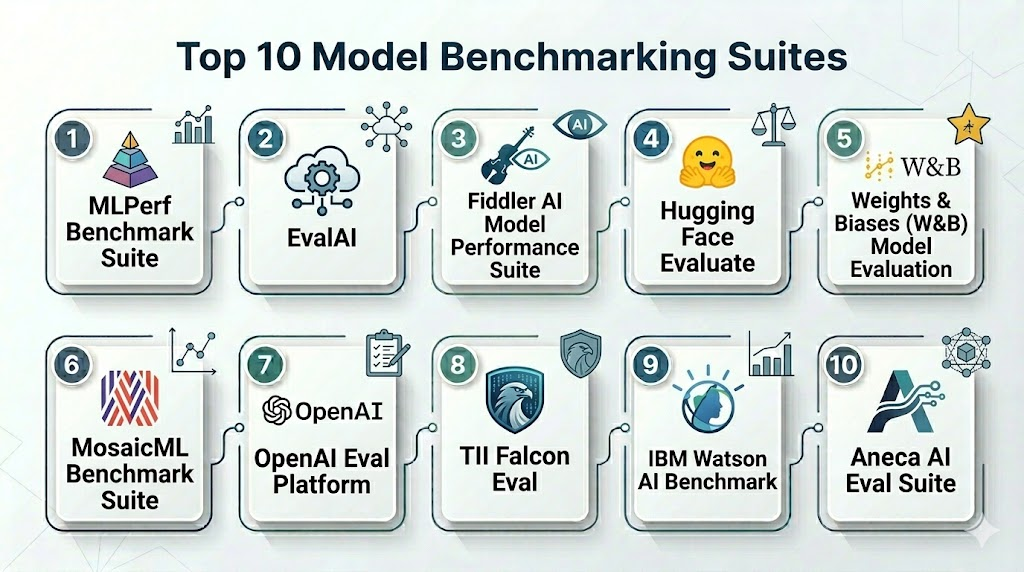
Top 10 Model Benchmarking Suites
#1 — MLPerf Benchmark Suite
One-line verdict: Industry-standard benchmarking for AI models across vision, language, and recommendation workloads.
Short description: MLPerf provides standardized tests for AI model performance, used widely by enterprises, cloud providers, and research labs.
Standout Capabilities
- Benchmarks for LLMs, vision, and recommendation systems
- Supports inference and training evaluation
- Detailed latency and throughput reporting
- Scalable across multi-GPU and distributed clusters
- Open-source community with ongoing updates
- Supports reproducibility with fixed datasets
AI-Specific Depth
- Model support: Proprietary, open-source, BYO
- RAG / knowledge integration: N/A
- Evaluation: Training/inference benchmarks, accuracy, latency, throughput
- Guardrails: Varies / N/A
- Observability: Traces, token/cost metrics
Pros
- Industry-accepted metrics
- Strong reproducibility
- Community-backed and transparent
Cons
- Limited to supported benchmark categories
- No built-in enterprise guardrails
- Requires infrastructure for large-scale runs
Security & Compliance
- Varies / N/A
Deployment & Platforms
- Linux, Cloud, On-prem HPC clusters
Integrations & Ecosystem
- Python SDK, APIs for metrics reporting, CI/CD integration, community scripts
Pricing Model
- Open-source, free to use
Best-Fit Scenarios
- Enterprise AI evaluation for procurement decisions
- Research labs testing new model architectures
- Cloud providers comparing hardware performance
#2 — EvalAI
One-line verdict: Developer-friendly platform for evaluating models against custom benchmarks in research and enterprise contexts.
Short description: EvalAI allows teams to define tasks, upload models, and benchmark performance across datasets with automated scoring.
Standout Capabilities
- Custom challenge creation for specific evaluation tasks
- Automated leaderboard generation
- Multimodal dataset support
- Community-driven competition hosting
- Supports model submission pipelines
- Fine-grained scoring and metrics analysis
AI-Specific Depth
- Model support: Open-source, BYO
- RAG / knowledge integration: Connectors via API
- Evaluation: Automated scoring, leaderboard, offline eval
- Guardrails: Task-based policy checks
- Observability: Metrics dashboards
Pros
- Flexible for research and enterprise
- Easy setup for competitions
- Good community engagement
Cons
- Less enterprise-grade security features
- Cloud-dependent for full functionality
- Not tailored for large-scale LLM benchmarking
Security & Compliance
- Varies / N/A
Deployment & Platforms
- Web-based, Cloud-hosted, Linux backend
Integrations & Ecosystem
- REST APIs, Python SDK, dataset connectors, CI/CD hooks
Pricing Model
- Free for community tasks; enterprise tier: Not publicly stated
Best-Fit Scenarios
- Academic or enterprise model competitions
- Benchmarking custom datasets
- Early-stage model evaluation
#3 — Fiddler AI Model Performance Suite
One-line verdict: Enterprise-grade model monitoring and benchmarking suite focused on AI reliability and explainability.
Short description: Provides continuous evaluation of models in production with bias, fairness, and drift detection, widely used in regulated industries.
Standout Capabilities
- Continuous monitoring of production models
- Bias, fairness, and performance tracking
- Drift detection alerts and retraining recommendations
- Explainability and feature attribution dashboards
- Model version comparisons
- Enterprise integrations with data pipelines
AI-Specific Depth
- Model support: Hosted, BYO, multi-model
- RAG / knowledge integration: Connectors for vector DBs
- Evaluation: Offline and real-time evaluation
- Guardrails: Policy-based alerts, drift detection
- Observability: Detailed token/cost/latency dashboards
Pros
- Strong enterprise compliance
- Comprehensive model observability
- Focus on explainability
Cons
- Complex setup for small teams
- Pricing not transparent
- Limited open-source integration
Security & Compliance
- SSO/SAML, RBAC, audit logs
- Encryption at rest/in transit
- Not publicly stated certifications
Deployment & Platforms
- Web, Cloud, Hybrid
Integrations & Ecosystem
- Python SDK, REST APIs, data warehouse connectors, CI/CD pipelines
Pricing Model
- Tiered enterprise subscription; Not publicly stated
Best-Fit Scenarios
- Regulated industries monitoring
- Production LLM deployments
- Multi-model enterprise setups
#4 — Hugging Face Evaluate
One-line verdict: Community-driven benchmarking for transformers and open-source NLP models.
Short description: Hugging Face Evaluate offers a library of evaluation metrics and datasets to benchmark NLP models easily.
Standout Capabilities
- Prebuilt metrics for NLP and vision models
- Easy integration with Transformers library
- Custom metric support
- Versioned datasets for reproducibility
- Supports distributed benchmarking
- Open-source and community-maintained
AI-Specific Depth
- Model support: Open-source, BYO
- RAG / knowledge integration: N/A
- Evaluation: Standard NLP metrics, regression tests
- Guardrails: Varies / N/A
- Observability: Logs, metrics
Pros
- Open-source and free
- Strong community support
- Easy integration with existing pipelines
Cons
- Limited enterprise-grade features
- Not designed for multimodal benchmarks
- No built-in guardrails
Security & Compliance
- Varies / N/A
Deployment & Platforms
- Python, Linux, Cloud optional
Integrations & Ecosystem
- Hugging Face Hub, Transformers library, Datasets library, Python SDK
Pricing Model
- Free open-source
Best-Fit Scenarios
- NLP model benchmarking
- Academic research tasks
- Early-stage model evaluation
#5 — Weights & Biases (W&B) Model Evaluation
One-line verdict: Comprehensive ML experiment tracking and benchmarking for teams building enterprise models.
Short description: W&B offers experiment tracking, model performance dashboards, and reproducible evaluation pipelines for ML teams.
Standout Capabilities
- Experiment and hyperparameter tracking
- Automated performance visualization
- Reproducible evaluation pipelines
- Model version comparisons
- Integration with cloud GPU and distributed training
- Collaboration dashboards for teams
AI-Specific Depth
- Model support: BYO, multi-framework
- RAG / knowledge integration: Varies / N/A
- Evaluation: Automated logging, offline eval
- Guardrails: Not publicly stated
- Observability: Latency, cost, token usage
Pros
- Strong for team collaboration
- Good visualization and dashboards
- Flexible for multiple ML frameworks
Cons
- Less focused on enterprise compliance
- Cost scales with usage
- Not prebuilt for multimodal models
Security & Compliance
- SSO/SAML, RBAC, audit logs
- Encryption: Not publicly stated
Deployment & Platforms
- Web, Cloud, Linux, macOS
Integrations & Ecosystem
- Python, TensorFlow, PyTorch
- CI/CD hooks
- API for custom dashboards
Pricing Model
- Usage-based tiered; Not publicly stated
Best-Fit Scenarios
- ML teams with frequent model experimentation
- Hyperparameter tuning evaluation
- Collaborative enterprise ML projects
#6 — MosaicML Benchmark Suite
One-line verdict: High-performance suite for benchmarking training and inference of large models on-prem and in cloud.
Short description: Focuses on speed, efficiency, and cost metrics for enterprise-grade models with distributed GPU support.
Standout Capabilities
- Distributed benchmarking across GPUs and nodes
- Optimized for large model inference
- Training performance metrics (throughput, memory)
- Integration with cloud and on-prem infrastructure
- Cost/latency tracking
- Supports mixed precision and quantized models
AI-Specific Depth
- Model support: BYO, multi-model
- RAG / knowledge integration: Varies / N/A
- Evaluation: Offline evaluation, throughput metrics
- Guardrails: Varies / N/A
- Observability: Detailed latency and cost metrics
Pros
- High scalability
- Precise performance metrics
- Supports enterprise deployments
Cons
- Requires GPU infrastructure
- Limited community support
- Setup complexity
Security & Compliance
- Varies / N/A
Deployment & Platforms
- Cloud, On-prem Linux, GPU clusters
Integrations & Ecosystem
- Python SDK, Cloud GPU orchestration, ML pipeline integration
Pricing Model
- Not publicly stated
Best-Fit Scenarios
- Large model inference benchmarking
- Distributed training evaluation
- Enterprise AI ops
#7 — OpenAI Eval Platform
One-line verdict: Streamlined evaluation suite for OpenAI models including GPT family and multimodal agents.
Short description: Provides built-in prompts, regression tests, and safety evaluations tailored for OpenAI’s hosted models.
Standout Capabilities
- Prebuilt evaluation harness for GPT models
- Hallucination detection tests
- Automated prompt regression
- Safety and guardrail checks
- Token and cost metrics
- Multimodal input testing
AI-Specific Depth
- Model support: Proprietary hosted
- RAG / knowledge integration: Varies / N/A
- Evaluation: Prompt-based regression, safety checks
- Guardrails: Jailbreak/prompt-injection defense
- Observability: Token usage, latency, cost
Pros
- Optimized for OpenAI models
- Easy integration with hosted APIs
- Safety-focused evaluation
Cons
- Limited to OpenAI models
- Vendor lock-in risk
- Pricing and tiers: Not publicly stated
Security & Compliance
- Not publicly stated
Deployment & Platforms
- Cloud, Web
Integrations & Ecosystem
- API integration, Python SDK, monitoring dashboards
Pricing Model
- Not publicly stated
Best-Fit Scenarios
- OpenAI GPT evaluation
- Safety and prompt testing
- Internal AI agent benchmarking
#8 — TII Falcon Eval
One-line verdict: Open-source evaluation for multilingual and multimodal AI models with global community contributions.
Short description: Developed by the Technology Innovation Institute, supports diverse model evaluation including LLMs and vision-language models.
Standout Capabilities
- Multilingual evaluation datasets
- Multimodal benchmark support
- Open-source reproducibility
- Leaderboards for research collaboration
- Integration with Hugging Face models
- Fine-grained metrics reporting
AI-Specific Depth
- Model support: Open-source, BYO
- RAG / knowledge integration: N/A
- Evaluation: Standardized metrics, regression tests
- Guardrails: Varies / N/A
- Observability: Metrics dashboards
Pros
- Strong open-source community
- Multimodal and multilingual support
- Transparent evaluation methodology
Cons
- Enterprise support limited
- Not cloud-native
- May require custom infrastructure
Security & Compliance
- Varies / N/A
Deployment & Platforms
- Linux, Cloud optional
Integrations & Ecosystem
- Python APIs, Hugging Face Hub, Leaderboard integration
Pricing Model
- Free, open-source
Best-Fit Scenarios
- Academic benchmarking
- Multilingual LLM evaluation
- Multimodal research
#9 — IBM Watson AI Benchmark
One-line verdict: Enterprise-ready suite for benchmarking Watson models with production monitoring and compliance insights.
Short description: Combines performance evaluation, drift detection, and AI reliability metrics for enterprise deployments.
Standout Capabilities
- Model drift and bias detection
- Regression and throughput evaluation
- Governance and compliance dashboards
- Integration with IBM Cloud and on-prem
- Automated evaluation pipelines
AI-Specific Depth
- Model support: Hosted, BYO
- RAG / knowledge integration: IBM connectors, NLU pipelines
- Evaluation: Automated metrics, offline eval
- Guardrails: Policy enforcement, prompt filtering
- Observability: Latency, token, cost metrics
Pros
- Enterprise-grade compliance
- Production-ready monitoring
- Prebuilt integrations with IBM ecosystem
Cons
- Limited open-source support
- Complexity for small teams
- Not multi-cloud optimized
Security & Compliance
- SSO/SAML, RBAC, audit logs
- Encryption at rest/in transit
- Data residency configurable
Deployment & Platforms
- Cloud, On-prem, Hybrid
Integrations & Ecosystem
- IBM Cloud services, APIs for MLOps pipelines, SDK for Python
Pricing Model
- Tiered enterprise subscription; Not publicly stated
Best-Fit Scenarios
- Production enterprise AI monitoring
- Regulated industry deployments
- IBM ecosystem users
#10 — Aneca AI Eval Suite
One-line verdict: Flexible AI benchmarking platform supporting multiple frameworks, multimodal models, and BYO integration.
Short description: Designed for both research and enterprise, Aneca provides evaluation, guardrails, and observability dashboards for diverse AI models.
Standout Capabilities
- Multi-framework support (PyTorch, TensorFlow, JAX)
- Multimodal evaluation across text, image, video
- Cost and latency tracking
- Guardrails for policy enforcement
- Model versioning and comparison
- CI/CD integration
AI-Specific Depth
- Model support: BYO, multi-model, open-source
- RAG / knowledge integration: Vector DB connectors
- Evaluation: Automated regression, human review
- Guardrails: Policy enforcement, injection defense
- Observability: Token usage, latency, cost dashboards
Pros
- High flexibility
- Enterprise-grade observability
- CI/CD friendly
Cons
- Smaller community
- Setup complexity
- Pricing: Not publicly stated
Security & Compliance
- Not publicly stated
Deployment & Platforms
- Cloud, Web, Linux, macOS
Integrations & Ecosystem
- Python, APIs, Vector DB connectors, CI/CD pipelines
Pricing Model
- Usage-based or subscription; Not publicly stated
Best-Fit Scenarios
- Multi-framework model evaluation
- Enterprise benchmarking
- Multimodal AI research
Comparison Table (Top 10)
| Tool Name | Best For | Deployment | Model Flexibility | Strength | Watch-Out | Public Rating |
|---|---|---|---|---|---|---|
| MLPerf Benchmark Suite | Enterprise / research | On-prem / Cloud | BYO / Open-source | Standardized metrics | Limited categories | N/A |
| EvalAI | Research / Dev | Cloud | BYO / Open-source | Custom benchmarks | Not enterprise-grade | N/A |
| Fiddler AI | Enterprise / regulated | Cloud / Hybrid | Multi-model | Observability & compliance | Complex setup | N/A |
| Hugging Face Evaluate | NLP / Transformers | Cloud / Linux | Open-source / BYO | Community & reproducible | Enterprise features limited | N/A |
| W&B Model Evaluation | Dev teams / ML ops | Cloud | BYO | Experiment tracking | Limited multimodal | N/A |
| MosaicML Benchmark | Large-scale ML | Cloud / On-prem | BYO / Multi-model | Distributed performance | GPU infrastructure needed | N/A |
| OpenAI Eval Platform | OpenAI models | Cloud | Hosted | Safety & prompt eval | Limited to OpenAI | N/A |
| TII Falcon Eval | Multilingual research | Linux / Cloud | Open-source / BYO | Multilingual & multimodal | Small community | N/A |
| IBM Watson AI Benchmark | Enterprise / regulated | Cloud / Hybrid | Hosted / BYO | Production-ready monitoring | Complexity for small teams | N/A |
| Aneca AI Eval Suite | Multi-framework AI | Cloud / Linux / Web | BYO / Multi-model | Flexible & extensible | Smaller community | N/A |
Scoring & Evaluation
Scoring is comparative: each tool is assessed against core features, reliability, guardrails, integrations, ease, performance/cost, security, and support. Weighted totals help buyers quickly identify fit.
| Tool | Core | Reliability/Eval | Guardrails | Integrations | Ease | Perf/Cost | Security/Admin | Support | Weighted Total |
|---|---|---|---|---|---|---|---|---|---|
| MLPerf Benchmark Suite | 9 | 8 | 5 | 7 | 7 | 8 | 6 | 7 | 7.6 |
| EvalAI | 7 | 6 | 5 | 6 | 8 | 6 | 5 | 7 | 6.3 |
| Fiddler AI | 8 | 8 | 8 | 8 | 7 | 8 | 8 | 7 | 7.9 |
| Hugging Face Evaluate | 7 | 6 | 5 | 7 | 8 | 6 | 5 | 7 | 6.5 |
| W&B Model Evaluation | 8 | 7 | 5 | 7 | 8 | 7 | 6 | 7 | 7.1 |
| MosaicML Benchmark | 8 | 7 | 6 | 7 | 6 | 8 | 6 | 6 | 7.0 |
| OpenAI Eval Platform | 7 | 7 | 7 | 6 | 7 | 7 | 5 | 6 | 6.7 |
| TII Falcon Eval | 7 | 6 | 5 | 6 | 6 | 6 | 5 | 6 | 6.0 |
| IBM Watson AI Benchmark | 8 | 7 | 7 | 8 | 6 | 7 | 8 | 7 | 7.4 |
| Aneca AI Eval Suite | 8 | 7 | 7 | 7 | 6 | 7 | 6 | 6 | 7.0 |
Top 3 for Enterprise: Fiddler AI, IBM Watson AI Benchmark, MLPerf Benchmark Suite
Top 3 for SMB: W&B Model Evaluation, Aneca AI Eval Suite, EvalAI
Top 3 for Developers: Hugging Face Evaluate, EvalAI, TII Falcon Eval
Which Model Benchmarking Tool Is Right for You?
Solo / Freelancer
Open-source tools like Hugging Face Evaluate or EvalAI provide flexibility and free access for experimentation.
SMB
W&B Model Evaluation or Aneca AI Suite offer collaborative dashboards, integration, and moderate enterprise-grade evaluation.
Mid-Market
Fiddler AI or MosaicML Benchmark balance scalability, monitoring, and advanced evaluation for growing organizations.
Enterprise
IBM Watson AI Benchmark and Fiddler AI provide compliance, governance, observability, and multi-model support.
Regulated industries
Fiddler AI or IBM Watson AI Benchmark ensure audit-ready reporting, guardrails, and enterprise security.
Budget vs premium
Open-source suites are cost-effective for experimentation; enterprise platforms offer full governance, monitoring, and compliance features.
Build vs buy
DIY with MLPerf or EvalAI suits research; enterprise-grade monitoring and compliance often require a full platform.
Implementation Playbook (30 / 60 / 90 Days)
- 30 days: Pilot with a small dataset; define evaluation metrics, run test models, measure initial performance.
- 60 days: Harden security, integrate guardrails, configure drift detection, run regression tests, and start rollout.
- 90 days: Optimize cost and latency, implement observability dashboards, formalize governance, and scale to all models.
AI-specific tasks: build evaluation harness, red-team test for prompt injections, version control for models and prompts, incident handling framework.
Common Mistakes & How to Avoid Them
- Ignoring prompt-injection vulnerabilities
- Failing to evaluate models thoroughly before deployment
- Unmanaged data retention leading to compliance issues
- Lack of observability over tokens, latency, and costs
- Unexpected cost spikes without usage monitoring
- Over-automation without human review
- Vendor lock-in without abstraction layers
- Not testing multimodal or BYO models
- Skipping regression evaluation after model updates
- Overlooking enterprise compliance and security requirements
- Using inconsistent metrics across models
- Not tracking model drift or bias
- Not integrating benchmarking with CI/CD pipelines
- Relying solely on vendor-reported benchmarks
FAQs
H3: What is a Model Benchmarking Suite used for?
They evaluate AI models across performance, reliability, bias, latency, and cost metrics to identify the best-fit model for specific use cases.
H3: Can I benchmark open-source and proprietary models together?
Yes, most suites support BYO and open-source models, though some vendor platforms may limit support to hosted models.
H3: How do these suites handle data privacy?
Enterprise suites often provide configurable retention, data residency, and anonymization, while open-source tools rely on local infrastructure.
H3: Are these tools suitable for multimodal AI?
Many modern suites now support multimodal benchmarking, including text, images, audio, and video inputs.
H3: How do guardrails work in benchmarking suites?
They enforce policy checks, detect prompt injection or unsafe outputs, and alert teams to ensure compliance.
H3: Can I monitor model drift and reliability in production?
Yes, enterprise suites like Fiddler AI and IBM Watson AI Benchmark provide real-time monitoring and drift detection.
H3: What is the cost model?
Varies by tool: open-source suites are free, while enterprise platforms use subscription or usage-based pricing; exact prices often not public.
H3: Do these suites integrate with CI/CD pipelines?
Most provide APIs, SDKs, and hooks to integrate benchmarking into continuous deployment workflows.
H3: Can I run benchmarks offline?
Some platforms allow offline evaluation; others, especially cloud-hosted, may require internet connectivity.
H3: Are human reviews required?
Best practice combines automated evaluation with human review for sensitive or critical models.
H3: Can these tools handle BYO models?
Yes, most support BYO models, enabling testing of proprietary and open-source models in the same suite.
H3: How do I avoid vendor lock-in?
Abstract benchmarking pipelines and maintain local evaluation scripts to ensure flexibility across platforms.
Conclusion
Model Benchmarking Suites are essential for AI teams and enterprises to ensure reliable, secure, and high-performing deployments. Selection depends on your model types, organizational size, compliance needs, and budget. Open-source suites provide flexibility for experimentation, while enterprise platforms offer governance, monitoring, and compliance oversight.
One area that could be explored further is benchmark relevance over time. Many models perform well on standardized evaluation datasets but struggle when exposed to evolving business data and real user behavior. Establishing a process to continuously refresh test datasets can be just as important as the benchmarking platform itself.