Introduction
If you are planning to migrate, your journey begins with the Austria PR Points Calculator. This tool is your first step to understanding where you stand and how you can successfully secure your residency. For an easy and direct way to evaluate your score based on your personal profile, you can utilize the interactive tool available at Desinri Austria PR Points Calculator. This comprehensive guide will break down everything you need to know about the points system, the core requirements, and how to maximize your score to make your dream of moving to Austria a reality.
What Is Austria PR Points Calculator?
The Austria PR Points Calculator is an automated pre-assessment framework modeled after Austria’s official immigration regulations. Its primary purpose is to help third-country nationals (non-EU/EEA citizens) evaluate whether they meet the legal score thresholds required for the Red-White-Red Card. Instead of leaving visa approvals to subjective opinions, the Austrian government awards points based on quantifiable human capital factors. The calculator simulates this process by looking at your age, educational background, professional experience, and language proficiencies. It is vital to distinguish between initial eligibility and final visa approval. Meeting the minimum score on a calculator means you are eligible to submit an application; it does not guarantee that the Austrian Public Employment Service (AMS) will approve your case. For instance, if a software engineer tallies 72 points using the calculator, they know they cross the minimum 70-point barrier for Highly Qualified Workers. This gives them the green light to prepare their official documentation with high confidence.
Austria PR Points System Explained
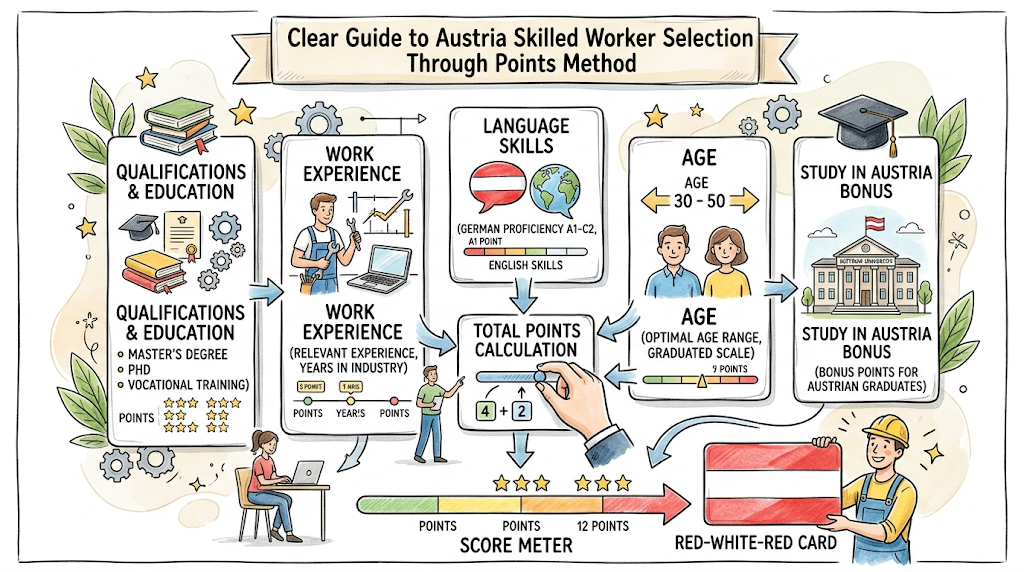
The backbone of the Austrian immigration model relies on five core metrics. Each category is weighted carefully to attract individuals who can quickly integrate into the local economy and society.
Education Points
Your academic credentials form the foundation of your point score. Higher levels of education and specialized technical degrees yield the most significant advantages.
- Vocational Training: Completing a specialized trade school or vocational program relevant to a shortage occupation grants you 30 points.
- General University Degree: A completed three-year tertiary or bachelor’s degree gives you 30 points.
- MINT/STEM Fields: If your degree is in Mathematics, Informatics, Natural Sciences, or Technology, you receive a boosted allocation of up to 30 points under specific shortage categories.
- PhD or Post-Doctoral Qualification: Reaching the absolute highest academic tier awards you up to 40 points in the Highly Qualified stream.
Work Experience Points
Austria highly values continuous, documented professional experience that aligns directly with your academic background.
- General Experience: You receive 2 points for every completed year of relevant work experience (calculated as 1 point per half-year), up to a maximum of 20 points.
- Austrian Experience: If you have worked legally inside Austria for at least six months, you receive a substantial bonus depending on your application stream.
Age Factor
The points system is designed to favor younger professionals who can contribute to the tax and pension systems for decades.
- Up to 30 Years Old: Grants the maximum of 15 points.
- 31 to 40 Years Old: Awards 10 points.
- 41 to 50 Years Old: Awards 5 points.
Language Skills (German & English)
Communication is critical for integration. You can score points for proving your proficiency in either German, English, or both.
- German Language: Reaching an A1 level gives 5 points, A2 gives 10 points, and B1 gives 15 points.
- English Language: An A2 level gives 5 points, while a B1 level or higher gives 10 points.
Bonus Points
Certain streams offer additional points if your prospective employer uses English as their primary corporate language, or if you completed your university studies directly within an Austrian institution.
Red-White-Red Card System
The Red-White-Red (RWR) Card is a combination of a work permit and a residence permit. It binds you to a specific employer for a set period, after which you can transition to an open work permit.
The system is split into distinct categories, each tailored to different professional backgrounds and market needs.
Highly Qualified Workers
This stream is for elite professionals with exceptional academic records or executive experience. If you score at least 70 points out of 100, you can apply for a 6-month Job Seeker Visa to look for work on the ground in Austria without needing a prior job offer.
Skilled Workers in Shortage Occupations
If your profession is listed on Austria’s official nationwide shortage list (such as mechanical engineers, nurses, or specific construction trades), you fall here. You must have a binding job offer in Austria and score a minimum of 55 points out of 90 to qualify.
Other Key Workers
This category accommodates professionals whose jobs are not on the shortage list but who bring specialized skills to an Austrian company. It requires a binding job offer, a specific minimum gross monthly salary, and a score of at least 55 points out of 90.
Startup Founders
Ambitious entrepreneurs looking to establish an innovative business that creates jobs or introduces new technologies to Austria can apply under this track. It requires a detailed business plan, capital investment, and a minimum of 50 points.
| Category | Minimum Points Required | Job Offer Needed First? | Key Defining Criteria |
| Highly Qualified Workers | 70 out of 100 | No (Can use Job Seeker Visa) | Advanced degrees, research, patents, high salaries |
| Skilled Workers in Shortage Occupations | 55 out of 90 | Yes | Occupation must be on the official shortage list |
| Other Key Workers | 55 out of 90 | Yes | Must meet strict minimum salary thresholds |
| Startup Founders | 50 out of 85 | No (Requires Company Setup) | Viable business plan, capital transfer (€30,000+) |
How Austria PR Points Are Calculated
To figure out your true point standing, you must run through a structured mathematical addition across the eligible criteria for your specific category. Let us take an in-depth look at a realistic step-by-step assessment.
Step-by-Step Scoring System
First, identify your primary application category. If you have a job offer in a shortage field, you will calculate your points based on the 90-point maximum scale. If you do not have a job offer but hold a Master’s or PhD, you will evaluate your profile based on the 100-point scale.
Next, match your exact certificates against the specific tiers. Do not guess your language levels; ensure you possess verifiable certificates like IELTS for English or Goethe/ÖSD for German.
Points Breakdown Table (Skilled Workers in Shortage Occupations)
| Assessment Criteria | Sub-Category Details | Points Awarded |
| Qualifications (Max 30) | Vocational training or degree in shortage field | 30 Points |
| Work Experience (Max 20) | 2 Points per year of related experience | Up to 20 Points |
| Austrian Experience | 4 Points per year worked in Austria | Up to 20 Points |
| German Language (Max 15) | A1 level = 5 | A2 level = 10 | B1 level = 15 | Max 15 Points |
| English Language (Max 10) | A2 level = 5 | B1 level or higher = 10 | Max 10 Points |
| Age Profile (Max 15) | Under 30 = 15 | Under 40 = 10 | Under 50 = 5 | Max 15 Points |
Real-Life Sample Profile Calculation
Let us look at a profile named Sarah. She is a 28-year-old software developer applying under the Shortage Occupations stream.
- Education: Bachelor’s degree in Computer Science (30 points).
- Experience: 4 years of documented software development experience (8 points).
- Language: Fluent English with a B2 IELTS certificate (10 points) + Beginner German A1 certificate (5 points).
- Age: 28 years old (15 points).
Sarah’s Total Score Calculation: 30 (Education) + 8 (Experience) + 10 (English) + 5 (German) + 15 (Age) = 68 Points.
Since the passing threshold for the Shortage Occupations stream is 55 points, Sarah comfortably qualifies to submit her application for the Red-White-Red Card.
Step-by-Step Application Process
Moving your application from a point calculator to an approved physical visa card requires a disciplined approach. The process involves multiple domestic and foreign government departments.
Step 1 – Check Eligibility
Use the Austria PR Points Calculator to verify your category and make sure you cross the required point floor. If you fall short by even one point, your application will be rejected automatically.
Step 2 – Collect Documents
Gather all supporting evidence, including employment references, university transcripts, birth certificates, and language scores. Every foreign document must be translated into German or English and properly authenticated.
Step 3 – Secure a Job Offer
Unless you are entering through the Highly Qualified Job Seeker Visa, you must sign a binding employment contract with a company registered in Austria. The contract must list your salary, job duties, and weekly working hours.
Step 4 – Submit Application
You can file your application at the competent Austrian embassy or consulate in your home country. If you are already inside Austria legally (e.g., on a student visa or visa-free regime), you can submit it directly to the local residence authority (Bezirkshauptmannschaft or Magistrat).
Step 5 – AMS Evaluation
The residence authority forwards your file to the Public Employment Service (AMS). The AMS checks if you meet the point criteria, reviews your employer’s credentials, and confirms that your salary matches local legal standards.
Step 6 – Approval & Collection
Once the AMS issues a positive evaluation, the residence authority approves your residence permit. You will be notified to collect your physical Red-White-Red Card, allowing you to move to Austria and start working.
Documents Required
Document preparation is where most applicants face setbacks. Having an incomplete file can stall your application for months or lead to an outright denial.
- Valid Passport: Must be valid for the entire initial duration of your stay and have clean pages.
- Birth Certificate: Properly apostilled or legalized according to your country’s diplomatic agreements with Austria.
- Degree Certificates & Transcripts: Diplomas must be accompanied by detailed course transcripts to prove your field of specialization.
- Work Experience Letters: Formal letters from past employers detailing your exact job titles, daily responsibilities, start and end dates, and company seal.
- Language Certificates: Only certificates from recognized institutions (such as ÖSD, Goethe-Institut, Telc, or IELTS) issued within the last two years are accepted.
- Binding Job Contract: Signed by both you and your future Austrian employer, clearly stating the remuneration terms.
- Proof of Local Accommodation: A rental agreement (Mietvertrag) or a legally binding accommodation agreement showing where you will reside in Austria.
- Health Insurance: Comprehensive travel health insurance coverage valid from your entry date until your local Austrian public health insurance takes effect.
Processing Time & Validity
Processing Time
On average, the processing time for a complete Red-White-Red Card application ranges between 8 to 12 weeks from the date of submission. Delays occur if the authorities request additional clarifying documents or if the AMS backlog is high.
Visa Validity
Your initial Red-White-Red Card is issued for a fixed duration of 24 months (two years). It grants you the right to reside in Austria and work exclusively for the specific employer listed on your application.
Renewal Process & Path to PR
If you wish to change jobs during these first two years, you must apply for a modified RWR card based on the new job offer.
After completing 21 months of employment within the last 24 months under your RWR Card, you become eligible to apply for the Red-White-Red Card Plus.
The RWR Card Plus removes the employer restriction. It gives you full, open access to the entire Austrian labor market, meaning you can work for any employer or switch to self-employment.
After living continuously in Austria for five years and fulfilling the Integration Agreement (which includes reaching a B1 level in German), you can apply for long-term permanent residency (Daueraufenthalt – EU).
How to Increase Your Austria PR Points
If your initial run through the Austria PR Points Calculator leaves you below the required passing line, do not panic. The points system is dynamic, meaning you can take targeted actions to raise your score.
- Learn the German Language: This is the most practical way to boost your score. Moving from no knowledge to a certified A2 level adds 10 points to your application. Reaching B1 adds 15 points.
- Gain More Work Experience: If you are a few points short, working for another year or two in your home country will add valuable points to your experience tally.
- Improve Qualifications: Completing an additional post-graduate certificate, diploma, or master’s program can help you cross higher educational point thresholds.
- Focus on Shortage Occupations: Align your career path with professions facing critical shortages in Austria. The passing threshold for shortage occupations is 55 points, which is significantly lower than the 70 points required for the general highly qualified track.
- Leverage Austrian Studies: If you have the financial means, completing a degree program at an Austrian university simplifies your immigration path, bypasses strict points tracking, and awards you direct local job-hunting rights.
Common Mistakes Applicants Make
Avoiding structural slip-ups during the preparation phase can save you time, stress, and money.
Wrong Category Selection
Applicants often miscalculate which stream they belong to. Applying under the “Highly Qualified” stream when your profile actually fits “Other Key Workers” can lead to immediate rejection because the evaluation rubrics are completely different.
Missing or Expired Documents
Submitting old language test results (older than two years) or employment letters that lack detailed job descriptions will pause your evaluation. The AMS will not guess your qualifications; they require precise written proof.
No Formal Language Certificate
Assuming you do not need a language certificate because your university degree was taught in English is a common mistake. Unless you can provide an official, accepted standardized language certificate, the AMS will award you zero points for language proficiency.
Misunderstanding the Job Offer Rule
Many applicants believe the Red-White-Red Card is an open immigration search visa. Except for the Highly Qualified Job Seeker stream, you cannot obtain an RWR Card without having a signed job contract from an Austrian company first.
Real-Life Examples
To see how these rules apply in practice, let us explore three distinct applicant profiles and their respective paths through the points system.
Example 1: The IT Professional (Shortage Occupation Route)
- Profile: David, 34 years old, Senior Systems Engineer from Brazil. Holds a Bachelor’s degree in Information Technology. Has 8 years of work experience. Possesses an IELTS B1 English certificate but speaks no German. Has a job offer in Vienna paying €4,500 gross per month.
- Points Estimation: 30 (Education) + 16 (Experience) + 10 (English Language) + 10 (Age) = 66 Points.
- Outcome: Approved. David passes the 55-point minimum for shortage occupations and transitions smoothly to his new role in Vienna.
Example 2: The Experienced Tradesperson (Moderate Academic Track)
- Profile: Amit, 27 years old, CNC Machinist from India. Holds a formal 2-year vocational training certificate in mechanical engineering. Has 5 years of certified workshop experience. Holds a German A2 language certificate. Has a job offer from a manufacturing firm in Linz.
- Points Estimation: 30 (Vocational Shortage Education) + 10 (Experience) + 10 (German Language) + 15 (Age) = 65 Points.
- Outcome: Approved. Despite lacking a university degree, Amit’s specialized vocational training and early language preparation help him clear the 55-point threshold easily.
Example 3: The International Student (Transition Route)
- Profile: Sophia, 25 years old, from Canada. She completed a 2-year Master’s degree in Business Administration at a university in Vienna. She secured a local marketing job offer matching her qualification, paying €3,400 gross per month.
- Points Estimation: As a graduate of an Austrian university, Sophia does not have to meet the standard points grid. Instead, she must show her job matches her degree level and meets the minimum wage requirement for graduates.
- Outcome: Approved. Sophia sidesteps the points calculator entirely and switches directly from her student visa to a Red-White-Red Card.
FAQs
1. What is Austria PR Points Calculator?
The Austria PR Points Calculator is an evaluation framework used to assess whether a non-EU applicant has enough points across education, work history, language, and age to qualify for a Red-White-Red residency card.
2. Is German required for Austria PR?
No, German is not mandatory for every single visa category, as you can claim points for English proficiency. However, learning German adds significant points to your calculator score and is required later if you want to apply for permanent residency.
3. How many points are needed for the Shortage Occupation visa?
You must score a minimum of 55 points out of a maximum of 90 points to be considered eligible under the Skilled Workers in Shortage Occupations category.
4. Can I apply for an Austria RWR Card without a job offer?
Only individuals who qualify as “Very Highly Qualified Workers” can apply without an active job offer. They do this by obtaining a 6-month Job Seeker Visa to find work locally. All other streams require a binding job contract first.
5. How long does the RWR Card application take to process?
The average processing time is between 8 to 12 weeks once a complete application file has been submitted to the Austrian authorities.
6. Can I convert my Red-White-Red Card into permanent residency?
Yes. After working for 21 months under an RWR Card, you can upgrade to an RWR Card Plus. After 5 years of continuous legal residence and meeting the integration requirements, you can apply for permanent PR status.
7. What happens if I lose my job while holding an RWR Card?
Because your initial card is tied directly to your specific employer, losing your job means you must notify the residence authorities immediately. You will be given a reasonable grace period to find another qualifying job and update your visa.
8. Does my spouse get work rights under my Austria immigration application?
Yes. Dependents of Red-White-Red Card holders typically receive a Red-White-Red Card Plus, which gives them immediate, unrestricted access to work anywhere in the Austrian labor market.
9. What are the main MINT/STEM subjects that receive bonus focus?
MINT subjects include Mathematics, Informatics, Natural Sciences, and Technology. Qualifications in these fields are highly prized and receive favorable treatment under the Highly Qualified worker points tables.
10. Are language certificates from any local school accepted?
No. The Austrian authorities only accept standardized certificates from internationally accredited testing bodies such as the Goethe-Institut, ÖSD, Telc, or IELTS.
Conclusion
Navigating the Austrian immigration framework can seem challenging at first glance, but its structured, points-based nature is actually an advantage. By removing guesswork, the system gives you a transparent blueprint to prepare your profile, address your shortcomings, and build a competitive application.
Taking the time to accurately calculate your points, invest in language learning, and organize your career history will save you from common mistakes and set you up for success. Austria is actively looking for global talent to fill critical gaps in its expanding economy, and the Red-White-Red Card is your clear pathway to that future.
Stay organized, verify every point systematically, and approach your documentation with precision. With the right preparation, you will soon find yourself living, working, and thriving in one of Europe’s most beautiful and prosperous nations.