Introduction
RLHF (Reinforcement Learning with Human Feedback) and RLAIF (Reinforcement Learning with AI Feedback) training platforms are specialized tools that allow organizations to fine-tune large AI models using structured human or AI feedback. These platforms improve the alignment, reliability, and safety of AI systems by reducing errors, hallucinations, and unintended behaviors. They are widely used for optimizing AI outputs in enterprise and research environments.
These platforms are essential for teams that need AI models to act consistently, comply with internal policies, and integrate into critical workflows.
Real-world use cases include:
- Enhancing customer support chatbots to deliver accurate and context-aware responses.
- Fine-tuning AI agents for healthcare, ensuring safe recommendations.
- Aligning financial and legal AI models with domain regulations and reducing bias.
- Optimizing generative AI for marketing and content creation.
- Training AI coding assistants to adhere to internal development standards.
- Continuous evaluation and alignment of AI tools for safety-critical applications.
Evaluation criteria for buyers:
- Model support (proprietary, open-source, BYO)
- Human-in-the-loop orchestration and AI feedback loops
- Guardrails and prompt-injection defense
- Evaluation and testing pipelines
- Observability (token usage, latency, cost metrics)
- Security, governance, and compliance
- Deployment flexibility (cloud, hybrid, self-hosted)
- Multi-modal input/output support
- Cost and latency optimization
- RAG/knowledge base integration
- Admin and access control mechanisms
- Community and support ecosystem
Best for: AI developers, enterprise AI teams, and mid-to-large organizations across finance, healthcare, legal, retail, and high-compliance industries.
Not ideal for: Solo developers, small teams without ML expertise, or projects that only need basic pre-trained APIs.
What’s Changed in RLHF / RLAIF Training Platforms
- Agentic workflows and tool calling integrated into pipelines.
- Multi-modal input support: text, image, audio, structured data.
- Enhanced evaluation pipelines for hallucination detection and alignment.
- Built-in guardrails for prompt-injection prevention.
- Enterprise privacy controls: data residency, retention, and secure logging.
- Cost and latency optimization with multi-model routing and batching.
- Observability dashboards for token usage, latency, and costs.
- Governance frameworks supporting auditability and compliance reporting.
- Continuous AI feedback loops for safe model refinement.
- Scalable pipelines for federated and multi-region deployments.
- Collaboration tools for annotators, reviewers, and trainers.
- Fine-grained access controls (RBAC, SSO) for enterprise deployments.
Quick Buyer Checklist
- ✅ Data privacy & retention
- ✅ Model choice: hosted, BYO, open-source
- ✅ RAG / knowledge connectors
- ✅ Evaluation & testing frameworks
- ✅ Guardrails & safe prompting
- ✅ Latency & cost optimization
- ✅ Auditability & admin controls (RBAC, SSO, logs)
- ✅ Vendor lock-in assessment
- ✅ Multi-modal support
- ✅ Developer tooling and SDK availability
- ✅ Scalable distributed training
- ✅ Human-in-the-loop integration
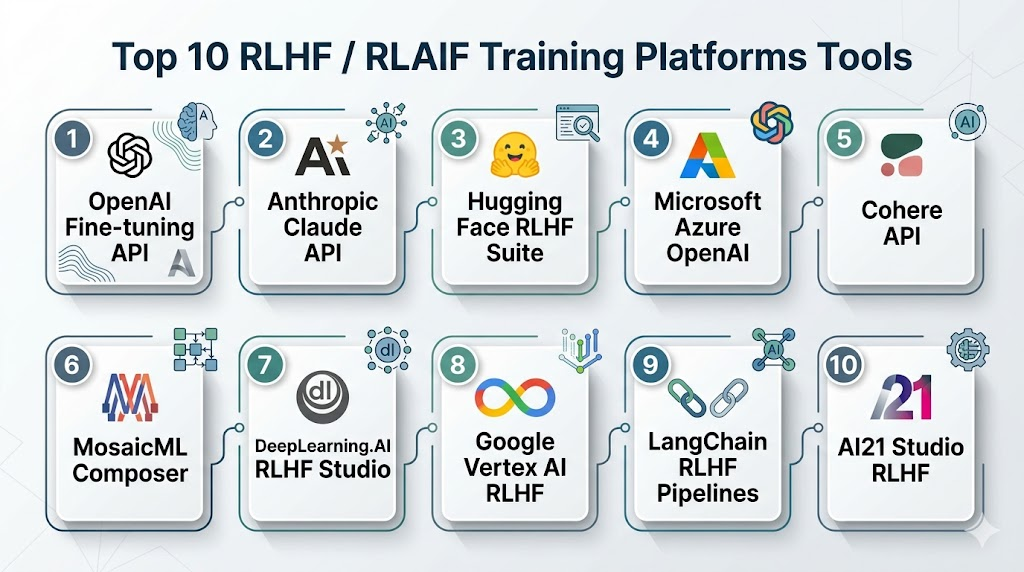
Top 10 RLHF / RLAIF Training Platforms Tools
1- OpenAI Fine-tuning API
One-line verdict: Best for enterprises and developers needing scalable GPT model fine-tuning with alignment pipelines.
Short description: Provides API access to proprietary GPT models with human feedback fine-tuning, widely used in enterprise AI and SaaS solutions.
Standout Capabilities
- End-to-end fine-tuning pipeline
- Multi-modal input support
- Token usage and latency monitoring
- Model versioning and rollback
- Cost optimization via batching
- Built-in safety checks and guardrails
AI-Specific Depth
- Model support: Proprietary GPT models, limited BYO
- RAG / knowledge integration: Vector DBs, embedding connectors
- Evaluation: Prompt tests, regression, human review
- Guardrails: Policy checks, prompt-injection defense
- Observability: Traces, token/cost metrics, latency
Pros
- Enterprise-ready and scalable
- Strong evaluation and monitoring
- Wide adoption with documentation
Cons
- Proprietary limits flexibility
- High cost at scale
- Limited BYO support
Security & Compliance
- SSO/SAML, RBAC, audit logs, encryption
- Data retention controls: Varies / N/A
Deployment & Platforms
- Web API
- Cloud only
Integrations & Ecosystem
- Python SDK, REST API
- Embedding/vector DB connectors
- Analytics integration
- CI/CD pipelines
Pricing Model
- Usage-based per token, tiered enterprise subscriptions
Best-Fit Scenarios
- Enterprise AI model alignment
- Chatbots or AI assistant deployment
- Generative AI content fine-tuning
2- Anthropic Claude API
One-line verdict: Ideal for enterprises prioritizing safe AI with strong guardrails and multi-modal fine-tuning.
Short description: Provides API access to Claude models with safety-first RLHF pipelines and human feedback integration for high-stakes use cases.
Standout Capabilities
- Safety and alignment guardrails
- Human-in-the-loop interface
- Multi-modal input support
- Cost-aware batching
- Regression testing pipelines
- Model versioning
AI-Specific Depth
- Model support: Proprietary Claude models
- RAG / knowledge integration: Connectors supported
- Evaluation: Regression tests, human review
- Guardrails: Jailbreak and prompt-injection defense
- Observability: Token and latency metrics
Pros
- Safety-first design
- Enterprise-grade evaluation
- HITL workflow management
Cons
- Limited BYO support
- Cloud-only deployment
- Proprietary constraints
Security & Compliance
- SSO, audit logs, RBAC
- Encryption: At rest and in transit
- Certifications: Not publicly stated
Deployment & Platforms
- Web API
- Cloud
Integrations & Ecosystem
- Python SDK, REST API
- Analytics dashboards
- Vector DB connectors
- Experiment tracking
Pricing Model
- Usage-based, tiered enterprise contracts
Best-Fit Scenarios
- Healthcare AI agents
- Financial AI alignment
- Compliance-focused enterprise AI
3- Hugging Face RLHF Suite
One-line verdict: Best for developers and researchers leveraging open-source models with RLHF and evaluation pipelines.
Short description: Provides access to open-source transformer models, fine-tuning pipelines, human feedback workflows, and evaluation harnesses.
Standout Capabilities
- Multi-model open-source support
- Human feedback annotation pipelines
- Evaluation harnesses and benchmark datasets
- Distributed multi-GPU training
- Model versioning and experiment tracking
AI-Specific Depth
- Model support: Open-source, BYO
- RAG / knowledge integration: Vector DBs supported
- Evaluation: Benchmark datasets, human review
- Guardrails: Varies / N/A
- Observability: Metrics tracking, logging
Pros
- Open-source flexibility
- Strong developer tooling
- Active community and model hub
Cons
- Requires ML expertise
- Guardrails not enterprise-ready
- Cloud deployment optional
Security & Compliance
- Varies / N/A
Deployment & Platforms
- Linux, macOS, Windows
- Cloud or self-hosted
Integrations & Ecosystem
- Python SDK, REST API
- Vector DB connectors
- Experiment tracking and logging
Pricing Model
- Open-source free
- Enterprise subscription optional
Best-Fit Scenarios
- Research labs
- Developer experimentation
- Open-source fine-tuning
4- Microsoft Azure OpenAI
One-line verdict: Enterprise-grade platform with cloud integration, governance, and evaluation pipelines for scalable deployments.
Short description: Managed API access to GPT models with enterprise-focused observability, compliance, and evaluation pipelines.
Standout Capabilities
- Integration with Azure services
- Multi-region scaling
- Token and latency monitoring
- Prebuilt evaluation harness
- Human-in-the-loop annotation support
AI-Specific Depth
- Model support: Proprietary GPT models
- RAG / knowledge integration: Vector DBs, Azure Cognitive Services
- Evaluation: Regression tests, human review
- Guardrails: Safe prompting, policy enforcement
- Observability: Token tracking, latency dashboards
Pros
- Enterprise-grade governance
- Multi-region scaling
- Tight Azure integration
Cons
- Cloud-only deployment
- Cost scales with usage
- Limited BYO support
Security & Compliance
- SSO, RBAC, audit logs
- Encryption: Not publicly stated
Deployment & Platforms
- Web API
- Cloud
Integrations & Ecosystem
- Python, .NET SDKs
- Vector DB and analytics connectors
- CI/CD integration
Pricing Model
- Usage-based, enterprise tiers
Best-Fit Scenarios
- Enterprise AI teams
- Compliance-focused projects
- Multi-region deployment
5- Cohere API
One-line verdict: Developer-friendly NLP-focused API for embedding generation and RLHF fine-tuning.
Short description: Provides APIs for text processing, embeddings, and alignment using feedback pipelines.
Standout Capabilities
- Managed fine-tuning pipelines
- Embeddings and vector DB integration
- Evaluation and regression pipelines
- Token usage monitoring
- Multi-GPU scaling
AI-Specific Depth
- Model support: Proprietary/BYO limited
- RAG / knowledge integration: Vector DB
- Evaluation: Prompt tests, human review
- Guardrails: Varies / N/A
- Observability: Token and latency metrics
Pros
- Fast deployment for NLP
- Scalable pipelines
- Easy API integration
Cons
- Limited multi-modal support
- Proprietary constraints
- Guardrails not enterprise-grade
Security & Compliance
- SSO, audit logs, encryption: Varies / N/A
Deployment & Platforms
- Cloud API
Integrations & Ecosystem
- Python SDK, REST API
- Vector DB connectors
- Analytics integration
Pricing Model
- Usage-based, tiered enterprise
Best-Fit Scenarios
- NLP assistants
- Embedding pipelines
- Developer-led AI alignment
6- MosaicML Composer
One-line verdict: Best for research teams seeking flexible RLHF pipelines with distributed training and open-source support.
Short description: Provides scalable RLHF pipelines, model composability, and distributed GPU training.
Standout Capabilities
- Distributed multi-GPU support
- Open-source model support
- Experiment tracking and evaluation
- Human feedback integration
- Cost optimization via batching
AI-Specific Depth
- Model support: Open-source, BYO
- RAG / knowledge integration: N/A
- Evaluation: Benchmark datasets, human review
- Guardrails: Varies / N/A
- Observability: Metrics dashboards
Pros
- Flexible and scalable
- Open-source friendly
- Distributed training support
Cons
- Requires ML infrastructure
- Guardrails limited
- Enterprise support optional
Security & Compliance
- Varies / N/A
Deployment & Platforms
- Linux, cloud
- Self-hosted or hybrid
Integrations & Ecosystem
- Python, APIs
- Experiment tracking
- Vector DB integration
Pricing Model
- Open-source free
- Enterprise managed: tiered
Best-Fit Scenarios
- Research labs
- ML infrastructure teams
- Open-source LLM projects
7- DeepLearning.AI RLHF Studio
One-line verdict: Educational and developer-friendly platform for guided RLHF experiments and alignment testing.
Short description: Simplified pipelines for developers and researchers to experiment with human-feedback loops on AI models.
Standout Capabilities
- Guided RLHF experiments
- Prebuilt evaluation templates
- Human feedback annotation interface
- Token usage monitoring
- Model versioning and rollback
AI-Specific Depth
- Model support: Proprietary + open-source
- RAG / knowledge integration: Varies / N/A
- Evaluation: Human review, regression tests
- Guardrails: Basic policy checks
- Observability: Token metrics, latency
Pros
- Easy onboarding
- Prebuilt evaluation harness
- Experiment tracking
Cons
- Limited enterprise features
- Cloud-only deployment
- Guardrails not robust
Security & Compliance
- Varies / N/A
Deployment & Platforms
- Web-based
- Cloud
Integrations & Ecosystem
- Python SDK
- Experiment dashboards
- API connectors
Pricing Model
- Usage-based, tiered subscription
Best-Fit Scenarios
- Developer experiments
- Educational projects
- Proof-of-concept RLHF
8- Google Vertex AI RLHF
One-line verdict: Enterprise-grade platform with integration to Google Cloud AI services for safe RLHF model training.
Short description: Managed pipelines for human-feedback fine-tuning, evaluation, and alignment for enterprise users.
Standout Capabilities
- Integrated with Google Cloud services
- Token and latency observability
- Multi-region deployment
- Human feedback interface
- Evaluation harness for regression and prompt tests
AI-Specific Depth
- Model support: Proprietary, BYO limited
- RAG / knowledge integration: Vector DBs, connectors
- Evaluation: Regression, human review
- Guardrails: Policy checks
- Observability: Latency, token metrics
Pros
- Enterprise-ready
- Multi-region support
- Integrated evaluation pipelines
Cons
- Proprietary, limited BYO
- Cost scales with usage
- Cloud-only deployment
Security & Compliance
- SSO, RBAC, audit logs
- Encryption: Not publicly stated
Deployment & Platforms
- Cloud, Web API
- Cloud only
Integrations & Ecosystem
- Python, Java SDKs
- Vector DB connectors
- Google Cloud analytics
Pricing Model
- Usage-based, enterprise tiers
Best-Fit Scenarios
- Enterprise AI teams
- Cloud-first organizations
- Safety-sensitive model alignment
9- LangChain RLHF Pipelines
One-line verdict: Developer-focused platform for integrating RLHF pipelines with LLM-based agent frameworks.
Short description: Supports RLHF integration for agentic workflows, RAG pipelines, and multi-modal document ingestion.
Standout Capabilities
- RAG & knowledge base integration
- Agentic workflow pipelines
- Open-source model support
- Human feedback annotation interface
- Metrics dashboards and experiment tracking
AI-Specific Depth
- Model support: BYO, open-source, hosted
- RAG / knowledge integration: Vector DB, APIs
- Evaluation: Offline tests, human review
- Guardrails: Varies / N/A
- Observability: Token tracking, latency
Pros
- Flexible and developer-friendly
- Excellent RAG integration
- Supports agentic pipelines
Cons
- Requires ML expertise
- No default enterprise guardrails
- Self-hosting optional
Security & Compliance
- Varies / N/A
Deployment & Platforms
- Linux, Cloud
- Self-hosted or cloud
Integrations & Ecosystem
- Python SDK
- RAG connectors
- Multi-model pipelines
Pricing Model
- Open-source free
- Enterprise managed: tiered
Best-Fit Scenarios
- Developer-led agentic RLHF
- RAG-enabled pipelines
- Open-source experimentation
10- AI21 Studio RLHF
One-line verdict: Ideal for developers seeking lightweight RLHF fine-tuning with human-in-the-loop evaluation.
Short description: APIs and tools for human-feedback-guided fine-tuning on NLP-focused models.
Standout Capabilities
- Human-in-the-loop feedback pipelines
- Token usage monitoring
- Evaluation harness for NLP tasks
- Model versioning and rollback
- Vector DB integration for RAG
AI-Specific Depth
- Model support: Proprietary
- RAG / knowledge integration: Vector DB compatible
- Evaluation: Human review, regression tests
- Guardrails: Basic policy checks
- Observability: Token and latency metrics
Pros
- Quick developer onboarding
- Fast fine-tuning pipelines
- Built-in evaluation
Cons
- Limited multi-modal support
- Proprietary
- Enterprise-grade guardrails limited
Security & Compliance
- Varies / N/A
Deployment & Platforms
- Web API
- Cloud
Integrations & Ecosystem
- Python SDK, REST API
- Vector DB support
- Experiment dashboards
Pricing Model
- Usage-based, tiered subscription
Best-Fit Scenarios
- Developer RLHF experimentation
- NLP model fine-tuning
- Prototype AI alignment
Comparison Table
| Tool Name | Best For | Deployment | Model Flexibility | Strength | Watch-Out | Public Rating |
|---|---|---|---|---|---|---|
| OpenAI API | Enterprise & Developers | Cloud | Proprietary/BYO limited | Scalable fine-tuning | Costly | N/A |
| Anthropic Claude API | Safety-focused Enterprises | Cloud | Proprietary | Guardrails & alignment | Limited BYO | N/A |
| Hugging Face RLHF Suite | Developers & Researchers | Cloud/Self-hosted | Open-source/BYO | Open-source flexibility | Expertise required | N/A |
| Microsoft Azure OpenAI | Enterprise Cloud Teams | Cloud | Proprietary | Enterprise governance | Costly | N/A |
| Cohere API | NLP Developers | Cloud | Proprietary/BYO limited | NLP pipelines | Limited multi-modal | N/A |
| MosaicML Composer | Research Teams | Cloud/Self-hosted | Open-source/BYO | Distributed training | ML infrastructure needed | N/A |
| DeepLearning.AI RLHF Studio | Developers & Learners | Cloud | Proprietary/Open-source | Guided experimentation | Guardrails limited | N/A |
| Google Vertex AI RLHF | Enterprise Cloud AI | Cloud | Proprietary/BYO limited | Scalable & monitored | Cloud-only | N/A |
| LangChain RLHF Pipelines | Developers | Cloud/Self-hosted | BYO/Open-source | RAG & agentic pipelines | Expertise required | N/A |
| AI21 Studio RLHF | Developers | Cloud | Proprietary | Quick NLP fine-tuning | Limited guardrails | N/A |
Scoring & Evaluation
| Tool | Core | Reliability/Eval | Guardrails | Integrations | Ease | Perf/Cost | Security/Admin | Support | Weighted Total |
|---|---|---|---|---|---|---|---|---|---|
| OpenAI API | 9 | 9 | 8 | 8 | 9 | 7 | 8 | 8 | 8.4 |
| Anthropic Claude API | 8 | 9 | 9 | 7 | 8 | 7 | 8 | 7 | 8.1 |
| Hugging Face RLHF Suite | 8 | 8 | 7 | 9 | 7 | 8 | 7 | 7 | 7.8 |
| Microsoft Azure OpenAI | 9 | 8 | 8 | 9 | 8 | 7 | 8 | 7 | 8.1 |
| Cohere API | 7 | 7 | 6 | 7 | 8 | 7 | 7 | 7 | 7.0 |
Top 3 for Enterprise: OpenAI API, Microsoft Azure OpenAI, Anthropic Claude API
Top 3 for SMB: Cohere API, Hugging Face RLHF Suite, DeepLearning.AI RLHF Studio
Top 3 for Developers: Hugging Face RLHF Suite, LangChain RLHF Pipelines, AI21 Studio RLHF
Which RLHF / RLAIF Training Platform Is Right for You?
Solo / Freelancer
Open-source platforms like Hugging Face or AI21 Studio for experimentation and prototyping.
SMB
Cohere API or DeepLearning.AI RLHF Studio for small-scale alignment workflows.
Mid-Market
OpenAI API or LangChain RLHF Pipelines for multi-model integration and evaluation.
Enterprise
Microsoft Azure OpenAI, Google Vertex AI, and Anthropic Claude API for governance, compliance, and scale.
Regulated industries
Platforms with guardrails, audit logs, and human-in-the-loop evaluation are recommended.
Budget vs premium
Open-source/BYO reduces cost but requires expertise; premium managed platforms reduce operational overhead.
Build vs buy
DIY open-source is ideal for experimentation; managed enterprise platforms ensure governance, compliance, and monitoring.
Implementation Playbook
- 30 Days: Pilot RLHF workflows, track evaluation metrics, monitor token usage, and gather feedback.
- 60 Days: Harden guardrails, integrate evaluation harnesses, enforce regression testing, and implement security policies.
- 90 Days: Optimize cost and latency, scale HITL pipelines, enforce governance, and monitor observability dashboards.
Common Mistakes & How to Avoid Them
- Prompt injection exposure
- Skipping evaluation pipelines
- Unmanaged data retention
- Lack of observability dashboards
- Unexpected cost spikes
- Over-automation without human review
- Vendor lock-in without abstraction
- Inadequate model versioning
- Ignoring latency metrics
- Poor guardrail implementation
- Insufficient HITL integration
- Skipping compliance audits
- Lack of multi-modal evaluation
- Ignoring regression and safety tests
FAQs
1- Can I use open-source models with these platforms?
Yes, Hugging Face and MosaicML allow BYO and open-source models; proprietary APIs may have restrictions.
2- How is data privacy handled?
Enterprise platforms offer RBAC, SSO, encryption, audit logs, and configurable data residency.
3- Do I need human annotators?
Human feedback improves alignment; some platforms also provide AI-generated evaluation loops.
4- Can I integrate my knowledge base?
Most platforms support RAG and vector DB connectors for grounding AI outputs.
5- How do I evaluate fine-tuned models?
Through regression tests, benchmark datasets, prompt evaluation, and human-in-the-loop review.
6- Are these platforms multi-modal?
Some platforms, like OpenAI and Anthropic Claude, support text, image, and audio; others focus on text.
7- Can I self-host?
Open-source frameworks allow self-hosting; enterprise APIs are cloud-based.
8- Are guardrails reliable?
Enterprise platforms provide robust safety and policy enforcement; open-source may require custom implementation.
9- Is BYO model supported?
Varies; open-source and some cloud platforms support BYO; proprietary APIs may restrict it.
10- How do I manage costs and latency?
Use token monitoring, batching, and multi-model routing.
11- Which platforms are best for regulated industries?
Enterprise-grade solutions with guardrails, HITL review, and audit logs are recommended.
12- How scalable are these platforms?
Enterprise APIs and open-source frameworks with distributed training enable large-scale operations.
Conclusion
RLHF and RLAIF platforms provide the foundation for safe, aligned, and scalable AI deployment. Open-source solutions excel for experimentation, while managed enterprise platforms offer governance, observability, and guardrails for mission-critical applications.
One interesting consideration is cultural and regional bias in preference data. A model aligned using feedback from one user population may not behave as expected for users in different regions, languages, or business contexts.