Introduction
Sovereign AI Cloud Platforms are specialized cloud environments designed to give organizations full control over their AI workloads, data storage, and processing boundaries—often tied to specific geographic regions or legal jurisdictions. Unlike traditional cloud AI services, these platforms prioritize strict data sovereignty, ensuring sensitive data never leaves approved environments while still enabling advanced AI capabilities.
This category has become critical as organizations deploy AI across regulated, high-risk, or mission-critical systems where data exposure is unacceptable. Sovereign AI clouds allow teams to build, deploy, and operate AI systems while maintaining compliance, auditability, and operational independence.
Real-world use cases:
- Deploying AI copilots on confidential enterprise knowledge bases
- Running fraud detection models on regulated financial data
- Building secure healthcare AI diagnostics systems
- Operating AI-driven intelligence systems in public sector environments
- Hosting internal multimodal AI systems with strict access controls
What to evaluate:
- Data residency guarantees and geographic control
- Model flexibility (proprietary, open-source, BYO)
- Security architecture (encryption, isolation, access control)
- Evaluation and testing capabilities for AI outputs
- Guardrails against misuse and prompt injection
- Observability (logs, traces, cost metrics)
- Latency and performance reliability
- Integration with enterprise systems
- Governance and audit readiness
- Cost structure and scalability
- Vendor lock-in risks
Best for: large enterprises, government bodies, financial institutions, healthcare organizations, and any team handling sensitive or regulated data.
Not ideal for: small teams, prototypes, or applications where speed and low cost matter more than compliance and infrastructure control.
What’s Changed in Sovereign AI Cloud Platforms
- Strong adoption of agentic AI systems operating within sovereign boundaries
- Increased demand for fully isolated and air-gapped AI deployments
- Built-in evaluation pipelines for hallucination detection and reliability scoring
- Advanced guardrails for prompt injection and unsafe outputs
- Growth of multi-model routing inside sovereign environments
- Integration of multimodal AI (text, image, audio) within private infrastructure
- Enhanced observability with token-level cost and latency tracking
- Expansion of hybrid deployments combining on-prem and sovereign cloud
- Rising importance of compliance frameworks and audit logs
- Better cost optimization within private AI infrastructure
- Support for BYO models alongside managed AI services
Quick Buyer Checklist (Scan-Friendly)
- Does the platform enforce strict data residency and sovereignty?
- Can you bring your own models or use open-source models?
- Does it support secure RAG pipelines with internal data sources?
- Are there evaluation tools for testing model reliability?
- Does it include guardrails for prompt injection and misuse?
- Can you track latency, token usage, and operational costs?
- Are audit logs and admin controls available?
- Does it support air-gapped or hybrid deployments?
- How easy is integration with existing enterprise systems?
- What is the risk of vendor lock-in?
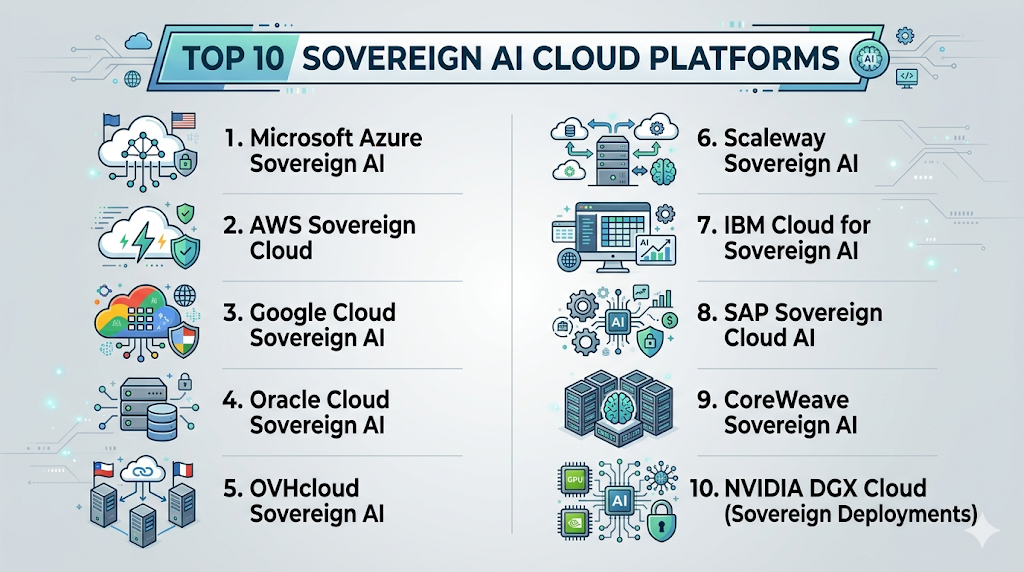
Top 10 Sovereign AI Cloud Platforms
1 — Microsoft Azure Sovereign AI
One-line verdict: Best for enterprises needing integrated AI, compliance, and deep ecosystem support in regulated environments.
Short description:
Microsoft Azure Sovereign AI provides region-specific cloud environments designed for strict data governance and compliance. It integrates tightly with Azure AI services, enabling organizations to deploy AI workloads while maintaining full control over data residency and access policies.
Standout Capabilities
- Dedicated sovereign cloud regions with strict jurisdictional boundaries
- Deep integration with enterprise identity and access systems
- Hybrid cloud capabilities for on-prem and cloud workloads
- Built-in compliance and governance tooling
- Scalable infrastructure for large AI workloads
- Integration with enterprise productivity and data tools
- Strong security and isolation mechanisms
AI-Specific Depth
- Model support: Proprietary + BYO + multi-model routing
- RAG / knowledge integration: Supported via internal data services
- Evaluation: Built-in monitoring and evaluation pipelines
- Guardrails: Policy enforcement and safety controls
- Observability: Advanced logging, tracing, and cost tracking
Pros
- Mature enterprise ecosystem
- Strong compliance and governance features
- Highly scalable
Cons
- Complex setup
- Potential vendor lock-in
- Pricing not transparent
Security & Compliance
SSO, RBAC, audit logs, encryption, data residency controls; certifications: Not publicly stated.
Deployment & Platforms
Cloud + Hybrid; Web-based.
Integrations & Ecosystem
Extensive integration across enterprise systems.
- APIs and SDKs
- Identity systems
- Data platforms
- DevOps tools
Pricing Model
Usage-based + enterprise agreements.
Best-Fit Scenarios
- Enterprise AI copilots with sensitive data
- Government AI deployments
- Large-scale regulated AI systems
2 — AWS Sovereign Cloud
One-line verdict: Best for flexible sovereign infrastructure with powerful AI services and large-scale scalability.
Short description:
AWS Sovereign Cloud enables organizations to deploy AI workloads within region-specific environments while maintaining control over infrastructure, data access, and compliance requirements.
Standout Capabilities
- Dedicated sovereign regions with strict access control
- Extensive AI and ML service ecosystem
- Flexible infrastructure and networking
- Scalable compute and storage
- Hybrid and multi-cloud support
- Advanced monitoring and logging
- Strong developer ecosystem
AI-Specific Depth
- Model support: Proprietary + BYO
- RAG / knowledge integration: Supported
- Evaluation: Basic evaluation tools
- Guardrails: Configurable
- Observability: Strong monitoring capabilities
Pros
- Highly scalable infrastructure
- Flexible deployment options
- Large ecosystem
Cons
- Complex configuration
- Guardrails require setup
- Pricing varies
Security & Compliance
Encryption, IAM, audit logs; certifications: Not publicly stated.
Deployment & Platforms
Cloud + Hybrid.
Integrations & Ecosystem
- AWS services
- APIs and SDKs
- Data lakes
- DevOps pipelines
Pricing Model
Usage-based.
Best-Fit Scenarios
- Large-scale AI platforms
- Hybrid enterprise AI
- Data-intensive AI workloads
3 — Google Cloud Sovereign AI
One-line verdict: Best for advanced AI capabilities combined with regional compliance and analytics-driven workflows.
Short description:
Google Cloud Sovereign AI offers region-controlled deployments with strong AI capabilities, particularly for data analytics and machine learning workflows.
Standout Capabilities
- Advanced AI model ecosystem
- Strong analytics integration
- Regional deployment controls
- Scalable infrastructure
- Integrated data processing tools
- Security-focused architecture
AI-Specific Depth
- Model support: Proprietary + BYO
- RAG / knowledge integration: Supported
- Evaluation: Built-in tools
- Guardrails: Policy-based controls
- Observability: Advanced analytics
Pros
- Strong AI capabilities
- Excellent data analytics integration
- Scalable
Cons
- Pricing complexity
- Less flexible than some competitors
- Limited air-gapped options
Security & Compliance
Encryption, IAM, audit logs; certifications: Not publicly stated.
Deployment & Platforms
Cloud.
Integrations & Ecosystem
- AI tools
- APIs
- Data platforms
- Analytics systems
Pricing Model
Usage-based.
Best-Fit Scenarios
- AI analytics pipelines
- Data-heavy AI systems
- Enterprise ML workflows
4 — Oracle Cloud Sovereign AI
One-line verdict: Best for enterprises focused on secure data-driven AI with strong database integration.
Short description:
Oracle Cloud Sovereign AI focuses on secure data handling and enterprise-grade database integration, making it suitable for organizations with heavy data dependencies.
Standout Capabilities
- Strong database integration
- Regional cloud deployments
- Enterprise security features
- Hybrid cloud support
- Scalable infrastructure
AI-Specific Depth
- Model support: BYO + proprietary
- RAG / knowledge integration: Supported
- Evaluation: Limited
- Guardrails: Basic
- Observability: Moderate
Pros
- Strong database ecosystem
- Reliable infrastructure
- Secure
Cons
- Limited AI-native features
- Smaller ecosystem
- Less developer-friendly
Security & Compliance
Encryption, IAM; certifications: Not publicly stated.
Deployment & Platforms
Cloud + Hybrid.
Integrations & Ecosystem
- Oracle databases
- APIs
- Enterprise systems
Pricing Model
Enterprise contracts.
Best-Fit Scenarios
- Data-centric AI systems
- Enterprise analytics
- Secure database workloads
5 — OVHcloud Sovereign AI
One-line verdict: Best for cost-effective sovereign AI deployments with open-source flexibility.
Short description:
OVHcloud provides sovereign cloud infrastructure focused on regional compliance and affordability, supporting open-source AI workloads.
Standout Capabilities
- Strong data sovereignty focus
- Open-source friendly environment
- Cost-efficient infrastructure
- Flexible deployments
- Scalable compute resources
AI-Specific Depth
- Model support: Open-source + BYO
- RAG / knowledge integration: Supported
- Evaluation: Limited
- Guardrails: Basic
- Observability: Moderate
Pros
- Cost-effective
- Flexible
- Strong sovereignty focus
Cons
- Limited AI tooling
- Smaller ecosystem
- Less enterprise support
Security & Compliance
Encryption, data residency; certifications: Not publicly stated.
Deployment & Platforms
Cloud.
Integrations & Ecosystem
- Open-source tools
- APIs
- DevOps integrations
Pricing Model
Usage-based.
Best-Fit Scenarios
- EU-based AI deployments
- Open-source AI projects
- Budget-conscious teams
6 — Scaleway Sovereign AI
One-line verdict: Best for flexible sovereign AI infrastructure tailored to startups and mid-market organizations.
Short description:
Scaleway provides sovereign cloud infrastructure with a focus on simplicity and flexibility, supporting AI workloads with regional control and cost efficiency.
Standout Capabilities
- EU-focused data sovereignty
- Flexible infrastructure setup
- Cost-efficient compute
- Open-source friendly
- Developer-centric tools
AI-Specific Depth
- Model support: Open-source + BYO
- RAG / knowledge integration: Supported
- Evaluation: Limited
- Guardrails: Basic
- Observability: Moderate
Pros
- Affordable
- Flexible
- Easy to use
Cons
- Limited enterprise features
- Smaller ecosystem
- Less advanced AI tooling
Security & Compliance
Encryption, data residency; certifications: Not publicly stated.
Deployment & Platforms
Cloud.
Integrations & Ecosystem
- APIs
- DevOps tools
- Open-source ecosystem
Pricing Model
Usage-based.
Best-Fit Scenarios
- Startup AI deployments
- Regional compliance needs
- Open-source AI workloads
7 — IBM Cloud for Sovereign AI
One-line verdict: Best for governance-heavy AI deployments in highly regulated industries.
Short description:
IBM Cloud focuses on compliance, governance, and secure AI deployment, making it ideal for industries with strict regulatory requirements.
Standout Capabilities
- Strong governance frameworks
- Enterprise-grade security
- Compliance-focused architecture
- Hybrid deployment support
- AI lifecycle management
AI-Specific Depth
- Model support: BYO + proprietary
- RAG / knowledge integration: Supported
- Evaluation: Built-in tools
- Guardrails: Strong policy controls
- Observability: Advanced
Pros
- Strong governance
- High security
- Enterprise-ready
Cons
- Expensive
- Complex
- Slower innovation pace
Security & Compliance
SSO, RBAC, audit logs, encryption; certifications: Not publicly stated.
Deployment & Platforms
Hybrid.
Integrations & Ecosystem
- Enterprise tools
- APIs
- Data systems
Pricing Model
Enterprise contracts.
Best-Fit Scenarios
- Financial services AI
- Healthcare AI systems
- Government deployments
8 — SAP Sovereign Cloud AI
One-line verdict: Best for enterprises deeply integrated into SAP ecosystems requiring sovereign AI capabilities.
Short description:
SAP Sovereign Cloud AI extends SAP enterprise systems with AI capabilities while maintaining strict data governance and regional compliance.
Standout Capabilities
- Deep SAP integration
- Enterprise workflow automation
- Data governance controls
- Regional cloud deployments
- Business process AI
AI-Specific Depth
- Model support: BYO
- RAG / knowledge integration: Supported
- Evaluation: Limited
- Guardrails: Basic
- Observability: Moderate
Pros
- Strong enterprise integration
- Reliable
- Business-focused AI
Cons
- Limited flexibility
- Niche use cases
- SAP dependency
Security & Compliance
Encryption, access controls; certifications: Not publicly stated.
Deployment & Platforms
Cloud.
Integrations & Ecosystem
- SAP systems
- APIs
- Enterprise workflows
Pricing Model
Enterprise contracts.
Best-Fit Scenarios
- SAP-driven enterprises
- Business process AI
- ERP-integrated AI
9 — CoreWeave Sovereign AI
One-line verdict: Best for high-performance AI workloads requiring GPU-heavy sovereign infrastructure.
Short description:
CoreWeave provides GPU-optimized infrastructure tailored for AI workloads, enabling sovereign deployments with high performance.
Standout Capabilities
- GPU-optimized infrastructure
- High-performance compute
- Scalable AI workloads
- Flexible deployment
- Developer-friendly APIs
AI-Specific Depth
- Model support: BYO
- RAG / knowledge integration: Supported
- Evaluation: Limited
- Guardrails: Basic
- Observability: Moderate
Pros
- High performance
- Scalable
- Developer-friendly
Cons
- Expensive
- Limited governance tools
- Smaller ecosystem
Security & Compliance
Encryption, access controls; certifications: Not publicly stated.
Deployment & Platforms
Cloud.
Integrations & Ecosystem
- APIs
- AI frameworks
- DevOps tools
Pricing Model
Usage-based.
Best-Fit Scenarios
- Model training workloads
- GPU-heavy AI applications
- High-performance inference
10 — NVIDIA DGX Cloud (Sovereign Deployments)
One-line verdict: Best for large-scale AI training and inference with dedicated GPU infrastructure and sovereignty control.
Short description:
NVIDIA DGX Cloud provides high-performance GPU infrastructure tailored for AI workloads, supporting sovereign deployments for sensitive environments.
Standout Capabilities
- GPU-accelerated infrastructure
- Optimized for large AI models
- Scalable training environments
- High-performance inference
- Enterprise-grade reliability
AI-Specific Depth
- Model support: Proprietary + BYO
- RAG / knowledge integration: Supported
- Evaluation: Limited
- Guardrails: Basic
- Observability: Strong
Pros
- Best-in-class GPU performance
- Scalable
- Reliable
Cons
- High cost
- Complex setup
- Limited flexibility
Security & Compliance
Encryption, access controls; certifications: Not publicly stated.
Deployment & Platforms
Cloud + Hybrid.
Integrations & Ecosystem
- AI frameworks
- APIs
- GPU ecosystem
Pricing Model
Usage-based + enterprise.
Best-Fit Scenarios
- Large model training
- High-performance inference
- Enterprise AI labs
Comparison Table
| Tool Name | Best For | Deployment | Model Flexibility | Strength | Watch-Out | Public Rating |
|---|---|---|---|---|---|---|
| Azure Sovereign AI | Enterprise compliance | Hybrid | Multi-model | Ecosystem | Lock-in | N/A |
| AWS Sovereign Cloud | Flexible infra | Hybrid | BYO | Scalability | Complexity | N/A |
| Google Sovereign AI | AI analytics | Cloud | Multi-model | AI power | Cost | N/A |
| Oracle Cloud | Data-heavy apps | Hybrid | BYO | Databases | Limited AI | N/A |
| OVHcloud | EU sovereignty | Cloud | Open-source | Cost | Ecosystem | N/A |
| Scaleway | Startups | Cloud | Open-source | Flexibility | Scale | N/A |
| IBM Cloud | Governance-heavy | Hybrid | BYO | Compliance | Cost | N/A |
| SAP Cloud | SAP users | Cloud | BYO | Integration | Niche | N/A |
| CoreWeave | GPU workloads | Cloud | BYO | Performance | Cost | N/A |
| NVIDIA DGX | AI training | Hybrid | Proprietary | GPU power | Complexity | N/A |
Scoring & Evaluation (Transparent Rubric)
Scoring is comparative based on overall capability across enterprise AI needs, not absolute performance. Scores reflect relative strengths across governance, flexibility, performance, and usability.
| Tool | Core | Reliability/Eval | Guardrails | Integrations | Ease | Perf/Cost | Security/Admin | Support | Weighted Total |
|---|---|---|---|---|---|---|---|---|---|
| Azure | 9 | 9 | 9 | 10 | 7 | 8 | 9 | 8 | 8.8 |
| AWS | 9 | 8 | 7 | 10 | 7 | 9 | 9 | 8 | 8.5 |
| 9 | 9 | 8 | 9 | 7 | 8 | 8 | 8 | 8.4 | |
| Oracle | 7 | 6 | 6 | 7 | 7 | 7 | 8 | 7 | 6.9 |
| OVH | 7 | 6 | 6 | 6 | 8 | 8 | 7 | 6 | 7.0 |
| Scaleway | 7 | 6 | 6 | 6 | 8 | 8 | 7 | 6 | 7.0 |
| IBM | 8 | 8 | 9 | 8 | 6 | 7 | 9 | 8 | 8.1 |
| SAP | 7 | 7 | 7 | 9 | 6 | 7 | 8 | 7 | 7.5 |
| CoreWeave | 8 | 7 | 6 | 7 | 7 | 9 | 7 | 7 | 7.7 |
| NVIDIA | 9 | 8 | 7 | 8 | 6 | 9 | 8 | 8 | 8.3 |
Top 3 for Enterprise: Azure, AWS, IBM
Top 3 for SMB: OVHcloud, Scaleway, CoreWeave
Top 3 for Developers: AWS, NVIDIA, CoreWeave
Which Sovereign AI Cloud Platform Is Right for You?
Solo / Freelancer
Sovereign platforms are usually unnecessary. Standard cloud AI services are more practical unless strict data control is required.
SMB
OVHcloud or Scaleway offer a balance of affordability and sovereignty, especially for regional compliance needs.
Mid-Market
AWS or Google Cloud provide flexibility, scalability, and strong AI tooling without excessive complexity.
Enterprise
Azure, AWS, and IBM are best suited due to governance, scalability, and integration capabilities.
Regulated industries (finance/healthcare/public sector)
IBM, Azure, and AWS provide the strongest compliance, auditability, and security controls.
Budget vs premium
- Budget: OVHcloud, Scaleway
- Premium: Azure, AWS, NVIDIA DGX
Build vs buy (when to DIY)
Build if you require full infrastructure control and customization. Buy if speed, managed services, and reliability are priorities.
Implementation Playbook (30 / 60 / 90 Days)
30 Days
- Identify use cases and define success metrics
- Run pilot deployments with limited datasets
- Test model performance and latency
60 Days
- Implement security controls and access policies
- Set up evaluation pipelines and guardrails
- Begin internal rollout
90 Days
- Optimize cost and latency
- Implement governance and audit processes
- Scale across teams and workloads
Common Mistakes & How to Avoid Them
- Ignoring data residency requirements
- Not implementing evaluation frameworks
- Weak guardrails against prompt injection
- Lack of observability and monitoring
- Underestimating infrastructure costs
- Over-automating without human oversight
- Vendor lock-in without abstraction layers
- Poor integration planning
- No governance model
- Ignoring latency optimization
- Not testing edge cases
- Inadequate access control policies
FAQs
1. What is a sovereign AI cloud platform?
A cloud environment designed to keep AI workloads and data within specific geographic or legal boundaries.
2. Why is sovereignty important in AI?
It ensures compliance, security, and control over sensitive data.
3. Can I use my own models?
Yes, most platforms support BYO or open-source models.
4. Are these platforms expensive?
Costs vary based on infrastructure and usage.
5. Do they support hybrid deployments?
Yes, many support hybrid and on-prem setups.
6. How do they handle security?
Through encryption, IAM, audit logs, and isolation mechanisms.
7. Can I migrate between platforms?
Possible but can be complex due to ecosystem dependencies.
8. Do they include evaluation tools?
Some do, others require external tools.
9. Are they suitable for startups?
Only if strict compliance or data control is required.
10. Do they support multimodal AI?
Yes, most modern platforms support multiple data types.
11. What is vendor lock-in?
Dependence on a single provider’s ecosystem.
12. How is latency managed?
Through optimized infrastructure and regional deployments.
Conclusion
Sovereign AI Cloud Platforms are essential for organizations that need full control over data, compliance, and AI infrastructure. While enterprise leaders like Azure, AWS, and IBM offer robust governance and scalability, emerging platforms provide flexibility and cost advantages for specific use cases. The right choice depends on your regulatory needs, scale, and technical maturity—so start by shortlisting aligned platforms, run a focused pilot, validate security and evaluation workflows, and then scale with confidence.
Very insightful breakdown of how sovereign cloud platforms ensure data residency, compliance, and operational control.It makes the concept much easier to understand for enterprise and government use cases.
Excellent overview of Sovereign AI Cloud Platforms! The blog clearly explains how these solutions ensure data sovereignty, compliance, and secure AI deployment for enterprises and government use cases.