Introduction
Search relevance tuning for RAG focuses on improving how AI systems retrieve the right information before generating responses. In retrieval-augmented generation, even small improvements in ranking, filtering, and context selection can dramatically impact accuracy, latency, and user trust. These tools help optimize query understanding, ranking algorithms, hybrid search, and contextual relevance so that AI outputs are grounded in the most useful data.
As AI adoption grows, the challenge is no longer just retrieving data—but retrieving the most relevant data efficiently. Poor relevance leads to hallucinations, irrelevant answers, and increased cost due to unnecessary token usage. Modern tuning tools address this with semantic ranking, query rewriting, feedback loops, and evaluation frameworks.
Common use cases include:
- Improving enterprise AI assistants and chatbots
- Optimizing internal knowledge search systems
- Enhancing customer support AI accuracy
- Personalizing search results in applications
- Refining document retrieval for compliance and legal use
- Boosting relevance in e-commerce or recommendation systems
What buyers should evaluate:
- Ranking and reranking capabilities
- Query understanding and rewriting features
- Support for hybrid search (keyword + semantic)
- Evaluation and benchmarking tools
- Feedback loops and learning systems
- Integration with vector databases
- Latency and performance optimization
- Cost efficiency and token usage control
- Security and access control alignment
- Observability and debugging tools
Best for: AI engineers, data scientists, and enterprises optimizing RAG pipelines for accuracy and efficiency.
Not ideal for: Teams with basic search needs or those not using retrieval-based AI systems.
What’s Changed in Search Relevance Tuning for RAG
- Shift toward AI-driven query rewriting and intent understanding
- Use of reranking models to improve retrieval precision
- Integration of agentic workflows that adapt search dynamically
- Increased adoption of hybrid search combining keyword and vector methods
- Built-in evaluation frameworks for retrieval quality
- Focus on reducing hallucinations through better relevance tuning
- Stronger guardrails against irrelevant or unsafe data retrieval
- Improved observability with trace-level debugging and metrics
- Emphasis on cost optimization through efficient retrieval pipelines
- Growth of multi-model retrieval strategies
- Integration of user feedback loops for continuous improvement
- Increased need for enterprise-grade governance and auditability
Quick Buyer Checklist
- Supports hybrid search (keyword + semantic)
- Includes reranking and relevance scoring features
- Integrates with vector databases and RAG frameworks
- Offers evaluation and benchmarking tools
- Provides guardrails against irrelevant retrieval
- Supports multi-model or BYO model approaches
- Tracks latency, cost, and performance
- Includes audit logs and admin controls
- Enables feedback-driven tuning
- Avoids vendor lock-in with flexible APIs
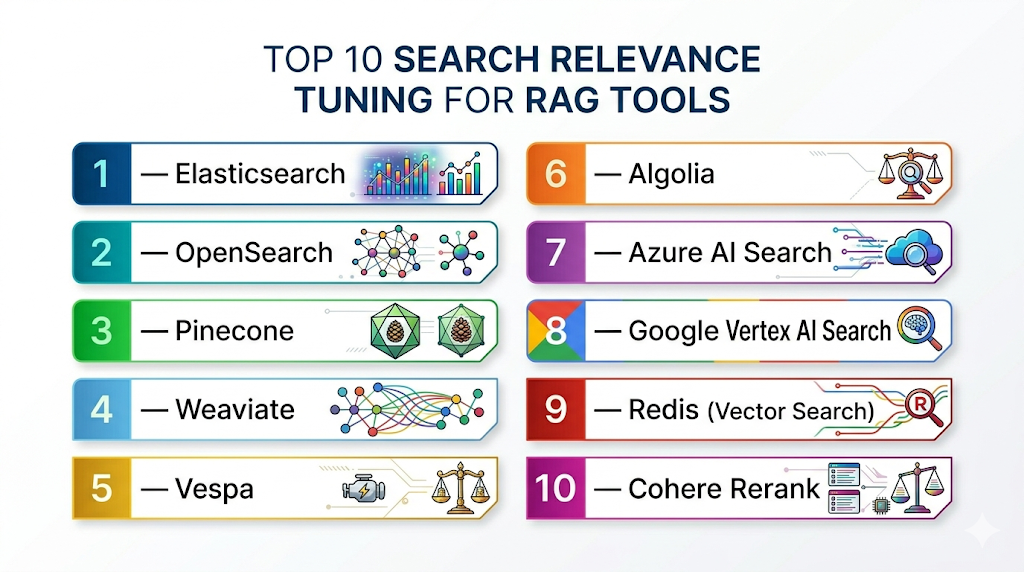
Top 10 Search Relevance Tuning for RAG Tools
1 — Elasticsearch
One-line verdict: Best for enterprises needing powerful hybrid search and advanced relevance tuning capabilities.
Short description:
Elasticsearch is a widely used search engine offering strong keyword and semantic search capabilities with advanced tuning features.
Standout Capabilities
- Hybrid search combining keyword and vector search
- Custom ranking algorithms
- Query rewriting and boosting
- Scalable architecture
- Real-time indexing
- Advanced analytics
- Strong ecosystem
AI-Specific Depth
- Model support: Multi-model
- RAG / knowledge integration: Strong
- Evaluation: Limited built-in
- Guardrails: Limited
- Observability: Strong
Pros
- Highly scalable and flexible
- Strong search capabilities
- Extensive ecosystem
Cons
- Requires tuning expertise
- Complex setup
- Limited native AI evaluation
Deployment & Platforms
Cloud, Self-hosted
Integrations & Ecosystem
Elasticsearch integrates with a wide range of enterprise tools and AI systems
- APIs and SDKs
- Data pipelines
- AI frameworks
- Analytics tools
Pricing Model
Varies / N/A
Best-Fit Scenarios
- Enterprise search systems
- Large-scale data retrieval
- Hybrid search implementations
2 — OpenSearch
One-line verdict: Strong open-source alternative for relevance tuning with enterprise scalability.
Short description:
OpenSearch provides powerful search and analytics capabilities with customizable relevance tuning features.
Standout Capabilities
- Open-source flexibility
- Hybrid search support
- Custom ranking
- Scalable infrastructure
- Real-time indexing
- Plugin ecosystem
AI-Specific Depth
- Model support: Multi-model
- RAG / knowledge integration: Strong
- Evaluation: Limited
- Guardrails: Limited
- Observability: Strong
Pros
- Cost-effective
- Flexible
- Scalable
Cons
- Requires setup
- Limited built-in AI features
- Needs tuning expertise
Deployment & Platforms
Cloud, Self-hosted
Integrations & Ecosystem
- APIs
- Data sources
- AI tools
- Search frameworks
Pricing Model
Open-source
Best-Fit Scenarios
- Open-source deployments
- Enterprise search
- Custom tuning setups
3 — Pinecone
One-line verdict: Best for high-performance vector search with managed relevance tuning.
Short description:
Pinecone offers managed vector search with capabilities to optimize retrieval relevance for AI systems.
Standout Capabilities
- High-performance vector search
- Managed infrastructure
- Scalable indexing
- Metadata filtering
- API-driven workflows
AI-Specific Depth
- Model support: BYO
- RAG / knowledge integration: Strong
- Evaluation: Limited
- Guardrails: Limited
- Observability: Moderate
Pros
- Easy to scale
- High performance
- Managed service
Cons
- Cost considerations
- Limited customization
- Vendor dependency
Deployment & Platforms
Cloud
Integrations & Ecosystem
- APIs
- AI frameworks
- Data systems
- Vector tools
Pricing Model
Usage-based
Best-Fit Scenarios
- Production RAG systems
- High-scale retrieval
- Managed environments
4 — Weaviate
One-line verdict: Best for semantic search and hybrid relevance tuning in AI-native applications.
Short description:
Weaviate provides vector search with hybrid capabilities and built-in relevance tuning options.
Standout Capabilities
- Semantic search
- Hybrid search
- Metadata filtering
- Scalable architecture
- API-first design
AI-Specific Depth
- Model support: Multi-model
- RAG / knowledge integration: Strong
- Evaluation: Limited
- Guardrails: Limited
- Observability: Moderate
Pros
- AI-native design
- Scalable
- Flexible
Cons
- Requires integration
- Moderate complexity
- Limited evaluation tools
Deployment & Platforms
Cloud, Self-hosted
Integrations & Ecosystem
- APIs
- AI frameworks
- Data pipelines
- Vector databases
Pricing Model
Varies / N/A
Best-Fit Scenarios
- Semantic search
- RAG pipelines
- AI applications
5 — Vespa
One-line verdict: Best for real-time relevance tuning with large-scale data processing.
Short description:
Vespa is a powerful engine for large-scale search and recommendation systems with advanced ranking capabilities.
Standout Capabilities
- Real-time ranking
- Large-scale processing
- Custom ranking models
- High performance
- Machine learning integration
AI-Specific Depth
- Model support: Multi-model
- RAG / knowledge integration: Strong
- Evaluation: Limited
- Guardrails: Limited
- Observability: Strong
Pros
- High performance
- Flexible ranking
- Scalable
Cons
- Complex setup
- Requires expertise
- Limited out-of-box features
Deployment & Platforms
Self-hosted, Cloud
Integrations & Ecosystem
- APIs
- ML models
- Data pipelines
- Search systems
Pricing Model
Open-source
Best-Fit Scenarios
- Large-scale systems
- Real-time search
- Advanced ranking
6 — Algolia
One-line verdict: Best for fast, user-friendly search relevance tuning in applications.
Short description:
Algolia provides hosted search with built-in relevance tuning features for applications and websites.
Standout Capabilities
- Instant search
- Relevance tuning UI
- Personalization
- Analytics
- Fast indexing
AI-Specific Depth
- Model support: Hosted
- RAG / knowledge integration: Moderate
- Evaluation: Limited
- Guardrails: Limited
- Observability: Strong
Pros
- Easy to use
- Fast performance
- Managed service
Cons
- Costly at scale
- Limited customization
- Not fully AI-native
Deployment & Platforms
Cloud
Integrations & Ecosystem
- APIs
- SDKs
- App integrations
- Data sources
Pricing Model
Usage-based
Best-Fit Scenarios
- App search
- E-commerce
- User-facing applications
7 — Azure AI Search
One-line verdict: Best for enterprise-grade relevance tuning with integrated AI capabilities.
Short description:
Azure AI Search provides integrated search, indexing, and relevance tuning within a secure ecosystem.
Standout Capabilities
- AI-powered search
- Hybrid search
- Enterprise security
- Scalable architecture
- Built-in indexing
AI-Specific Depth
- Model support: Hosted
- RAG / knowledge integration: Strong
- Evaluation: Limited
- Guardrails: Moderate
- Observability: Strong
Pros
- Enterprise-ready
- Secure
- Integrated
Cons
- Vendor lock-in
- Less flexible
- Cloud dependency
Deployment & Platforms
Cloud
Integrations & Ecosystem
- Azure services
- APIs
- AI tools
- Data pipelines
Pricing Model
Usage-based
Best-Fit Scenarios
- Enterprise AI
- Secure environments
- Large-scale systems
8 — Google Vertex AI Search
One-line verdict: Best for scalable, AI-powered search relevance tuning in cloud-native environments.
Short description:
Vertex AI Search provides advanced search capabilities with relevance tuning and AI integration.
Standout Capabilities
- AI-driven search
- Scalable infrastructure
- Integration with AI models
- Hybrid search
- Data processing
AI-Specific Depth
- Model support: Hosted
- RAG / knowledge integration: Strong
- Evaluation: Limited
- Guardrails: Moderate
- Observability: Strong
Pros
- Scalable
- Integrated AI features
- Cloud-native
Cons
- Vendor dependency
- Complexity
- Cost considerations
Deployment & Platforms
Cloud
Integrations & Ecosystem
- Cloud services
- APIs
- AI tools
- Data systems
Pricing Model
Usage-based
Best-Fit Scenarios
- Cloud AI systems
- Large-scale search
- Enterprise use
9 — Redis (Vector Search)
One-line verdict: Best for low-latency relevance tuning in real-time applications.
Short description:
Redis offers vector search capabilities optimized for fast retrieval and relevance tuning.
Standout Capabilities
- Low latency
- In-memory performance
- Vector search
- Scalability
- Real-time processing
AI-Specific Depth
- Model support: BYO
- RAG / knowledge integration: Strong
- Evaluation: Limited
- Guardrails: Limited
- Observability: Moderate
Pros
- Fast performance
- Real-time capabilities
- Scalable
Cons
- Memory-intensive
- Requires setup
- Limited evaluation tools
Deployment & Platforms
Cloud, Self-hosted
Integrations & Ecosystem
- APIs
- AI frameworks
- Data pipelines
- Applications
Pricing Model
Varies / N/A
Best-Fit Scenarios
- Real-time apps
- Low-latency search
- High-performance systems
10 — Cohere Rerank
One-line verdict: Best for improving retrieval quality using advanced reranking models.
Short description:
Cohere Rerank enhances relevance by reordering retrieved results using AI-based ranking models.
Standout Capabilities
- Reranking models
- Query understanding
- Relevance scoring
- Easy integration
- API-driven
AI-Specific Depth
- Model support: Proprietary
- RAG / knowledge integration: Strong
- Evaluation: Moderate
- Guardrails: Limited
- Observability: Moderate
Pros
- Improves accuracy
- Easy integration
- AI-driven
Cons
- Limited control
- Cost considerations
- Dependency on provider
Deployment & Platforms
Cloud
Integrations & Ecosystem
- APIs
- AI pipelines
- Search systems
- Data tools
Pricing Model
Usage-based
Best-Fit Scenarios
- RAG optimization
- Relevance tuning
- AI retrieval systems
Comparison Table
| Tool | Best For | Deployment | Model Flexibility | Strength | Watch-Out | Public Rating |
|---|---|---|---|---|---|---|
| Elasticsearch | Enterprise search | Hybrid | Multi-model | Hybrid search | Complexity | N/A |
| OpenSearch | Open-source search | Hybrid | Multi-model | Flexibility | Setup effort | N/A |
| Pinecone | Vector search | Cloud | BYO | Performance | Cost | N/A |
| Weaviate | Semantic search | Hybrid | Multi-model | AI-native | Integration | N/A |
| Vespa | Large-scale systems | Hybrid | Multi-model | Real-time ranking | Complexity | N/A |
| Algolia | App search | Cloud | Hosted | Speed | Cost | N/A |
| Azure AI Search | Enterprise AI | Cloud | Hosted | Integration | Lock-in | N/A |
| Vertex AI Search | Cloud AI | Cloud | Hosted | Scalability | Complexity | N/A |
| Redis | Real-time search | Hybrid | BYO | Low latency | Memory usage | N/A |
| Cohere Rerank | Reranking | Cloud | Proprietary | Accuracy | Dependency | N/A |
Scoring & Evaluation
This scoring compares tools based on real-world usability, relevance tuning capability, and enterprise readiness rather than absolute benchmarks. Each score reflects how effectively a tool handles search quality, AI reliability, integration flexibility, and operational performance in practical scenarios.
| Tool | Core | Reliability/Eval | Guardrails | Integrations | Ease | Perf/Cost | Security/Admin | Support | Weighted Total |
|---|---|---|---|---|---|---|---|---|---|
| Elasticsearch | 9 | 7 | 6 | 9 | 6 | 8 | 7 | 8 | 7.8 |
| OpenSearch | 8 | 7 | 6 | 8 | 7 | 7 | 7 | 7 | 7.5 |
| Pinecone | 8 | 7 | 6 | 8 | 8 | 9 | 8 | 7 | 7.9 |
| Weaviate | 8 | 7 | 6 | 8 | 7 | 8 | 7 | 7 | 7.5 |
| Vespa | 9 | 7 | 6 | 7 | 6 | 9 | 7 | 7 | 7.6 |
| Algolia | 8 | 6 | 6 | 8 | 9 | 8 | 7 | 8 | 7.7 |
| Azure AI Search | 9 | 8 | 7 | 9 | 8 | 8 | 9 | 8 | 8.4 |
| Vertex AI Search | 9 | 8 | 7 | 9 | 8 | 8 | 9 | 8 | 8.4 |
| Redis | 8 | 6 | 6 | 7 | 7 | 9 | 7 | 7 | 7.4 |
| Cohere Rerank | 8 | 8 | 6 | 7 | 8 | 7 | 7 | 7 | 7.5 |
Top 3 for Enterprise: Azure AI Search, Vertex AI Search, Elasticsearch
Top 3 for SMB: Algolia, Weaviate, OpenSearch
Top 3 for Developers: LangChain (via integration), Elasticsearch, Cohere Rerank
Which Search Relevance Tuning for RAG Tool Is Right for You?
Solo / Freelancer
If you are working on small AI projects or prototypes, tools like Cohere Rerank or Redis are good starting points. They are relatively easier to integrate and help improve relevance without requiring complex infrastructure or heavy setup.
SMB
Small to mid-sized businesses should prioritize ease of use and scalability. Tools like Algolia or Weaviate offer a balance of performance, usability, and integration support without needing a large engineering team to manage everything.
Mid-Market
As your system grows, relevance tuning becomes more critical. Solutions like Elasticsearch or Pinecone provide better control over ranking, hybrid search, and performance, helping you handle larger datasets and more complex queries efficiently.
Enterprise
Large organizations need highly scalable, secure, and customizable solutions. Azure AI Search or Vertex AI Search are strong choices because they provide enterprise-grade security, governance features, and deep integration with broader cloud ecosystems.
Regulated industries (finance/healthcare/public sector)
In regulated environments, you should focus on tools that provide strong access control, auditability, and data governance. Enterprise cloud solutions are typically better suited because they support compliance requirements and secure data handling practices.
Budget vs premium
If you are working with a limited budget, open-source tools like OpenSearch or self-hosted Elasticsearch provide flexibility at lower cost but require more effort to manage. Premium managed solutions reduce operational overhead and improve reliability but increase cost.
Build vs buy (when to DIY)
If you need highly customized ranking logic or domain-specific tuning, building your own pipeline using tools like Elasticsearch makes sense. However, if you want faster deployment and less maintenance, managed solutions like Pinecone or Azure AI Search are better options.
Implementation Playbook (30 / 60 / 90 Days)
30 Days — Pilot & Foundation
- Identify key use cases and define what “relevance” means for your system
- Select a small dataset and build a basic retrieval pipeline
- Test different strategies like keyword, vector, and hybrid search
- Define success metrics such as accuracy, latency, and cost
- Validate basic query results with real user scenarios
60 Days — Security, Evaluation & Rollout
- Introduce evaluation frameworks to measure retrieval quality consistently
- Implement guardrails to reduce irrelevant or unsafe results
- Expand data sources and improve indexing strategies
- Add monitoring for latency, cost, and performance tracking
- Start collecting user feedback to improve relevance tuning
90 Days — Optimization, Governance & Scale
- Optimize ranking models, reranking, and query pipelines
- Improve cost efficiency through caching and query optimization
- Implement governance policies like audit logs and access control
- Scale across teams or production environments
- Continuously refine relevance using feedback and evaluation
Common Mistakes & How to Avoid Them
- Relying only on vector search without hybrid approaches
- Ignoring evaluation and testing of retrieval quality
- Poor query understanding leading to irrelevant results
- Lack of observability into search performance
- Unexpected cost increases due to inefficient queries
- Over-automation without human validation
- Ignoring prompt injection risks
- Weak metadata and filtering strategies
- Vendor lock-in without abstraction layers
- Not using reranking models
- Poor scalability planning
- Ignoring user feedback loops
FAQs
1. What is search relevance tuning in RAG?
It is the process of improving how AI systems retrieve the most relevant data before generating responses.
2. Why is relevance important in AI systems?
Better relevance reduces hallucinations and improves response accuracy.
3. What is hybrid search?
Hybrid search combines keyword and semantic search to improve retrieval quality.
4. What is reranking?
Reranking reorders retrieved results using AI models to improve relevance.
5. Can I use open-source tools?
Yes, tools like OpenSearch and Elasticsearch are widely used.
6. How do I measure search relevance?
Use metrics like precision, recall, and response accuracy.
7. Do these tools support real-time search?
Many tools support real-time or near-real-time retrieval.
8. What is vector search?
It retrieves data based on semantic similarity rather than exact keywords.
9. How do I reduce hallucinations?
Improve retrieval quality and use evaluation frameworks.
10. Are these tools expensive?
Costs vary depending on usage and deployment model.
11. Can I switch tools later?
Yes, but switching may require reconfiguration and data migration.
12. What industries benefit most?
Enterprise IT, finance, healthcare, and e-commerce benefit greatly.
Conclusion
Search relevance tuning is one of the most critical factors in making RAG systems accurate, efficient, and trustworthy. Even with strong data pipelines, poor relevance can lead to incorrect outputs and increased costs, while well-tuned systems deliver precise and context-aware responses. The right tool depends on your scale, data complexity, and need for customization versus managed simplicity, so there is no single best option for every use case. Organizations should focus on solutions that balance performance, evaluation, and governance while supporting continuous improvement through feedback and monitoring.
Next steps:
- Shortlist tools based on your use case
- Run a pilot with real data
- Verify evaluation, security, and scalability before scaling