Introduction
AI agent marketplaces are centralized platforms where businesses, developers, and enterprises can discover, deploy, and manage intelligent agents capable of automating complex workflows. Unlike traditional software marketplaces, AI agent marketplaces focus on autonomous agents that can perform multi-step tasks, integrate with APIs and SaaS platforms, and interact with structured and unstructured data. In 2026, these marketplaces have become essential as organizations increasingly rely on AI-driven automation to improve operational efficiency, reduce costs, and accelerate decision-making.
The rise of AI agent marketplaces reflects the demand for scalable, modular, and monetizable AI solutions. Organizations can now purchase pre-built agents for tasks such as customer service, marketing automation, operational workflows, and research aggregation. Developers and AI enthusiasts can monetize their agents by publishing them on marketplaces, while enterprises benefit from reliable, tested, and compliance-ready solutions.
Key real-world use cases include:
- Customer service automation: Handling FAQs, ticketing, and post-purchase follow-ups.
- Marketing personalization: Generating tailored campaigns based on real-time customer behavior.
- Operational automation: Executing repetitive business processes like scheduling, invoicing, and approvals.
- Research and knowledge aggregation: Summarizing multi-source data for actionable insights.
- Monitoring and alerting: Detecting anomalies and triggering workflow actions across systems.
- Cross-department workflows: Automating approvals, compliance checks, and reporting.
Evaluation criteria for buyers: agent variety, multi-model support, integrations, RAG/knowledge base support, evaluation frameworks, guardrails, observability, cost/latency controls, governance, compliance, and community/support.
Best for: AI engineers, developers, IT managers, SMBs, mid-market, and enterprises seeking customizable AI agents.
Not ideal for: Organizations requiring fully on-premise deployment or those wanting to develop all agents internally from scratch.
What’s Changed in AI Agent Marketplaces
- Agents now collaborate in multi-agent workflows for complex automation.
- Tool calling and API integration allow seamless SaaS and internal system interaction.
- Support for multimodal inputs: text, audio, images, and structured data.
- Evaluation frameworks detect hallucinations, track performance, and provide regression testing.
- Guardrails and prompt-injection defenses enhance safety and prevent misuse.
- Enterprise-grade privacy controls: data residency, retention, encryption.
- Cost and latency optimization through dynamic model routing and BYO model support.
- Observability dashboards for token usage, latency, and workflow tracing.
- Governance features including audit trails, RBAC, and compliance tracking.
- Developer monetization models: subscription, royalties, usage-based fees.
- Ethical AI validation, including bias detection and fairness monitoring.
- Integration with vector databases, analytics platforms, and workflow tools.
Quick Buyer Checklist
- Verify data privacy & retention policies.
- Check model flexibility: hosted, BYO, open-source, multi-model routing.
- Confirm RAG/knowledge integration: vector DBs, connectors, internal data.
- Assess evaluation and testing frameworks: regression tests, human-in-the-loop.
- Ensure guardrails: prompt injection defense, policy enforcement.
- Review latency & cost optimization features.
- Confirm auditability & admin controls: RBAC, SSO, logging.
- Check vendor lock-in risk and portability.
- Verify integration compatibility with tech stack (API/SDK support).
- Evaluate community support and documentation.
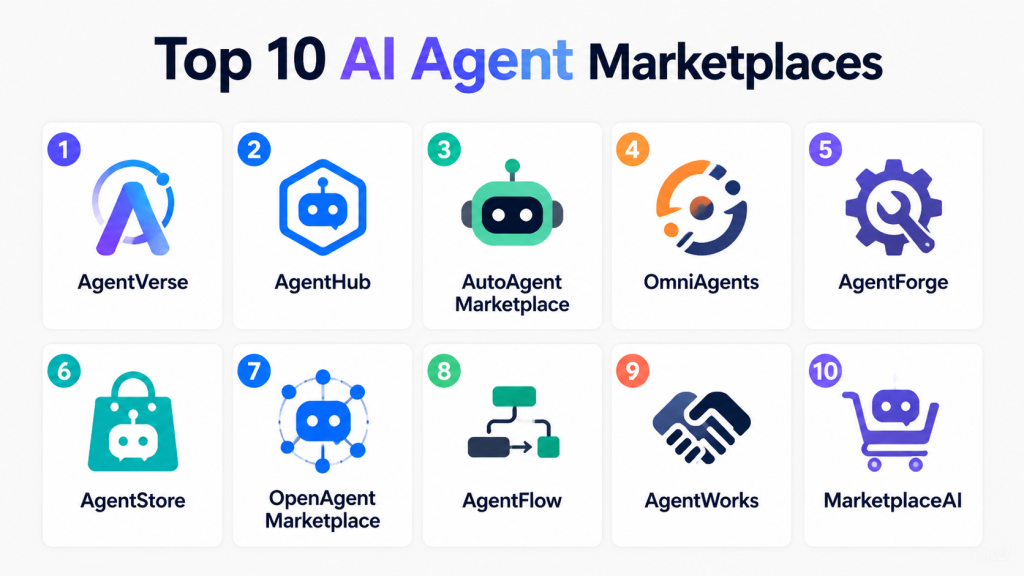
Top 10 AI Agent Marketplaces
1 — AgentVerse
One-line verdict: Ideal for developers deploying multi-agent workflows with strong orchestration and observability.
Short description: AgentVerse hosts a full marketplace of AI agents for enterprise and developer use. It supports multi-step workflows, API integration, and team collaboration.
Standout Capabilities
- Multi-agent orchestration for complex tasks
- Pre-built workflow templates
- API & SaaS integration
- Version control and rollback
- Collaboration for teams
- Observability dashboards
- Marketplace for agent monetization
AI-Specific Depth
- Model support: Proprietary + BYO
- RAG / knowledge integration: Vector DBs and API connectors
- Evaluation: Prompt testing, regression tracking
- Guardrails: Policy checks, prompt injection defenses
- Observability: Token usage, latency, trace logs
Pros
- Extensive marketplace & agent variety
- Multi-agent orchestration
- Enterprise-ready observability
Cons
- Steep learning curve
- Costs scale with agents
- Premium features require enterprise subscription
Security & Compliance
- SSO/SAML, RBAC, audit logs, encryption: Not publicly stated
Deployment & Platforms
- Web, Windows, macOS
- Cloud-based, hybrid
Integrations & Ecosystem
- APIs & SDKs
- CRM, vector DB, analytics connectors
- Extensible via plugins
Pricing Model
- Usage-based with enterprise tiers
Best-Fit Scenarios
- Multi-step workflows
- Developer monetization
- Enterprise deployment
2 — AgentHub
One-line verdict: Curated marketplace for enterprises seeking reliable, vetted AI agents.
Short description: AgentHub focuses on enterprise-grade agents with compliance and governance. Supports multi-modal inputs, templates, and analytics dashboards.
Standout Capabilities
- Curated agent marketplace
- Multi-modal support: text, audio, images
- Workflow templates for business automation
- Analytics dashboards
- Role-based access
- API & SaaS integration
AI-Specific Depth
- Model support: Proprietary + open-source connectors
- RAG / knowledge integration: Vector DB, API connectors
- Evaluation: Human review + automated tests
- Guardrails: Policy enforcement, injection prevention
- Observability: Trace logs, token usage, latency metrics
Pros
- Enterprise-ready, reliable agents
- Strong compliance & governance
- Integration-ready
Cons
- Limited customization
- Premium pricing
- Smaller developer community
Security & Compliance
- SSO/SAML, RBAC, audit logging, encryption: Not publicly stated
Deployment & Platforms
- Cloud, hybrid: Varies / N/A
Integrations & Ecosystem
- API/SDK for CRM, ERP, analytics
- SaaS connectors
- Workflow automation
Pricing Model
- Tiered subscriptions with usage scaling
Best-Fit Scenarios
- Enterprise workflow automation
- Customer service automation
- Compliance-heavy industries
3 — AutoAgent Marketplace
One-line verdict: Developer-first platform for creating and monetizing autonomous agents.
Short description: AutoAgent allows developers to deploy and sell AI agents across multiple industries with flexible workflow integration.
Standout Capabilities
- Developer-focused publishing
- Open-source & proprietary model support
- API & SaaS connectivity
- Multi-agent orchestration
- Version control
- Usage analytics
AI-Specific Depth
- Model support: Open-source + proprietary
- RAG / knowledge integration: Vector DB connectors
- Evaluation: Automated regression & prompt tests
- Guardrails: Policy checks, injection defense
- Observability: Token, latency, cost metrics
Pros
- Monetization options for developers
- Flexible deployment
- Strong developer tools
Cons
- Limited enterprise governance
- Learning curve
- Marketplace discoverability varies
Security & Compliance
- Not publicly stated
Deployment & Platforms
- Cloud, Linux, macOS
- Web dashboard
Integrations & Ecosystem
- APIs for SaaS integration
- SDKs for custom agents
- Workflow & analytics connectors
Pricing Model
- Usage-based + marketplace commission
Best-Fit Scenarios
- Developer agent monetization
- SMB automation projects
- Research workflow agents
4 — OmniAgents
One-line verdict: Enterprise-grade marketplace with multi-agent orchestration and compliance focus.
Short description: OmniAgents enables enterprises to manage multiple AI agents with strong governance, evaluation, and observability features.
Standout Capabilities
- Multi-agent orchestration dashboards
- Compliance tracking
- Pre-built enterprise templates
- Version control & rollback
- API & SaaS integrations
- Team management features
AI-Specific Depth
- Model support: BYO, proprietary
- RAG / knowledge integration: Vector DB + SaaS connectors
- Evaluation: Human-in-the-loop + automated tests
- Guardrails: Policy enforcement, injection defenses
- Observability: Latency, token, action tracing
Pros
- Enterprise-grade governance
- Observability dashboards
- Multi-agent workflow support
Cons
- Complexity for small teams
- Premium pricing
- Requires training
Security & Compliance
- RBAC, SSO/SAML, audit logs, encryption: Not publicly stated
Deployment & Platforms
- Cloud, hybrid
- Web dashboards
Integrations & Ecosystem
- API & SDK support
- Vector DB connectors
- SaaS & analytics integration
Pricing Model
- Tiered enterprise subscriptions
Best-Fit Scenarios
- Enterprise workflow orchestration
- Compliance-heavy industries
- Multi-agent monitoring
5 — AgentForge
One-line verdict: Developer-first tool for building, testing, and deploying custom AI agents.
Short description: AgentForge allows teams to create agents, run evaluations, and deploy them on marketplaces or internal systems.
Standout Capabilities
- Low-code agent builder
- Testing & evaluation harness
- Deployment pipelines
- API & SaaS integration
- Collaboration dashboards
- Observability monitoring
AI-Specific Depth
- Model support: BYO + proprietary
- RAG / knowledge integration: API connectors & vector DBs
- Evaluation: Automated & human review
- Guardrails: Policy enforcement, injection prevention
- Observability: Token, latency, cost metrics
Pros
- Developer-friendly
- Flexible deployment
- Rich evaluation tools
Cons
- Marketplace reach limited
- Limited templates
- Enterprise governance features minimal
Security & Compliance
- Not publicly stated
Deployment & Platforms
- Web, macOS, Linux
- Cloud or hybrid
Integrations & Ecosystem
- APIs & SDKs
- SaaS & analytics connectors
- Workflow integration
Pricing Model
- Usage-based + enterprise tiers
Best-Fit Scenarios
- Custom AI agent development
- Multi-team collaboration
- Internal workflow automation
6 — AgentStore
One-line verdict: Curated marketplace offering pre-vetted AI agents for enterprises needing reliable, compliant solutions.
Short description: AgentStore focuses on enterprise reliability and trustworthiness, providing pre-tested agents suitable for customer service, operations, and internal workflows.
Standout Capabilities
- Pre-vetted agents for enterprise workflows
- Workflow templates for common tasks
- SaaS and API integration support
- Observability dashboards with token/latency tracking
- Role-based access and team management
- Marketplace for secure agent deployment
AI-Specific Depth
- Model support: Proprietary
- RAG / knowledge integration: Vector DB connectors
- Evaluation: Human review + automated tests
- Guardrails: Policy enforcement
- Observability: Latency, token usage
Pros
- Trusted and reliable for enterprise use
- Easy deployment
- Strong observability and compliance
Cons
- Limited customization
- Smaller developer community
- Less experimental flexibility
Security & Compliance
- SSO/SAML, RBAC, audit logs: Not publicly stated
Deployment & Platforms
- Cloud
- Web-based
Integrations & Ecosystem
- CRM and ERP connectors
- Vector DB integration
- Workflow and analytics tools
Pricing Model
- Tiered subscriptions
Best-Fit Scenarios
- Enterprise automation
- Compliance-heavy workflows
- Non-developer teams
7 — OpenAgent Marketplace
One-line verdict: Open-source-focused marketplace ideal for developers seeking flexibility and experimentation.
Short description: OpenAgent Marketplace hosts community-built AI agents, providing open-source, BYO model support and flexibility for experimentation.
Standout Capabilities
- Open-source agent repository
- Community contributions and collaboration
- Flexible deployment options
- Versioning and rollback
- API & SDK support for custom integrations
AI-Specific Depth
- Model support: Open-source + BYO
- RAG / knowledge integration: API connectors, vector DB
- Evaluation: Developer-managed automated testing
- Guardrails: Community-defined, limited
- Observability: Basic logs and metrics
Pros
- Transparent, open-source flexibility
- Supports experimentation and customization
- Community-driven improvements
Cons
- Limited enterprise support
- Guardrails minimal
- Observability requires custom setup
Security & Compliance
- Varies / N/A
Deployment & Platforms
- Web, Linux, macOS
- Self-hosted or cloud
Integrations & Ecosystem
- API connectors
- SDKs for custom integration
- Community plugins
Pricing Model
- Free + optional enterprise services
Best-Fit Scenarios
- Developers experimenting with agents
- Academic research
- Open-source internal automation
8 — AgentFlow
One-line verdict: Lightweight platform for SMBs needing low-code AI agents for repetitive business tasks.
Short description: AgentFlow allows small teams to deploy AI agents quickly without extensive technical expertise, supporting automation and integration.
Standout Capabilities
- Low-code agent builder
- Pre-built templates for common tasks
- SaaS & API integrations
- Monitoring dashboards
- Role-based team access
AI-Specific Depth
- Model support: Proprietary, hosted
- RAG / knowledge integration: API connectors
- Evaluation: Simple automated testing
- Guardrails: Policy enforcement included
- Observability: Token and latency metrics
Pros
- Rapid deployment
- Easy for non-developers
- Cost-effective
Cons
- Limited orchestration for multi-agent workflows
- Less flexible for advanced tasks
- Minimal enterprise compliance
Security & Compliance
- Basic RBAC and audit logs: Not publicly stated
Deployment & Platforms
- Web, iOS, Android
- Cloud
Integrations & Ecosystem
- SaaS connectors
- API integration
- Workflow automation tools
Pricing Model
- Tiered subscription for SMBs
Best-Fit Scenarios
- SMB task automation
- Customer support chatbots
- Marketing workflow agents
9 — AgentWorks
One-line verdict: Enterprise-focused platform providing strong observability, governance, and multi-agent orchestration.
Short description: AgentWorks emphasizes secure deployment, monitoring, and governance for regulated enterprise environments with high-stakes workflows.
Standout Capabilities
- Observability dashboards for token, latency, and workflow tracking
- Multi-agent orchestration
- Compliance and governance monitoring
- Version control and rollback
- API and SaaS integrations
- Team management features
AI-Specific Depth
- Model support: BYO + proprietary
- RAG / knowledge integration: Vector DB, API connectors
- Evaluation: Human review + automated tests
- Guardrails: Policy enforcement, injection defense
- Observability: Latency, token, cost, trace metrics
Pros
- Enterprise-grade governance
- Strong observability
- Supports complex multi-agent workflows
Cons
- Complexity for small teams
- Premium pricing
- Requires training
Security & Compliance
- SSO/SAML, RBAC, audit logs, encryption: Not publicly stated
Deployment & Platforms
- Cloud, hybrid
- Web dashboards
Integrations & Ecosystem
- API/SDK support
- SaaS & vector DB connectors
- Analytics & workflow integration
Pricing Model
- Tiered enterprise subscriptions
Best-Fit Scenarios
- Regulated industry automation
- Mission-critical workflows
- Multi-agent monitoring
10 — MarketplaceAI
One-line verdict: Flexible platform combining agent marketplace and development tools for enterprise and developer use.
Short description: MarketplaceAI enables discovery, deployment, and creation of agents, balancing enterprise needs and developer flexibility.
Standout Capabilities
- Marketplace + development toolkit
- Multi-agent orchestration
- Evaluation dashboards
- Vector DB and API connectors
- Version control & rollback
- Analytics dashboards
AI-Specific Depth
- Model support: Proprietary + BYO
- RAG / knowledge integration: Connectors to DBs & SaaS
- Evaluation: Prompt testing, regression, human review
- Guardrails: Policy enforcement, injection defenses
- Observability: Latency, token usage, cost tracking
Pros
- Combines marketplace & development tools
- Multi-agent support
- Observability & evaluation included
Cons
- Enterprise features require premium plan
- Learning curve for non-technical users
- Marketplace depth may vary by region
Security & Compliance
- RBAC, SSO/SAML, audit logs, encryption: Not publicly stated
Deployment & Platforms
- Web, macOS, Windows
- Cloud, hybrid
Integrations & Ecosystem
- APIs & SDKs
- SaaS connectors
- Analytics & workflow integration
- Plugin support
Pricing Model
- Tiered subscription, usage-based options
Best-Fit Scenarios
- Enterprise automation & discovery
- Developer agent deployment
- Multi-team orchestration
Comparison Table
| Tool Name | Best For | Deployment | Model Flexibility | Strength | Watch-Out | Public Rating |
|---|---|---|---|---|---|---|
| AgentVerse | Developers | Cloud/Hybrid | Proprietary + BYO | Multi-agent orchestration | Learning curve | N/A |
| AgentHub | Enterprises | Cloud | Proprietary + Open | Curated, enterprise-ready | Limited customization | N/A |
| AutoAgent Marketplace | Developers | Cloud | Open-source + Proprietary | Developer monetization | Enterprise governance limited | N/A |
| OmniAgents | Enterprises | Cloud/Hybrid | BYO + Proprietary | Compliance & monitoring | Complexity | N/A |
| AgentForge | Developers | Cloud/Hybrid | BYO + Proprietary | Flexible deployment | Marketplace reach limited | N/A |
| AgentStore | Enterprises | Cloud | Proprietary | Pre-vetted agents | Limited customization | N/A |
| OpenAgent Marketplace | Developers | Self-hosted/Cloud | Open-source + BYO | Open-source flexibility | Guardrails limited | N/A |
| AgentFlow | SMBs | Cloud | Proprietary | Low-code simplicity | Limited orchestration | N/A |
| AgentWorks | Enterprises | Cloud/Hybrid | BYO + Proprietary | Observability & governance | Complexity, cost | N/A |
| MarketplaceAI | Enterprises + Developers | Cloud/Hybrid | Proprietary + BYO | Marketplace + dev tools | Learning curve | N/A |
Scoring & Evaluation Table
| Tool | Core | Reliability/Eval | Guardrails | Integrations | Ease | Perf/Cost | Security/Admin | Support | Weighted Total |
|---|---|---|---|---|---|---|---|---|---|
| AgentVerse | 9 | 8 | 8 | 9 | 7 | 8 | 7 | 7 | 8.1 |
| AgentHub | 8 | 9 | 9 | 8 | 8 | 7 | 8 | 7 | 8.2 |
| AutoAgent Marketplace | 8 | 7 | 7 | 8 | 8 | 7 | 6 | 6 | 7.4 |
| OmniAgents | 9 | 8 | 9 | 8 | 7 | 8 | 8 | 7 | 8.3 |
| AgentForge | 8 | 8 | 7 | 8 | 8 | 7 | 7 | 6 | 7.7 |
| AgentStore | 7 | 8 | 8 | 7 | 8 | 7 | 7 | 6 | 7.4 |
| OpenAgent Marketplace | 7 | 7 | 6 | 7 | 7 | 7 | 6 | 6 | 6.7 |
| AgentFlow | 7 | 7 | 7 | 7 | 9 | 7 | 6 | 6 | 7.2 |
| AgentWorks | 9 | 9 | 9 | 8 | 7 | 8 | 8 | 7 | 8.4 |
| MarketplaceAI | 8 | 8 | 8 | 8 | 7 | 8 | 7 | 7 | 7.9 |
Top 3 for Enterprise: AgentWorks, OmniAgents, AgentHub
Top 3 for SMB: AgentFlow, AgentForge, AgentVerse
Top 3 for Developers: AutoAgent Marketplace, OpenAgent Marketplace, AgentForge
Which AI Agent Marketplace Tool Is Right for You?
Solo / Freelancer
- OpenAgent Marketplace, AgentFlow for experimentation and low-cost deployment.
SMB
- AgentFlow, AgentForge, AgentVerse for low-code automation and workflow efficiency.
Mid-Market
- MarketplaceAI, AgentVerse for marketplace + custom deployment combination.
Enterprise
- OmniAgents, AgentWorks, AgentHub for governance, compliance, and orchestration.
Regulated Industries
- OmniAgents, AgentWorks for auditability, compliance, and secure agent deployment.
Budget vs Premium
- Budget: AgentFlow, OpenAgent
- Premium: OmniAgents, AgentWorks, AgentHub
Build vs Buy
- Build: OpenAgent, AgentForge for experimental or niche agents
- Buy: OmniAgents, AgentHub for enterprise-grade workflows
Implementation Playbook (30 / 60 / 90 Days)
30 Days: Deploy 1–3 agents in a sandbox. Define success metrics: task accuracy, latency, token usage. Test integrations with APIs and SaaS apps. Set up observability dashboards. Implement initial guardrails for safety.
60 Days: Harden guardrails and RBAC/SSO. Conduct red-team testing for prompt injections. Evaluate multi-agent orchestration and workflow dependencies. Implement version control and rollback. Monitor compliance with privacy policies and enterprise standards.
90 Days: Optimize cost and latency via model routing. Scale agents to production workflows. Enforce governance and security policies. Establish incident handling, alerts, and escalation procedures. Continuous monitoring of agent behavior and multi-agent interactions. Train teams on observability dashboards and workflow troubleshooting.
Common Mistakes & How to Avoid Them
- Ignoring prompt injection exposure
- No evaluation or regression testing
- Unmanaged data retention
- Lack of observability
- Unexpected costs
- Over-automation without human review
- Vendor lock-in without abstraction
- Neglecting multi-agent orchestration complexity
- Ignoring compliance and audit trails
- Weak BYO model governance
- Missing telemetry dashboards
- Underestimating latency in complex workflows
- Poor API monitoring
- Insufficient team access control
FAQs
- What data do AI agent marketplaces store?
Metadata, usage logs, and optionally agent input data. Storage and retention policies differ by platform. - Can I bring my own model (BYO)?
Yes, most marketplaces support BYO models, but integration requirements vary per platform. - Are there open-source options?
Yes, OpenAgent Marketplace and developer-oriented platforms allow open-source agent deployment. - Can agents connect to my internal APIs?
Most marketplaces allow secure API connections with authentication and RBAC controls. - How are hallucinations or errors handled?
Platforms use evaluation frameworks, regression tests, and human review to detect and correct errors. - Are these tools secure for sensitive data?
Enterprise-grade platforms provide SSO, RBAC, encryption, and observability dashboards. - How is cost controlled?
Dynamic model routing, usage-based pricing, and token monitoring help manage operational costs. - Can I test agents before deployment?
Yes, most marketplaces provide sandbox or staging environments for evaluation. - What guardrails exist for AI safety?
Policy enforcement, prompt injection defenses, and configurable rules prevent unsafe behaviors. - Is multi-agent orchestration supported?
Yes, platforms like AgentVerse, OmniAgents, and AgentWorks offer orchestration dashboards. - How do I switch platforms?
Export agent definitions and workflows if supported; otherwise, manual migration may be needed. - Are marketplace agents suitable for regulated industries?
Yes, enterprise-grade platforms with governance, audit, and compliance tools are recommended.
Conclusion
AI agent marketplaces in 2026 provide secure, scalable, and flexible platforms for deploying autonomous agents across workflows. The ideal marketplace depends on organizational context: developers prioritize flexibility and monetization, SMBs focus on low-code automation, and enterprises require governance, compliance, and multi-agent orchestration. Key considerations include evaluation frameworks, guardrails, observability, integration, and model flexibility.