Introduction
LLMOps Lifecycle Management Platforms are specialized tools designed to operationalize large language models (LLMs) in enterprise and developer workflows. They provide end-to-end management for LLMs, covering training, fine-tuning, evaluation, deployment, monitoring, and governance. As organizations increasingly adopt generative AI and LLMs across applications, these platforms are critical for ensuring reliability, efficiency, and compliance.
Real-world use cases include: powering AI-driven customer support agents, building automated content generation pipelines, managing LLM-based code completion, orchestrating multimodal AI workflows, deploying knowledge-augmented assistants via RAG pipelines, and auditing LLM outputs for bias or hallucinations. Buyers should evaluate platforms based on deployment flexibility, model routing, observability, guardrails, evaluation/testing, cost/latency optimization, security and compliance, integration capabilities, version control, collaboration features, and scalability.
Best for: AI engineers, LLM research and operations teams, enterprises leveraging generative AI, and regulated industries such as finance, healthcare, and public sector.
Not ideal for: organizations with minimal AI needs, small-scale NLP pipelines, or teams relying solely on prebuilt LLM APIs without operational workflows.
Key use cases include:
- Deploying multi-model conversational AI agents in enterprise apps.
- Automating customer support workflows with LLM-driven agents.
- Integrating internal knowledge bases using RAG pipelines.
- Tracking and evaluating model outputs for reliability and bias.
- Monitoring token usage and controlling operational costs.
- Applying enterprise security policies and audit logs to LLM deployments.
Evaluation criteria buyers should consider:
- Model hosting flexibility and BYO support.
- Integration with knowledge bases and vector databases.
- Evaluation and testing workflows.
- Guardrails against prompt injections or hallucinations.
- Observability and monitoring capabilities.
- Security, compliance, and access controls.
- Cost and latency management.
- Deployment options (cloud, on-prem, hybrid).
- Vendor ecosystem and extensibility.
- Usability for developers and non-technical users.
- Support and community availability.
Best for: CTOs, AI engineers, IT managers, and enterprises implementing multi-model LLM pipelines across finance, healthcare, SaaS, and technology sectors.
Not ideal for: organizations with minimal LLM use, single-model deployments, or those relying solely on pre-built SaaS AI services without customization.
What’s Changed in LLMOps Lifecycle Management Platforms
- Agentic workflows and tool-calling integration for LLM pipelines.
- Multimodal inputs including text, image, and structured data.
- Evaluation frameworks detecting hallucinations, bias, and performance drift.
- Guardrails against prompt injection and unsafe outputs.
- Enterprise privacy features, data residency, and retention controls.
- Cost and latency optimization via model routing and BYO model support.
- Observability dashboards tracking tokens, latency, and usage costs.
- Governance and compliance tracking for audit and regulatory needs.
- Versioned model registries with rollback capabilities.
- CI/CD integration for automated LLM deployment.
- RAG pipelines and vector database integration.
- Collaboration features for research, data science, and operations teams.
Quick Buyer Checklist
- Enforceable data privacy and retention policies.
- Hosted, BYO, or open-source model support.
- Support for RAG pipelines and knowledge connectors.
- Built-in evaluation/testing for hallucinations and bias.
- Guardrails for prompt injection and unsafe outputs.
- Latency and cost control features.
- Observability for token usage, performance, and cost.
- Admin controls, audit logs, and versioning.
- Vendor lock-in risk assessment.
- Collaboration and multi-team workflow support.
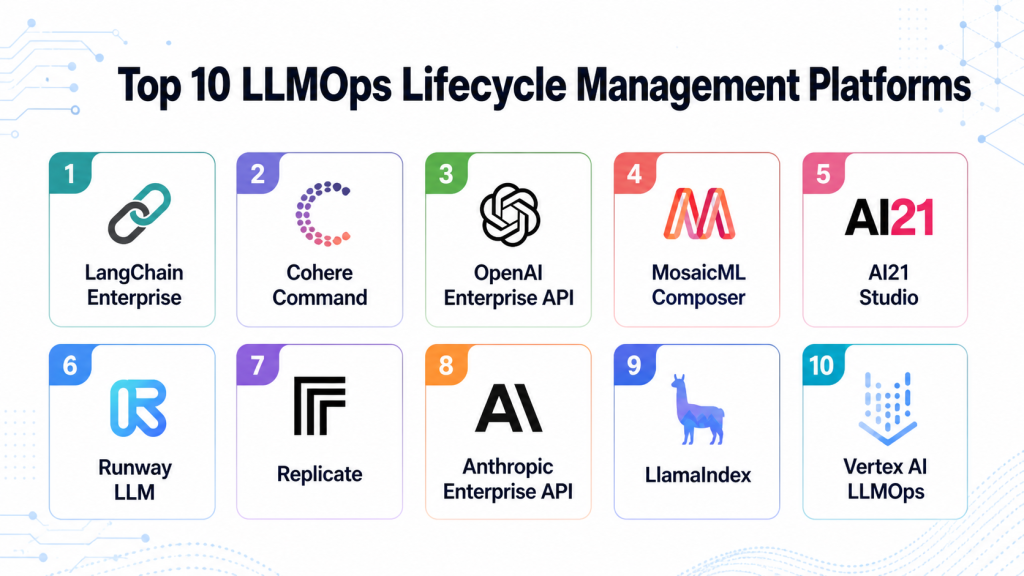
Top 10 LLMOps Lifecycle Management Platforms
1 — LangChain Enterprise
One-line verdict: Ideal for developers and enterprises building scalable LLM-driven agentic workflows.
Short description: LangChain Enterprise orchestrates LLM pipelines, providing evaluation, guardrails, observability, and governance for enterprise AI teams.
Standout Capabilities
- Agentic workflow orchestration
- Multi-model routing
- Hallucination and bias detection
- Guardrails for safe prompts
- Observability dashboards for tokens, cost, and latency
- Multi-cloud deployment
- Versioned model registry
AI-Specific Depth
- Model support: BYO / Multi-model routing
- RAG / knowledge integration: Vector DB connectors
- Evaluation: Prompt tests, regression, human review
- Guardrails: Policy checks, prompt injection defense
- Observability: Traces, token/cost metrics, latency
Pros
- Robust workflow orchestration
- Scalable multi-model support
- Advanced monitoring
Cons
- Enterprise cost
- Steep learning curve
- Limited prebuilt LLMs
Security & Compliance
- SSO/SAML, RBAC, audit logs, encryption
- Certifications: Not publicly stated
Deployment & Platforms
- Web, Linux, Windows, Cloud, Hybrid
Integrations & Ecosystem
Supports SDKs, APIs, vector DBs, cloud, and CI/CD pipelines:
- Python SDK
- REST APIs
- Vector DB integration
- CI/CD automation
- Cloud connectors
Pricing Model
- Usage-based + enterprise subscription
- Not publicly stated
Best-Fit Scenarios
- Autonomous LLM agents
- Multi-cloud enterprise LLM deployments
- Audit-ready LLM workflows
2 — Cohere Command
One-line verdict: Suited for enterprises deploying LLMs with fine-tuning and production observability.
Short description: Cohere Command centralizes LLM lifecycle management, supporting fine-tuning, monitoring, and multi-team deployment workflows.
Standout Capabilities
- Fine-tuning pipelines
- Observability dashboards
- Model registry and rollback
- Guardrails for safe outputs
- Vector DB and RAG integration
- API-first automation
- Team collaboration tools
AI-Specific Depth
- Model support: Proprietary + BYO
- RAG / knowledge integration: Vector DB connectors
- Evaluation: Offline evaluation, regression tests
- Guardrails: Policy checks, injection prevention
- Observability: Token metrics, latency, cost dashboards
Pros
- Fine-tuning and evaluation
- Centralized monitoring
- Collaborative enterprise workflows
Cons
- Proprietary ecosystem
- Costly for large deployments
- Limited open-source integration
Security & Compliance
- SSO, RBAC, audit logs, encryption
- Certifications: Not publicly stated
Deployment & Platforms
- Web, Cloud, Hybrid
Integrations & Ecosystem
- Python SDK, REST APIs
- Vector DB and CI/CD connectors
- Cloud integration
Pricing Model
- Tiered subscription, usage-based
- Not publicly stated
Best-Fit Scenarios
- Enterprise fine-tuning teams
- Multi-team deployments
- Governance and observability
3 — OpenAI Enterprise API
One-line verdict: Best for organizations leveraging proprietary GPT models with enterprise observability and guardrails.
Short description: Provides enterprise-grade GPT access with monitoring, auditing, and cost control for large-scale LLM usage.
Standout Capabilities
- GPT-family access
- Fine-tuning and embeddings
- Usage monitoring
- Guardrails for safe generation
- Vector DB integration
- Multi-team collaboration
AI-Specific Depth
- Model support: Proprietary GPT + BYO embeddings
- RAG / knowledge integration: Vector DB connectors
- Evaluation: Prompt tests, human review
- Guardrails: Policy enforcement, injection defense
- Observability: Token, latency, and cost metrics
Pros
- Enterprise GPT access
- Monitoring and auditing
- Vector DB integration
Cons
- Proprietary lock-in
- Usage cost
- Limited offline evaluation
Security & Compliance
- SSO/RBAC, audit logs
- Certifications: Not publicly stated
Deployment & Platforms
- Cloud-based
Integrations & Ecosystem
- Python SDK, REST APIs
- Embedding and RAG integration
- CI/CD and cloud connectors
Pricing Model
- Usage-based enterprise plans
- Not publicly stated
Best-Fit Scenarios
- GPT-driven enterprise solutions
- Chatbots and agentic applications
- Teams monitoring usage and cost
4 — MosaicML Composer
One-line verdict: Developer-focused platform for building, training, and deploying LLMs efficiently.
Short description: MosaicML Composer offers pipelines for LLM training, evaluation, and deployment with multi-cloud support.
Standout Capabilities
- Efficient training pipelines
- Monitoring and evaluation dashboards
- Multi-cloud deployment
- Guardrails and safe generation
- Open-source model support
- Observability for token and latency
- Reproducibility tools
AI-Specific Depth
- Model support: BYO/Open-source/Multi-model
- RAG / knowledge integration: Varies / N/A
- Evaluation: Offline eval, regression
- Guardrails: Policy checks, injection prevention
- Observability: Traces, cost, latency
Pros
- Open-source flexibility
- Scalable training
- Transparent model management
Cons
- DevOps expertise required
- Limited commercial LLMs
- Complex setup
Security & Compliance
- Varies / N/A
Deployment & Platforms
- Cloud, Self-hosted, Linux, Windows
Integrations & Ecosystem
- Python SDK, Docker/Kubernetes
- ML frameworks, CI/CD, vector DB
Pricing Model
- Open-source; optional enterprise support
Best-Fit Scenarios
- Custom LLM development
- Research environments
- Reproducible training pipelines
5 — AI21 Studio
One-line verdict: Ideal for API-driven LLM applications with governance and cost control.
Short description: Provides LLM lifecycle orchestration, monitoring, and RAG pipeline integration.
Standout Capabilities
- API orchestration
- Guardrails and policy enforcement
- RAG integration
- Monitoring and token dashboards
- Multi-model routing
- Fine-tuning support
- Team collaboration
AI-Specific Depth
- Model support: Proprietary + BYO
- RAG / knowledge integration: Vector DB connectors
- Evaluation: Regression, prompt validation
- Guardrails: Policy enforcement, injection defense
- Observability: Token/cost metrics, latency
Pros
- API-first orchestration
- Observability dashboards
- Multi-model support
Cons
- Proprietary restrictions
- Limited offline evaluation
- Cost scaling
Security & Compliance
- SSO/RBAC, audit logs
- Certifications: Not publicly stated
Deployment & Platforms
- Cloud, Web
Integrations & Ecosystem
- Python SDK, REST APIs
- Vector DB and CI/CD integration
Pricing Model
- Tiered usage-based subscription
Best-Fit Scenarios
- API-driven LLM applications
- RAG pipelines
- Multi-model management
6 — Runway LLM
One-line verdict: Designed for creative AI teams deploying multimodal LLMs with orchestration and evaluation tools.
Short description: Runway LLM orchestrates text, image, and audio LLM pipelines for creative workflows.
Standout Capabilities
- Multimodal LLM support
- Fine-tuning and experiment tracking
- Real-time monitoring
- Guardrails for safe outputs
- Vector DB / RAG integration
- API orchestration
- Team collaboration
AI-Specific Depth
- Model support: BYO + Multi-model routing
- RAG / knowledge integration: Vector DB connectors
- Evaluation: Prompt tests, regression, offline eval
- Guardrails: Policy checks, injection defense
- Observability: Token/cost metrics, latency
Pros
- Excellent for multimodal use cases
- Real-time monitoring
- Scalable orchestration
Cons
- Limited governance for regulated industries
- Cloud dependency for some features
- Learning curve
Security & Compliance
- SSO, RBAC, audit logs, encryption
- Certifications: Not publicly stated
Deployment & Platforms
- Web, Cloud, Hybrid
Integrations & Ecosystem
- Python SDK, REST APIs
- Vector DB connectors, CI/CD integration
Pricing Model
- Usage-based, tiered
Best-Fit Scenarios
- Creative content generation
- Multimodal AI experiments
- Enterprise LLM workflows
7 — Replicate
One-line verdict: Ideal for developers experimenting with open-source and BYO LLM models.
Short description: Deploy, version, and share open-source LLMs with scalable inference endpoints.
Standout Capabilities
- Easy open-source deployment
- Model versioning
- Multi-framework support
- Lightweight API
- Performance monitoring
- Community-driven models
- Hybrid deployment support
AI-Specific Depth
- Model support: Open-source + BYO
- RAG / knowledge integration: Varies / N/A
- Evaluation: Experiment tracking, offline tests
- Guardrails: Varies / N/A
- Observability: Token/latency metrics
Pros
- Flexible open-source
- Fast setup
- Multi-framework
Cons
- Limited monitoring
- Developer expertise required
- Minimal governance
Security & Compliance
- Varies / N/A
Deployment & Platforms
- Cloud, Self-hosted, Linux, Windows
Integrations & Ecosystem
- Python SDK, REST API
- CI/CD, vector DB connectors
Pricing Model
- Open-source; optional enterprise support
Best-Fit Scenarios
- Experimentation and research
- SMB AI deployments
- Developer pipelines
8 — Anthropic Enterprise API
One-line verdict: Enterprise-ready LLMOps platform focusing on safety and guardrails.
Short description: Provides lifecycle management emphasizing ethical AI, safety policies, and monitoring.
Standout Capabilities
- Safety-first deployment
- Guardrails and policy enforcement
- Model versioning and rollback
- Performance dashboards
- RAG/vector DB integration
- API orchestration
- Audit-ready dashboards
AI-Specific Depth
- Model support: Proprietary + BYO
- RAG / knowledge integration: Connectors / Vector DB
- Evaluation: Regression, prompt validation
- Guardrails: Policy enforcement
- Observability: Token/cost metrics, latency
Pros
- Safety-focused
- Enterprise-grade monitoring
- Multi-model orchestration
Cons
- Proprietary constraints
- Higher cost
- Limited offline evaluation
Security & Compliance
- SSO, RBAC, audit logs
- Certifications: Not publicly stated
Deployment & Platforms
- Cloud, Web
Integrations & Ecosystem
- Python SDK, REST API
- Vector DB / CI/CD integration
Pricing Model
- Tiered usage-based
Best-Fit Scenarios
- Regulated industries
- Multi-model enterprise workflows
- Safety-focused deployments
9 — LlamaIndex
One-line verdict: Suited for knowledge-augmented LLM applications with flexible data integrations.
Short description: Builds pipelines connecting LLMs to knowledge sources with RAG orchestration.
Standout Capabilities
- RAG pipeline orchestration
- Vector DB/document store integration
- Query-response logging
- Multi-model routing
- Open-source SDKs
- Guardrails for query safety
- Observability dashboards
AI-Specific Depth
- Model support: Open-source + BYO
- RAG / knowledge integration: Connectors / Vector DB
- Evaluation: Offline eval, prompt tests
- Guardrails: Policy checks
- Observability: Token and latency metrics
Pros
- Ideal for RAG projects
- Developer-friendly
- Open-source and extensible
Cons
- Limited enterprise monitoring
- DevOps needed
- Minimal governance
Security & Compliance
- Varies / N/A
Deployment & Platforms
- Cloud, Self-hosted, Linux, Windows
Integrations & Ecosystem
- Python SDK
- Vector DB, CI/CD pipelines
Pricing Model
- Open-source; enterprise support optional
Best-Fit Scenarios
- RAG developer projects
- Knowledge agents
- Research environments
10 — Vertex AI LLMOps
One-line verdict: Best for enterprises on Google Cloud needing scalable LLM lifecycle orchestration.
Short description: Manages LLM pipelines with monitoring, governance, model routing, and cost/latency optimization.
Standout Capabilities
- Multi-model orchestration
- Cost/latency optimization
- Monitoring dashboards
- Guardrails and safe pipelines
- RAG/vector DB integration
- Versioning and rollback
- Enterprise governance
AI-Specific Depth
- Model support: Multi-model + BYO
- RAG / knowledge integration: Vector DB connectors
- Evaluation: Offline/regression tests
- Guardrails: Policy checks, injection defense
- Observability: Token/cost metrics, latency
Pros
- Scalable enterprise deployments
- Google Cloud integration
- Strong monitoring and governance
Cons
- Cloud lock-in
- Complexity for small teams
- Pricing scales quickly
Security & Compliance
- IAM, RBAC, audit logs, encryption
- Certifications: Not publicly stated
Deployment & Platforms
- Cloud (Google Cloud), Web
Integrations & Ecosystem
- Python SDK, REST APIs
- Vector DB and RAG pipelines
- CI/CD pipelines
Pricing Model
- Usage-based, tiered enterprise plan
Best-Fit Scenarios
- Enterprise Google Cloud teams
- Multi-model LLM workflows
- Knowledge-augmented AI applications
Comparison Table
| Tool Name | Best For | Deployment | Model Flexibility | Strength | Watch-Out | Public Rating |
|---|---|---|---|---|---|---|
| LangChain Enterprise | Agentic workflows | Cloud/Hybrid | BYO/Multi-model | Workflow orchestration | Enterprise cost | N/A |
| Cohere Command | Enterprise fine-tuning | Cloud | Proprietary/BYO | Fine-tuning + observability | Proprietary ecosystem | N/A |
| OpenAI Enterprise API | GPT enterprise | Cloud | Hosted/BYO embeddings | GPT models | Locked-in models | N/A |
| MosaicML Composer | Custom LLM training | Cloud/Self-hosted | Open-source/BYO | Training efficiency | Setup complexity | N/A |
| AI21 Studio | API orchestration | Cloud | Proprietary/BYO | API-driven | Proprietary models | N/A |
| Runway LLM | Creative AI | Cloud | Hosted/BYO | Creative multimodal | Less enterprise governance | N/A |
| Replicate | Open-source deployment | Cloud | Open-source/BYO | Experiment flexibility | Limited observability | N/A |
| Anthropic Enterprise API | Safety-focused | Cloud | Proprietary/BYO | Safety guardrails | Proprietary cost | N/A |
| LlamaIndex | Knowledge integration | Cloud/Self-hosted | Open-source/BYO | RAG pipelines | Requires dev setup | N/A |
| Vertex AI LLMOps | Google Cloud | Cloud | Multi-model/BYO | Scalability | Cloud lock-in | N/A |
Scoring & Evaluation (Transparent Rubric)
Scores are comparative. Weighted scoring uses Core features – 20%, AI reliability & evaluation – 15%, Guardrails & safety – 10%, Integrations & ecosystem – 15%, Ease of use – 10%, Performance & cost – 15%, Security/admin – 10%, Support/community – 5%.
| Tool | Core | Reliability/Eval | Guardrails | Integrations | Ease | Perf/Cost | Security/Admin | Support | Weighted Total |
|---|---|---|---|---|---|---|---|---|---|
| LangChain Enterprise | 9 | 9 | 9 | 8 | 7 | 8 | 8 | 7 | 8.3 |
| Cohere Command | 8 | 8 | 8 | 8 | 7 | 7 | 7 | 7 | 7.7 |
| OpenAI Enterprise API | 9 | 9 | 8 | 8 | 8 | 8 | 8 | 7 | 8.3 |
| MosaicML Composer | 8 | 8 | 7 | 7 | 7 | 8 | 6 | 6 | 7.1 |
| AI21 Studio | 8 | 8 | 7 | 7 | 7 | 7 | 7 | 6 | 7.1 |
| Runway LLM | 7 | 7 | 6 | 6 | 8 | 7 | 6 | 6 | 6.7 |
| Replicate | 7 | 7 | 6 | 6 | 8 | 7 | 6 | 6 | 6.7 |
| Anthropic Enterprise API | 8 | 8 | 9 | 7 | 7 | 8 | 7 | 7 | 7.8 |
| LlamaIndex | 7 | 7 | 7 | 6 | 7 | 7 | 6 | 6 | 6.7 |
| Vertex AI LLMOps | 9 | 9 | 8 | 8 | 7 | 8 | 8 | 7 | 8.2 |
Top 3 for Enterprise: LangChain Enterprise, OpenAI Enterprise API, Vertex AI LLMOps
Top 3 for SMB: MosaicML Composer, AI21 Studio, LlamaIndex
Top 3 for Developers: Replicate, LlamaIndex, Runway LLM
Which LLMOps Lifecycle Management Platform Is Right for You?
Solo / Freelancer
- Lightweight open-source tools like Replicate or LlamaIndex provide experimentation and local control.
SMB
- AI21 Studio, MosaicML Composer balance usability, API access, and cost efficiency.
Mid-Market
- LangChain Enterprise or Cohere Command for fine-tuning, monitoring, and workflow orchestration.
Enterprise
- OpenAI Enterprise API, Vertex AI LLMOps for scalable, audited, and secure deployments.
Regulated industries
- Platforms with guardrails and compliance tracking (LangChain Enterprise, Anthropic Enterprise API).
Budget vs premium
- Open-source tools for cost-conscious teams; enterprise-grade APIs for robust governance.
Build vs buy
- DIY with Replicate or LlamaIndex; buy enterprise solutions for production-grade, secure LLM pipelines.
Implementation Playbook (30 / 60 / 90 Days)
- 30 days: Pilot LLM pipelines, set success metrics, deploy test agents, implement basic observability.
- 60 days: Harden security, integrate guardrails, conduct evaluation/testing, expand CI/CD and multi-model workflows.
- 90 days: Optimize cost/latency, enforce governance, version control, incident response, and scale production LLMs.
Common Mistakes & How to Avoid Them
- Ignoring prompt injection and unsafe outputs.
- No evaluation for hallucinations or bias.
- Unmanaged data retention policies.
- Limited observability on latency or token usage.
- Unexpected cost scaling.
- Over-automation without human review.
- Vendor lock-in with proprietary APIs.
- Poor model versioning and rollback.
- Inadequate guardrails.
- Ignoring RAG pipeline validation.
- Missing regulatory compliance checks.
- Weak CI/CD integration.
- Lack of team collaboration and governance.
- Ignoring multi-cloud or hybrid deployment implications.
FAQs
1. What are LLMOps Lifecycle Management Platforms?
Platforms that manage LLMs end-to-end: training, deployment, monitoring, evaluation, and governance.
2. Can I use my own models?
Many platforms support BYO models or open-source LLMs alongside proprietary models.
3. Are self-hosted deployments possible?
Some tools support self-hosting; others are cloud-native only.
4. How do guardrails work?
Platforms enforce policies to prevent unsafe outputs and adversarial prompt injections.
5. Can I track token usage and latency?
Yes, observability dashboards track token consumption, latency, and associated costs.
6. Are these platforms secure?
Enterprise-grade tools include SSO, RBAC, audit logs, encryption, and data retention controls.
7. Do these platforms integrate with RAG pipelines?
Many support vector DB connectors and knowledge integrations for retrieval-augmented workflows.
8. How scalable are LLMOps tools?
Enterprise platforms support multi-model, multi-team, multi-region scaling.
9. Which platforms are best for experimentation?
Open-source or lightweight tools like Replicate, LlamaIndex, or MosaicML Composer.
10. How is evaluation performed?
Prompt testing, regression tests, offline evaluation, and human-in-the-loop review.
11. Are enterprise APIs locked to proprietary models?
Some tools are proprietary, while others allow BYO or open-source models.
12. Which industries benefit most?
Finance, healthcare, public sector, customer support, content generation, and creative industries.
Conclusion
LLMOps Lifecycle Management Platforms are essential for operationalizing large language models safely, efficiently, and at scale. Choosing the right platform depends on your team size, deployment needs, model flexibility, security, and budget. Enterprises benefit from platforms offering workflow orchestration, monitoring, and governance, while developers and SMBs may prioritize open-source or lightweight solutions for experimentation and reproducibility. The best approach is to shortlist platforms, run a pilot to validate integration, evaluation, and observability, and then scale workflows with guardrails, cost optimization, and governance in place.
The pros and cons section gives a balanced understanding of each lifecycle management solution instead of focusing only on advantages. That makes the article more useful for practical decision-making.
The blog does a good job of covering workflow automation, monitoring, governance, and deployment capabilities across multiple platforms. The explanations are practical and easy to follow for technical readers.