Introduction
Agent observability and tracing tools are platforms that help you monitor, debug, and understand how AI agents behave in real time. In simple terms, they act like “logging and analytics systems” for AI—tracking every step an agent takes, including prompts, tool calls, decisions, and outputs.
As AI systems evolve into multi-step, autonomous agents, visibility becomes critical. Without observability, teams are essentially operating blind—unable to diagnose failures, track hallucinations, or optimize performance. These tools provide detailed traces, cost metrics, latency insights, and behavioral logs, making it easier to build reliable and scalable AI systems.
real world use cases include:
- Debugging multi-step agent workflows
- Monitoring hallucinations and failure patterns
- Tracking token usage and cost across workflows
- Analyzing latency and performance bottlenecks
- Auditing agent decisions for compliance
- Improving prompts and tool interactions
Key evaluation criteria buyers should consider:
- Depth of tracing (step-by-step visibility)
- Real-time observability vs batch logging
- Cost and token tracking accuracy
- Integration with AI frameworks and APIs
- Support for multi-agent systems
- Evaluation and testing capabilities
- Guardrails and anomaly detection
- Data privacy and retention controls
- Deployment flexibility (cloud/self-hosted)
- Ease of debugging and visualization
Best for: AI engineers, ML teams, DevOps teams, and enterprises building agent-based systems in SaaS, fintech, healthcare, and e-commerce.
Not ideal for: Teams running simple, single-prompt AI applications where full tracing and observability are unnecessary.
What’s Changed in Agent Observability & Tracing Tools
- Shift from simple logging to full agent workflow tracing
- Native support for multi-agent and tool-calling systems
- Real-time observability with live debugging capabilities
- Built-in cost and token usage analytics
- Integration with evaluation pipelines for reliability testing
- Enhanced guardrails and anomaly detection
- Multimodal tracing (text, image, voice interactions)
- Model comparison and routing insights
- Stronger privacy controls and data masking
- Automated root-cause analysis for failures
- Integration with DevOps and monitoring stacks
- Policy-aware observability for governance
Quick Buyer Checklist (Scan-Friendly)
- Does it provide step-by-step agent traces?
- Can you monitor token usage and cost in real time?
- Does it support multi-agent workflows and tool calls?
- Are there built-in evaluation and debugging tools?
- Does it include guardrails or anomaly detection?
- Can it integrate with RAG systems and APIs?
- Are data privacy and retention controls configurable?
- Does it support multiple models (BYO or hosted)?
- Is deployment flexible (cloud, self-hosted, hybrid)?
- Are there audit logs and compliance features?
- Does it help reduce vendor lock-in?
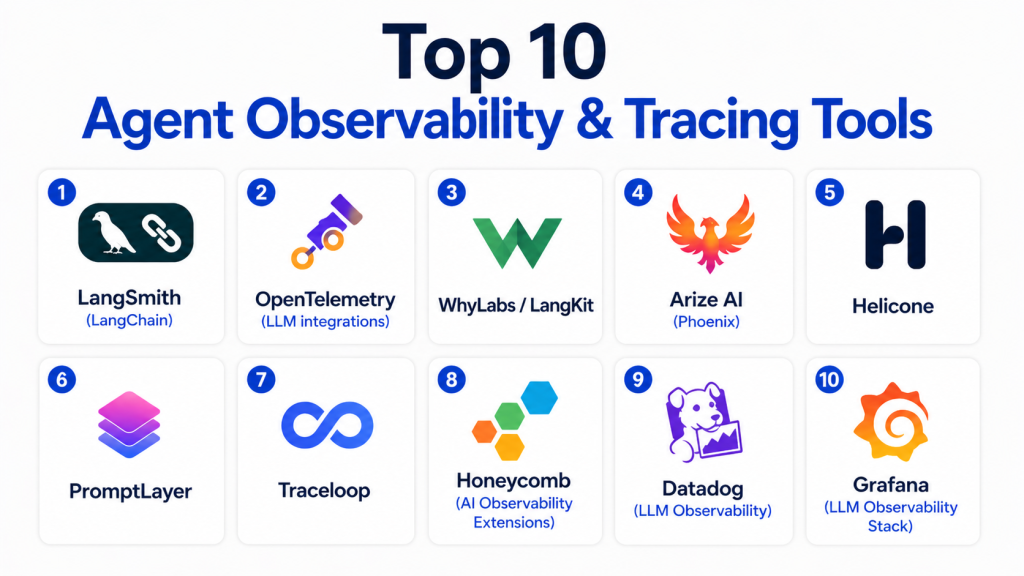
Top 10 Agent Observability & Tracing Tools
1 — LangSmith (LangChain)
One-line verdict: Best for developers needing deep tracing and debugging for complex agent workflows.
Short description:
LangSmith is a developer-focused observability platform that provides detailed tracing, evaluation, and debugging for LLM and agent applications.
Standout Capabilities
- End-to-end agent tracing
- Dataset-based evaluation
- Prompt and workflow versioning
- Debugging tool calls and chains
- Experiment tracking
AI-Specific Depth
- Model support: Multi-model / BYO
- RAG / knowledge integration: Strong
- Evaluation: Strong
- Guardrails: Limited
- Observability: Strong
Pros
- Deep visibility into workflows
- Strong developer ecosystem
- Easy debugging
Cons
- Requires technical expertise
- Limited built-in guardrails
- Best within LangChain ecosystem
Security & Compliance
- Not publicly stated
Deployment & Platforms
- Web
- Cloud
Integrations & Ecosystem
- LangChain ecosystem
- APIs
- Vector databases
- Custom LLMs
Pricing Model
- Usage-based
Best-Fit Scenarios
- Debugging agent workflows
- LLM experimentation
- Development environments
2 — OpenTelemetry (LLM integrations)
One-line verdict: Best for teams integrating AI observability into existing DevOps and monitoring pipelines.
Short description:
OpenTelemetry provides open standards for tracing and monitoring, extended to AI and LLM systems.
Standout Capabilities
- Distributed tracing
- Vendor-neutral standard
- Integration with monitoring tools
- Scalable telemetry collection
AI-Specific Depth
- Model support: Multi-model
- RAG / knowledge integration: N/A
- Evaluation: Limited
- Guardrails: N/A
- Observability: Strong
Pros
- Open standard
- Highly flexible
- Integrates widely
Cons
- Not AI-native
- Requires setup
- Limited evaluation
Security & Compliance
- Not publicly stated
Deployment & Platforms
- Self-hosted / Cloud
Integrations & Ecosystem
- DevOps tools
- Monitoring platforms
- APIs
Pricing Model
- Open-source
Best-Fit Scenarios
- Enterprise monitoring
- DevOps integration
- Custom observability
3 — WhyLabs / LangKit
One-line verdict: Best for monitoring AI behavior, drift, and anomalies in production environments.
Short description:
WhyLabs provides observability and monitoring tools for AI systems, focusing on reliability and drift detection.
Standout Capabilities
- Data drift detection
- AI monitoring dashboards
- Integration with LangKit
- Production observability
AI-Specific Depth
- Model support: Multi-model
- RAG / knowledge integration: N/A
- Evaluation: Moderate
- Guardrails: Limited
- Observability: Strong
Pros
- Strong monitoring
- Production-ready
- Good analytics
Cons
- Limited tracing depth
- Not full debugging tool
- Requires integration
Security & Compliance
- Not publicly stated
Deployment & Platforms
- Cloud
Integrations & Ecosystem
- APIs
- ML pipelines
- Data platforms
Pricing Model
- Tiered
Best-Fit Scenarios
- Production monitoring
- Drift detection
- Reliability tracking
4 — Arize AI (Phoenix)
One-line verdict: Best for combining observability with evaluation and performance monitoring.
Short description:
Arize AI provides observability and evaluation tools for AI systems, including LLM applications.
Standout Capabilities
- Model performance monitoring
- Evaluation workflows
- Root cause analysis
- Data and prediction tracking
AI-Specific Depth
- Model support: Multi-model
- RAG / knowledge integration: Moderate
- Evaluation: Strong
- Guardrails: Limited
- Observability: Strong
Pros
- Strong analytics
- Combines eval + observability
- Enterprise-friendly
Cons
- Setup complexity
- Cost considerations
- Not agent-specific
Security & Compliance
- Not publicly stated
Deployment & Platforms
- Cloud
Integrations & Ecosystem
- ML tools
- APIs
- Data pipelines
Pricing Model
- Tiered
Best-Fit Scenarios
- Model monitoring
- Evaluation workflows
- Performance analysis
5 — Helicone
One-line verdict: Best for lightweight, cost-focused observability and request tracking for LLM applications.
Short description:
Helicone is an observability platform focused on logging, analytics, and cost tracking for LLM usage.
Standout Capabilities
- Request logging
- Cost tracking
- Latency monitoring
- Simple integration
AI-Specific Depth
- Model support: Multi-model
- RAG / knowledge integration: Limited
- Evaluation: Limited
- Guardrails: Limited
- Observability: Moderate
Pros
- Easy to use
- Cost visibility
- Lightweight
Cons
- Limited advanced features
- Not enterprise-grade
- Basic tracing
Security & Compliance
- Not publicly stated
Deployment & Platforms
- Cloud
Integrations & Ecosystem
- APIs
- LLM providers
- SDKs
Pricing Model
- Usage-based
Best-Fit Scenarios
- Cost tracking
- Small teams
- Quick setup
6 — PromptLayer
One-line verdict: Best for tracking prompts, logs, and interactions across AI applications.
Short description:
PromptLayer provides logging and analytics for prompts and agent interactions.
Standout Capabilities
- Prompt logging
- Version control
- Analytics dashboards
- Debugging tools
AI-Specific Depth
- Model support: Multi-model
- RAG / knowledge integration: Limited
- Evaluation: Limited
- Guardrails: Limited
- Observability: Moderate
Pros
- Easy to use
- Good visibility
- Lightweight
Cons
- Limited advanced tracing
- Not enterprise-focused
- Basic evaluation
Security & Compliance
- Not publicly stated
Deployment & Platforms
- Web / Cloud
Integrations & Ecosystem
- APIs
- SDKs
- LLM tools
Pricing Model
- Tiered
Best-Fit Scenarios
- Prompt tracking
- Debugging
- Small teams
7 — Traceloop
One-line verdict: Best for developers needing open-source tracing tailored for LLM and agent workflows.
Short description:
Traceloop provides open-source observability for AI systems with tracing and monitoring features.
Standout Capabilities
- Open-source tracing
- LLM-specific instrumentation
- Integration with OpenTelemetry
- Developer-friendly
AI-Specific Depth
- Model support: Multi-model
- RAG / knowledge integration: Moderate
- Evaluation: Limited
- Guardrails: Limited
- Observability: Strong
Pros
- Open-source
- Flexible
- Good tracing
Cons
- Requires setup
- Limited UI
- Smaller ecosystem
Security & Compliance
- Not publicly stated
Deployment & Platforms
- Self-hosted / Cloud
Integrations & Ecosystem
- OpenTelemetry
- APIs
- Dev tools
Pricing Model
- Open-source
Best-Fit Scenarios
- Custom observability
- Developer workflows
- Open-source stacks
8 — Honeycomb (AI Observability Extensions)
One-line verdict: Best for high-scale observability with strong debugging and performance insights.
Short description:
Honeycomb provides observability for distributed systems, extended to AI workflows.
Standout Capabilities
- High-cardinality tracing
- Real-time debugging
- Performance insights
- Distributed system monitoring
AI-Specific Depth
- Model support: Multi-model
- RAG / knowledge integration: N/A
- Evaluation: Limited
- Guardrails: N/A
- Observability: Strong
Pros
- Powerful analytics
- Scalable
- Real-time insights
Cons
- Not AI-native
- Requires integration
- Cost considerations
Security & Compliance
- Not publicly stated
Deployment & Platforms
- Cloud
Integrations & Ecosystem
- DevOps tools
- APIs
- Monitoring systems
Pricing Model
- Usage-based
Best-Fit Scenarios
- Large-scale systems
- Performance debugging
- Real-time monitoring
9 — Datadog (LLM Observability)
One-line verdict: Best for enterprises integrating AI observability into existing monitoring infrastructure.
Short description:
Datadog extends its observability platform to support AI and LLM monitoring.
Standout Capabilities
- Unified observability
- Metrics and logs
- Performance monitoring
- Integration with cloud systems
AI-Specific Depth
- Model support: Multi-model
- RAG / knowledge integration: N/A
- Evaluation: Limited
- Guardrails: Limited
- Observability: Strong
Pros
- Enterprise-grade
- Scalable
- Unified platform
Cons
- Expensive
- Not AI-native
- Setup complexity
Security & Compliance
- Enterprise controls (details vary)
Deployment & Platforms
- Cloud
Integrations & Ecosystem
- Cloud platforms
- APIs
- DevOps tools
Pricing Model
- Usage-based
Best-Fit Scenarios
- Enterprise monitoring
- Unified observability
- Large systems
10 — Grafana (LLM Observability Stack)
One-line verdict: Best for open-source observability with customizable dashboards for AI systems.
Short description:
Grafana provides dashboards and monitoring tools that can be adapted for AI observability.
Standout Capabilities
- Custom dashboards
- Open-source flexibility
- Integration with Prometheus
- Visualization tools
AI-Specific Depth
- Model support: Multi-model
- RAG / knowledge integration: N/A
- Evaluation: Limited
- Guardrails: N/A
- Observability: Strong
Pros
- Highly customizable
- Open-source
- Large ecosystem
Cons
- Not AI-specific
- Requires setup
- Limited evaluation
Security & Compliance
- Not publicly stated
Deployment & Platforms
- Cloud / Self-hosted
Integrations & Ecosystem
- Prometheus
- APIs
- Monitoring tools
Pricing Model
- Open-source + enterprise
Best-Fit Scenarios
- Custom dashboards
- Open-source stacks
- Monitoring
Comparison Table
| Tool Name | Best For | Deployment | Model Flexibility | Strength | Watch-Out | Public Rating |
|---|---|---|---|---|---|---|
| LangSmith | Developers | Cloud | Multi-model | Deep tracing | LangChain dependency | N/A |
| OpenTelemetry | DevOps | Self-hosted | Multi-model | Open standard | Setup complexity | N/A |
| WhyLabs | Monitoring | Cloud | Multi-model | Drift detection | Limited tracing | N/A |
| Arize AI | Analytics | Cloud | Multi-model | Eval + monitoring | Cost | N/A |
| Helicone | Cost tracking | Cloud | Multi-model | Simplicity | Limited features | N/A |
| PromptLayer | Logging | Cloud | Multi-model | Ease of use | Basic features | N/A |
| Traceloop | Open-source | Hybrid | Multi-model | Flexibility | Smaller ecosystem | N/A |
| Honeycomb | Scale | Cloud | Multi-model | Real-time insights | Not AI-native | N/A |
| Datadog | Enterprise | Cloud | Multi-model | Unified monitoring | Cost | N/A |
| Grafana | Custom dashboards | Hybrid | Multi-model | Customization | Setup required | N/A |
Scoring & Evaluation (Transparent Rubric)
These scores are comparative and based on capabilities across observability, integration, and performance.
| Tool | Core | Reliability/Eval | Guardrails | Integrations | Ease | Perf/Cost | Security/Admin | Support | Weighted Total |
|---|---|---|---|---|---|---|---|---|---|
| LangSmith | 9 | 8 | 6 | 9 | 8 | 8 | 7 | 8 | 8.2 |
| OpenTelemetry | 8 | 6 | 5 | 9 | 6 | 8 | 7 | 8 | 7.4 |
| WhyLabs | 8 | 7 | 6 | 8 | 7 | 8 | 7 | 7 | 7.6 |
| Arize AI | 9 | 8 | 6 | 8 | 7 | 7 | 7 | 7 | 7.9 |
| Helicone | 7 | 6 | 5 | 7 | 8 | 8 | 6 | 6 | 7.0 |
| PromptLayer | 6 | 6 | 5 | 7 | 8 | 7 | 6 | 6 | 6.8 |
| Traceloop | 7 | 6 | 5 | 8 | 6 | 8 | 6 | 6 | 7.0 |
| Honeycomb | 8 | 6 | 5 | 9 | 6 | 7 | 7 | 7 | 7.3 |
| Datadog | 9 | 7 | 6 | 9 | 6 | 7 | 8 | 8 | 7.8 |
| Grafana | 8 | 6 | 5 | 9 | 6 | 8 | 7 | 8 | 7.5 |
Top 3 for Enterprise:
- Datadog
- Arize AI
- LangSmith
Top 3 for SMB:
- Helicone
- PromptLayer
- WhyLabs
Top 3 for Developers:
- LangSmith
- Traceloop
- OpenTelemetry
Which Agent Observability & Tracing Tool Is Right for You?
Solo / Freelancer
Use lightweight tools like Helicone or PromptLayer for simplicity and cost control.
SMB
WhyLabs and LangSmith offer a balance of functionality and usability.
Mid-Market
Arize AI and Grafana provide deeper insights and scalability.
Enterprise
Datadog and Honeycomb are strong for large-scale systems.
Regulated industries (finance/healthcare/public sector)
Focus on tools with strong auditability and logging like Datadog.
Budget vs premium
- Budget: Open-source tools
- Premium: Enterprise observability platforms
Build vs buy (when to DIY)
Build if you need custom observability; buy if you need speed and reliability.
Implementation Playbook (30 / 60 / 90 Days)
30 Days
- Define observability goals
- Implement basic tracing
- Set up dashboards
60 Days
- Add evaluation pipelines
- Integrate guardrails
- Expand monitoring
90 Days
- Optimize cost and latency
- Add governance
- Scale across teams
Common Mistakes & How to Avoid Them
- No tracing for agent workflows
- Ignoring cost tracking
- Lack of evaluation
- Poor logging
- No anomaly detection
- Overlooking latency
- Weak integration
- Vendor lock-in
- No governance
- Lack of debugging tools
FAQs
1. What is agent observability?
It is the ability to monitor, trace, and analyze how AI agents behave during execution.
2. Why is tracing important?
It helps debug issues, understand decisions, and improve performance.
3. Can I use my own models?
Yes, most tools support multi-model environments.
4. Do these tools support self-hosting?
Many tools offer self-hosted or hybrid options.
5. Are they necessary?
Yes, for complex agent systems.
6. Do they include guardrails?
Some include basic guardrails; others require integration.
7. How do they handle privacy?
Through logging controls and data policies.
8. Are they expensive?
Costs vary widely.
9. Can I switch tools?
Switching can be complex without abstraction.
10. Do they support evaluation?
Some tools include evaluation features.
11. Are they beginner-friendly?
Some are, but many require expertise.
12. What is the main benefit?
Improved reliability and visibility.
Conclusion
Agent observability and tracing tools are essential for building reliable, scalable AI systems by providing deep visibility into agent behavior, performance, and costs. The right tool depends on your technical needs, scale, and budget—so start by shortlisting a few options, run a pilot with real workflows, and validate observability, evaluation, and governance capabilities before scaling.
The blog clearly explains how modern platforms help developers monitor multi-step AI agent workflows by tracking prompts, tool calls, latency, cost, and decision paths in real time.