Introduction
Private LLM Hosting Air-Gapped Platforms enable organizations to deploy and operate large language models inside isolated environments without exposing sensitive data to public cloud AI services. These platforms are designed for enterprises, government agencies, defense organizations, healthcare providers, financial institutions, and critical infrastructure operators that require complete control over AI workloads, data residency, compliance, and security.
As AI adoption accelerates, organizations are increasingly concerned about data leakage, intellectual property protection, regulatory compliance, and vendor dependency. Air-gapped AI deployments help address these concerns by allowing companies to run AI models entirely within their own infrastructure while maintaining strict security boundaries.
Real-World Use Cases
- Government and defense intelligence analysis
- Healthcare clinical documentation and research
- Financial risk assessment and compliance workflows
- Legal document review and contract analysis
- Industrial manufacturing knowledge assistants
- Internal enterprise search and knowledge management
Evaluation Criteria for Buyers
When evaluating Private LLM Hosting Air-Gapped Platforms, consider:
- Model flexibility and support
- Air-gap deployment capabilities
- Security and access controls
- Data residency and sovereignty
- RAG and vector database compatibility
- Evaluation and testing frameworks
- Guardrails and AI governance
- Performance and inference optimization
- Multi-model orchestration
- Observability and monitoring
- Scalability and hardware utilization
- Vendor lock-in risks
Best for: Large enterprises, government agencies, defense organizations, healthcare providers, financial institutions, research institutions, and organizations handling highly sensitive data.
Not ideal for: Small businesses, startups, or teams that primarily need public-cloud AI services and do not have strict security or compliance requirements.
What’s Changed in Private LLM Hosting Air-Gapped Platforms in 2026+
- Agentic AI workflows are becoming standard enterprise requirements.
- Multimodal models increasingly support text, image, audio, and document processing.
- Model routing across multiple open-source and proprietary models is gaining adoption.
- AI governance requirements now extend beyond traditional cybersecurity controls.
- Evaluation frameworks are becoming mandatory before production deployments.
- Prompt injection defense capabilities are increasingly integrated into enterprise AI stacks.
- Organizations demand complete audit trails for AI-generated outputs.
- Vector databases are becoming core infrastructure components.
- GPU optimization and inference efficiency have become strategic priorities.
- Air-gapped AI deployments are expanding from defense into commercial sectors.
- Synthetic data generation and private fine-tuning are becoming common.
- Enterprises increasingly prefer BYO-model architectures over vendor-locked ecosystems.
Quick Buyer Checklist
Before shortlisting platforms, verify:
- □ Supports fully air-gapped deployment
- □ Supports open-source LLMs
- □ Supports BYO models
- □ Offers multi-model orchestration
- □ Integrates with vector databases
- □ Provides evaluation and testing workflows
- □ Includes guardrails and policy controls
- □ Supports RBAC and SSO
- □ Provides audit logging
- □ Supports data residency requirements
- □ Includes observability and tracing
- □ Offers latency and cost optimization
- □ Supports enterprise APIs
- □ Minimizes vendor lock-in risks
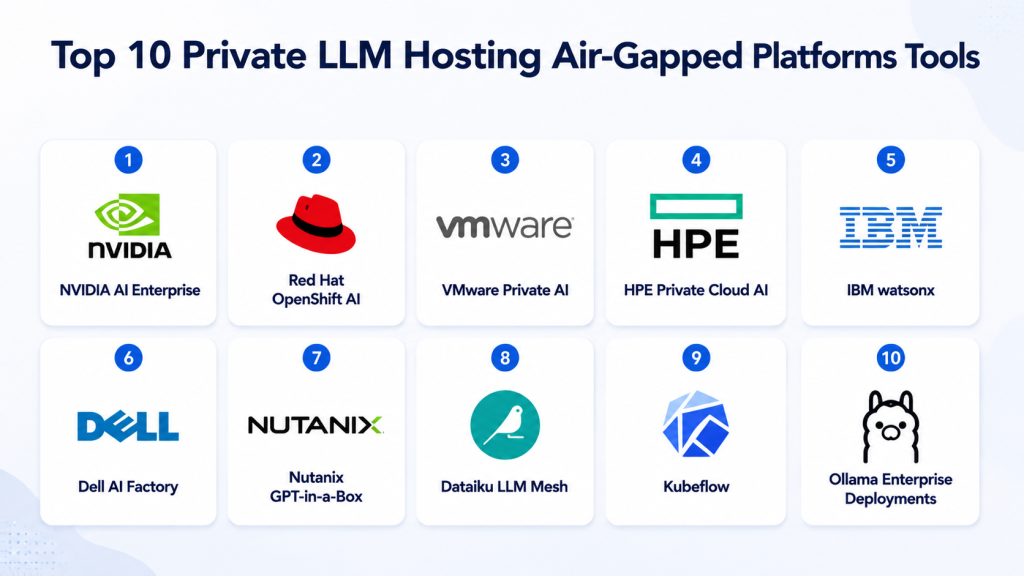
Top 10 Private LLM Hosting Air-Gapped Platforms Tools
1- NVIDIA AI Enterprise
One-line verdict: Best for large enterprises requiring optimized AI infrastructure and enterprise-grade deployment support.
Short Description
NVIDIA AI Enterprise provides a comprehensive software platform for deploying generative AI and machine learning workloads across private infrastructure. It is widely used in enterprise AI deployments requiring GPU acceleration and controlled environments.
Standout Capabilities
- Optimized inference stack
- Enterprise AI software suite
- NIM microservices
- GPU acceleration
- Model deployment toolkit
- Kubernetes support
- Hybrid deployment options
- Enterprise support ecosystem
AI-Specific Depth
- Model support: Open-source, proprietary, BYO models
- RAG / knowledge integration: Compatible with major vector databases
- Evaluation: Varies / N/A
- Guardrails: Varies / N/A
- Observability: Performance monitoring and inference metrics
Pros
- Excellent performance optimization
- Strong enterprise ecosystem
- Extensive hardware support
Cons
- Premium pricing
- Infrastructure complexity
- Requires GPU expertise
Security & Compliance
Supports RBAC, encryption, audit logging, and enterprise access controls. Certifications vary by deployment.
Deployment & Platforms
- Linux
- Kubernetes
- Private cloud
- Self-hosted
- Hybrid
Integrations & Ecosystem
Strong ecosystem centered around enterprise AI infrastructure.
- Kubernetes
- VMware
- Red Hat OpenShift
- Vector databases
- Enterprise APIs
- AI frameworks
Pricing Model
Enterprise subscription.
Best-Fit Scenarios
- Defense AI deployments
- Enterprise AI platforms
- Large-scale inference clusters
2- Red Hat OpenShift AI
One-line verdict: Best for organizations standardizing AI deployment across hybrid and air-gapped environments.
Short Description
OpenShift AI enables enterprises to deploy, manage, and govern AI workloads using Kubernetes-based infrastructure with strong enterprise controls.
Standout Capabilities
- Kubernetes-native AI platform
- MLOps integration
- Multi-cluster management
- Open-source ecosystem
- Model serving
- Governance controls
- Enterprise support
AI-Specific Depth
- Model support: Open-source, BYO
- RAG / knowledge integration: Vector DB integrations
- Evaluation: Supported through ecosystem tools
- Guardrails: Ecosystem-based
- Observability: Monitoring and tracing integrations
Pros
- Strong Kubernetes integration
- Flexible deployment options
- Large ecosystem
Cons
- Learning curve
- Infrastructure complexity
- Requires platform expertise
Security & Compliance
Supports enterprise authentication, RBAC, audit logging, and encryption.
Deployment & Platforms
- Linux
- OpenShift
- Self-hosted
- Hybrid
Integrations & Ecosystem
- Kubernetes
- OpenShift ecosystem
- MLflow
- Kubeflow
- Vector databases
Pricing Model
Enterprise subscription.
Best-Fit Scenarios
- Hybrid cloud AI
- Regulated industries
- Enterprise platform teams
3- VMware Private AI
One-line verdict: Best for enterprises extending existing VMware infrastructure into private AI.
Short Description
VMware Private AI combines virtualization infrastructure with enterprise AI deployment capabilities for secure and governed AI operations.
Standout Capabilities
- VMware ecosystem integration
- Secure AI deployment
- Data governance
- Infrastructure consistency
- Enterprise operations model
AI-Specific Depth
- Model support: Open-source and partner models
- RAG / knowledge integration: Supported through integrations
- Evaluation: Varies / N/A
- Guardrails: Varies / N/A
- Observability: Infrastructure-level monitoring
Pros
- Familiar enterprise operations
- Strong infrastructure controls
- Hybrid flexibility
Cons
- VMware dependency
- Less developer-focused
- Premium licensing
Security & Compliance
Enterprise access management, encryption, logging, and governance controls.
Deployment & Platforms
- VMware infrastructure
- Self-hosted
- Hybrid
Integrations & Ecosystem
- VMware ecosystem
- Kubernetes
- Enterprise storage
- AI frameworks
Pricing Model
Enterprise licensing.
Best-Fit Scenarios
- Existing VMware customers
- Private cloud environments
- Enterprise IT operations
4- HPE Private Cloud AI
One-line verdict: Best for organizations seeking turnkey private AI infrastructure.
Short Description
HPE Private Cloud AI delivers integrated AI infrastructure designed for enterprise-scale AI workloads with strong governance and operational controls.
Standout Capabilities
- Turnkey deployment
- Enterprise infrastructure
- AI-ready architecture
- Scalability
- Governance capabilities
AI-Specific Depth
- Model support: Open-source and enterprise models
- RAG / knowledge integration: Supported
- Evaluation: Varies / N/A
- Guardrails: Varies / N/A
- Observability: Infrastructure monitoring
Pros
- Simplified deployment
- Enterprise support
- Scalable architecture
Cons
- Hardware dependence
- Higher cost
- Less flexibility than DIY
Security & Compliance
Enterprise-grade security controls and governance.
Deployment & Platforms
- Self-hosted
- Private cloud
Integrations & Ecosystem
- Enterprise infrastructure
- Kubernetes
- AI software ecosystem
Pricing Model
Infrastructure and subscription based.
Best-Fit Scenarios
- Enterprise AI transformation
- Secure AI workloads
- Private cloud deployments
5- IBM watsonx
One-line verdict: Best for governed enterprise AI with strong compliance requirements.
Short Description
watsonx combines AI governance, model management, and enterprise deployment capabilities for organizations operating in regulated industries.
Standout Capabilities
- AI governance
- Model lifecycle management
- Enterprise security
- Compliance support
- Multi-model operations
AI-Specific Depth
- Model support: Open-source, IBM, BYO
- RAG / knowledge integration: Supported
- Evaluation: Built-in governance workflows
- Guardrails: Governance controls
- Observability: Monitoring and auditing
Pros
- Strong governance
- Enterprise-grade controls
- Flexible model options
Cons
- Enterprise complexity
- Learning curve
- Premium positioning
Security & Compliance
Enterprise security, auditing, RBAC, and governance capabilities.
Deployment & Platforms
- Hybrid
- Self-hosted
- Cloud
Integrations & Ecosystem
- IBM ecosystem
- Data platforms
- APIs
- Governance tooling
Pricing Model
Enterprise subscription.
Best-Fit Scenarios
- Banking
- Insurance
- Government agencies
6- Dell AI Factory
One-line verdict: Best for organizations building on Dell infrastructure.
Best-Fit Scenarios
- Enterprise AI infrastructure
- Secure deployments
- Existing Dell environments
7- Nutanix GPT-in-a-Box
One-line verdict: Best for simplified private generative AI deployments.
Best-Fit Scenarios
- Mid-market enterprises
- Private AI initiatives
- Hybrid deployments
8- Dataiku LLM Mesh
One-line verdict: Best for governed AI workflows and enterprise AI orchestration.
Best-Fit Scenarios
- AI governance programs
- Enterprise analytics
- Regulated environments
9- Kubeflow
One-line verdict: Best for open-source AI platform teams building custom AI infrastructure.
Best-Fit Scenarios
- Platform engineering teams
- Open-source environments
- Custom AI architectures
10- Ollama Enterprise Deployments
One-line verdict: Best for developer-led private AI and local model hosting.
Best-Fit Scenarios
- Developer teams
- Internal AI assistants
- Cost-sensitive deployments
Comparison Table
| Tool | Best For | Deployment | Model Flexibility | Strength | Watch-Out | Public Rating |
|---|---|---|---|---|---|---|
| NVIDIA AI Enterprise | Large Enterprise | Hybrid | Multi-model | Performance | Cost | N/A |
| OpenShift AI | Platform Teams | Hybrid | BYO | Flexibility | Complexity | N/A |
| VMware Private AI | VMware Users | Hybrid | BYO | Infrastructure Integration | Licensing | N/A |
| HPE Private Cloud AI | Enterprise AI | Private | Open-source | Turnkey Deployment | Cost | N/A |
| IBM watsonx | Governance | Hybrid | Multi-model | Compliance | Complexity | N/A |
| Dell AI Factory | Infrastructure | Private | BYO | Enterprise Hardware | Cost | N/A |
| Nutanix GPT-in-a-Box | Mid-Market | Hybrid | Open-source | Simplicity | Ecosystem Size | N/A |
| Dataiku LLM Mesh | Governance | Hybrid | Multi-model | AI Control | Licensing | N/A |
| Kubeflow | Developers | Self-hosted | BYO | Open Source | Complexity | N/A |
| Ollama Enterprise | Small Teams | Self-hosted | Open-source | Simplicity | Scaling | N/A |
Scoring & Evaluation
These scores are comparative rather than absolute. They reflect how each platform performs relative to other leading private LLM hosting platforms across deployment flexibility, governance, security, developer experience, AI reliability, and operational maturity.
| Tool | Core | Reliability/Eval | Guardrails | Integrations | Ease | Perf/Cost | Security/Admin | Support | Weighted Total |
|---|---|---|---|---|---|---|---|---|---|
| NVIDIA AI Enterprise | 10 | 9 | 8 | 10 | 7 | 10 | 9 | 9 | 9.2 |
| OpenShift AI | 9 | 8 | 8 | 10 | 7 | 8 | 9 | 9 | 8.6 |
| IBM watsonx | 9 | 9 | 9 | 8 | 7 | 8 | 10 | 9 | 8.8 |
| VMware Private AI | 8 | 8 | 8 | 8 | 8 | 8 | 9 | 8 | 8.2 |
| HPE Private Cloud AI | 8 | 8 | 8 | 8 | 8 | 8 | 9 | 8 | 8.1 |
| Dell AI Factory | 8 | 8 | 8 | 7 | 8 | 8 | 9 | 8 | 8.0 |
| Dataiku LLM Mesh | 8 | 9 | 9 | 8 | 8 | 7 | 9 | 8 | 8.3 |
| Nutanix GPT-in-a-Box | 7 | 7 | 7 | 7 | 9 | 8 | 8 | 8 | 7.7 |
| Kubeflow | 9 | 8 | 6 | 9 | 5 | 8 | 8 | 8 | 7.9 |
| Ollama Enterprise | 7 | 6 | 5 | 6 | 10 | 9 | 6 | 7 | 7.2 |
Top 3 for Enterprise
- NVIDIA AI Enterprise
- IBM watsonx
- Red Hat OpenShift AI
Top 3 for SMB
- Nutanix GPT-in-a-Box
- Ollama Enterprise Deployments
- Dataiku LLM Mesh
Top 3 for Developers
- Kubeflow
- Ollama Enterprise Deployments
- OpenShift AI
Which Private LLM Hosting Air-Gapped Platform Is Right for You?
Solo / Freelancer
Ollama is typically the simplest and most cost-effective option. It supports local model deployment and avoids complex enterprise infrastructure.
SMB
Nutanix GPT-in-a-Box and Dataiku LLM Mesh offer a balance between governance, usability, and deployment simplicity.
Mid-Market
OpenShift AI and VMware Private AI provide flexibility without requiring hyperscale infrastructure investments.
Enterprise
NVIDIA AI Enterprise, IBM watsonx, and HPE Private Cloud AI deliver the strongest governance, scalability, and operational controls.
Regulated Industries
Finance, healthcare, government, and defense organizations should prioritize IBM watsonx, NVIDIA AI Enterprise, and OpenShift AI due to their governance capabilities.
Budget vs Premium
Budget-conscious organizations may prefer Kubeflow and Ollama. Premium enterprise buyers should evaluate NVIDIA, IBM, HPE, and VMware.
Build vs Buy
Build using Kubeflow when customization is critical. Buy an enterprise platform when governance, support, and operational simplicity matter more than flexibility.
Implementation Playbook 30 / 60 / 90 Days
First 30 Days
- Define success metrics
- Select models
- Establish governance requirements
- Build pilot environment
- Create evaluation benchmarks
- Establish baseline latency and cost metrics
First 60 Days
- Implement RBAC
- Enable audit logging
- Perform red-team testing
- Deploy guardrails
- Establish prompt versioning
- Validate compliance controls
First 90 Days
- Optimize inference performance
- Expand user adoption
- Implement governance workflows
- Establish incident response procedures
- Scale infrastructure
- Automate evaluation pipelines
Common Mistakes & How to Avoid Them
- Deploying models without evaluation benchmarks
- Ignoring prompt injection risks
- Failing to implement RBAC
- No audit logging
- Excessive model sprawl
- Lack of governance policies
- Poor GPU utilization planning
- Overlooking data retention controls
- Missing observability capabilities
- No human review process
- Vendor lock-in through proprietary architectures
- Lack of disaster recovery planning
FAQs
What is an air-gapped AI platform?
An air-gapped AI platform operates in isolated environments without direct internet connectivity, reducing exposure to external threats.
Why host LLMs privately?
Private hosting improves security, compliance, data control, and intellectual property protection.
Can open-source models be used?
Yes. Most platforms support popular open-source models alongside custom models.
What is BYO model support?
It allows organizations to deploy their own fine-tuned or proprietary models.
Do air-gapped deployments support RAG?
Yes. Most enterprise deployments integrate vector databases and internal knowledge repositories.
Are these platforms suitable for healthcare?
Yes, particularly when handling sensitive patient information and compliance requirements.
How important are guardrails?
Guardrails help reduce policy violations, unsafe outputs, and prompt injection risks.
What role does evaluation play?
Evaluation ensures models remain accurate, reliable, and safe before production deployment.
Can these platforms support AI agents?
Increasingly yes. Agentic workflows are becoming a standard requirement.
Is self-hosting cheaper?
Not always. Hardware, staffing, maintenance, and operational costs can be significant.
How difficult is migration?
Difficulty varies depending on model dependencies, infrastructure architecture, and integration complexity.
What is the biggest buyer mistake?
Choosing a platform based solely on model performance while ignoring governance, security, and operational requirements.
Conclusion
Private LLM Hosting Air-Gapped Platforms have evolved from niche defense and intelligence deployments into a strategic enterprise AI category. Organizations now require far more than model hosting—they need governance, observability, evaluation, security controls, cost management, and support for agentic workflows. NVIDIA AI Enterprise, IBM watsonx, and Red Hat OpenShift AI currently lead for large enterprises, while Kubeflow and Ollama remain strong options for organizations prioritizing flexibility and control. The right choice depends on security requirements, internal expertise, deployment preferences, governance needs, and long-term AI strategy. Start by shortlisting three platforms, run a structured pilot with measurable evaluation criteria, validate security and governance controls, and then scale gradually across production workloads.
The comparison covers platform capabilities well, but it would be valuable to discuss disaster recovery and operational resilience in air-gapped environments. When inference clusters, storage systems, or GPU resources fail, recovery options are far more limited than in connected cloud environments, making redundancy planning a critical part of production readiness.
A unique challenge in air-gapped LLM environments is keeping models and knowledge sources current without introducing security risks. As new threats, regulations, and business information emerge, organizations must balance strict isolation requirements with the need for periodic updates. The update process itself can become a critical part of the platform’s long-term viability.