Introduction
PII Detection & Redaction Tools for AI Training are data privacy solutions that help organizations identify, remove, mask, or protect Personally Identifiable Information (PII) before using datasets for machine learning, Large Language Model (LLM) training, and AI development.
Modern AI systems require large amounts of training data, but enterprise datasets often contain sensitive information such as:
- Names
- Email addresses
- Phone numbers
- Addresses
- Financial details
- Medical information
- Government identifiers
- Customer records
Using raw sensitive data for AI training can create privacy, security, and compliance risks.
PII Detection & Redaction platforms help organizations prepare safe AI datasets by automatically finding sensitive information and applying protection techniques such as:
- Data masking
- Anonymization
- Tokenization
- Removal
- Replacement
- Encryption
These platforms are widely used by:
- AI engineers
- Data scientists
- MLOps teams
- Security teams
- Compliance teams
- Enterprise AI developers
Modern PII protection tools provide capabilities such as:
- Automated PII discovery
- Entity recognition
- Data classification
- Redaction workflows
- Privacy monitoring
- Compliance support
- Dataset cleaning
- AI training protection
The goal of PII Detection & Redaction for Training is to create privacy-safe datasets while maintaining useful information for AI model development.
What Is PII Detection?
PII Detection is the process of identifying personally identifiable information inside datasets.
Examples of PII include:
Personal Information
- Full names
- Addresses
- Email IDs
- Phone numbers
Financial Information
- Bank account numbers
- Credit card details
- Payment information
Healthcare Information
- Patient records
- Medical identifiers
Government Information
- Passport numbers
- Tax IDs
- Social security numbers
AI systems use techniques such as:
- Natural Language Processing
- Named Entity Recognition
- Pattern matching
- Machine learning models
to locate sensitive information.
What Is PII Redaction?
PII Redaction is the process of removing or hiding sensitive information from datasets.
Example:
Before:
Customer John Smith purchased a product.
Email: john@email.com
After:
Customer [NAME] purchased a product.
Email: [REDACTED]
Redaction helps organizations safely use data for:
- AI training
- Analytics
- Testing
- Research
Why PII Protection Matters for AI Training
AI training datasets often contain valuable information but may also include sensitive details.
Without proper protection, organizations risk:
- Privacy violations
- Data leaks
- Regulatory penalties
- Security problems
- Unauthorized exposure
PII detection tools help organizations:
- Protect customer information
- Meet compliance requirements
- Build safer AI systems
- Share datasets securely
How PII Detection & Redaction Works
Step 1: Data Collection
Systems analyze:
- Documents
- Text files
- Databases
- Logs
- Conversations
Step 2: PII Identification
AI models detect:
- Names
- Locations
- Identifiers
- Sensitive entities
Step 3: Classification
Detected information is categorized by:
- Data type
- Risk level
- Sensitivity
Step 4: Redaction
The system applies:
- Masking
- Removal
- Replacement
- Encryption
Step 5: Validation
Teams verify:
- Privacy protection
- Data usability
- Compliance
Types of PII Protection Methods
Masking
Replacing sensitive values with hidden characters.
Example:
john@email.com
****
Tokenization
Replacing real values with generated tokens.
Example:
John Smith → User_123
Anonymization
Removing identifying information completely.
Pseudonymization
Replacing identity while maintaining relationships.
Data Filtering
Removing unwanted sensitive records.
Key Components of PII Detection Platforms
Detection Engine
Identifies:
- Sensitive entities
- Personal information
NLP Processing Layer
Uses:
- Entity recognition
- Language models
Rule-Based Detection
Uses:
- Patterns
- Regular expressions
Redaction Engine
Handles:
- Masking
- Replacement
- Removal
Compliance Management
Supports:
- Privacy regulations
- Audit tracking
Integration Layer
Connects with:
- Data pipelines
- AI workflows
- Cloud platforms
Key Features of PII Detection & Redaction Tools
Automated PII Discovery
Finds sensitive information automatically.
Multi-Format Support
Works with:
- Text
- Documents
- Databases
- Logs
AI-Based Detection
Uses:
- NLP
- Machine learning
Custom Rules
Allows organizations to define:
- Sensitive patterns
- Business rules
Compliance Support
Helps meet:
- GDPR
- HIPAA
- Data privacy standards
Training Data Preparation
Creates:
- Clean datasets
- Safe AI training material
Common Use Cases
LLM Training Data Protection
Removing sensitive information from:
- Conversations
- Documents
- Text datasets
Healthcare AI
Protecting:
- Patient information
- Medical records
Financial AI
Removing:
- Account details
- Transaction information
Customer Support AI
Protecting:
- Chat history
- Customer details
Data Sharing
Preparing safe datasets for:
- Research
- Development
AI Governance
Supporting:
- Responsible AI practices
Benefits of PII Detection & Redaction Tools
Improved Data Privacy
Sensitive information remains protected.
Safer AI Training
Models are trained on cleaner datasets.
Regulatory Compliance
Helps organizations follow privacy requirements.
Reduced Security Risks
Limits accidental exposure.
Faster Data Preparation
Automation reduces manual review.
Evaluation Criteria
Detection Accuracy
Evaluate:
- Entity recognition
- False positives
- False negatives
Data Coverage
Check support for:
- Text
- Documents
- Databases
AI Integration
Evaluate:
- ML pipeline support
- API availability
Compliance Features
Consider:
- Privacy standards
- Audit capabilities
Scalability
Evaluate:
- Large dataset processing
- Enterprise workloads
Customization
Check:
- Custom rules
- Domain-specific detection
Key Trends
AI-Powered Privacy Protection
Machine learning is improving PII detection accuracy.
Privacy-Aware LLM Training
Organizations are focusing on:
- Safe datasets
- Responsible AI
Automated Data Governance
AI systems are helping monitor sensitive information.
Privacy-Preserving Machine Learning
Techniques such as:
- Differential privacy
- Data anonymization
are becoming more common.
Real-Time PII Monitoring
Organizations are detecting sensitive data continuously.
Methodology
The following PII Detection & Redaction Tools were evaluated based on:
- Detection accuracy
- Redaction capabilities
- AI integration
- Privacy features
- Scalability
- Compliance support
- Enterprise readiness
- Ease of use
- Security
- Value
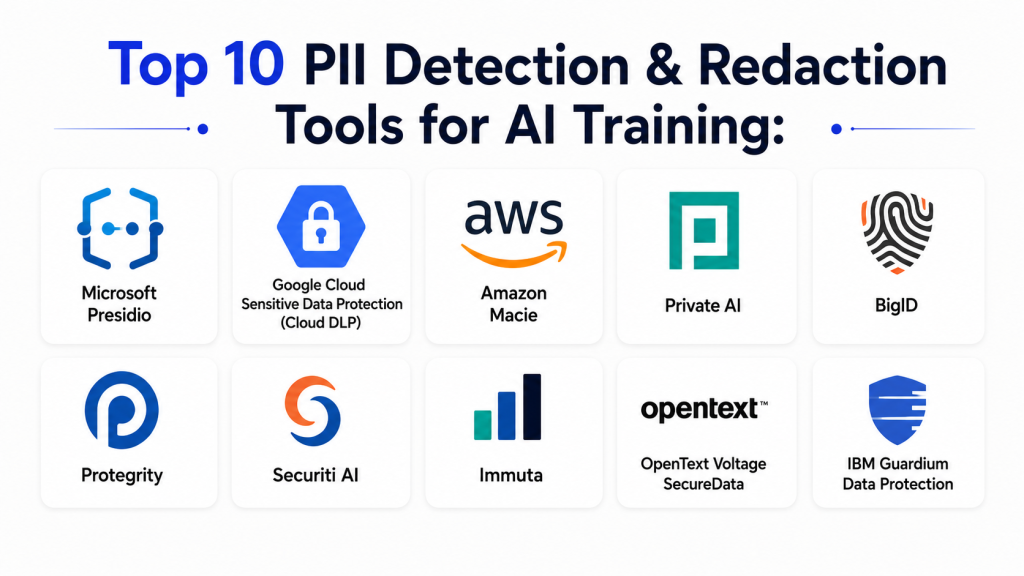
Top 10 PII Detection & Redaction Tools for AI Training
1. Microsoft Presidio
Microsoft Presidio is an open-source framework for identifying and anonymizing sensitive information.
Key Features
- PII detection
- Named entity recognition
- Data anonymization
- Custom recognizers
- Text analysis
- Privacy workflows
- AI integration
- Multiple language support
- Developer APIs
- Open-source framework
Pros
- Open source
- Flexible customization
- Developer friendly
- Strong NLP capabilities
Cons
- Requires technical setup
- Needs configuration for advanced use cases
2. Google Cloud Sensitive Data Protection
Google Cloud Sensitive Data Protection helps organizations discover and protect sensitive information.
Key Features
- Data discovery
- PII classification
- Data masking
- Tokenization
- Risk analysis
- Cloud integration
- Compliance support
- Automated scanning
Pros
- Enterprise security
- Strong cloud integration
- Scalable
Cons
- Google Cloud dependency
3. AWS Comprehend PII Detection
AWS Comprehend provides machine learning-based PII detection.
Key Features
- Entity recognition
- Text analysis
- PII identification
- NLP processing
- API integration
- AWS workflow support
- Automated detection
Pros
- Easy AWS integration
- Managed service
- Good NLP capabilities
Cons
- AWS ecosystem dependency
4. Amazon Macie
Amazon Macie helps discover and protect sensitive data stored in AWS environments.
Key Features
- Data discovery
- PII identification
- Security monitoring
- Risk classification
- Data protection
- Compliance support
- AWS integration
Pros
- Strong cloud security
- Automated discovery
- Enterprise ready
Cons
- AWS focused
5. IBM Guardium Data Protection
IBM Guardium provides enterprise data security and privacy management.
Key Features
- Data discovery
- Sensitive data monitoring
- Compliance reporting
- Data protection
- Security analytics
- Access monitoring
Pros
- Enterprise security
- Strong governance
- Compliance features
Cons
- Complex deployment
6. Private AI
Private AI provides privacy solutions for AI applications.
Key Features
- PII detection
- Data anonymization
- NLP privacy protection
- AI training protection
- API integration
- Multiple languages
- Privacy workflows
Pros
- AI-focused privacy
- Strong PII detection
Cons
- Commercial solution
7. Nightfall AI
Nightfall AI provides data protection and privacy monitoring.
Key Features
- Sensitive data discovery
- PII detection
- Data classification
- Cloud monitoring
- Security alerts
- Compliance support
Pros
- Modern security platform
- Strong automation
Cons
- Enterprise pricing
8. BigID
BigID provides data discovery and privacy management solutions.
Key Features
- Data discovery
- Classification
- Privacy management
- Risk assessment
- Compliance workflows
- Data intelligence
Pros
- Enterprise governance
- Strong discovery features
Cons
- Complex implementation
9. Immuta
Immuta provides data access and privacy management.
Key Features
- Data policy management
- Access control
- Privacy automation
- Data governance
- Compliance support
- Secure data sharing
Pros
- Strong governance
- Enterprise focused
Cons
- Requires setup
10. OpenText Voltage SecureData
OpenText Voltage provides data protection and tokenization solutions.
Key Features
- Data masking
- Tokenization
- Encryption
- Privacy protection
- Enterprise security
- Compliance support
Pros
- Strong security
- Enterprise adoption
Cons
- Complex deployment
Comparison Table: Top 10 PII Detection & Redaction Tools
| No. | Tool Name | Best For | Platform(s) Supported | Deployment | Standout Feature | Public Rating |
|---|---|---|---|---|---|---|
| 1 | Microsoft Presidio | AI data privacy | Cloud / Local | Open Source | Custom PII detection | 4.8/5 |
| 2 | Google Sensitive Data Protection | Cloud privacy | GCP | Managed | Data discovery | 4.7/5 |
| 3 | AWS Comprehend PII | NLP privacy | AWS | Managed | AI entity detection | 4.7/5 |
| 4 | Amazon Macie | Cloud security | AWS | Managed | Sensitive data discovery | 4.6/5 |
| 5 | IBM Guardium | Enterprise governance | Cloud / Local | Enterprise | Data protection | 4.6/5 |
| 6 | Private AI | AI privacy | Cloud | Managed | AI-focused PII removal | 4.5/5 |
| 7 | Nightfall AI | Data security | Cloud | Managed | Automated detection | 4.5/5 |
| 8 | BigID | Data intelligence | Cloud | Enterprise | Data discovery | 4.5/5 |
| 9 | Immuta | Data governance | Cloud | Enterprise | Policy automation | 4.4/5 |
| 10 | OpenText Voltage | Data protection | Cloud / Local | Enterprise | Tokenization | 4.4/5 |
Weighted Evaluation Table
| No. | Tool Name | Detection 25% | Ease of Use 15% | AI Integration 15% | Security 10% | Scalability 10% | Compliance 10% | Value 15% | Total Score |
|---|---|---|---|---|---|---|---|---|---|
| 1 | Microsoft Presidio | 25 | 14 | 15 | 9 | 10 | 10 | 15 | 98 |
| 2 | Google Sensitive Data Protection | 25 | 14 | 15 | 10 | 10 | 10 | 13 | 97 |
| 3 | AWS Comprehend PII | 24 | 15 | 15 | 10 | 10 | 10 | 13 | 97 |
| 4 | Amazon Macie | 24 | 14 | 14 | 10 | 10 | 10 | 14 | 96 |
| 5 | IBM Guardium | 24 | 13 | 14 | 10 | 10 | 10 | 14 | 95 |
| 6 | Private AI | 24 | 14 | 15 | 9 | 10 | 10 | 13 | 95 |
| 7 | Nightfall AI | 23 | 14 | 14 | 10 | 10 | 10 | 13 | 94 |
| 8 | BigID | 24 | 13 | 14 | 10 | 10 | 10 | 13 | 94 |
| 9 | Immuta | 23 | 13 | 14 | 10 | 10 | 10 | 13 | 93 |
| 10 | OpenText Voltage | 23 | 12 | 13 | 10 | 10 | 10 | 14 | 92 |
Which PII Detection & Redaction Tool Is Right for You?
Choose Microsoft Presidio for flexible AI privacy workflows.
Choose Google Sensitive Data Protection for cloud data protection.
Choose AWS Comprehend PII Detection for AWS AI applications.
Choose Amazon Macie for AWS security monitoring.
Choose IBM Guardium for enterprise governance.
Choose Private AI for AI-specific privacy protection.
Choose Nightfall AI for automated data security.
Choose BigID for enterprise data discovery.
Choose Immuta for data governance.
Choose OpenText Voltage for tokenization and encryption.
Implementation Playbook
Phase 1: Identify Sensitive Data
- Review datasets
- Define PII categories
- Create privacy rules
Phase 2: Configure Detection
- Setup detection models
- Add custom patterns
- Test accuracy
Phase 3: Apply Redaction
- Mask sensitive fields
- Remove unnecessary information
- Protect identities
Phase 4: Validate Dataset
- Check privacy
- Review quality
- Approve training data
Phase 5: Integrate With AI Pipeline
- Connect with ML workflows
- Monitor data usage
- Maintain compliance
Common Mistakes
- Training AI with raw sensitive data
- Ignoring privacy regulations
- Poor PII detection rules
- No validation process
- Weak access controls
- Lack of monitoring
FAQs
1. What are PII Detection & Redaction Tools?
They are platforms that identify and remove sensitive personal information from datasets.
2. Why is PII removal important for AI training?
It protects privacy and reduces security risks.
3. What types of PII can tools detect?
Names, emails, addresses, financial details, medical information, and identifiers.
4. Can PII tools protect LLM training data?
Yes, they help prepare safer datasets for AI models.
5. Are open-source PII tools available?
Yes, Microsoft Presidio provides an open-source option.
6. How accurate are PII detection tools?
Accuracy depends on models, configuration, and data complexity.
7. Can PII tools support compliance requirements?
Yes, many support GDPR, HIPAA, and privacy standards.
8. Do these tools work with unstructured data?
Yes, many support documents, text, and conversations.
9. Can PII redaction be automated?
Yes, modern tools provide automated detection and masking.
10. What is the future of PII protection in AI?
AI privacy systems will become essential for secure and responsible AI development.
Conclusion
PII Detection & Redaction Tools are becoming a critical part of responsible AI development. They help organizations protect sensitive information while creating high-quality datasets for machine learning and LLM training.Platforms such as Microsoft Presidio, Google Sensitive Data Protection, AWS Comprehend PII Detection, Private AI, BigID, and IBM Guardium help enterprises build privacy-safe AI workflows.As AI adoption grows, protecting personal information during training and deployment will remain essential for secure, compliant, and trustworthy AI systems.