Introduction
Prompt Versioning Systems are AI development tools that help teams create, manage, track, test, compare, and improve prompts used in large language models (LLMs) and generative AI applications.
As organizations increasingly use AI assistants, chatbots, AI agents, and automation systems, prompts have become important production assets. A small change in a prompt can significantly impact AI output quality, accuracy, safety, and user experience.
Prompt versioning systems provide a structured way to manage prompt changes by maintaining:
- Prompt history
- Different versions
- Performance results
- Testing outcomes
- Team collaboration
- Deployment workflows
These platforms help organizations:
- Track prompt modifications
- Compare prompt performance
- Roll back previous versions
- Improve AI response quality
- Maintain consistency across AI applications
- Support prompt engineering workflows
Prompt Versioning Systems are used by:
- AI engineers
- Prompt engineers
- Machine learning teams
- Product developers
- LLM application teams
- Enterprise AI teams
Modern prompt management platforms provide capabilities such as:
- Prompt templates
- Version control
- Prompt testing
- Evaluation tracking
- Collaboration
- Deployment management
- Experiment tracking
- Analytics
- Security controls
- Integration with LLM providers
The goal of Prompt Versioning Systems is to help teams build reliable, scalable, and maintainable generative AI applications.
What Are Prompt Versioning Systems?
Prompt Versioning Systems are platforms that store and manage different versions of prompts used with AI models.
A prompt version represents a specific change made to an instruction given to an AI model.
Example:
Version 1:
“Summarize this document.”
Version 2:
“Summarize this document in five bullet points with key business insights.”
A prompt versioning system tracks these changes and measures which version produces better results.
Why Organizations Need Prompt Versioning Systems
LLM applications constantly require prompt improvements because:
- Models change
- User requirements change
- AI responses need optimization
- Business workflows evolve
Without prompt versioning, teams face:
- Lost prompt improvements
- Difficult debugging
- Inconsistent AI outputs
- Poor collaboration
- Deployment problems
Prompt versioning systems help organizations:
- Maintain prompt history
- Improve AI quality
- Test changes safely
- Manage AI applications efficiently
How Prompt Versioning Systems Work
Prompt Creation
Developers create:
- Instructions
- Templates
- System prompts
- AI workflows
Version Tracking
Every change creates:
- New version
- Timestamp
- Author information
- Change history
Testing
Teams evaluate prompts using:
- Test datasets
- AI responses
- Performance metrics
Comparison
Different versions are compared based on:
- Accuracy
- Quality
- Safety
- Cost
Deployment
Approved prompts are deployed into:
- Applications
- Chatbots
- AI agents
Monitoring
Teams track:
- User feedback
- Model responses
- Performance changes
Key Components of Prompt Versioning Systems
Prompt Repository
Stores:
- Prompt templates
- Versions
- Metadata
Version Control Engine
Manages:
- Changes
- History
- Rollbacks
Testing Framework
Supports:
- Prompt evaluation
- Automated testing
- Benchmarking
Collaboration Layer
Enables:
- Team reviews
- Sharing
- Approval workflows
Analytics System
Tracks:
- Response quality
- Usage
- Performance
Deployment Management
Handles:
- Production releases
- Environment management
Types of Prompt Versioning Systems
Developer-Focused Tools
Designed for:
- AI engineers
- Developers
- Researchers
Examples:
- LangSmith
- PromptLayer
Enterprise Prompt Management Platforms
Designed for:
- Large teams
- Governance
- Collaboration
Examples:
- Humanloop
- Braintrust
Open Source Prompt Systems
Designed for:
- Custom workflows
- Self-hosting
Examples:
- Langfuse
- OpenPrompt
AI Application Platforms
Include:
- Prompt workflows
- Evaluation
- Monitoring
Key Features of Prompt Versioning Systems
Prompt History Tracking
Maintains:
- Previous versions
- Change logs
- Contributors
Prompt Comparison
Allows teams to:
- Compare outputs
- Select better versions
- Optimize performance
Prompt Templates
Supports:
- Reusable prompts
- Variables
- Dynamic workflows
Automated Evaluation
Measures:
- Response accuracy
- Quality
- Safety
Collaboration Tools
Supports:
- Team editing
- Reviews
- Approvals
Deployment Controls
Manages:
- Production prompts
- Testing environments
- Rollbacks
Common Use Cases
AI Chatbots
Managing:
- Customer support prompts
- Conversation flows
AI Agents
Optimizing:
- Agent instructions
- Tool usage prompts
Content Generation
Improving:
- Marketing prompts
- Writing workflows
Enterprise Search
Managing:
- RAG prompts
- Knowledge queries
Software Development Assistants
Optimizing:
- Code generation prompts
- Debugging instructions
Data Analysis Assistants
Improving:
- Analytical prompts
- Report generation
Why Prompt Versioning Systems Matter
Better AI Quality
Teams improve outputs through testing.
Safer AI Updates
Changes can be reviewed before deployment.
Faster Collaboration
Multiple teams can work together.
Easier Debugging
Previous versions help identify problems.
Enterprise AI Governance
Organizations maintain control over AI behavior.
Evaluation Criteria for Buyers
Version Control
Evaluate:
- History tracking
- Rollback support
- Change management
Testing Capabilities
Consider:
- Evaluation tools
- Benchmark support
- Automated testing
Integration Support
Look for:
- LLM providers
- AI frameworks
- Application platforms
Collaboration
Evaluate:
- Team workflows
- Permissions
- Reviews
Analytics
Consider:
- Performance tracking
- User feedback
- Cost analysis
Security
Evaluate:
- Access control
- Data protection
- Compliance
Key Trends
Prompt Engineering Maturity
Organizations are treating prompts as production assets.
AI Application Governance
Companies are adding approval workflows.
Automated Prompt Optimization
AI systems are helping improve prompts automatically.
Prompt Testing Automation
Teams are adopting continuous prompt evaluation.
Agent Prompt Management
Prompt systems are expanding to AI agent workflows.
Enterprise Prompt Libraries
Organizations are creating reusable prompt repositories.
Methodology
The following Prompt Versioning Systems were evaluated based on:
- Version control capabilities
- Prompt management features
- Evaluation support
- Collaboration
- Integration ecosystem
- Deployment support
- Security
- Developer experience
- Enterprise readiness
- Value
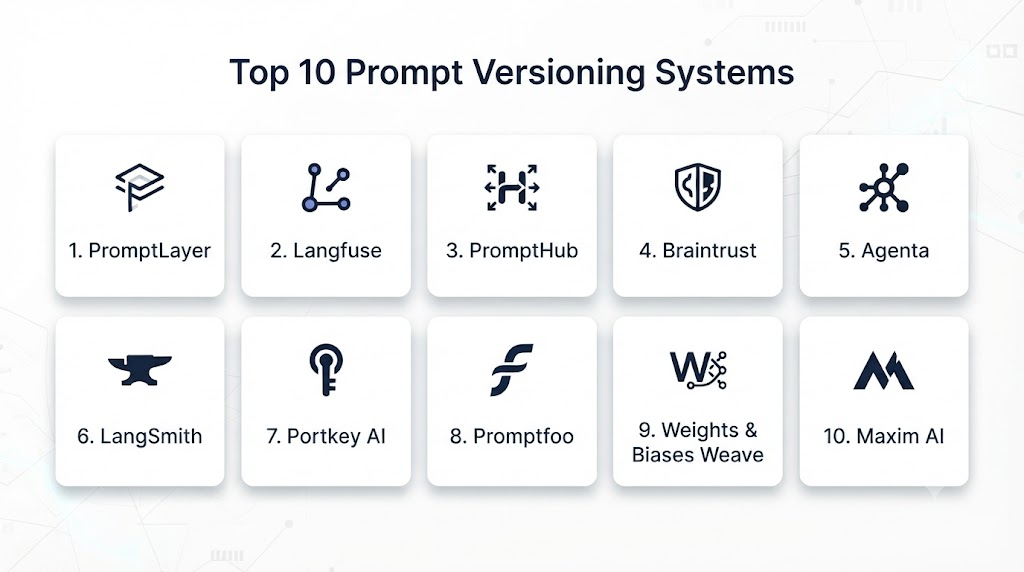
Top 10 Prompt Versioning Systems
1. LangSmith
LangSmith provides prompt management, tracing, and evaluation capabilities for LLM applications.
Key Features
- Prompt version tracking
- Prompt testing
- LLM tracing
- Evaluation workflows
- Dataset management
- Experiment comparison
- Application monitoring
- Agent support
- Collaboration
- Developer APIs
Pros
- Strong LLM workflow support
- Good debugging
- Developer-friendly
- Agent integration
- Evaluation capabilities
Cons
- Best with LangChain ecosystem
- Requires technical knowledge
- Enterprise features may require upgrades
Platforms
Cloud environments.
Deployment or Support
LLM application development.
Security & Compliance
Platform security controls.
Integrations & Ecosystem
LLM frameworks and providers.
Support & Community
Developer community.
2. PromptLayer
PromptLayer focuses on prompt management and version control for LLM applications.
Key Features
- Prompt versioning
- Prompt repository
- Request tracking
- Analytics
- Collaboration
- Prompt templates
- Testing
- Deployment workflows
- LLM integrations
- Monitoring
Pros
- Strong prompt management
- Easy integration
- Good tracking
- Developer-friendly
- Simple workflow
Cons
- Focused mainly on prompts
- Requires integration
- Advanced features vary
Platforms
Cloud environments.
Deployment or Support
AI development teams.
Security & Compliance
Enterprise controls.
Integrations & Ecosystem
LLM APIs.
Support & Community
Developer community.
3. Langfuse
Langfuse provides open-source LLM observability and prompt management.
Key Features
- Prompt versioning
- LLM tracing
- Evaluation
- Analytics
- Cost tracking
- Dataset management
- Collaboration
- Open-source deployment
- Experiment tracking
- API support
Pros
- Open source
- Flexible deployment
- Strong observability
- Good community
- Cost tracking
Cons
- Requires setup
- Technical knowledge needed
- Enterprise features vary
Platforms
Cloud and self-hosted environments.
Deployment or Support
LLM application teams.
Security & Compliance
Self-managed security.
Integrations & Ecosystem
LLM frameworks.
Support & Community
Open-source community.
4. Humanloop
Humanloop provides prompt engineering and evaluation workflows.
Key Features
- Prompt versioning
- Prompt testing
- Evaluation
- Collaboration
- Feedback collection
- Model comparison
- Dataset management
- Deployment workflows
- Analytics
- AI improvement tools
Pros
- User-friendly
- Strong evaluation
- Good collaboration
- Prompt-focused
- Enterprise workflows
Cons
- Premium pricing
- Requires integration
- Smaller ecosystem
Platforms
Cloud environments.
Deployment or Support
AI product teams.
Security & Compliance
Enterprise controls.
Integrations & Ecosystem
LLM providers.
Support & Community
Developer community.
5. Braintrust
Braintrust provides AI evaluation and prompt management capabilities.
Key Features
- Prompt experiments
- Version tracking
- Evaluation workflows
- Dataset management
- Analytics
- Collaboration
- AI testing
- Performance tracking
- Developer tools
- Experiment comparison
Pros
- Strong evaluation
- Good testing workflows
- Developer-friendly
- Flexible
- Analytics support
Cons
- Requires technical knowledge
- Newer ecosystem
- Enterprise pricing
Platforms
Cloud environments.
Deployment or Support
AI development teams.
Security & Compliance
Enterprise controls.
Integrations & Ecosystem
AI frameworks.
Support & Community
Developer community.
6. Weights & Biases Weave
Weave provides AI experiment tracking and prompt workflow management.
Key Features
- Prompt tracking
- Experiment management
- Evaluation
- Visualization
- Collaboration
- Dataset tracking
- Model comparison
- AI monitoring
- Workflow management
- Analytics
Pros
- Strong tracking
- Excellent visualization
- ML ecosystem support
- Good collaboration
- Developer-friendly
Cons
- Requires setup
- Enterprise features cost more
- Not only prompt focused
Platforms
Cloud environments.
Deployment or Support
AI engineering teams.
Security & Compliance
Enterprise controls.
Integrations & Ecosystem
ML frameworks.
Support & Community
Developer community.
7. Helicone
Helicone provides LLM analytics and monitoring with prompt tracking features.
Key Features
- Prompt tracking
- Request logging
- Cost monitoring
- Analytics
- Performance tracking
- API monitoring
- Debugging
- Model comparison
- Reporting
- Developer tools
Pros
- Easy setup
- Strong analytics
- Cost tracking
- Lightweight
- Developer-friendly
Cons
- Limited prompt lifecycle features
- Monitoring focused
- Requires integrations
Platforms
Cloud environments.
Deployment or Support
LLM applications.
Security & Compliance
Platform controls.
Integrations & Ecosystem
LLM APIs.
Support & Community
Developer community.
8. PromptHub
PromptHub provides prompt management and collaboration workflows.
Key Features
- Prompt library
- Version control
- Testing
- Sharing
- Collaboration
- Prompt organization
- AI workflows
- Templates
- Team management
- Documentation
Pros
- Easy prompt organization
- Good collaboration
- Simple interface
- Prompt-focused
- Useful for teams
Cons
- Limited advanced evaluation
- Smaller ecosystem
- Requires integrations
Platforms
Cloud environments.
Deployment or Support
Prompt engineering teams.
Security & Compliance
Platform controls.
Integrations & Ecosystem
AI tools.
Support & Community
Developer community.
9. MLflow Prompt Management
MLflow provides prompt tracking capabilities within its AI lifecycle platform.
Key Features
- Prompt versioning
- Experiment tracking
- Model management
- Artifact storage
- Evaluation
- Collaboration
- AI lifecycle integration
- Metadata tracking
- Deployment workflows
- Open-source support
Pros
- Open source
- Complete AI lifecycle support
- Flexible
- Large ecosystem
- Cost-effective
Cons
- Requires setup
- Prompt-specific features developing
- Infrastructure management needed
Platforms
Cloud and local environments.
Deployment or Support
MLOps teams.
Security & Compliance
Depends on deployment.
Integrations & Ecosystem
ML frameworks.
Support & Community
Large community.
10. Arize Phoenix
Arize Phoenix provides LLM observability and evaluation capabilities.
Key Features
- Prompt tracking
- LLM tracing
- Evaluation
- Debugging
- Performance analysis
- Monitoring
- Experiment tracking
- Visualization
- Open-source support
- AI quality management
Pros
- Strong observability
- Open source
- Good debugging
- AI-focused
- Evaluation support
Cons
- Monitoring focused
- Requires setup
- Technical knowledge needed
Platforms
Cloud and local environments.
Deployment or Support
AI engineering teams.
Security & Compliance
Depends on deployment.
Integrations & Ecosystem
AI frameworks.
Support & Community
Developer community.
Comparison Table
| Tool Name | Best For | Platform(s) Supported | Deployment | Standout Feature | Public Rating |
|---|---|---|---|---|---|
| LangSmith | LLM applications | Cloud | Flexible | Prompt + tracing | |
| PromptLayer | Prompt management | Cloud | Flexible | Version control | |
| Langfuse | Open-source LLMOps | Cloud/Self-hosted | Flexible | Prompt observability | |
| Humanloop | Prompt teams | Cloud | Business | Evaluation workflows | |
| Braintrust | AI testing | Cloud | Flexible | Experiments | |
| W&B Weave | AI tracking | Cloud | Flexible | Visualization | |
| Helicone | LLM analytics | Cloud | Flexible | Cost tracking | |
| PromptHub | Prompt libraries | Cloud | Flexible | Collaboration | |
| MLflow | AI lifecycle | Cloud/Local | Flexible | Open-source | |
| Arize Phoenix | AI observability | Cloud/Local | Flexible | Debugging |
Weighted Evaluation
| Tool Name | Core Features 25% | Ease of Use 15% | Integrations & Ecosystem 15% | Security & Compliance 10% | Performance & Reliability 10% | Support & Community 10% | Price/Value 15% | Total |
|---|---|---|---|---|---|---|---|---|
| LangSmith | 25 | 15 | 14 | 10 | 10 | 10 | 14 | 98 |
| PromptLayer | 24 | 15 | 14 | 10 | 10 | 10 | 15 | 98 |
| Langfuse | 24 | 14 | 15 | 10 | 10 | 10 | 15 | 98 |
| Humanloop | 23 | 15 | 13 | 10 | 10 | 10 | 14 | 95 |
| Braintrust | 24 | 14 | 14 | 10 | 10 | 10 | 14 | 96 |
| W&B Weave | 24 | 14 | 15 | 10 | 10 | 10 | 14 | 97 |
| Helicone | 22 | 15 | 13 | 10 | 10 | 10 | 15 | 95 |
| PromptHub | 22 | 15 | 13 | 10 | 10 | 10 | 15 | 95 |
| MLflow | 24 | 14 | 15 | 10 | 10 | 10 | 15 | 98 |
| Arize Phoenix | 23 | 14 | 14 | 10 | 10 | 10 | 15 | 96 |
Which Prompt Versioning System Is Right for You?
Choose LangSmith for LLM application development.
Choose PromptLayer for dedicated prompt management.
Choose Langfuse for open-source prompt workflows.
Choose Humanloop for prompt evaluation teams.
Choose Braintrust for AI testing and experiments.
Choose Weights & Biases Weave for AI tracking.
Choose Helicone for LLM analytics.
Choose PromptHub for prompt libraries.
Choose MLflow for complete AI lifecycle management.
Choose Arize Phoenix for LLM observability.
Implementation Playbook
Phase 1: Create Prompt Management Strategy
- Define prompt ownership
- Create naming standards
- Organize prompt libraries
Phase 2: Enable Version Control
- Track changes
- Maintain history
- Review updates
Phase 3: Test Prompt Performance
- Create evaluation datasets
- Compare outputs
- Measure quality
Phase 4: Deploy Safely
- Approve versions
- Monitor performance
- Enable rollback
Phase 5: Improve Continuously
- Analyze feedback
- Optimize prompts
- Update workflows
Common Mistakes
- No prompt version tracking
- Changing prompts without testing
- Poor documentation
- Lack of evaluation
- No rollback strategy
- Ignoring security
- Managing prompts manually
FAQs
1. What are Prompt Versioning Systems?
They are tools that help teams manage, track, and improve prompt versions for AI applications.
2. Why is prompt versioning important?
It helps maintain AI quality, collaboration, and controlled updates.
3. Who uses prompt versioning tools?
AI engineers, prompt engineers, developers, and product teams use them.
4. Can prompt versions be compared?
Yes, many platforms support prompt testing and comparison.
5. Do prompt versioning systems support LLM applications?
Yes, they are designed for generative AI workflows.
6. Can teams collaborate on prompts?
Yes, most provide sharing and review features.
7. How do prompt systems improve AI quality?
They allow testing, evaluation, and optimization of prompts.
8. Are open-source prompt versioning tools available?
Yes, Langfuse and MLflow provide open-source options.
9. Can prompt systems integrate with AI agents?
Yes, many support agent workflows and AI applications.
10. What is the future of prompt versioning?
Prompt management will become a key part of enterprise AI governance and LLM operations.
Conclusion
Prompt Versioning Systems are becoming essential for managing modern generative AI applications. They help organizations treat prompts as valuable AI assets by providing version control, testing, collaboration, and performance tracking.Platforms such as LangSmith, PromptLayer, Langfuse, Humanloop, Braintrust, and MLflow help teams build reliable and scalable AI workflows.As businesses continue adopting LLM applications and AI agents, prompt versioning will play a critical role in improving AI quality, reducing risks, and managing enterprise AI operations.