Introduction
Model Canary & A/B Deployment Tools are AI deployment platforms that help organizations safely release, test, compare, and manage machine learning models in production environments.
Deploying a new AI model directly to all users can create risks such as unexpected prediction changes, performance issues, accuracy drops, or business impact. Canary and A/B deployment strategies allow teams to gradually introduce new models, compare performance, and make data-driven deployment decisions.
These platforms help organizations:
- Test new models safely
- Compare multiple model versions
- Reduce deployment risks
- Monitor production performance
- Roll back unsuccessful releases
- Improve AI reliability
Model Canary & A/B Deployment Tools are used by:
- MLOps engineers
- Machine learning teams
- AI platform engineers
- DevOps teams
- Data scientists
- Enterprise AI organizations
Modern model deployment platforms provide capabilities such as:
- Canary releases
- A/B testing
- Traffic splitting
- Model version control
- Automated rollback
- Performance monitoring
- Experiment tracking
- Deployment automation
- Kubernetes integration
- Production analytics
The goal of Model Canary & A/B Deployment Tools is to help organizations deploy AI models faster while maintaining reliability, performance, and business confidence.
What Are Model Canary & A/B Deployment Tools?
Model Canary & A/B Deployment Tools are systems that allow teams to run multiple model versions simultaneously and evaluate their performance before full deployment.
A canary deployment introduces a new model to a small percentage of users first.
Example:
- Old Model Version: 95% traffic
- New Model Version: 5% traffic
The system monitors:
- Accuracy
- Latency
- Errors
- User feedback
If the new model performs well, traffic gradually increases.
What Is A/B Model Deployment?
A/B deployment compares two or more models by sending different users to different versions.
Example:
Model A:
- Existing recommendation model
Model B:
- New improved recommendation model
The organization compares:
- Click-through rates
- Conversion rates
- Prediction quality
- User engagement
The better model becomes the production version.
Why Organizations Need Model Deployment Testing Tools
Machine learning models can behave differently after deployment because of:
- Real-world data changes
- User behavior changes
- Production environments
- Infrastructure differences
Without controlled deployment, organizations may face:
- Poor AI decisions
- Business losses
- Customer dissatisfaction
- Difficult rollbacks
Canary and A/B deployment tools help organizations:
- Reduce deployment risks
- Validate models in production
- Improve AI quality
- Deploy confidently
How Model Canary & A/B Deployment Works
Model Preparation
Teams create:
- New model version
- Deployment package
- Evaluation metrics
Initial Deployment
The new model receives:
- Limited traffic
- Controlled users
- Specific workloads
Performance Monitoring
The system tracks:
- Accuracy
- Latency
- Errors
- Business metrics
Model Comparison
Teams compare:
- Old model
- New model
Traffic Adjustment
Successful models receive:
- More traffic
- Wider deployment
Full Production Release
The approved model becomes the primary version.
Key Components of Model Deployment Platforms
Traffic Management
Controls:
- User routing
- Request distribution
- Model exposure
Model Registry Integration
Manages:
- Model versions
- Deployment history
- Approvals
Monitoring System
Tracks:
- Model quality
- Performance
- Errors
Rollback Management
Provides:
- Previous versions
- Fast recovery
- Deployment safety
Experiment Tracking
Measures:
- A/B results
- User behavior
- Model impact
Automation Pipeline
Supports:
- CI/CD workflows
- Automated deployment
Types of Model Canary & A/B Deployment Tools
Kubernetes-Based Deployment Platforms
Designed for:
- Cloud-native AI systems
Examples:
- Argo Rollouts
- Seldon Core
- KServe
Cloud AI Deployment Platforms
Designed for:
- Managed machine learning environments
Examples:
- Amazon SageMaker
- Vertex AI
- Azure Machine Learning
MLOps Platforms
Provide:
- Complete lifecycle management
Examples:
- MLflow
- Kubeflow
AI Serving Platforms
Focus on:
- Production inference
Examples:
- NVIDIA Triton
- BentoML
Key Features of Model Canary & A/B Deployment Tools
Traffic Splitting
Allows:
- Percentage-based routing
- User-based routing
- Geographic routing
Automated Rollbacks
Automatically returns to:
- Previous model versions
- Stable deployments
Model Comparison
Evaluates:
- Accuracy
- Latency
- Business impact
Deployment Automation
Supports:
- Continuous delivery
- Production workflows
Monitoring Integration
Tracks:
- Model health
- User impact
- System performance
Experiment Management
Supports:
- Controlled testing
- Statistical analysis
Common Use Cases
Recommendation Systems
Testing:
- Ranking models
- Personalization models
Fraud Detection
Validating:
- Risk prediction models
- Security models
Search Systems
Comparing:
- Ranking algorithms
- Retrieval models
Customer Support AI
Testing:
- Chatbot models
- Response quality
Financial Models
Deploying:
- Risk models
- Forecasting models
Generative AI Applications
Testing:
- LLM versions
- Prompt changes
- AI agents
Why Model Canary & A/B Deployment Tools Matter
Safer AI Releases
Teams reduce production risks.
Better Model Decisions
Organizations use real-world performance data.
Faster Innovation
New models can be tested quickly.
Improved Reliability
Failed deployments are easier to reverse.
Business Optimization
Teams measure real user impact.
Evaluation Criteria for Buyers
Deployment Strategies
Evaluate:
- Canary support
- A/B testing
- Traffic control
Automation
Consider:
- CI/CD integration
- Automated rollbacks
Monitoring
Look for:
- Performance metrics
- Model quality tracking
Infrastructure Support
Evaluate:
- Kubernetes
- Cloud platforms
- On-premise systems
Scalability
Consider:
- Number of models
- Traffic volume
- Enterprise workloads
Security
Evaluate:
- Access control
- Deployment governance
Key Trends
Continuous AI Delivery
Organizations are adopting ML CI/CD workflows.
Safer LLM Deployment
Companies are testing AI models before full release.
Automated Model Governance
Deployment decisions are becoming more automated.
Real-Time Experimentation
Businesses are comparing AI systems continuously.
Kubernetes AI Operations
Cloud-native deployment is becoming standard.
AI Agent Deployment
Canary testing is expanding to autonomous AI systems.
Methodology
The following Model Canary & A/B Deployment Tools were evaluated based on:
- Canary deployment capabilities
- A/B testing support
- Traffic management
- Automation
- Monitoring integration
- Scalability
- Security
- Developer experience
- Enterprise readiness
- Value
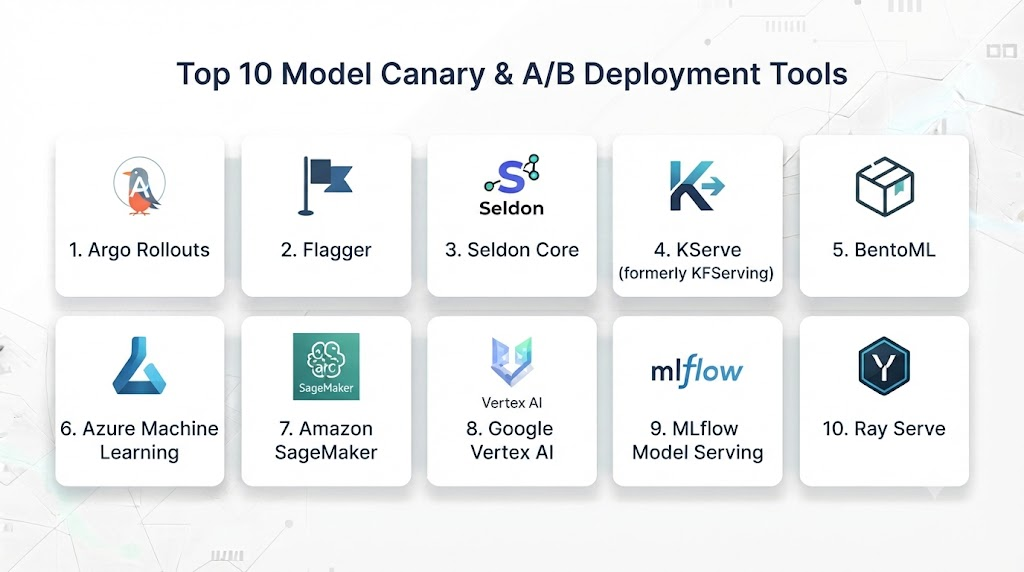
Top 10 Model Canary & A/B Deployment Tools
1. Argo Rollouts
Argo Rollouts provides Kubernetes-native progressive delivery capabilities.
Key Features
- Canary deployments
- Blue-green deployments
- Traffic splitting
- Automated analysis
- Rollback support
- Kubernetes integration
- Metrics-based decisions
- Deployment automation
- Progressive delivery
- CI/CD integration
Pros
- Open source
- Strong Kubernetes support
- Excellent traffic control
- Automated rollbacks
- Flexible
Cons
- Requires Kubernetes expertise
- Setup complexity
- Infrastructure management needed
Platforms
Kubernetes environments.
Deployment or Support
Cloud-native AI teams.
Security & Compliance
Kubernetes security controls.
Integrations & Ecosystem
Cloud-native tools.
Support & Community
Large open-source community.
2. Seldon Core
Seldon Core provides enterprise ML deployment and testing workflows.
Key Features
- Canary deployment
- A/B testing
- Traffic routing
- Model monitoring
- Explainability
- Kubernetes support
- Deployment graphs
- Model management
- Rollbacks
- Enterprise workflows
Pros
- ML-focused
- Strong Kubernetes support
- Enterprise capabilities
- Good monitoring
- Flexible
Cons
- Requires Kubernetes knowledge
- Complex setup
- Learning curve
Platforms
Kubernetes environments.
Deployment or Support
Enterprise MLOps teams.
Security & Compliance
Enterprise controls.
Integrations & Ecosystem
Cloud-native AI platforms.
Support & Community
Developer community.
3. KServe
KServe provides Kubernetes-native model serving and deployment.
Key Features
- Canary releases
- Traffic splitting
- Model serving
- Autoscaling
- Kubernetes integration
- Multiple frameworks
- Monitoring
- Version management
- Serverless inference
- Deployment automation
Pros
- Open source
- Cloud-native
- Scalable
- Strong Kubernetes ecosystem
- AI-focused
Cons
- Requires Kubernetes expertise
- Complex configuration
- Infrastructure management needed
Platforms
Kubernetes environments.
Deployment or Support
AI platform teams.
Security & Compliance
Kubernetes security.
Integrations & Ecosystem
Cloud-native ecosystem.
Support & Community
Open-source community.
4. Amazon SageMaker Deployment
Amazon SageMaker provides managed model deployment and testing capabilities.
Key Features
- A/B testing
- Traffic shifting
- Canary deployment
- Endpoint management
- Model versions
- Monitoring
- Automated rollback
- Cloud integration
- Security controls
- Production workflows
Pros
- Fully managed
- AWS integration
- Enterprise security
- Scalable
- Production-ready
Cons
- AWS dependency
- Cost complexity
- Requires AWS expertise
Platforms
AWS Cloud.
Deployment or Support
Enterprise AI teams.
Security & Compliance
AWS security framework.
Integrations & Ecosystem
AWS services.
Support & Community
Enterprise support.
5. Google Vertex AI Deployment
Vertex AI provides managed model deployment with traffic control.
Key Features
- Traffic splitting
- Model versions
- Deployment management
- Monitoring
- Explainability
- Cloud integration
- Experiment workflows
- Security
- AI pipelines
- Production analytics
Pros
- Managed platform
- Google AI ecosystem
- Scalable
- Enterprise-ready
- Strong infrastructure
Cons
- Google Cloud dependency
- Pricing complexity
- Learning curve
Platforms
Google Cloud.
Deployment or Support
Enterprise AI teams.
Security & Compliance
Google Cloud security.
Integrations & Ecosystem
Google AI services.
Support & Community
Enterprise support.
6. Azure Machine Learning Deployment
Azure ML provides enterprise model deployment workflows.
Key Features
- Canary deployment
- A/B testing
- Online endpoints
- Traffic management
- Monitoring
- Security
- Model versions
- Governance
- Automation
- Enterprise workflows
Pros
- Microsoft ecosystem
- Strong governance
- Enterprise security
- Scalable
- Managed service
Cons
- Azure dependency
- Configuration complexity
- Learning curve
Platforms
Microsoft Azure.
Deployment or Support
Enterprise AI organizations.
Security & Compliance
Microsoft security framework.
Integrations & Ecosystem
Azure services.
Support & Community
Enterprise support.
7. Kubeflow
Kubeflow provides Kubernetes-based machine learning workflows.
Key Features
- Model deployment
- Experiment management
- Kubernetes integration
- Version control
- Pipeline automation
- Scaling
- Monitoring integration
- Model serving
- ML lifecycle management
- Deployment workflows
Pros
- Open source
- Complete MLOps platform
- Kubernetes native
- Flexible
- Large ecosystem
Cons
- Complex setup
- Requires expertise
- Operational overhead
Platforms
Kubernetes environments.
Deployment or Support
MLOps teams.
Security & Compliance
Kubernetes security.
Integrations & Ecosystem
Cloud-native ML tools.
Support & Community
Open-source community.
8. MLflow Model Deployment
MLflow supports model lifecycle management and deployment workflows.
Key Features
- Model versions
- Deployment tracking
- Experiment management
- Model registry
- Integration support
- Testing workflows
- Rollback support
- Artifact management
- API deployment
- MLOps workflows
Pros
- Open source
- Popular ecosystem
- Flexible
- Easy integration
- Developer-friendly
Cons
- Requires infrastructure setup
- Limited advanced traffic control
- Additional tools needed
Platforms
Cloud and local environments.
Deployment or Support
ML teams.
Security & Compliance
Depends on deployment.
Integrations & Ecosystem
ML frameworks.
Support & Community
Large community.
9. NVIDIA Triton Inference Server
Triton supports production model serving and deployment management.
Key Features
- Model versioning
- Request routing
- Dynamic batching
- Performance monitoring
- Multi-model serving
- GPU optimization
- Deployment management
- API serving
- Scaling support
- Production inference
Pros
- High performance
- GPU optimized
- Enterprise ready
- Multi-framework support
- Reliable
Cons
- NVIDIA focused
- Requires expertise
- Complex deployment
Platforms
Cloud and enterprise environments.
Deployment or Support
Production AI systems.
Security & Compliance
Enterprise controls.
Integrations & Ecosystem
NVIDIA ecosystem.
Support & Community
Developer community.
10. BentoML
BentoML provides model deployment and serving workflows.
Key Features
- Model packaging
- Deployment automation
- API serving
- Version management
- Container deployment
- Scaling support
- Cloud integration
- Testing workflows
- Monitoring integration
- Developer tools
Pros
- Developer-friendly
- Easy deployment
- Open source
- Flexible
- Good ecosystem
Cons
- Requires engineering knowledge
- Limited enterprise governance
- Scaling depends on infrastructure
Platforms
Cloud and local environments.
Deployment or Support
AI developers.
Security & Compliance
Implementation dependent.
Integrations & Ecosystem
ML frameworks.
Support & Community
Developer community.
Comparison Table
| Tool Name | Best For | Platform(s) Supported | Deployment | Standout Feature | Public Rating |
|---|---|---|---|---|---|
| Argo Rollouts | Progressive delivery | Kubernetes | Enterprise | Canary automation | |
| Seldon Core | Enterprise ML deployment | Kubernetes | Enterprise | A/B testing | |
| KServe | Cloud-native serving | Kubernetes | Production | Traffic splitting | |
| SageMaker | AWS ML deployment | AWS | Enterprise | Managed rollout | |
| Vertex AI | Google AI deployment | GCP | Enterprise | Traffic control | |
| Azure ML | Enterprise AI | Azure | Enterprise | Governance | |
| Kubeflow | Complete MLOps | Kubernetes | Flexible | ML workflows | |
| MLflow | Model lifecycle | Cloud/Local | Flexible | Model registry | |
| Triton | AI inference | Cloud/Enterprise | Production | Performance | |
| BentoML | AI deployment | Cloud/Local | Flexible | Packaging |
Weighted Evaluation
| Tool Name | Core Features 25% | Ease of Use 15% | Integrations & Ecosystem 15% | Security & Compliance 10% | Performance & Reliability 10% | Support & Community 10% | Price/Value 15% | Total |
|---|---|---|---|---|---|---|---|---|
| Argo Rollouts | 25 | 13 | 15 | 10 | 10 | 10 | 15 | 98 |
| Seldon Core | 24 | 12 | 14 | 10 | 10 | 10 | 14 | 94 |
| KServe | 24 | 12 | 15 | 10 | 10 | 10 | 15 | 96 |
| SageMaker | 25 | 13 | 15 | 10 | 10 | 10 | 12 | 95 |
| Vertex AI | 25 | 13 | 15 | 10 | 10 | 10 | 12 | 95 |
| Azure ML | 24 | 13 | 15 | 10 | 10 | 10 | 13 | 95 |
| Kubeflow | 24 | 11 | 15 | 10 | 10 | 10 | 15 | 95 |
| MLflow | 23 | 15 | 15 | 10 | 10 | 10 | 15 | 98 |
| Triton | 25 | 13 | 15 | 10 | 10 | 10 | 13 | 96 |
| BentoML | 23 | 15 | 14 | 10 | 10 | 10 | 15 | 97 |
Which Model Canary & A/B Deployment Tool Is Right for You?
Choose Argo Rollouts for Kubernetes progressive delivery.
Choose Seldon Core for enterprise ML deployment.
Choose KServe for cloud-native model serving.
Choose Amazon SageMaker for AWS environments.
Choose Vertex AI for Google Cloud.
Choose Azure ML for Microsoft ecosystems.
Choose Kubeflow for complete Kubernetes MLOps.
Choose MLflow for model lifecycle management.
Choose NVIDIA Triton for high-performance inference.
Choose BentoML for flexible model deployment.
Implementation Playbook
Phase 1: Define Deployment Strategy
- Select rollout method
- Define success metrics
- Identify rollback conditions
Phase 2: Prepare Models
- Register model versions
- Create deployment packages
- Configure monitoring
Phase 3: Launch Controlled Release
- Deploy small traffic percentage
- Compare performance
- Collect feedback
Phase 4: Expand Deployment
- Increase traffic gradually
- Monitor results
- Approve release
Phase 5: Maintain Model Lifecycle
- Track performance
- Update models
- Improve deployment processes
Common Mistakes
- Deploying models directly to all users
- No rollback strategy
- Poor monitoring
- Ignoring business metrics
- No traffic control
- Manual deployment processes
- Lack of testing
FAQs
1. What are Model Canary & A/B Deployment Tools?
They are platforms that help organizations safely test and release machine learning models.
2. What is a canary deployment in machine learning?
It gradually introduces a new model to a small percentage of users before full release.
3. What is A/B model testing?
It compares two model versions using real user traffic.
4. Why are these tools important?
They reduce deployment risks and improve model reliability.
5. Can these tools support LLM deployments?
Yes, many support generative AI and LLM applications.
6. Who uses model deployment tools?
MLOps teams, AI engineers, and enterprise organizations use them.
7. Can failed deployments be rolled back?
Yes, most platforms provide rollback capabilities.
8. Do these tools integrate with Kubernetes?
Many modern deployment platforms support Kubernetes.
9. How do A/B deployments improve AI systems?
They help teams select better-performing models using real-world results.
10. What is the future of AI model deployment?
Deployment will become more automated, intelligent, and continuously optimized.
Conclusion
Model Canary & A/B Deployment Tools are essential for organizations that want to release AI models safely and efficiently. They allow teams to test new versions, compare performance, reduce risks, and improve production reliability.Platforms such as Argo Rollouts, KServe, Seldon Core, MLflow, NVIDIA Triton, and cloud AI deployment services provide powerful capabilities for modern MLOps workflows.As AI systems become more complex, progressive deployment strategies will become a critical part of reliable machine learning and enterprise AI operations.