Introduction
Hybrid Search (Lexical + Vector) Tooling combines traditional keyword-based search with modern AI-powered vector search to deliver more accurate and context-aware search experiences.
Traditional lexical search focuses on matching exact words, while vector search understands the meaning and relationship between concepts. Hybrid search combines both approaches to provide better retrieval accuracy, especially for enterprise AI applications, Retrieval-Augmented Generation (RAG), and intelligent search systems.
Hybrid Search Tooling helps organizations build:
- Enterprise knowledge search
- AI assistants
- RAG applications
- Customer support systems
- E-commerce search
- Document discovery platforms
- AI agent knowledge systems
These platforms are used by:
- AI engineers
- Search engineers
- Data scientists
- MLOps teams
- Software developers
- Enterprise technology teams
Modern hybrid search platforms provide capabilities such as:
- Keyword search
- Vector similarity search
- Semantic ranking
- Query understanding
- Metadata filtering
- Relevance optimization
- AI model integration
- Search analytics
- Real-time indexing
- Enterprise security
The goal of Hybrid Search Tooling is to combine the precision of lexical search with the intelligence of vector search for highly relevant results.
What Is Hybrid Search?
Hybrid Search is a search technique that combines two different retrieval methods:
Lexical Search
Lexical search matches exact terms and keywords.
Example:
User searches:
“cloud security certification”
Lexical search finds documents containing:
- Cloud
- Security
- Certification
Vector Search
Vector search understands the meaning behind queries.
Example:
User searches:
“ways to protect cloud infrastructure”
Vector search understands related concepts:
- Cloud security
- Infrastructure protection
- Security practices
Hybrid Search Combination
Hybrid search combines both methods:
- Keyword accuracy
- Semantic understanding
This produces more relevant search results.
Why Organizations Need Hybrid Search Platforms
Modern applications require better search experiences.
Traditional search systems struggle with:
- Different wording
- Natural language questions
- Complex user intent
Pure vector search can struggle with:
- Exact product names
- Technical terms
- Specific identifiers
Hybrid search solves these challenges by combining both approaches.
Organizations use hybrid search to:
- Improve search relevance
- Reduce irrelevant results
- Support AI applications
- Enhance user experience
How Hybrid Search Works
Step 1: Data Collection
Systems collect:
- Documents
- Websites
- Product data
- Knowledge bases
- Databases
Step 2: Keyword Indexing
Content is indexed using:
- Inverted indexes
- Term matching
- Keyword analysis
Step 3: Vector Embedding
AI models convert content into:
- Numerical vectors
- Semantic representations
Step 4: Dual Retrieval
The system performs:
- Lexical search
- Vector similarity search
Step 5: Result Ranking
Results are combined using:
- Ranking algorithms
- AI scoring
- Relevance models
Step 6: Response Delivery
The best results are returned to:
- Users
- AI assistants
- RAG systems
Key Components of Hybrid Search Tooling
Lexical Search Engine
Handles:
- Keyword matching
- Exact queries
- Text ranking
Vector Search Engine
Handles:
- Semantic retrieval
- Similarity matching
- Context understanding
Ranking System
Combines:
- Keyword scores
- Vector scores
Embedding Models
Creates:
- Semantic representations
- Search vectors
Index Management
Controls:
- Data updates
- Search performance
Analytics System
Tracks:
- Search quality
- User behavior
Types of Hybrid Search Platforms
Enterprise Search Platforms
Designed for:
- Business knowledge discovery
Examples:
- Elasticsearch
- Azure AI Search
- Coveo
Vector Search Platforms
Designed for:
- AI retrieval systems
Examples:
- Pinecone
- Weaviate
Cloud AI Search Services
Designed for:
- Managed enterprise AI search
Examples:
- Google Vertex AI Search
- Amazon OpenSearch
Open Source Search Platforms
Designed for:
- Custom implementations
Examples:
- Vespa
- Typesense
Key Features of Hybrid Search Platforms
Combined Retrieval
Supports:
- Keyword search
- Semantic search
AI Ranking
Improves:
- Result relevance
- Search quality
Natural Language Understanding
Supports:
- Conversational queries
- Complex questions
Metadata Filtering
Allows:
- Category filtering
- Permission control
- Data segmentation
Real-Time Indexing
Supports:
- Fresh information
- Continuous updates
RAG Integration
Connects with:
- LLMs
- AI assistants
- Knowledge systems
Common Use Cases
Enterprise Knowledge Management
Helping employees find:
- Policies
- Documentation
- Internal knowledge
Customer Support AI
Improving:
- Help center search
- AI chatbot responses
E-Commerce Search
Enhancing:
- Product discovery
- Recommendations
Software Documentation Search
Helping developers find:
- APIs
- Technical guides
- Solutions
Legal and Healthcare Search
Finding:
- Complex documents
- Research information
Generative AI Applications
Supporting:
- RAG systems
- AI agents
Why Hybrid Search Matters
Better Search Accuracy
Combines keyword precision with semantic understanding.
Improved AI Responses
Provides better context for LLMs.
Handles Complex Queries
Understands natural language questions.
Supports Enterprise Data
Works with structured and unstructured information.
Reduces Search Failures
Balances exact matching and meaning-based retrieval.
Evaluation Criteria for Buyers
Search Quality
Evaluate:
- Ranking accuracy
- Retrieval relevance
AI Integration
Consider:
- LLM compatibility
- Embedding support
Scalability
Evaluate:
- Data volume
- Query performance
Deployment Options
Consider:
- Cloud
- On-premise
- Hybrid deployment
Security
Evaluate:
- Access control
- Enterprise compliance
Developer Experience
Consider:
- APIs
- Documentation
- SDK support
Key Trends
RAG-Powered Hybrid Search
Hybrid search is becoming the foundation of enterprise AI assistants.
AI Ranking Models
Machine learning models are improving search relevance.
Multimodal Hybrid Search
Platforms are supporting:
- Text
- Images
- Audio
- Video
Agentic Search
AI agents are using hybrid retrieval for decision-making.
Real-Time Enterprise Search
Organizations need continuously updated knowledge.
Personalized Search
AI is improving results based on user behavior.
Methodology
The following Hybrid Search Tooling platforms were evaluated based on:
- Search capabilities
- Vector support
- AI integration
- Ranking quality
- Scalability
- Security
- Developer experience
- Enterprise readiness
- Performance
- Value
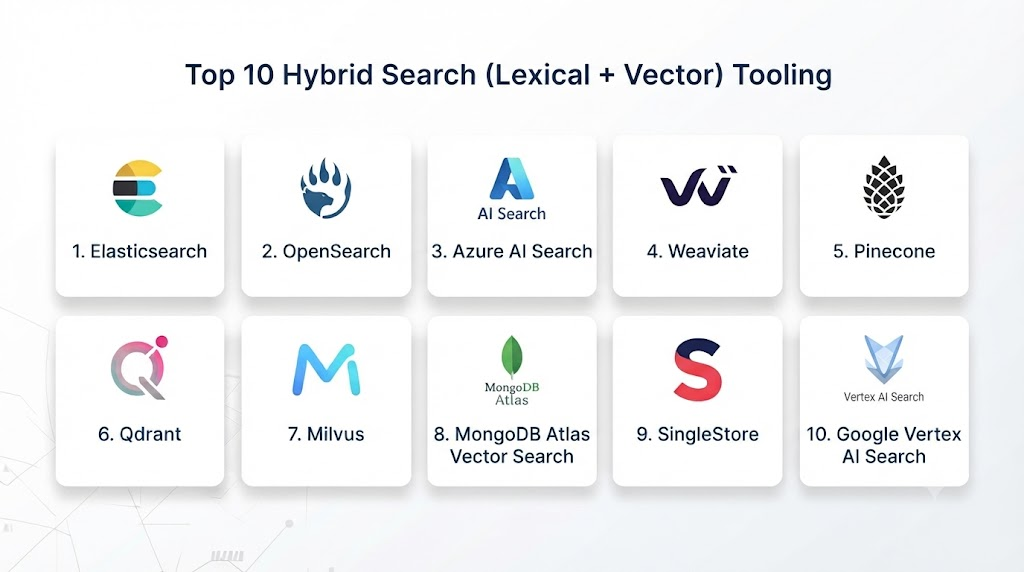
Top 10 Hybrid Search (Lexical + Vector) Tooling
1. Elasticsearch
Elasticsearch is one of the most popular enterprise search platforms supporting hybrid retrieval.
Key Features
- Full-text search
- Vector search
- Hybrid ranking
- Semantic search
- Document indexing
- Analytics
- Query optimization
- Search APIs
- Security controls
- Enterprise scalability
Pros
- Mature ecosystem
- Strong search capabilities
- Enterprise adoption
- Flexible deployment
- Large community
Cons
- Complex management
- Requires expertise
- Resource intensive
Platforms
Cloud and local environments.
Deployment or Support
Enterprise search teams.
Security & Compliance
Enterprise security features.
Integrations & Ecosystem
AI and data platforms.
Support & Community
Large community.
2. Azure AI Search
Azure AI Search provides managed hybrid search capabilities.
Key Features
- Keyword search
- Vector search
- Semantic ranking
- AI enrichment
- Document processing
- Data connectors
- Security
- RAG support
- Enterprise workflows
- Cloud integration
Pros
- Microsoft ecosystem
- Managed service
- Strong AI capabilities
- Enterprise security
- Scalable
Cons
- Azure dependency
- Pricing complexity
- Learning curve
3. Amazon OpenSearch
Amazon OpenSearch combines traditional search with vector capabilities.
Key Features
- Full-text search
- Vector search
- Hybrid retrieval
- AWS integration
- Analytics
- Security
- Monitoring
- Scaling
- AI workflows
- Index management
Pros
- AWS integration
- Managed service
- Enterprise ready
- Flexible
Cons
- AWS dependency
- Configuration complexity
4. Google Vertex AI Search
Vertex AI Search provides AI-powered enterprise search.
Key Features
- Semantic search
- Keyword search
- Vector retrieval
- Generative AI integration
- Data connectors
- Search analytics
- Security
- Cloud scaling
- RAG support
- Enterprise deployment
Pros
- Managed platform
- Google AI integration
- Strong AI features
- Scalable
Cons
- Google Cloud dependency
- Pricing complexity
5. Weaviate
Weaviate is an open-source vector database supporting hybrid search.
Key Features
- Hybrid search
- Vector retrieval
- Keyword search
- GraphQL APIs
- Metadata filtering
- AI modules
- Multimodal support
- RAG integration
- Cloud deployment
- Developer tools
Pros
- Open source
- AI focused
- Flexible
- Strong community
Cons
- Requires configuration
- Operational complexity
6. Pinecone
Pinecone provides managed vector search with hybrid retrieval support.
Key Features
- Vector search
- Metadata filtering
- Hybrid retrieval
- Low latency
- API access
- RAG support
- Scaling
- AI integrations
- Security
- Production deployment
Pros
- Easy deployment
- High performance
- Developer friendly
- Production ready
Cons
- Cloud dependency
- Cost at scale
7. Vespa
Vespa is a scalable search and AI serving platform.
Key Features
- Hybrid retrieval
- Vector search
- Ranking models
- Real-time indexing
- Personalization
- Machine learning ranking
- Distributed architecture
- AI serving
- Query optimization
- Large-scale search
Pros
- High scalability
- Advanced ranking
- Real-time capabilities
Cons
- Complex learning curve
- Smaller community
8. Algolia NeuralSearch
Algolia provides AI-powered search experiences.
Key Features
- Neural search
- Keyword matching
- AI ranking
- Personalization
- Analytics
- APIs
- Fast retrieval
- Product search
- Search optimization
- Developer tools
Pros
- Fast
- Easy integration
- Great user experience
Cons
- Commercial pricing
- Limited customization
9. Typesense
Typesense provides fast hybrid search capabilities.
Key Features
- Keyword search
- Vector search
- Instant search
- Typo tolerance
- Filtering
- Ranking
- APIs
- Developer tools
- Lightweight architecture
- Cloud deployment
Pros
- Simple
- Fast
- Developer friendly
- Open source
Cons
- Smaller ecosystem
- Limited enterprise features
10. Qdrant
Qdrant provides vector search capabilities with filtering support.
Key Features
- Vector search
- Filtering
- Hybrid retrieval
- APIs
- Embedding storage
- Real-time indexing
- AI integrations
- Cloud deployment
- High performance
- Metadata support
Pros
- Open source
- Fast
- Flexible
- Developer friendly
Cons
- Smaller ecosystem
- Requires management
Comparison Table
| Tool Name | Best For | Platform(s) Supported | Deployment | Standout Feature | Public Rating |
|---|---|---|---|---|---|
| Elasticsearch | Enterprise search | Cloud/Local | Flexible | Hybrid search | |
| Azure AI Search | Microsoft AI | Azure | Managed | Semantic ranking | |
| OpenSearch | AWS search | AWS | Managed | Vector integration | |
| Vertex AI Search | Google AI | GCP | Managed | Generative search | |
| Weaviate | AI applications | Cloud/Local | Flexible | Hybrid retrieval | |
| Pinecone | Vector AI apps | Cloud | Managed | Low latency | |
| Vespa | Large-scale search | Cloud/Local | Enterprise | AI ranking | |
| Algolia NeuralSearch | Product search | Cloud | Managed | Fast search | |
| Typesense | Developer search | Cloud/Local | Flexible | Simplicity | |
| Qdrant | Vector retrieval | Cloud/Local | Flexible | Performance |
Which Hybrid Search Tool Is Right for You?
Choose Elasticsearch for enterprise search infrastructure.
Choose Azure AI Search for Microsoft environments.
Choose Amazon OpenSearch for AWS workloads.
Choose Vertex AI Search for Google Cloud AI.
Choose Weaviate for open-source hybrid AI search.
Choose Pinecone for managed AI retrieval.
Choose Vespa for large-scale search systems.
Choose Algolia NeuralSearch for product experiences.
Choose Typesense for developer-focused search.
Choose Qdrant for flexible vector retrieval.
Implementation Playbook
Phase 1: Prepare Data
- Collect content sources
- Clean documents
- Define metadata
Phase 2: Build Indexes
- Create lexical indexes
- Generate embeddings
- Configure vector indexes
Phase 3: Configure Ranking
- Combine search scores
- Tune relevance
- Test queries
Phase 4: Integrate AI Systems
- Connect RAG workflows
- Add LLMs
- Build applications
Phase 5: Monitor Performance
- Track search quality
- Improve ranking
- Update data
Common Mistakes
- Using only keyword search
- Ignoring vector quality
- Poor ranking configuration
- No evaluation process
- Weak metadata design
- Not monitoring relevance
- Poor data preparation
FAQs
1. What is Hybrid Search?
Hybrid search combines keyword-based search with vector-based semantic search.
2. Why use hybrid search instead of only vector search?
It provides better accuracy by combining exact matching with meaning-based retrieval.
3. Is hybrid search used in RAG applications?
Yes, many RAG systems use hybrid retrieval for better context.
4. What industries use hybrid search?
Healthcare, finance, e-commerce, software, and enterprises use hybrid search.
5. What is lexical search?
Lexical search matches exact words and terms.
6. What is vector search?
Vector search finds information based on semantic similarity.
7. Can hybrid search support AI agents?
Yes, it helps agents retrieve accurate knowledge.
8. Are hybrid search tools cloud-based?
Many are available as cloud services and self-hosted solutions.
9. How does hybrid search improve AI answers?
It provides more relevant context to AI models.
10. What is the future of hybrid search?
Hybrid search will become a core technology for enterprise AI, RAG, and intelligent search systems.
Conclusion
Hybrid Search (Lexical + Vector) Tooling represents the next generation of search technology by combining traditional keyword precision with AI-powered semantic understanding.Platforms such as Elasticsearch, Azure AI Search, OpenSearch, Weaviate, Pinecone, and Vertex AI Search help organizations create accurate, scalable, and intelligent search experiences.As Generative AI and RAG applications continue expanding, hybrid search will become a critical foundation for enterprise knowledge systems, AI assistants, and intelligent applications.