Introduction
MLOps Lifecycle Management Platforms are AI and machine learning management systems that help organizations build, train, deploy, monitor, maintain, and improve machine learning models throughout their entire lifecycle.
Unlike traditional machine learning workflows that require manual processes between data scientists, engineers, and operations teams, MLOps platforms provide automated systems for managing models from experimentation to production.
These platforms help organizations:
- Manage machine learning projects
- Track experiments
- Version datasets and models
- Automate model deployment
- Monitor model performance
- Detect model drift
- Improve collaboration between teams
Modern businesses use MLOps Lifecycle Management Platforms to create reliable, scalable, and production-ready AI systems.
MLOps platforms are used by:
- Data scientists
- Machine learning engineers
- DevOps teams
- AI engineers
- Data engineering teams
- Enterprise technology teams
Modern platforms provide capabilities such as:
- Model lifecycle management
- Experiment tracking
- Model registry
- Data versioning
- ML pipelines
- Deployment automation
- Model monitoring
- Governance
- Security controls
- Collaboration tools
The goal of MLOps Lifecycle Management Platforms is to create a continuous process where machine learning models can be developed, deployed, monitored, and improved efficiently.
What Are MLOps Lifecycle Management Platforms?
MLOps Lifecycle Management Platforms are tools that manage the complete machine learning lifecycle.
The lifecycle includes:
- Data collection
- Data preparation
- Model development
- Experiment tracking
- Model training
- Testing
- Deployment
- Monitoring
- Optimization
Example:
A company builds a fraud detection model.
MLOps platform helps:
- Manage training data
- Track experiments
- Register models
- Deploy the model
- Monitor accuracy
- Retrain when performance drops
Why Organizations Need MLOps Platforms
Machine learning projects face challenges:
- Complex model development
- Data changes
- Deployment difficulties
- Model performance issues
- Collaboration problems
Without MLOps, organizations struggle with:
- Reproducibility
- Model governance
- Production reliability
- Scaling AI applications
MLOps platforms help organizations:
- Accelerate AI development
- Improve model quality
- Reduce deployment risks
- Maintain production systems
How MLOps Lifecycle Management Platforms Work
Data Management
Platforms manage:
- Datasets
- Data versions
- Data pipelines
Experiment Tracking
Teams track:
- Models
- Parameters
- Results
- Performance metrics
Model Development
Engineers build:
- Machine learning models
- AI applications
- Training workflows
Model Registry
Stores:
- Model versions
- Metadata
- Deployment information
Deployment Automation
Platforms deploy models to:
- Cloud
- Containers
- Enterprise environments
Monitoring
Tracks:
- Accuracy
- Performance
- Data drift
- Model health
Continuous Improvement
Models are improved through:
- Retraining
- Optimization
- Feedback loops
Key Components of MLOps Lifecycle Platforms
Experiment Tracking
Helps teams:
- Compare experiments
- Track metrics
- Reproduce results
Model Registry
Provides:
- Version control
- Approval workflows
- Model management
ML Pipeline Automation
Automates:
- Data processing
- Training
- Testing
- Deployment
Data Versioning
Manages:
- Dataset changes
- Data lineage
- Reproducibility
Model Monitoring
Detects:
- Drift
- Errors
- Performance issues
Governance and Security
Controls:
- Access
- Compliance
- Audit history
Types of MLOps Lifecycle Management Platforms
Cloud MLOps Platforms
Designed for:
- Enterprise AI workloads
- Cloud deployment
Examples:
- AWS SageMaker
- Google Vertex AI
- Azure Machine Learning
Open Source MLOps Platforms
Used for:
- Flexible deployments
- Custom workflows
Examples:
- MLflow
- Kubeflow
Enterprise AI Platforms
Support:
- Large organizations
- Governance
- Collaboration
Specialized ML Platforms
Focus on:
- Model management
- Deployment
- Monitoring
Key Features of MLOps Lifecycle Management Platforms
Model Version Control
Tracks:
- Model changes
- Versions
- Performance history
Automated ML Pipelines
Supports:
- Training automation
- Testing
- Deployment
Experiment Management
Allows teams to:
- Compare models
- Optimize performance
Model Deployment
Supports:
- APIs
- Containers
- Cloud environments
Model Monitoring
Tracks:
- Accuracy
- Latency
- Data changes
Collaboration Tools
Enable:
- Data scientists
- Engineers
- Operations teams
Common Use Cases
Financial Services
MLOps helps manage:
- Fraud detection
- Risk models
- Credit scoring
Healthcare
Used for:
- Medical prediction models
- Patient analytics
- Research AI
Retail
Supports:
- Recommendation systems
- Demand forecasting
- Customer analytics
Manufacturing
Used for:
- Predictive maintenance
- Quality analysis
- Automation
Technology Companies
Supports:
- AI applications
- Recommendation engines
- Search systems
Marketing
Helps with:
- Customer segmentation
- Campaign optimization
Why MLOps Lifecycle Management Platforms Matter
Faster AI Deployment
Teams move models into production faster.
Better Collaboration
Data scientists and engineers work together.
Improved Reliability
Models remain stable after deployment.
Continuous Monitoring
Organizations detect problems early.
Enterprise AI Scaling
Businesses manage many models efficiently.
Evaluation Criteria for Buyers
Lifecycle Coverage
Evaluate:
- Training
- Deployment
- Monitoring
- Governance
Integration Support
Look for:
- Cloud platforms
- Data tools
- Development frameworks
Automation Features
Consider:
- ML pipelines
- CI/CD support
- Deployment automation
Monitoring Capabilities
Evaluate:
- Drift detection
- Performance tracking
- Alerts
Security
Consider:
- Access controls
- Compliance
- Data protection
Scalability
Evaluate:
- Model volume
- Data size
- Enterprise workloads
Key Trends
Automated ML Pipelines
Organizations are adopting fully automated workflows.
AI Governance
Companies are focusing on responsible AI management.
Model Observability
Monitoring is becoming essential for production AI.
Cloud-Native MLOps
Businesses are using scalable cloud AI platforms.
Generative AI Lifecycle Management
MLOps platforms are expanding to support LLM applications.
AI Platform Engineering
Organizations are building dedicated AI infrastructure teams.
Methodology
The following MLOps Lifecycle Management Platforms were evaluated based on:
- Lifecycle capabilities
- Model management
- Deployment support
- Monitoring
- Integration ecosystem
- Security
- Scalability
- Enterprise readiness
- Developer experience
- Value
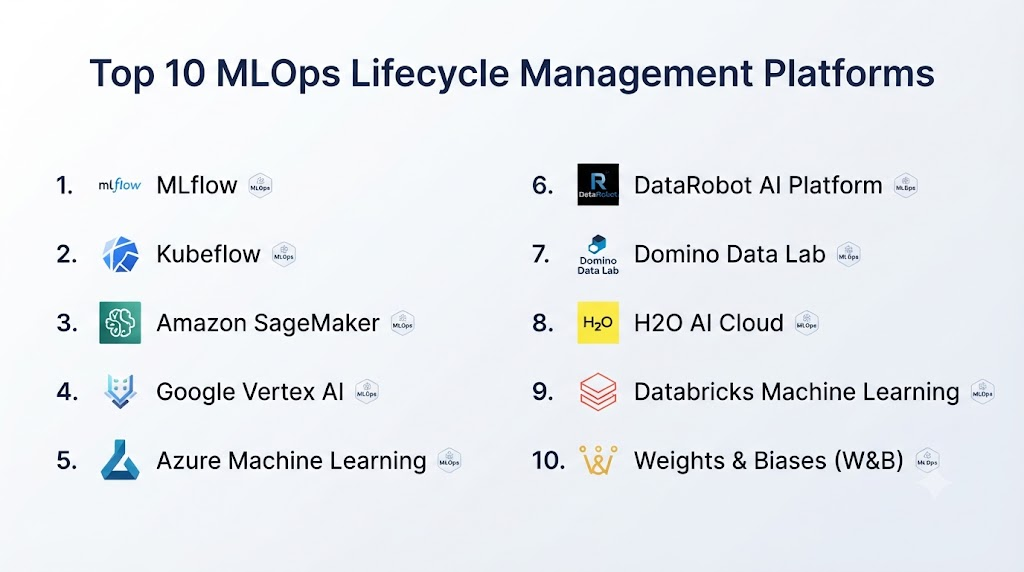
Top 10 MLOps Lifecycle Management Platforms
1. MLflow
MLflow is an open-source platform for managing machine learning lifecycle workflows.
Key Features
- Experiment tracking
- Model registry
- Model versioning
- Deployment support
- ML workflow management
- Artifact tracking
- Model packaging
- Collaboration tools
- Open-source ecosystem
- Framework compatibility
Pros
- Open source
- Flexible
- Large community
- Easy integration
- Framework independent
Cons
- Requires infrastructure management
- Enterprise features need additional setup
- Limited built-in automation
Platforms
Cloud and local environments.
Deployment or Support
Development and enterprise ML workflows.
Security & Compliance
Depends on deployment.
Integrations & Ecosystem
Machine learning frameworks.
Support & Community
Large developer community.
2. Kubeflow
Kubeflow provides Kubernetes-based MLOps workflows.
Key Features
- ML pipelines
- Model deployment
- Kubernetes integration
- Experiment management
- Notebook environments
- Training workflows
- Model serving
- Automation
- Scalability
- Cloud support
Pros
- Kubernetes-native
- Highly scalable
- Open source
- Flexible
- Enterprise-ready
Cons
- Complex setup
- Requires Kubernetes expertise
- Higher operational effort
Platforms
Cloud and Kubernetes environments.
Deployment or Support
Enterprise ML infrastructure.
Security & Compliance
Depends on Kubernetes configuration.
Integrations & Ecosystem
Cloud-native tools.
Support & Community
Open-source community.
3. Amazon SageMaker
Amazon SageMaker provides a complete machine learning lifecycle platform.
Key Features
- Model development
- Training
- Deployment
- Monitoring
- Data preparation
- Model registry
- ML pipelines
- Automated workflows
- AI governance
- Cloud integration
Pros
- Complete ML platform
- AWS integration
- Enterprise scalability
- Strong automation
- Managed infrastructure
Cons
- AWS dependency
- Cost complexity
- Learning curve
Platforms
AWS Cloud.
Deployment or Support
Enterprise AI workloads.
Security & Compliance
AWS security framework.
Integrations & Ecosystem
AWS services.
Support & Community
Enterprise support.
4. Google Vertex AI
Google Vertex AI provides machine learning lifecycle management through Google Cloud.
Key Features
- Model training
- Deployment
- Model registry
- Pipelines
- Monitoring
- Generative AI support
- Data integration
- Experiment tracking
- AI governance
- Cloud scalability
Pros
- Strong AI infrastructure
- Google ecosystem
- Enterprise-ready
- Generative AI support
- Scalable
Cons
- Google Cloud dependency
- Complex pricing
- Requires cloud knowledge
Platforms
Google Cloud.
Deployment or Support
Enterprise AI applications.
Security & Compliance
Google Cloud security.
Integrations & Ecosystem
Google AI services.
Support & Community
Enterprise support.
5. Azure Machine Learning
Azure Machine Learning provides MLOps capabilities for enterprise AI development.
Key Features
- Model management
- ML pipelines
- Deployment
- Monitoring
- Experiment tracking
- Data management
- AI governance
- Collaboration
- Security controls
- Enterprise integration
Pros
- Strong enterprise support
- Microsoft ecosystem
- Good governance
- Scalable
- Developer tools
Cons
- Azure dependency
- Complex setup
- Pricing complexity
Platforms
Microsoft Azure.
Deployment or Support
Enterprise AI.
Security & Compliance
Microsoft security framework.
Integrations & Ecosystem
Azure services.
Support & Community
Enterprise support.
6. Databricks Machine Learning
Databricks provides an integrated data and machine learning platform.
Key Features
- ML lifecycle management
- Experiment tracking
- Model registry
- Data engineering
- Feature management
- Model deployment
- Collaboration
- Analytics
- AI workflows
- Governance
Pros
- Strong data integration
- Unified platform
- Enterprise-ready
- Good collaboration
- Scalable
Cons
- Expensive
- Complex platform
- Requires expertise
Platforms
Cloud environments.
Deployment or Support
Enterprise data and AI.
Security & Compliance
Enterprise controls.
Integrations & Ecosystem
Data platforms.
Support & Community
Enterprise support.
7. Dataiku
Dataiku provides collaborative AI and machine learning development.
Key Features
- Data preparation
- ML workflows
- Model management
- Collaboration
- Automation
- Analytics
- Deployment
- Governance
- Visual development
- Enterprise integration
Pros
- User-friendly
- Good collaboration
- Supports technical and business users
- Strong governance
- Enterprise-ready
Cons
- Premium pricing
- Limited customization
- Requires training
Platforms
Cloud and enterprise environments.
Deployment or Support
Business AI teams.
Security & Compliance
Enterprise controls.
Integrations & Ecosystem
Data systems.
Support & Community
Enterprise support.
8. Domino Data Lab
Domino provides enterprise MLOps infrastructure.
Key Features
- Model management
- Experiment tracking
- Collaboration
- Deployment
- Governance
- Infrastructure management
- Monitoring
- AI workflows
- Security
- Enterprise scaling
Pros
- Enterprise-focused
- Strong governance
- Good collaboration
- Scalable
- Flexible infrastructure
Cons
- Expensive
- Enterprise complexity
- Requires setup
Platforms
Cloud and enterprise environments.
Deployment or Support
Enterprise AI teams.
Security & Compliance
Enterprise security.
Integrations & Ecosystem
ML tools and infrastructure.
Support & Community
Enterprise support.
9. Weights & Biases
Weights & Biases provides experiment tracking and ML collaboration tools.
Key Features
- Experiment tracking
- Model monitoring
- Visualization
- Dataset tracking
- Collaboration
- Model comparison
- Reports
- AI workflows
- Team management
- Integration support
Pros
- Excellent experiment tracking
- Developer-friendly
- Easy adoption
- Strong visualization
- Large community
Cons
- Limited full lifecycle management
- Requires integrations
- Enterprise features cost more
Platforms
Cloud and local environments.
Deployment or Support
ML development teams.
Security & Compliance
Enterprise controls.
Integrations & Ecosystem
ML frameworks.
Support & Community
Developer community.
10. H2O.ai MLOps
H2O.ai provides enterprise machine learning lifecycle management.
Key Features
- Model deployment
- Model monitoring
- Automated ML
- Model management
- AI governance
- Workflow automation
- Analytics
- Collaboration
- Enterprise deployment
- Monitoring
Pros
- Strong AutoML capabilities
- Enterprise-ready
- Good governance
- Easy model deployment
- Scalable
Cons
- Platform complexity
- Enterprise pricing
- Requires expertise
Platforms
Cloud and enterprise environments.
Deployment or Support
Enterprise AI operations.
Security & Compliance
Enterprise controls.
Integrations & Ecosystem
ML platforms.
Support & Community
Enterprise support.
Comparison Table
| Tool Name | Best For | Platform(s) Supported | Deployment | Standout Feature | Public Rating |
|---|---|---|---|---|---|
| MLflow | ML lifecycle tracking | Cloud/Local | Flexible | Open-source flexibility | |
| Kubeflow | Kubernetes ML | Cloud | Enterprise | Kubernetes pipelines | |
| SageMaker | AWS ML | AWS | Enterprise | Complete ML platform | |
| Vertex AI | Google ML | GCP | Enterprise | AI infrastructure | |
| Azure ML | Enterprise AI | Azure | Enterprise | Governance | |
| Databricks ML | Data + AI | Cloud | Enterprise | Unified platform | |
| Dataiku | Collaboration | Cloud | Enterprise | Visual workflows | |
| Domino Data Lab | Enterprise MLOps | Cloud | Enterprise | Governance | |
| W&B | Experiment tracking | Cloud | Flexible | Visualization | |
| H2O.ai MLOps | AutoML | Cloud | Enterprise | Automated ML |
Weighted Evaluation
| Tool Name | Core Features 25% | Ease of Use 15% | Integrations & Ecosystem 15% | Security & Compliance 10% | Performance & Reliability 10% | Support & Community 10% | Price/Value 15% | Total |
|---|---|---|---|---|---|---|---|---|
| MLflow | 24 | 14 | 15 | 10 | 10 | 10 | 15 | 98 |
| Kubeflow | 24 | 11 | 15 | 10 | 10 | 10 | 14 | 94 |
| SageMaker | 25 | 13 | 15 | 10 | 10 | 10 | 12 | 95 |
| Vertex AI | 25 | 13 | 15 | 10 | 10 | 10 | 12 | 95 |
| Azure ML | 24 | 13 | 15 | 10 | 10 | 10 | 12 | 94 |
| Databricks ML | 25 | 12 | 15 | 10 | 10 | 10 | 12 | 94 |
| Dataiku | 23 | 15 | 14 | 10 | 10 | 10 | 13 | 95 |
| Domino Data Lab | 24 | 12 | 14 | 10 | 10 | 10 | 12 | 92 |
| W&B | 23 | 15 | 14 | 10 | 10 | 10 | 14 | 96 |
| H2O.ai MLOps | 23 | 13 | 14 | 10 | 10 | 10 | 13 | 93 |
Which MLOps Lifecycle Management Platform Is Right for You?
Choose MLflow for flexible open-source MLOps.
Choose Kubeflow for Kubernetes-based ML systems.
Choose Amazon SageMaker for AWS environments.
Choose Google Vertex AI for Google Cloud AI.
Choose Azure Machine Learning for Microsoft ecosystems.
Choose Databricks ML for data-focused AI teams.
Choose Dataiku for collaborative AI development.
Choose Domino Data Lab for enterprise governance.
Choose Weights & Biases for experiment tracking.
Choose H2O.ai MLOps for AutoML-focused workflows.
Implementation Playbook
Phase 1: Define ML Requirements
- Identify AI use cases
- Select lifecycle needs
- Define success metrics
Phase 2: Build ML Infrastructure
- Connect data sources
- Configure environments
- Setup pipelines
Phase 3: Manage Models
- Track experiments
- Register models
- Automate deployment
Phase 4: Monitor Production
- Track performance
- Detect drift
- Improve models
Phase 5: Scale AI Operations
- Add more models
- Improve automation
- Strengthen governance
Common Mistakes
- Deploying models without monitoring
- Poor data management
- Ignoring model versioning
- Lack of governance
- No automation strategy
- Poor collaboration between teams
- Ignoring security requirements
FAQs
1. What are MLOps Lifecycle Management Platforms?
They are platforms that manage the complete machine learning lifecycle from development to production.
2. Why is MLOps important?
MLOps helps organizations deploy reliable and scalable machine learning systems.
3. Who uses MLOps platforms?
Data scientists, ML engineers, DevOps teams, and enterprises use them.
4. Can MLOps platforms automate model deployment?
Yes, many provide automated deployment workflows.
5. Do MLOps platforms support cloud environments?
Yes, most support major cloud platforms.
6. How do MLOps platforms monitor models?
They track accuracy, performance, latency, and data drift.
7. Are open-source MLOps tools available?
Yes, tools like MLflow and Kubeflow provide open-source solutions.
8. Can MLOps manage multiple AI models?
Yes, they help organizations manage large model portfolios.
9. How does MLOps improve AI reliability?
Through automation, monitoring, testing, and governance.
10. What is the future of MLOps?
MLOps will expand toward managing generative AI, LLMs, and autonomous AI systems.
Conclusion
MLOps Lifecycle Management Platforms are essential for organizations building production-level machine learning systems. They provide the infrastructure required to manage experiments, deploy models, monitor performance, and maintain reliable AI applications.Platforms such as MLflow, Amazon SageMaker, Google Vertex AI, Azure Machine Learning, Databricks ML, and Kubeflow are helping organizations create scalable and efficient AI operations.As artificial intelligence becomes a core part of business strategy, MLOps lifecycle management will remain a critical foundation for successful AI deployment.