Introduction
Semantic Search Platforms are AI-powered search systems designed to understand the meaning, intent, and context behind user queries instead of relying only on exact keyword matching.
Traditional search engines mainly depend on matching words, while semantic search uses artificial intelligence, natural language processing, machine learning, and vector embeddings to understand relationships between concepts.
Semantic Search Platforms help organizations build intelligent search experiences for:
- Enterprise knowledge discovery
- Customer support systems
- E-commerce search
- Document retrieval
- AI assistants
- Research platforms
- Internal knowledge management
These platforms are used by:
- AI engineers
- Search engineers
- Data scientists
- Software developers
- Enterprise technology teams
- Product teams
Modern semantic search solutions provide capabilities such as:
- Natural language understanding
- Vector search
- Hybrid search
- Query understanding
- Ranking optimization
- Knowledge retrieval
- AI integration
- Personalization
- Analytics
- Search relevance improvement
The goal of Semantic Search Platforms is to deliver more accurate, meaningful, and context-aware search results.
What Is Semantic Search?
Semantic Search is a search approach that focuses on understanding the meaning behind a query rather than matching exact words.
Example:
A user searches:
“How can I recover my account?”
A traditional search system looks for:
- Recover
- Account
A semantic search system understands related concepts:
- Password reset
- Login assistance
- Account access
- Authentication issues
This allows users to find relevant information even when they use different wording.
Why Organizations Need Semantic Search Platforms
Modern organizations manage huge amounts of information:
- Documents
- Knowledge articles
- Product catalogs
- Customer data
- Technical documentation
Traditional keyword search struggles with:
- Different wording
- Complex questions
- Unstructured information
Semantic search platforms help organizations:
- Improve search accuracy
- Reduce search time
- Provide better user experiences
- Enable AI-powered applications
How Semantic Search Works
Query Understanding
The system analyzes:
- User intent
- Context
- Meaning
Text Processing
Content is processed using:
- Natural language processing
- Machine learning techniques
Embedding Generation
Content and queries are converted into:
- Numerical vectors
- Semantic representations
Similarity Matching
The system compares:
- Query vectors
- Document vectors
and finds relevant results.
Ranking
Results are organized based on:
- Relevance
- Context
- User intent
Key Components of Semantic Search Platforms
Natural Language Processing Engine
Handles:
- Query understanding
- Language analysis
Embedding Models
Convert:
- Text
- Documents
- Queries
into vector representations.
Vector Search Engine
Performs:
- Similarity search
- Semantic retrieval
Ranking System
Improves:
- Search relevance
- Result ordering
Data Connectors
Connects:
- Databases
- Documents
- Websites
- Enterprise systems
Analytics Layer
Tracks:
- Search behavior
- User interactions
- Performance
Types of Semantic Search Platforms
Enterprise Search Platforms
Designed for:
- Internal company knowledge
Examples:
- Coveo
- Elastic Enterprise Search
Vector Search Platforms
Focused on:
- AI-powered retrieval
Examples:
- Pinecone
- Weaviate
Cloud AI Search Services
Designed for:
- Managed enterprise search
Examples:
- Azure AI Search
- Google Vertex AI Search
Open Source Search Platforms
Designed for:
- Custom implementations
Examples:
- Elasticsearch
- Vespa
Key Features of Semantic Search Platforms
Natural Language Queries
Allows users to search using:
- Questions
- Conversations
- Complex phrases
Vector-Based Retrieval
Finds:
- Similar meanings
- Related information
Hybrid Search
Combines:
- Keyword search
- Semantic search
AI Ranking
Improves:
- Search relevance
- User experience
Multilingual Search
Supports:
- Multiple languages
- Global users
Knowledge Integration
Connects:
- Business systems
- Documents
- Databases
Common Use Cases
Enterprise Knowledge Search
Helping employees find:
- Policies
- Documentation
- Internal information
Customer Support
Improving:
- Help centers
- AI assistants
E-commerce Search
Enhancing:
- Product discovery
- Recommendations
Healthcare Search
Supporting:
- Medical research
- Clinical information
Legal Search
Finding:
- Contracts
- Case documents
AI Applications
Supporting:
- RAG systems
- AI agents
Why Semantic Search Platforms Matter
Better Search Accuracy
Users find relevant information faster.
Improved User Experience
Search becomes more natural.
Supports Generative AI
Semantic search provides context for LLMs.
Handles Unstructured Data
Organizations can search complex information.
Enables Enterprise AI
Companies can build intelligent knowledge systems.
Evaluation Criteria for Buyers
Search Quality
Evaluate:
- Accuracy
- Ranking
- Relevance
AI Capabilities
Consider:
- NLP support
- Embedding models
- LLM integration
Data Connectivity
Evaluate:
- Data sources
- APIs
- Connectors
Scalability
Consider:
- Search volume
- Data size
- Enterprise requirements
Security
Evaluate:
- Access control
- Data protection
Developer Experience
Consider:
- APIs
- Documentation
- Community support
Key Trends
Generative AI Search
Semantic search is becoming a foundation for AI assistants.
RAG Integration
Search platforms are powering knowledge retrieval for LLMs.
Multimodal Search
Platforms are supporting:
- Text
- Images
- Audio
- Video
Personalized Search
AI is improving results based on user behavior.
Real-Time Search
Organizations need continuously updated information.
Agent-Based Search
AI agents are using semantic search for decision-making.
Methodology
The following Semantic Search Platforms were evaluated based on:
- Search relevance
- AI capabilities
- Scalability
- Integration ecosystem
- Deployment flexibility
- Security
- Developer experience
- Enterprise readiness
- Performance
- Value
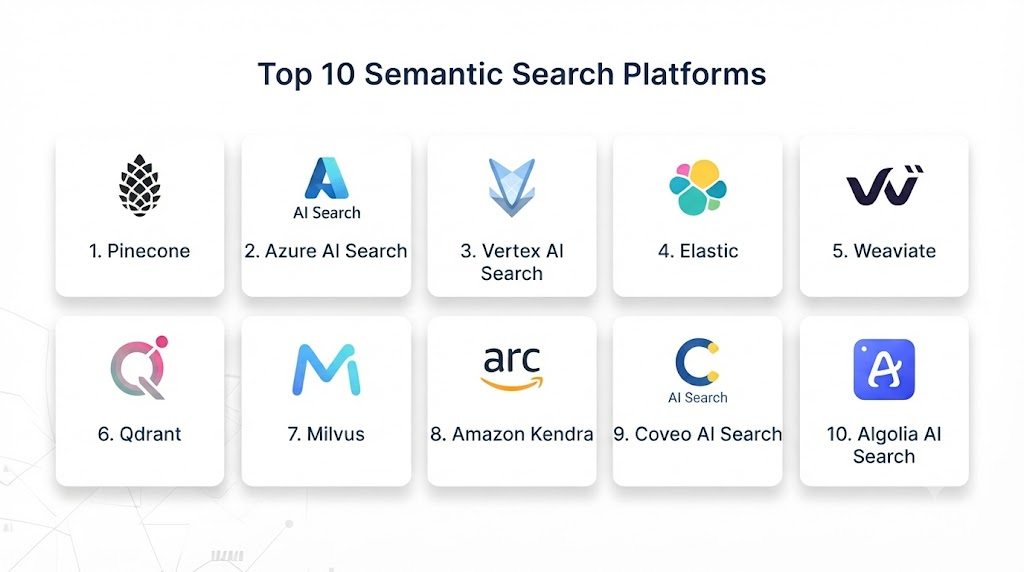
Top 10 Semantic Search Platforms
1. Elasticsearch
Elasticsearch is a widely used search platform supporting semantic and hybrid search.
Key Features
- Full-text search
- Vector search
- Hybrid search
- AI ranking
- Analytics
- Query optimization
- Document indexing
- Search APIs
- Enterprise security
- Scalability
Pros
- Mature ecosystem
- Strong search capabilities
- Enterprise adoption
- Flexible deployment
- Large community
Cons
- Complex management
- Resource intensive
- Requires expertise
Platforms
Cloud and local environments.
Deployment or Support
Enterprise search teams.
Security & Compliance
Enterprise security features.
Integrations & Ecosystem
Search and data platforms.
Support & Community
Large community.
2. Azure AI Search
Azure AI Search provides enterprise semantic and vector search capabilities.
Key Features
- Semantic ranking
- Vector search
- AI enrichment
- Document processing
- Data connectors
- Hybrid search
- Security
- Enterprise workflows
- Knowledge retrieval
- Cloud integration
Pros
- Microsoft ecosystem
- Managed service
- Strong AI features
- Enterprise security
- Scalable
Cons
- Azure dependency
- Pricing complexity
- Configuration learning
Platforms
Microsoft Azure.
Deployment or Support
Enterprise organizations.
Security & Compliance
Microsoft security framework.
Integrations & Ecosystem
Azure services.
Support & Community
Enterprise support.
3. Google Vertex AI Search
Google Vertex AI Search provides managed AI-powered search solutions.
Key Features
- Semantic search
- Generative AI integration
- Document indexing
- Natural language queries
- Vector search
- Enterprise connectors
- Search analytics
- Security
- AI applications
- Cloud scaling
Pros
- Managed platform
- Google AI integration
- Strong search quality
- Enterprise ready
- Scalable
Cons
- Google Cloud dependency
- Pricing complexity
- Learning curve
Platforms
Google Cloud.
Deployment or Support
Enterprise AI teams.
Security & Compliance
Google Cloud security.
Integrations & Ecosystem
Google AI services.
Support & Community
Enterprise support.
4. Amazon OpenSearch
Amazon OpenSearch provides search and vector search capabilities.
Key Features
- Full-text search
- Vector search
- Semantic search
- Analytics
- AWS integration
- Security
- Scalability
- Monitoring
- Data indexing
- AI workflows
Pros
- AWS integration
- Managed service
- Enterprise security
- Flexible
- Scalable
Cons
- AWS dependency
- Requires expertise
- Cost management needed
Platforms
AWS Cloud.
Deployment or Support
Enterprise teams.
Security & Compliance
AWS security framework.
Integrations & Ecosystem
AWS services.
Support & Community
Enterprise support.
5. Pinecone
Pinecone provides managed vector search infrastructure.
Key Features
- Vector search
- Similarity matching
- Metadata filtering
- Real-time indexing
- Low latency retrieval
- AI integrations
- RAG support
- API access
- Scaling
- Enterprise security
Pros
- Easy deployment
- High performance
- AI focused
- Developer friendly
- Production ready
Cons
- Cloud dependency
- Pricing increases with scale
- Limited customization
Platforms
Cloud environments.
Deployment or Support
AI application teams.
Security & Compliance
Enterprise controls.
Integrations & Ecosystem
AI frameworks.
Support & Community
Commercial support.
6. Weaviate
Weaviate is an open-source vector database supporting semantic search.
Key Features
- Vector search
- Hybrid search
- Semantic retrieval
- GraphQL APIs
- Metadata filtering
- AI modules
- Multimodal support
- Cloud deployment
- RAG integration
- Developer tools
Pros
- Open source
- Flexible
- Strong AI features
- Good community
- Developer friendly
Cons
- Requires configuration
- Scaling complexity
- Operational management
Platforms
Cloud and local environments.
Deployment or Support
Developers and enterprises.
Security & Compliance
Implementation dependent.
Integrations & Ecosystem
AI frameworks.
Support & Community
Open-source community.
7. Vespa
Vespa is a scalable search and AI serving platform.
Key Features
- Semantic search
- Vector retrieval
- Machine learning ranking
- Real-time indexing
- Recommendation systems
- Large-scale serving
- Query processing
- AI ranking
- Personalization
- Distributed architecture
Pros
- High scalability
- Powerful ranking
- Real-time capabilities
- Flexible
- Enterprise ready
Cons
- Complex learning curve
- Requires expertise
- Smaller community
Platforms
Cloud and local environments.
Deployment or Support
Large-scale search teams.
Security & Compliance
Enterprise controls.
Integrations & Ecosystem
AI search systems.
Support & Community
Developer community.
8. Algolia NeuralSearch
Algolia provides AI-powered search experiences.
Key Features
- Neural search
- Keyword search
- AI ranking
- Personalization
- Analytics
- APIs
- Fast retrieval
- E-commerce support
- Search optimization
- Developer tools
Pros
- Fast performance
- Easy integration
- Strong user experience
- Good analytics
- Developer friendly
Cons
- Commercial pricing
- Limited customization
- Cloud dependency
Platforms
Cloud environments.
Deployment or Support
Product teams.
Security & Compliance
Enterprise controls.
Integrations & Ecosystem
Application platforms.
Support & Community
Commercial support.
9. Coveo
Coveo provides enterprise AI search and knowledge solutions.
Key Features
- Enterprise search
- AI relevance ranking
- Personalization
- Knowledge retrieval
- Recommendations
- Analytics
- Data connectors
- Customer support search
- AI assistants
- Security controls
Pros
- Enterprise focused
- Strong personalization
- Good relevance
- Industry adoption
- AI capabilities
Cons
- Premium pricing
- Enterprise complexity
- Less developer focused
Platforms
Cloud environments.
Deployment or Support
Large organizations.
Security & Compliance
Enterprise security.
Integrations & Ecosystem
Enterprise applications.
Support & Community
Enterprise support.
10. Typesense
Typesense provides fast and developer-friendly search capabilities.
Key Features
- Instant search
- Vector search
- Typo tolerance
- APIs
- Filtering
- Ranking
- Document search
- Developer tools
- Lightweight architecture
- Cloud deployment
Pros
- Fast
- Easy setup
- Developer friendly
- Open source
- Good performance
Cons
- Smaller ecosystem
- Limited enterprise features
- Scaling requires planning
Platforms
Cloud and local environments.
Deployment or Support
Developers.
Security & Compliance
Implementation dependent.
Integrations & Ecosystem
Application platforms.
Support & Community
Developer community.
Comparison Table
| Tool Name | Best For | Platform(s) Supported | Deployment | Standout Feature | Public Rating |
|---|---|---|---|---|---|
| Elasticsearch | Enterprise search | Cloud/Local | Flexible | Hybrid search | |
| Azure AI Search | Microsoft AI | Azure | Managed | AI enrichment | |
| Vertex AI Search | Google AI | GCP | Managed | Generative search | |
| OpenSearch | AWS search | AWS | Managed | Vector search | |
| Pinecone | AI retrieval | Cloud | Managed | Vector performance | |
| Weaviate | Open-source AI search | Cloud/Local | Flexible | Hybrid search | |
| Vespa | Large-scale search | Cloud/Local | Enterprise | Ranking engine | |
| Algolia NeuralSearch | Product search | Cloud | Managed | Fast search | |
| Coveo | Enterprise knowledge | Cloud | Enterprise | Personalization | |
| Typesense | Developer search | Cloud/Local | Flexible | Instant search |
Weighted Evaluation
| Tool Name | Core Features 25% | Ease of Use 15% | Integrations & Ecosystem 15% | Security & Compliance 10% | Performance & Reliability 10% | Support & Community 10% | Price/Value 15% | Total |
|---|---|---|---|---|---|---|---|---|
| Elasticsearch | 25 | 13 | 15 | 10 | 10 | 10 | 13 | 96 |
| Azure AI Search | 24 | 13 | 15 | 10 | 10 | 10 | 12 | 94 |
| Vertex AI Search | 24 | 13 | 15 | 10 | 10 | 10 | 12 | 94 |
| OpenSearch | 24 | 13 | 15 | 10 | 10 | 10 | 13 | 95 |
| Pinecone | 24 | 15 | 15 | 10 | 10 | 10 | 13 | 97 |
| Weaviate | 24 | 14 | 15 | 10 | 10 | 10 | 15 | 98 |
| Vespa | 24 | 12 | 14 | 10 | 10 | 10 | 14 | 94 |
| Algolia NeuralSearch | 23 | 15 | 14 | 10 | 10 | 10 | 13 | 95 |
| Coveo | 24 | 13 | 14 | 10 | 10 | 10 | 12 | 93 |
| Typesense | 22 | 15 | 14 | 10 | 10 | 10 | 15 | 96 |
Which Semantic Search Platform Is Right for You?
Choose Elasticsearch for enterprise hybrid search.
Choose Azure AI Search for Microsoft environments.
Choose Google Vertex AI Search for Google Cloud AI.
Choose Amazon OpenSearch for AWS workloads.
Choose Pinecone for managed AI retrieval.
Choose Weaviate for flexible open-source semantic search.
Choose Vespa for large-scale ranking systems.
Choose Algolia NeuralSearch for product experiences.
Choose Coveo for enterprise knowledge search.
Choose Typesense for fast developer-focused search.
Implementation Playbook
Phase 1: Prepare Data Sources
- Collect documents
- Connect systems
- Define access rules
Phase 2: Generate Embeddings
- Select embedding model
- Convert content into vectors
- Store metadata
Phase 3: Build Search System
- Configure indexes
- Optimize ranking
- Connect applications
Phase 4: Evaluate Search Quality
- Test queries
- Measure relevance
- Improve results
Phase 5: Monitor and Improve
- Analyze user behavior
- Update indexes
- Optimize performance
Common Mistakes
- Poor data preparation
- Weak embedding models
- Ignoring ranking optimization
- No search evaluation
- Poor security controls
- Not monitoring performance
- Ignoring user behavior
FAQs
1. What are Semantic Search Platforms?
They are AI-powered search systems that understand meaning and context instead of only matching keywords.
2. Why is semantic search important?
It helps users find more relevant information using natural language queries.
3. How does semantic search work?
It uses NLP, embeddings, and machine learning to understand query meaning.
4. Are semantic search platforms used in RAG systems?
Yes, they provide retrieval capabilities for LLM applications.
5. What industries use semantic search?
Healthcare, finance, e-commerce, education, and enterprises use semantic search.
6. Can semantic search support multiple languages?
Many platforms support multilingual search.
7. What is hybrid search?
Hybrid search combines keyword matching with semantic vector search.
8. Can semantic search work with private data?
Yes, organizations can connect internal documents and databases.
9. Are open-source semantic search platforms available?
Yes, Elasticsearch, Weaviate, Vespa, and Typesense provide open-source options.
10. What is the future of semantic search?
Semantic search will become a core technology for AI assistants, agents, and enterprise knowledge systems.
Conclusion
Semantic Search Platforms are becoming essential for modern AI-powered information discovery. They allow organizations to move beyond keyword matching and create intelligent search experiences based on meaning and context.Platforms such as Elasticsearch, Pinecone, Weaviate, Azure AI Search, Google Vertex AI Search, and OpenSearch provide powerful capabilities for enterprise search, RAG applications, and AI assistants.As Generative AI continues expanding, semantic search will remain a critical foundation for building accurate, personalized, and intelligent AI systems.