Introduction
Data Clean Room Platforms for AI are secure data collaboration environments that allow organizations to analyze, process, and use sensitive datasets without directly exposing raw information.
As artificial intelligence adoption grows, organizations need access to large amounts of data for:
- AI model training
- Machine learning analytics
- Customer insights
- Data collaboration
- AI research
However, sharing sensitive data between companies or teams creates privacy and security challenges.
Data Clean Room platforms solve this problem by creating controlled environments where multiple parties can work with data while maintaining privacy rules and governance policies.
These platforms help organizations:
- Protect sensitive information
- Enable secure AI collaboration
- Support privacy-preserving analytics
- Improve AI training workflows
- Maintain compliance requirements
Data Clean Room Platforms are used by:
- AI engineers
- Data scientists
- Data privacy teams
- Enterprise architects
- Marketing analytics teams
- MLOps professionals
Modern Data Clean Room platforms provide capabilities such as:
- Secure data collaboration
- Privacy controls
- Data governance
- Access management
- Secure computation
- AI analytics
- Data matching
- Compliance monitoring
The goal of Data Clean Room Platforms for AI is to enable organizations to unlock data value while maintaining privacy and security.
Why Data Clean Rooms Matter for AI
AI systems require large and diverse datasets.
Organizations often face challenges such as:
- Privacy regulations
- Data ownership concerns
- Security risks
- Limited data access
Data Clean Rooms help organizations:
- Train AI models securely
- Combine datasets safely
- Protect customer information
- Enable responsible AI development
How Data Clean Rooms Work
Step 1: Data Upload
Organizations provide approved datasets.
Examples:
- Customer information
- Business records
- Research data
Step 2: Data Protection
The platform applies:
- Access restrictions
- Encryption
- Privacy controls
Step 3: Controlled Processing
Users perform approved operations such as:
- Analytics
- Machine learning workflows
- Data matching
Step 4: Privacy Validation
The system ensures:
- No unauthorized access
- No sensitive data exposure
Step 5: Result Sharing
Only approved outputs are shared.
Examples:
- Reports
- Insights
- Aggregated results
Key Components of Data Clean Room Platforms
Secure Data Environment
Provides:
- Isolated processing
- Protected storage
Privacy Controls
Includes:
- Encryption
- Access policies
- Data restrictions
Governance Layer
Manages:
- Permissions
- Compliance rules
- Auditing
Secure Computation Engine
Supports:
- Privacy-preserving analysis
- Controlled processing
AI Integration Layer
Connects with:
- ML pipelines
- AI platforms
- Data science tools
Monitoring System
Tracks:
- Data usage
- User activity
- Security events
Types of Data Clean Rooms
Cloud Data Clean Rooms
Examples:
- AWS Clean Rooms
- Google Ads Data Hub
Used for cloud-based collaboration.
Marketing Data Clean Rooms
Used for:
- Advertising analytics
- Customer insights
Enterprise AI Clean Rooms
Used for:
- Machine learning
- Data collaboration
Healthcare Data Clean Rooms
Used for:
- Medical research
- Privacy-safe analysis
Financial Data Clean Rooms
Used for:
- Risk analysis
- Secure financial modeling
Key Features of Data Clean Room Platforms
Secure Data Collaboration
Allows multiple organizations to work together safely.
Privacy Protection
Supports:
- Encryption
- Data masking
- Privacy rules
Access Control
Manages:
- User permissions
- Data policies
AI and ML Integration
Supports:
- Model training
- Data analysis
Governance and Compliance
Helps organizations meet:
- Privacy requirements
- Regulatory standards
Audit Tracking
Records:
- Data usage
- User activities
Common Use Cases
AI Model Training
Organizations can combine datasets securely for:
- Machine learning
- Generative AI
Advertising Analytics
Used for:
- Audience insights
- Campaign measurement
Healthcare Research
Supports:
- Medical AI research
- Patient data analysis
Financial AI
Enables:
- Fraud detection
- Risk modeling
Enterprise Data Collaboration
Allows:
- Partner data analysis
- Secure research
Customer Intelligence
Combines:
- Behavioral data
- Business insights
Benefits of Data Clean Room Platforms
Improved Data Privacy
Sensitive data remains protected.
Secure AI Collaboration
Organizations can work together safely.
Better AI Training Data
Models receive broader datasets.
Regulatory Compliance
Supports privacy requirements.
Reduced Data Sharing Risks
Raw information stays controlled.
Evaluation Criteria
Privacy Protection
Evaluate:
- Encryption
- Data controls
- Security features
AI Integration
Consider:
- ML workflows
- Data science support
Governance
Evaluate:
- Access management
- Compliance
Scalability
Consider:
- Data volume
- Enterprise workloads
Collaboration Features
Check:
- Multi-party support
- Secure sharing
Deployment Options
Evaluate:
- Cloud support
- Enterprise deployment
Key Trends
Privacy-Preserving AI
Organizations are adopting secure AI development methods.
Federated Learning Integration
Clean rooms are supporting distributed AI training.
Secure Generative AI Development
Companies are protecting data used for LLM workflows.
AI Governance Growth
Data control is becoming essential for enterprise AI.
Multi-Organization Collaboration
Businesses are sharing insights without exposing raw data.
Methodology
The following Data Clean Room Platforms were evaluated based on:
- Privacy capabilities
- AI integration
- Security
- Governance
- Scalability
- Collaboration features
- Enterprise adoption
- Performance
- Ease of use
- Value
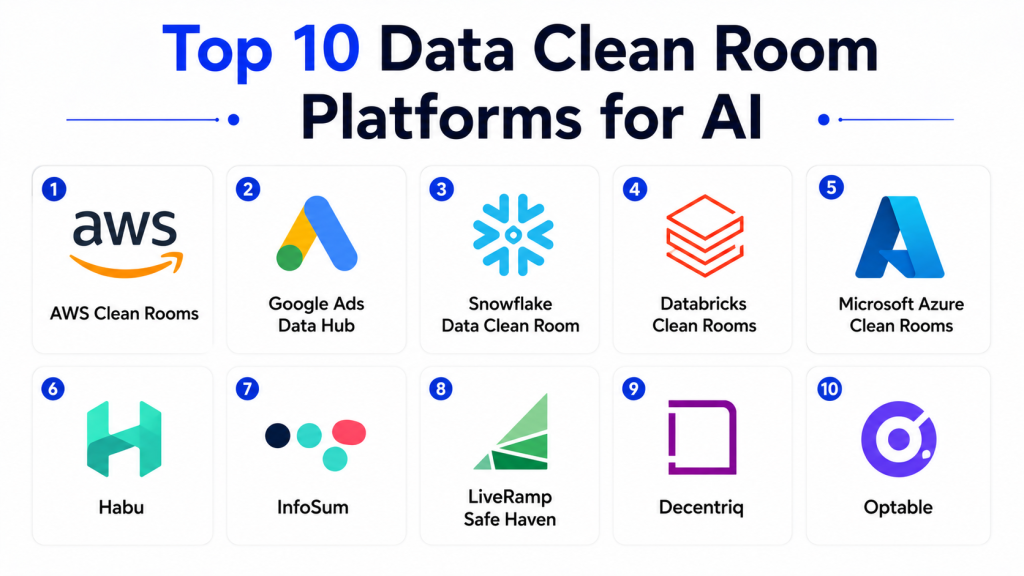
Top 10 Data Clean Room Platforms for AI
1. AWS Clean Rooms
AWS Clean Rooms provides secure collaboration environments for analyzing combined datasets.
Key Features
- Secure data collaboration
- Privacy controls
- SQL analysis
- Access policies
- AWS integration
- Cryptographic protection
- Governance controls
- Data matching
- Analytics workflows
Pros
- Strong cloud security
- AWS ecosystem integration
- Enterprise ready
Cons
- Best suited for AWS users
- Requires cloud expertise
2. Snowflake Data Clean Rooms
Snowflake provides secure data collaboration using its cloud data platform.
Key Features
- Secure data sharing
- Privacy controls
- Data governance
- Analytics workflows
- AI data access
- Multi-party collaboration
- Data marketplace integration
Pros
- Strong enterprise adoption
- Scalable architecture
- Easy data collaboration
Cons
- Snowflake dependency
3. Google Ads Data Hub
Google Ads Data Hub provides privacy-safe advertising data analysis.
Key Features
- Secure analytics
- Privacy controls
- Advertising insights
- Aggregated reporting
- Google ecosystem integration
- Audience measurement
Pros
- Strong advertising capabilities
- Enterprise scale
Cons
- Limited outside advertising use cases
4. Databricks Clean Rooms
Databricks provides secure data collaboration capabilities through its lakehouse platform.
Key Features
- Secure collaboration
- Data governance
- ML integration
- Data sharing
- Analytics workflows
- AI development support
Pros
- Strong AI ecosystem
- Good ML integration
- Enterprise scalability
Cons
- Requires Databricks environment
5. Microsoft Azure Confidential Computing
Azure Confidential Computing provides protected data processing environments.
Key Features
- Secure computation
- Encryption
- Privacy protection
- Cloud security
- AI workload support
- Enterprise governance
Pros
- Strong security
- Azure integration
Cons
- Requires Azure expertise
6. InfoSum
InfoSum provides privacy-focused data collaboration solutions.
Key Features
- Decentralized data collaboration
- Privacy protection
- Secure matching
- Identity resolution
- Analytics workflows
- Enterprise privacy controls
Pros
- Strong privacy architecture
- Secure collaboration
Cons
- Specialized use cases
7. LiveRamp Data Collaboration Platform
LiveRamp provides data collaboration and identity solutions.
Key Features
- Data collaboration
- Identity matching
- Privacy controls
- Marketing analytics
- Audience insights
- Secure activation
Pros
- Strong enterprise adoption
- Marketing data expertise
Cons
- Marketing focused
8. Decentriq
Decentriq provides privacy-enhancing computation platforms.
Key Features
- Secure collaboration
- Confidential computing
- Data protection
- Privacy analytics
- AI workflows
- Enterprise security
Pros
- Strong privacy technology
- Secure processing
Cons
- Smaller ecosystem
9. Habu
Habu provides data clean room solutions for enterprises.
Key Features
- Data collaboration
- Privacy management
- Analytics
- Data partnerships
- Governance
- Secure workflows
Pros
- Enterprise focused
- Strong collaboration
Cons
- Commercial platform
10. Protegrity
Protegrity provides enterprise data protection solutions.
Key Features
- Data security
- Tokenization
- Privacy management
- Compliance support
- Sensitive data protection
- Cloud integration
Pros
- Strong security
- Enterprise compliance
Cons
- Complex deployment
Comparison Table: Top 10 Data Clean Room Platforms for AI
| No. | Tool Name | Best For | Platform(s) Supported | Deployment | Standout Feature | Public Rating |
|---|---|---|---|---|---|---|
| 1 | AWS Clean Rooms | Secure AI collaboration | AWS | Managed | Privacy-safe analysis | 4.8/5 |
| 2 | Snowflake Clean Rooms | Enterprise data sharing | Cloud | Managed | Secure data collaboration | 4.7/5 |
| 3 | Google Ads Data Hub | Marketing analytics | Google Cloud | Managed | Privacy-safe measurement | 4.6/5 |
| 4 | Databricks Clean Rooms | AI data workflows | Cloud | Managed | ML integration | 4.7/5 |
| 5 | Azure Confidential Computing | Secure computation | Azure | Managed | Protected processing | 4.6/5 |
| 6 | InfoSum | Privacy collaboration | Cloud | Managed | Decentralized privacy | 4.5/5 |
| 7 | LiveRamp | Marketing collaboration | Cloud | Managed | Identity matching | 4.5/5 |
| 8 | Decentriq | Confidential AI workflows | Cloud | Managed | Privacy computing | 4.4/5 |
| 9 | Habu | Enterprise collaboration | Cloud | Managed | Clean room workflows | 4.4/5 |
| 10 | Protegrity | Data protection | Cloud / Local | Enterprise | Tokenization | 4.4/5 |
Weighted Evaluation Table
| No. | Tool Name | Privacy 25% | Ease of Use 15% | AI Integration 15% | Security 10% | Scalability 10% | Collaboration 10% | Value 15% | Total Score |
|---|---|---|---|---|---|---|---|---|---|
| 1 | AWS Clean Rooms | 25 | 14 | 15 | 10 | 10 | 10 | 14 | 98 |
| 2 | Snowflake Clean Rooms | 25 | 15 | 15 | 10 | 10 | 10 | 13 | 98 |
| 3 | Google Ads Data Hub | 24 | 14 | 13 | 10 | 10 | 10 | 13 | 94 |
| 4 | Databricks Clean Rooms | 25 | 14 | 15 | 10 | 10 | 10 | 13 | 97 |
| 5 | Azure Confidential Computing | 25 | 13 | 14 | 10 | 10 | 10 | 13 | 95 |
| 6 | InfoSum | 24 | 14 | 13 | 10 | 10 | 10 | 13 | 94 |
| 7 | LiveRamp | 24 | 15 | 13 | 9 | 10 | 10 | 13 | 94 |
| 8 | Decentriq | 24 | 13 | 14 | 10 | 10 | 10 | 13 | 94 |
| 9 | Habu | 23 | 14 | 13 | 10 | 10 | 10 | 13 | 93 |
| 10 | Protegrity | 24 | 12 | 13 | 10 | 10 | 10 | 13 | 92 |
Which Data Clean Room Platform Is Right for You?
Choose AWS Clean Rooms for AWS-based AI collaboration.
Choose Snowflake Clean Rooms for enterprise data sharing.
Choose Google Ads Data Hub for advertising analytics.
Choose Databricks Clean Rooms for AI and ML workflows.
Choose Azure Confidential Computing for secure cloud processing.
Choose InfoSum for privacy-focused collaboration.
Choose LiveRamp for marketing data partnerships.
Choose Decentriq for confidential computing.
Choose Habu for enterprise clean room workflows.
Choose Protegrity for data protection.
Implementation Playbook
Phase 1: Define Data Requirements
- Identify datasets
- Define collaboration goals
- Establish privacy rules
Phase 2: Setup Clean Room
- Configure access
- Apply security policies
- Connect data sources
Phase 3: Run AI Workflows
- Analyze data
- Build models
- Generate insights
Phase 4: Validate Privacy
- Review outputs
- Check compliance
- Monitor access
Phase 5: Maintain Governance
- Update policies
- Monitor usage
- Improve workflows
Common Mistakes
- Sharing raw sensitive data
- Poor access control
- Ignoring compliance requirements
- Weak governance policies
- No monitoring system
- Incorrect data permissions
FAQs
1. What are Data Clean Room Platforms for AI?
They are secure environments that allow organizations to use and analyze data without exposing raw information.
2. Why are clean rooms important for AI?
They allow safe AI training and data collaboration.
3. Can clean rooms support machine learning workflows?
Yes, many platforms integrate with AI and ML pipelines.
4. How do clean rooms protect data?
They use access controls, encryption, and privacy technologies.
5. Are clean rooms useful for LLM training?
Yes, they help organizations prepare privacy-safe AI datasets.
6. What industries use data clean rooms?
Healthcare, finance, advertising, technology, and research industries.
7. Are cloud providers offering clean rooms?
Yes, AWS, Google Cloud, Microsoft Azure, and Snowflake provide solutions.
8. Can multiple organizations collaborate inside clean rooms?
Yes, without directly sharing sensitive data.
9. Are clean rooms part of responsible AI practices?
Yes, they support privacy and governance.
10. What is the future of data clean rooms?
They will become important infrastructure for secure AI development.
Conclusion
Data Clean Room Platforms for AI provide a secure foundation for privacy-preserving data collaboration and machine learning development. They help organizations use valuable information while protecting sensitive data.Platforms such as AWS Clean Rooms, Snowflake Clean Rooms, Databricks Clean Rooms, Azure Confidential Computing, InfoSum, and LiveRamp enable secure AI workflows across industries.As AI systems require more data and privacy regulations continue evolving, Data Clean Rooms will become a key technology for responsible, secure, and scalable AI development.