Introduction
Model Serving Platforms are AI infrastructure solutions that help organizations deploy, manage, scale, and monitor machine learning models in production environments.
After a machine learning model is trained, it needs a reliable system to deliver predictions through APIs, applications, and business workflows. Model serving platforms provide the infrastructure required to make AI models available for real-world usage.
Unlike traditional application deployment systems, model serving platforms are designed specifically for AI workloads that require:
- Low-latency predictions
- High scalability
- Multiple model management
- Hardware optimization
- Version control
- Monitoring
- Automated deployment
These platforms help organizations:
- Deploy machine learning models
- Create prediction APIs
- Manage model versions
- Scale inference workloads
- Optimize GPU usage
- Monitor model performance
- Support real-time AI applications
Model Serving Platforms are used by:
- Machine learning engineers
- Data scientists
- AI platform teams
- DevOps engineers
- MLOps teams
- Enterprise AI developers
Modern model serving platforms provide capabilities such as:
- Model deployment
- Inference APIs
- Container-based serving
- GPU acceleration
- Autoscaling
- Model version management
- A/B testing
- Monitoring
- Security controls
- Multi-model hosting
The goal of Model Serving Platforms is to provide reliable, scalable, and efficient infrastructure for running AI models in production.
What Are Model Serving Platforms?
Model Serving Platforms are systems that allow trained machine learning models to be deployed and accessed by applications.
A model serving platform converts a trained model into a production service.
Example:
A company builds a recommendation model.
Model serving platform:
- Receives customer data
- Sends data to the AI model
- Generates recommendations
- Returns predictions to the application
Why Organizations Need Model Serving Platforms
Deploying AI models manually creates challenges:
- Infrastructure complexity
- Scaling problems
- Performance issues
- Version management difficulties
- Monitoring limitations
Organizations need model serving platforms to:
- Deliver AI predictions reliably
- Handle increasing workloads
- Reduce deployment effort
- Improve operational stability
- Support enterprise AI applications
How Model Serving Platforms Work
Model Packaging
The trained model is prepared with:
- Dependencies
- Runtime environment
- Configuration
Deployment
The model is deployed using:
- Containers
- APIs
- Cloud services
Inference Requests
Applications send:
- Input data
- Prediction requests
Model Execution
The platform:
- Loads the model
- Processes data
- Generates predictions
Response Delivery
The prediction is returned to:
- Applications
- Users
- Business systems
Monitoring
The system tracks:
- Latency
- Errors
- Resource usage
- Model performance
Key Components of Model Serving Platforms
Inference Engine
Handles:
- Model execution
- Prediction requests
- Response generation
API Gateway
Provides:
- REST APIs
- Authentication
- Request management
Model Registry Integration
Manages:
- Model versions
- Deployment history
- Metadata
Scaling System
Controls:
- Compute resources
- Traffic handling
- Performance
Monitoring Layer
Tracks:
- Model health
- Latency
- Accuracy
Security Layer
Provides:
- Authentication
- Authorization
- Data protection
Types of Model Serving Platforms
Cloud-Based Serving Platforms
Designed for:
- Enterprise AI workloads
- Managed infrastructure
Examples:
- Amazon SageMaker
- Google Vertex AI
- Azure Machine Learning
Open Source Serving Platforms
Used for:
- Custom deployments
- Flexible infrastructure
Examples:
- KServe
- TensorFlow Serving
- TorchServe
Large Language Model Serving Platforms
Optimized for:
- LLM inference
- Generative AI applications
Examples:
- vLLM
- NVIDIA Triton
Enterprise AI Serving Platforms
Support:
- Governance
- Security
- Large-scale deployment
Key Features of Model Serving Platforms
Real-Time Inference
Supports:
- Fast predictions
- Low latency applications
Batch Prediction
Handles:
- Large data processing
- Scheduled inference
Model Versioning
Manages:
- Multiple models
- Updates
- Rollbacks
Autoscaling
Automatically adjusts:
- Compute resources
- Server capacity
Hardware Optimization
Supports:
- GPUs
- CPUs
- Accelerators
Monitoring and Logging
Tracks:
- Performance
- Failures
- Usage
Common Use Cases
Recommendation Systems
Used for:
- Product recommendations
- Content personalization
Fraud Detection
Supports:
- Real-time transaction analysis
- Risk scoring
Healthcare AI
Deploys:
- Medical prediction models
- Diagnostic systems
Computer Vision
Handles:
- Image recognition
- Object detection
Natural Language Processing
Supports:
- Chatbots
- Text analysis
- AI assistants
Generative AI Applications
Provides:
- LLM inference
- AI application backends
Why Model Serving Platforms Matter
Reliable AI Deployment
Models run consistently in production.
Faster AI Adoption
Teams deploy models quickly.
Better Scalability
Applications handle increasing demand.
Improved Performance
Infrastructure optimization improves speed.
Enterprise AI Operations
Organizations manage many AI models efficiently.
Evaluation Criteria for Buyers
Deployment Capabilities
Evaluate:
- Model support
- Deployment options
- API availability
Performance
Consider:
- Latency
- Throughput
- Resource efficiency
Scalability
Evaluate:
- Autoscaling
- Multi-model support
- Large workloads
Integration Support
Look for:
- Cloud platforms
- ML frameworks
- DevOps tools
Security
Consider:
- Authentication
- Compliance
- Data protection
Monitoring
Evaluate:
- Logs
- Metrics
- Model health tracking
Key Trends
LLM Inference Optimization
Platforms are improving large language model serving efficiency.
GPU Acceleration
AI serving is increasingly optimized for specialized hardware.
Serverless Model Serving
Organizations are adopting pay-per-use inference systems.
Edge Model Deployment
AI models are moving closer to users and devices.
Multi-Model Serving
Companies are managing multiple AI models from one platform.
AI Infrastructure Automation
Deployment and scaling are becoming more automated.
Methodology
The following Model Serving Platforms were evaluated based on:
- Serving capabilities
- Performance
- Scalability
- Deployment flexibility
- Integration ecosystem
- Security
- Monitoring
- Enterprise readiness
- Developer experience
- Value
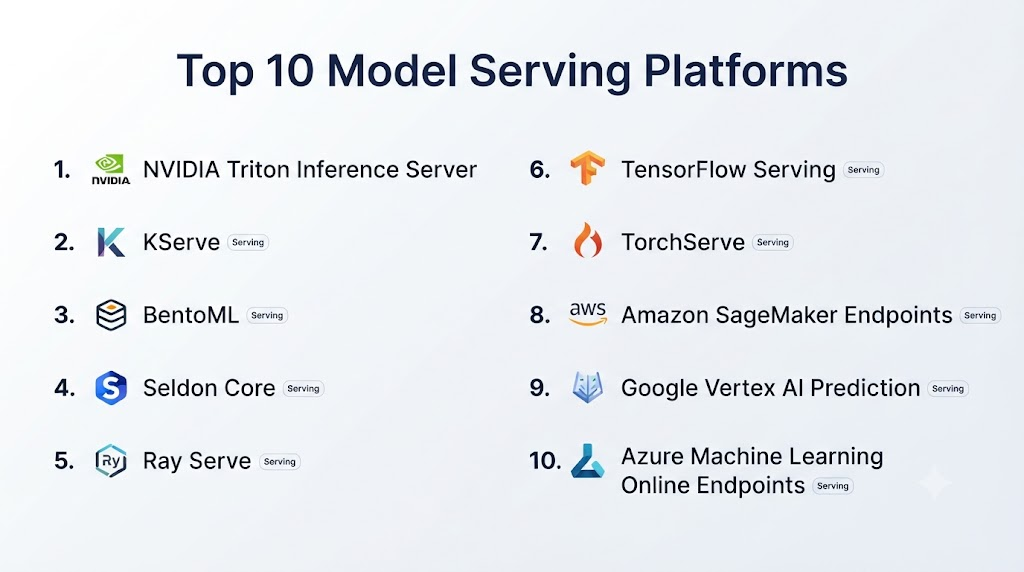
Top 10 Model Serving Platforms
- NVIDIA Triton Inference Server
- KServe
- TensorFlow Serving
- TorchServe
- Amazon SageMaker Model Serving
- Google Vertex AI Prediction
- Azure Machine Learning Online Endpoints
- BentoML
- Ray Serve
- vLLM
1. NVIDIA Triton Inference Server
NVIDIA Triton Inference Server is a high-performance model serving platform designed for enterprise AI inference.
Key Features
- Multi-framework support
- GPU acceleration
- Dynamic batching
- Model management
- Real-time inference
- LLM serving support
- Performance optimization
- API support
- Monitoring
- Enterprise deployment
Pros
- Excellent performance
- GPU optimization
- Multiple framework support
- Enterprise-ready
- High scalability
Cons
- Requires infrastructure expertise
- Best with NVIDIA hardware
- Complex configuration
Platforms
Cloud and enterprise environments.
Deployment or Support
Production AI inference.
Security & Compliance
Enterprise deployment controls.
Integrations & Ecosystem
AI frameworks and NVIDIA ecosystem.
Support & Community
Developer community.
2. KServe
KServe provides Kubernetes-native model serving capabilities.
Key Features
- Kubernetes integration
- Model deployment
- Autoscaling
- Serverless inference
- Multiple framework support
- Model versioning
- Traffic management
- Monitoring
- AI workflows
- Cloud-native architecture
Pros
- Kubernetes-native
- Scalable
- Open source
- Flexible
- Enterprise-ready
Cons
- Requires Kubernetes expertise
- Complex setup
- Infrastructure management needed
Platforms
Kubernetes environments.
Deployment or Support
Cloud-native AI systems.
Security & Compliance
Depends on Kubernetes configuration.
Integrations & Ecosystem
Kubernetes ecosystem.
Support & Community
Open-source community.
3. TensorFlow Serving
TensorFlow Serving provides production deployment infrastructure for TensorFlow models.
Key Features
- TensorFlow model serving
- REST APIs
- gRPC support
- Model version management
- Deployment automation
- Performance optimization
- Monitoring
- Production inference
- Integration support
- Scalability
Pros
- Mature platform
- TensorFlow integration
- Reliable
- Easy deployment
- Production proven
Cons
- Limited framework support
- TensorFlow focused
- Less flexible
Platforms
Cloud and local environments.
Deployment or Support
TensorFlow applications.
Security & Compliance
Implementation dependent.
Integrations & Ecosystem
TensorFlow ecosystem.
Support & Community
Large community.
4. TorchServe
TorchServe provides serving capabilities for PyTorch models.
Key Features
- PyTorch model serving
- REST APIs
- Model management
- Custom handlers
- Batch inference
- Monitoring
- Version control
- Deployment tools
- Scaling support
- Logging
Pros
- PyTorch optimized
- Developer-friendly
- Flexible
- Open source
- Easy deployment
Cons
- PyTorch focused
- Requires customization
- Limited enterprise features
Platforms
Cloud and local environments.
Deployment or Support
PyTorch applications.
Security & Compliance
Implementation dependent.
Integrations & Ecosystem
PyTorch ecosystem.
Support & Community
Developer community.
5. Amazon SageMaker Model Serving
Amazon SageMaker provides managed model deployment and inference services.
Key Features
- Real-time endpoints
- Batch inference
- Autoscaling
- Model registry
- Monitoring
- Security controls
- Deployment automation
- Multi-model hosting
- Cloud integration
- AI workflows
Pros
- Fully managed
- AWS integration
- Enterprise-ready
- Scalable
- Strong security
Cons
- AWS dependency
- Cost complexity
- Learning curve
Platforms
AWS Cloud.
Deployment or Support
Enterprise AI workloads.
Security & Compliance
AWS security framework.
Integrations & Ecosystem
AWS services.
Support & Community
Enterprise support.
6. Google Vertex AI Prediction
Google Vertex AI provides managed model serving infrastructure.
Key Features
- Online prediction
- Batch prediction
- Model deployment
- Autoscaling
- Monitoring
- AI model management
- Security
- Cloud integration
- Model registry
- Enterprise workflows
Pros
- Google Cloud integration
- Managed infrastructure
- Scalable
- Strong AI capabilities
- Enterprise support
Cons
- Google Cloud dependency
- Pricing complexity
- Requires expertise
Platforms
Google Cloud.
Deployment or Support
Enterprise AI deployment.
Security & Compliance
Google Cloud security.
Integrations & Ecosystem
Google AI services.
Support & Community
Enterprise support.
7. Azure Machine Learning Online Endpoints
Azure ML provides managed online model serving.
Key Features
- Real-time endpoints
- Model deployment
- Autoscaling
- Monitoring
- Security controls
- Model registry
- ML pipelines
- Enterprise integration
- Governance
- API management
Pros
- Microsoft ecosystem
- Enterprise security
- Good governance
- Scalable
- Managed service
Cons
- Azure dependency
- Complex setup
- Pricing complexity
Platforms
Microsoft Azure.
Deployment or Support
Enterprise AI applications.
Security & Compliance
Microsoft security framework.
Integrations & Ecosystem
Azure services.
Support & Community
Enterprise support.
8. BentoML
BentoML provides tools for building and deploying AI model services.
Key Features
- Model packaging
- API generation
- Deployment automation
- Container support
- Model management
- Cloud deployment
- Python integration
- Scaling
- Monitoring
- Developer workflows
Pros
- Developer-friendly
- Easy deployment
- Flexible
- Open source
- Good integrations
Cons
- Requires engineering knowledge
- Smaller ecosystem
- Enterprise features vary
Platforms
Cloud and local environments.
Deployment or Support
AI application development.
Security & Compliance
Implementation dependent.
Integrations & Ecosystem
ML frameworks.
Support & Community
Developer community.
9. Ray Serve
Ray Serve provides scalable model serving built on Ray.
Key Features
- Distributed serving
- Python APIs
- Multi-model deployment
- Autoscaling
- ML workflow integration
- Real-time inference
- Deployment management
- Performance optimization
- Cloud support
- Monitoring
Pros
- Flexible architecture
- Scalable
- Developer-friendly
- Good for complex AI systems
- Distributed computing support
Cons
- Requires Ray knowledge
- Infrastructure complexity
- Setup effort
Platforms
Cloud and local environments.
Deployment or Support
Distributed AI applications.
Security & Compliance
Implementation dependent.
Integrations & Ecosystem
Ray ecosystem.
Support & Community
Developer community.
10. vLLM
vLLM is an optimized inference engine for large language models.
Key Features
- LLM serving
- High-throughput inference
- GPU optimization
- OpenAI-compatible APIs
- Memory optimization
- Batch processing
- Model deployment
- Generative AI support
- Performance tuning
- Developer tools
Pros
- Excellent LLM performance
- Efficient memory usage
- Open source
- Fast inference
- Growing ecosystem
Cons
- Focused on LLMs
- Requires GPU expertise
- Limited general ML support
Platforms
Cloud and local environments.
Deployment or Support
Generative AI applications.
Security & Compliance
Implementation dependent.
Integrations & Ecosystem
LLM ecosystem.
Support & Community
Developer community.
Comparison Table
| Tool Name | Best For | Platform(s) Supported | Deployment | Standout Feature | Public Rating |
|---|---|---|---|---|---|
| NVIDIA Triton | High-performance inference | Cloud/Enterprise | Production | GPU optimization | |
| KServe | Kubernetes ML serving | Kubernetes | Enterprise | Cloud-native serving | |
| TensorFlow Serving | TensorFlow models | Cloud/Local | Production | Mature serving | |
| TorchServe | PyTorch models | Cloud/Local | Production | PyTorch support | |
| SageMaker Serving | AWS AI | AWS | Enterprise | Managed endpoints | |
| Vertex AI Prediction | Google AI | GCP | Enterprise | Cloud AI serving | |
| Azure ML Endpoints | Microsoft AI | Azure | Enterprise | Governance | |
| BentoML | Developer deployment | Cloud/Local | Flexible | Easy packaging | |
| Ray Serve | Distributed AI | Cloud/Local | Production | Distributed serving | |
| vLLM | LLM inference | Cloud/Local | Production | Fast LLM serving |
Weighted Evaluation
| Tool Name | Core Features 25% | Ease of Use 15% | Integrations & Ecosystem 15% | Security & Compliance 10% | Performance & Reliability 10% | Support & Community 10% | Price/Value 15% | Total |
|---|---|---|---|---|---|---|---|---|
| NVIDIA Triton | 25 | 12 | 15 | 10 | 10 | 10 | 13 | 95 |
| KServe | 24 | 11 | 15 | 10 | 10 | 10 | 14 | 94 |
| TensorFlow Serving | 23 | 14 | 14 | 10 | 10 | 10 | 15 | 96 |
| TorchServe | 23 | 14 | 14 | 10 | 10 | 10 | 15 | 96 |
| SageMaker Serving | 25 | 13 | 15 | 10 | 10 | 10 | 12 | 95 |
| Vertex AI Prediction | 25 | 13 | 15 | 10 | 10 | 10 | 12 | 95 |
| Azure ML Endpoints | 24 | 13 | 15 | 10 | 10 | 10 | 13 | 95 |
| BentoML | 23 | 15 | 14 | 10 | 10 | 10 | 15 | 97 |
| Ray Serve | 24 | 12 | 14 | 10 | 10 | 10 | 14 | 94 |
| vLLM | 24 | 14 | 14 | 10 | 10 | 10 | 15 | 97 |
Which Model Serving Platform Is Right for You?
Choose NVIDIA Triton for high-performance enterprise inference.
Choose KServe for Kubernetes-based AI serving.
Choose TensorFlow Serving for TensorFlow models.
Choose TorchServe for PyTorch applications.
Choose Amazon SageMaker Serving for AWS environments.
Choose Google Vertex AI Prediction for Google Cloud AI.
Choose Azure ML Online Endpoints for Microsoft ecosystems.
Choose BentoML for flexible developer workflows.
Choose Ray Serve for distributed AI applications.
Choose vLLM for large language model serving.
Implementation Playbook
Phase 1: Prepare Models
- Package models
- Define dependencies
- Test performance
Phase 2: Deploy Serving Infrastructure
- Configure APIs
- Select hardware
- Setup environments
Phase 3: Enable Scaling
- Configure autoscaling
- Optimize resources
- Manage traffic
Phase 4: Monitor Production
- Track latency
- Monitor errors
- Measure performance
Phase 5: Optimize Continuously
- Improve models
- Reduce costs
- Upgrade infrastructure
Common Mistakes
- Deploying without performance testing
- Ignoring monitoring
- Poor resource planning
- No model version management
- Lack of security controls
- Overlooking infrastructure costs
- Poor scaling strategy
FAQs
1. What are Model Serving Platforms?
They are platforms that deploy and run machine learning models in production environments.
2. Why are model serving platforms important?
They make AI models accessible, scalable, and reliable for real-world applications.
3. What is model inference?
Inference is the process where a trained model generates predictions from new data.
4. Can model serving platforms support deep learning models?
Yes, many support deep learning frameworks.
5. Do model serving platforms support LLMs?
Yes, platforms like vLLM and NVIDIA Triton support large language model inference.
6. Can organizations deploy multiple models?
Yes, many platforms support multi-model serving.
7. How do platforms improve AI performance?
Through optimization, batching, scaling, and hardware acceleration.
8. Are open-source model serving tools available?
Yes, tools like KServe, BentoML, and TensorFlow Serving are open source.
9. Can model serving platforms run on cloud infrastructure?
Yes, most support major cloud environments.
10. What is the future of model serving?
Model serving will become more automated with optimized infrastructure for generative AI and autonomous systems.
Conclusion
Model Serving Platforms are a critical foundation for deploying artificial intelligence applications into production. They provide the infrastructure required to deliver fast, reliable, and scalable AI predictions.Platforms such as NVIDIA Triton, KServe, BentoML, vLLM, Amazon SageMaker, Google Vertex AI, and Azure Machine Learning help organizations transform trained models into practical business solutions.As AI adoption continues to grow, efficient model serving will become increasingly important for managing machine learning and generative AI workloads at scale.