Introduction
Search Relevance Tuning for RAG (Retrieval-Augmented Generation) focuses on improving how AI systems find and rank the most useful information before generating responses.
In RAG applications, retrieval quality directly impacts the accuracy and reliability of Large Language Model (LLM) responses. Even powerful AI models can produce incorrect answers when the retrieved information is irrelevant, incomplete, or poorly ranked.
Search relevance tuning tools help organizations optimize:
- Document retrieval quality
- Ranking accuracy
- Query understanding
- Context selection
- Search performance
- AI response accuracy
These tools are used for:
- Enterprise AI assistants
- Customer support systems
- Knowledge management platforms
- AI search engines
- Internal document retrieval
- AI agent workflows
Search relevance tuning platforms help AI teams improve RAG systems through:
- Query analysis
- Ranking optimization
- Retrieval evaluation
- Hybrid search tuning
- Semantic relevance measurement
- Feedback-based improvement
- Search analytics
The goal of search relevance tuning is to ensure that RAG systems retrieve the most meaningful and useful context for every user query.
What Is Search Relevance Tuning in RAG?
Search relevance tuning is the process of improving how a retrieval system selects and ranks information for AI-generated responses.
A RAG system usually works through:
- User query
- Information retrieval
- Context selection
- LLM response generation
If retrieval quality is poor, the AI response may:
- Miss important details
- Provide inaccurate information
- Generate hallucinations
Search relevance tuning improves retrieval by optimizing:
- Search algorithms
- Ranking models
- Embeddings
- Metadata filters
- Retrieval strategies
Why Search Relevance Matters in RAG
RAG systems depend on retrieved information.
Poor retrieval can create problems such as:
- Incorrect answers
- Missing context
- Duplicate information
- Low user confidence
Search relevance tuning helps organizations:
- Improve AI accuracy
- Reduce hallucinations
- Increase user trust
- Deliver better search experiences
How Search Relevance Tuning Works
Query Analysis
The system understands:
- User intent
- Keywords
- Context
- Query complexity
Retrieval Evaluation
The system measures:
- Retrieved document quality
- Search accuracy
- Ranking performance
Ranking Optimization
Results are improved using:
- Ranking algorithms
- Machine learning models
- AI scoring
Feedback Collection
Systems analyze:
- User interactions
- Click behavior
- Search success
Continuous Improvement
Models are updated based on:
- New data
- User feedback
- Performance metrics
Key Components of Search Relevance Tuning
Retrieval Evaluation Framework
Measures:
- Accuracy
- Recall
- Precision
Ranking Engine
Controls:
- Result ordering
- Importance scoring
Query Understanding Layer
Handles:
- Natural language queries
- Intent detection
Feedback System
Collects:
- User behavior
- Search patterns
Analytics Dashboard
Tracks:
- Search performance
- Improvement areas
Testing Framework
Supports:
- A/B testing
- Retrieval experiments
Types of Search Relevance Tuning Tools
Search Analytics Platforms
Focus on:
- Search behavior analysis
- Ranking improvement
Examples:
- Algolia Analytics
- Coveo
RAG Evaluation Platforms
Focus on:
- AI retrieval quality
Examples:
- Ragas
- DeepEval
Vector Search Optimization Tools
Focus on:
- Semantic retrieval
Examples:
- Pinecone
- Weaviate
Enterprise Search Platforms
Focus on:
- Large-scale knowledge search
Examples:
- Elasticsearch
- Azure AI Search
Key Features of Search Relevance Tuning Tools
Relevance Evaluation
Measures:
- Search quality
- Retrieval accuracy
Ranking Optimization
Improves:
- Result ordering
- Context selection
Query Understanding
Supports:
- Intent recognition
- Semantic interpretation
Hybrid Search Tuning
Optimizes:
- Keyword search
- Vector search
Retrieval Testing
Supports:
- Benchmarking
- Experiments
Analytics and Monitoring
Tracks:
- Search behavior
- Performance trends
Common Use Cases
Enterprise Knowledge Assistants
Improving:
- Internal search
- Employee AI assistants
Customer Support AI
Enhancing:
- Help center retrieval
- Chatbot accuracy
E-commerce Search
Optimizing:
- Product discovery
- Recommendations
AI Research Assistants
Improving:
- Document retrieval
Developer Knowledge Systems
Supporting:
- Documentation search
AI Agents
Helping agents:
- Find relevant information
- Make better decisions
Benefits of Search Relevance Tuning
Better AI Responses
Relevant context improves LLM output.
Reduced Hallucinations
AI receives accurate information.
Improved User Experience
Users find answers faster.
Higher Retrieval Accuracy
Important information ranks higher.
Better Enterprise AI Adoption
Reliable systems increase trust.
Evaluation Criteria
Retrieval Quality
Evaluate:
- Precision
- Recall
- Ranking accuracy
AI Integration
Consider:
- LLM compatibility
- RAG framework support
Testing Features
Evaluate:
- Benchmarking
- Experiments
- Evaluation datasets
Scalability
Consider:
- Data volume
- Query traffic
Analytics
Check:
- Search insights
- Performance tracking
Developer Experience
Evaluate:
- APIs
- Documentation
- SDKs
Key Trends
AI-Based Ranking Models
Machine learning is improving retrieval quality.
RAG Evaluation Growth
Organizations are measuring retrieval performance more seriously.
Hybrid Search Optimization
Companies are combining:
- Keyword retrieval
- Vector retrieval
Feedback-Based Search Improvement
User interactions are becoming training signals.
Agentic Retrieval
AI agents are dynamically improving search strategies.
Methodology
The following Search Relevance Tuning Tools were evaluated based on:
- Retrieval optimization
- Evaluation capabilities
- AI integration
- Search analytics
- Scalability
- Developer experience
- Enterprise adoption
- Performance
- Reliability
- Value
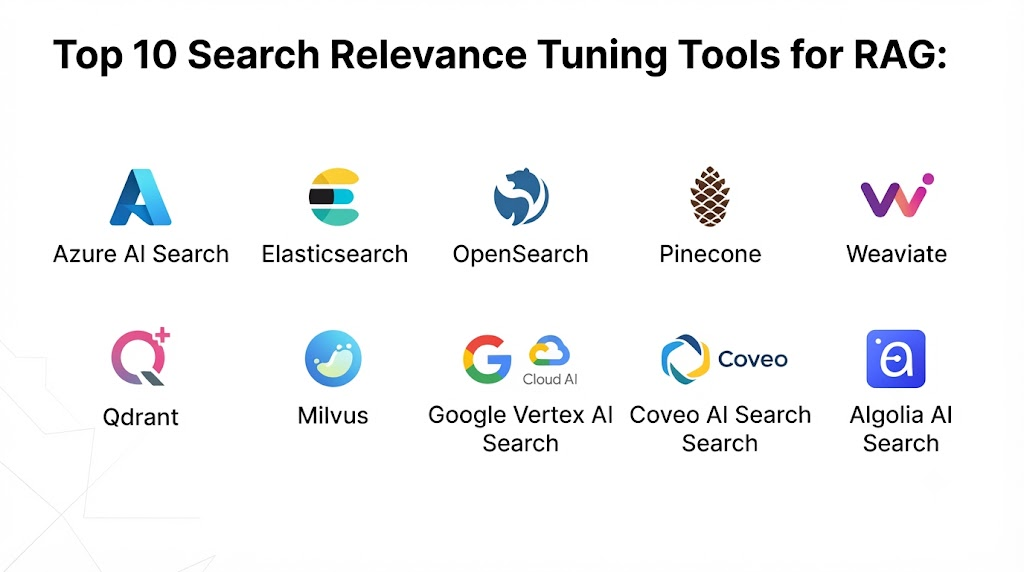
Top 10 Search Relevance Tuning Tools for RAG
1. Elasticsearch Learning to Rank
Elasticsearch provides ranking optimization capabilities for improving search relevance.
Key Features
- Learning-to-rank models
- Search analytics
- Query optimization
- Hybrid search support
- Ranking customization
- Relevance testing
- Search pipelines
- Vector search
- Enterprise scalability
Pros
- Mature search ecosystem
- Powerful ranking tools
- Enterprise adoption
- Flexible customization
Cons
- Requires search expertise
- Complex configuration
2. Azure AI Search Semantic Ranking
Azure AI Search provides AI-powered ranking improvements.
Key Features
- Semantic ranking
- Query understanding
- Vector search
- Hybrid retrieval
- Search analytics
- AI enrichment
- Enterprise security
Pros
- Managed service
- Strong AI capabilities
- Enterprise ready
Cons
- Azure dependency
- Pricing complexity
3. Pinecone Search Optimization
Pinecone provides tools for improving vector retrieval quality.
Key Features
- Vector ranking
- Metadata filtering
- Similarity tuning
- Retrieval optimization
- Search APIs
- RAG integration
Pros
- AI-focused
- High performance
- Easy deployment
Cons
- Cloud dependency
- Limited customization
4. Weaviate Hybrid Search Tuning
Weaviate supports hybrid search optimization.
Key Features
- Vector search
- Keyword search
- Hybrid ranking
- Filtering
- Query tuning
- Retrieval optimization
- AI integrations
Pros
- Open source
- Flexible
- Strong AI support
Cons
- Requires configuration
- Operational management
5. Ragas
Ragas provides evaluation tools for RAG systems.
Key Features
- Retrieval evaluation
- Context relevance scoring
- Answer quality measurement
- RAG benchmarks
- Dataset evaluation
- AI testing
Pros
- RAG focused
- Open source
- Easy integration
Cons
- Requires evaluation knowledge
6. DeepEval
DeepEval provides testing and evaluation frameworks for AI applications.
Key Features
- RAG evaluation
- Retrieval testing
- LLM evaluation
- Quality metrics
- Automated testing
- Benchmarking
Pros
- Developer friendly
- Testing focused
- Open source
Cons
- Requires setup
7. LangSmith Evaluation
LangSmith provides monitoring and evaluation for LLM applications.
Key Features
- Trace analysis
- Retrieval evaluation
- Dataset testing
- Performance monitoring
- Feedback collection
- AI debugging
Pros
- Strong LLM workflow support
- Good visualization
- Developer friendly
Cons
- Best with LangChain ecosystem
8. Haystack Evaluation Tools
Haystack provides evaluation features for retrieval pipelines.
Key Features
- Retrieval evaluation
- Pipeline testing
- Search metrics
- Document ranking
- RAG testing
- AI workflows
Pros
- Open source
- Flexible pipelines
- RAG focused
Cons
- Requires technical knowledge
9. Vespa Ranking Framework
Vespa provides advanced ranking capabilities for large-scale search.
Key Features
- Ranking models
- Machine learning ranking
- Vector search
- Real-time search
- Personalization
- Query optimization
Pros
- Highly scalable
- Advanced ranking
- Real-time performance
Cons
- Complex learning curve
10. OpenSearch Neural Search
OpenSearch provides neural and hybrid search optimization.
Key Features
- Neural search
- Vector retrieval
- Keyword search
- Ranking optimization
- Analytics
- AWS integration
Pros
- Open source
- Flexible
- Enterprise capable
Cons
- Requires management
Comparison Table: Top 10 Search Relevance Tuning Tools for RAG
| No. | Tool Name | Best For | Platform(s) Supported | Deployment | Standout Feature | Public Rating |
|---|---|---|---|---|---|---|
| 1 | Elasticsearch Learning to Rank | Enterprise search tuning | Cloud / Local | Flexible | Ranking optimization | 4.8/5 |
| 2 | Azure AI Search Semantic Ranking | Enterprise AI search | Azure | Managed | Semantic ranking | 4.7/5 |
| 3 | Pinecone Optimization | Vector retrieval | Cloud | Managed | Similarity tuning | 4.7/5 |
| 4 | Weaviate Hybrid Search | AI search systems | Cloud / Local | Flexible | Hybrid ranking | 4.6/5 |
| 5 | Ragas | RAG evaluation | Cloud / Local | Open Source | Retrieval metrics | 4.6/5 |
| 6 | DeepEval | AI testing | Cloud / Local | Open Source | Automated evaluation | 4.5/5 |
| 7 | LangSmith | LLM monitoring | Cloud | Managed | Trace evaluation | 4.5/5 |
| 8 | Haystack Evaluation | RAG pipelines | Cloud / Local | Flexible | Pipeline testing | 4.5/5 |
| 9 | Vespa Ranking Framework | Large-scale search | Cloud / Local | Enterprise | ML ranking | 4.4/5 |
| 10 | OpenSearch Neural Search | Open search systems | Cloud / Local | Flexible | Neural retrieval | 4.4/5 |
Weighted Evaluation Table
| No. | Tool Name | Core Features 25% | Ease of Use 15% | AI/RAG Integration 15% | Security 10% | Performance 10% | Community 10% | Value 15% | Total |
|---|---|---|---|---|---|---|---|---|---|
| 1 | Elasticsearch LTR | 25 | 13 | 15 | 10 | 10 | 10 | 14 | 97 |
| 2 | Azure AI Search | 24 | 14 | 15 | 10 | 10 | 10 | 13 | 96 |
| 3 | Pinecone | 24 | 15 | 15 | 9 | 10 | 10 | 13 | 96 |
| 4 | Weaviate | 24 | 14 | 15 | 9 | 10 | 10 | 14 | 96 |
| 5 | Ragas | 23 | 14 | 15 | 9 | 10 | 10 | 15 | 96 |
| 6 | DeepEval | 23 | 14 | 15 | 9 | 10 | 10 | 14 | 95 |
| 7 | LangSmith | 24 | 15 | 15 | 10 | 10 | 10 | 12 | 96 |
| 8 | Haystack | 23 | 13 | 15 | 9 | 10 | 10 | 14 | 94 |
| 9 | Vespa | 24 | 12 | 14 | 10 | 10 | 10 | 14 | 94 |
| 10 | OpenSearch | 24 | 13 | 14 | 10 | 10 | 10 | 14 | 95 |
Which Search Relevance Tuning Tool Is Right for You?
Choose Elasticsearch Learning to Rank for enterprise search optimization.
Choose Azure AI Search for Microsoft AI environments.
Choose Pinecone for vector retrieval optimization.
Choose Weaviate for flexible hybrid search.
Choose Ragas for RAG evaluation.
Choose DeepEval for AI testing.
Choose LangSmith for LLM application monitoring.
Choose Haystack for open-source RAG pipelines.
Choose Vespa for large-scale ranking systems.
Choose OpenSearch for open search infrastructure.
Implementation Playbook
Phase 1: Analyze Current Retrieval
- Measure search quality
- Identify failures
- Collect queries
Phase 2: Improve Retrieval
- Tune embeddings
- Adjust ranking
- Optimize filters
Phase 3: Evaluate Performance
- Run benchmarks
- Compare results
- Measure improvements
Phase 4: Add Feedback Loops
- Collect user feedback
- Improve ranking models
- Update retrieval strategies
Phase 5: Monitor Continuously
- Track quality
- Detect issues
- Improve over time
Common Mistakes
- Ignoring retrieval quality
- Using only one search method
- Poor evaluation strategy
- No user feedback collection
- Incorrect ranking configuration
- Weak metadata usage
FAQs
1. What is search relevance tuning in RAG?
It is the process of improving how AI systems retrieve and rank information.
2. Why is retrieval quality important for RAG?
Better retrieval improves AI response accuracy.
3. Can search tuning reduce hallucinations?
Yes, better context retrieval reduces incorrect responses.
4. What metrics are used for retrieval evaluation?
Common metrics include precision, recall, and relevance scores.
5. Is hybrid search useful for RAG?
Yes, combining keyword and vector search often improves results.
6. Which teams use relevance tuning tools?
AI engineers, search engineers, and MLOps teams use them.
7. Can these tools evaluate LLM responses?
Many provide AI quality evaluation capabilities.
8. Are open-source relevance tools available?
Yes, Ragas, DeepEval, Haystack, and OpenSearch provide open-source options.
9. How does feedback improve search?
User interactions help optimize ranking and retrieval.
10. What is the future of search relevance tuning?
AI-driven ranking and autonomous retrieval optimization will become essential for RAG systems.
Conclusion
Search Relevance Tuning for RAG is a critical part of building reliable AI applications. Retrieval quality determines how effectively AI systems access and use enterprise knowledge.Tools such as Elasticsearch, Azure AI Search, Pinecone, Weaviate, Ragas, LangSmith, and OpenSearch help organizations improve retrieval accuracy, reduce hallucinations, and create better AI experiences.As Generative AI and AI agents continue expanding, search relevance tuning will become a fundamental capability for enterprise AI systems.