Introduction
Experiment Tracking Platforms are machine learning management tools designed to record, organize, compare, and analyze machine learning experiments throughout the AI development lifecycle.
Building successful AI models requires teams to run multiple experiments with different datasets, algorithms, parameters, features, and training configurations. Without proper tracking, it becomes difficult to understand which changes improved performance and how a final model was created.
Experiment tracking platforms help organizations manage:
- Training experiments
- Model versions
- Hyperparameters
- Metrics
- Datasets
- Code versions
- Artifacts
- Results comparison
These platforms help teams:
- Reproduce successful experiments
- Compare model performance
- Improve collaboration
- Reduce development time
- Maintain AI transparency
Experiment Tracking Platforms are used by:
- Data scientists
- Machine learning engineers
- MLOps teams
- AI researchers
- Software engineers
- Enterprise AI teams
Modern experiment tracking solutions provide capabilities such as:
- Experiment logging
- Metric visualization
- Hyperparameter tracking
- Model comparison
- Artifact management
- Dataset tracking
- Collaboration workflows
- Model registry integration
- Notebook integration
- MLOps pipeline support
The goal of Experiment Tracking Platforms is to make machine learning development more organized, reproducible, and efficient.
What Are Experiment Tracking Platforms?
Experiment Tracking Platforms are systems that automatically record details about machine learning experiments.
During model development, teams may test:
- Different algorithms
- Various datasets
- Multiple parameters
- Different training strategies
Experiment tracking tools capture these changes and help teams identify the best-performing approach.
Example:
A data science team trains 50 versions of a recommendation model.
The platform records:
- Training dataset
- Model architecture
- Learning rate
- Accuracy score
- Training duration
- Final results
The team can compare experiments and select the best model.
Why Organizations Need Experiment Tracking Platforms
Machine learning development involves continuous testing and improvement.
Teams often face challenges such as:
- Losing experiment history
- Difficulty reproducing results
- Poor collaboration
- Manual documentation
- Confusing model versions
Without experiment tracking, organizations may experience:
- Repeated work
- Slow development
- Poor model governance
Experiment tracking platforms help organizations:
- Improve productivity
- Maintain experiment history
- Accelerate AI development
- Build reliable models
How Experiment Tracking Platforms Work
Experiment Setup
Teams define:
- Dataset
- Model architecture
- Parameters
- Training process
Automatic Logging
The platform records:
- Metrics
- Parameters
- Outputs
- Artifacts
Result Comparison
Teams compare:
- Accuracy
- Performance
- Resource usage
- Model quality
Visualization
Dashboards display:
- Training curves
- Metric trends
- Experiment comparisons
Model Selection
Teams choose the best experiment for deployment.
Model Registration
Successful experiments are connected with:
- Model registry
- Deployment workflows
Key Components of Experiment Tracking Platforms
Experiment Logger
Tracks:
- Parameters
- Metrics
- Training information
Dashboard System
Displays:
- Results
- Comparisons
- Visualizations
Artifact Storage
Stores:
- Models
- Files
- Reports
- Training outputs
Dataset Tracking
Records:
- Data versions
- Sources
- Changes
Collaboration Layer
Supports:
- Team sharing
- Experiment review
- Documentation
Model Registry Integration
Connects experiments with:
- Production models
- Deployment systems
Types of Experiment Tracking Platforms
Open Source Experiment Tracking Tools
Designed for:
- Researchers
- Developers
- Custom AI systems
Examples:
- MLflow
- Weights & Biases
- ClearML
Cloud AI Experiment Platforms
Designed for:
- Enterprise ML workloads
Examples:
- Amazon SageMaker Experiments
- Vertex AI Experiments
- Azure ML
Research-Focused Platforms
Designed for:
- AI experimentation
- Deep learning research
Examples:
- Neptune AI
- Comet ML
Key Features of Experiment Tracking Platforms
Hyperparameter Tracking
Records:
- Learning rates
- Batch sizes
- Model settings
Metric Monitoring
Tracks:
- Accuracy
- Loss
- Precision
- Recall
Experiment Comparison
Allows teams to compare:
- Multiple runs
- Model versions
- Configurations
Artifact Management
Stores:
- Model files
- Charts
- Reports
Collaboration Tools
Enables:
- Team sharing
- Experiment review
Reproducibility Support
Helps recreate:
- Previous experiments
- Successful results
Common Use Cases
Machine Learning Research
Managing:
- Training experiments
- Model improvements
Deep Learning Development
Tracking:
- Neural network experiments
- Training performance
Computer Vision
Comparing:
- Image models
- Detection algorithms
Natural Language Processing
Tracking:
- Language models
- NLP experiments
Generative AI
Managing:
- Prompt experiments
- LLM evaluations
Enterprise AI Development
Supporting:
- Collaborative model building
Why Experiment Tracking Platforms Matter
Better Reproducibility
Teams can recreate successful experiments.
Faster Development
Researchers find better models quickly.
Improved Collaboration
Teams share knowledge effectively.
Better Model Decisions
Organizations choose models based on evidence.
Stronger AI Governance
Experiment history improves transparency.
Evaluation Criteria for Buyers
Tracking Capabilities
Evaluate:
- Metrics
- Parameters
- Artifacts
Integration Support
Consider:
- ML frameworks
- Cloud platforms
- Development tools
Visualization
Evaluate:
- Dashboards
- Comparison features
Collaboration
Consider:
- Team workflows
- Sharing capabilities
Scalability
Evaluate:
- Number of experiments
- Data volume
- Enterprise requirements
Security
Consider:
- Access control
- Data protection
Key Trends
MLOps Integration
Experiment tracking is becoming a core MLOps component.
LLM Experiment Tracking
Organizations are tracking:
- Prompts
- Model responses
- AI evaluations
Automated Experimentation
AI systems are helping optimize models automatically.
Better Reproducibility
Organizations are focusing on transparent AI development.
Cloud-Based Collaboration
Teams are moving toward shared AI development environments.
Responsible AI Development
Experiment history supports better governance.
Methodology
The following Experiment Tracking Platforms were evaluated based on:
- Experiment management
- Tracking capabilities
- Visualization
- Integration ecosystem
- Collaboration
- Scalability
- Security
- Developer experience
- Enterprise readiness
- Value
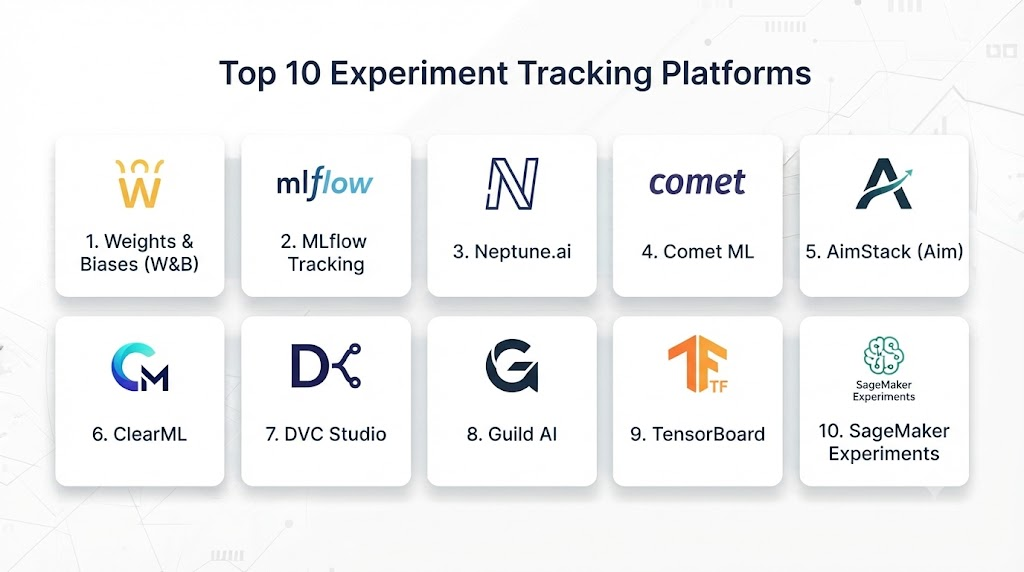
Top 10 Experiment Tracking Platforms
1. MLflow
MLflow is an open-source platform for managing machine learning lifecycle workflows.
Key Features
- Experiment tracking
- Metric logging
- Parameter tracking
- Artifact management
- Model registry
- Model versioning
- Deployment integration
- API support
- Collaboration
- MLOps workflows
Pros
- Open source
- Large ecosystem
- Flexible
- Easy integration
- Industry adoption
Cons
- Requires setup
- Limited advanced visualization
- Additional infrastructure needed
Platforms
Cloud and local environments.
Deployment or Support
ML teams.
Security & Compliance
Depends on deployment.
Integrations & Ecosystem
ML frameworks.
Support & Community
Large open-source community.
2. Weights & Biases (W&B)
Weights & Biases provides experiment tracking and AI development workflows.
Key Features
- Experiment tracking
- Metric visualization
- Hyperparameter optimization
- Artifact management
- Dataset tracking
- Model comparison
- Collaboration
- Dashboard analytics
- AI workflows
- Reporting
Pros
- Excellent visualization
- Strong collaboration
- Easy adoption
- Research friendly
- Large community
Cons
- Commercial pricing
- Cloud dependency
- Enterprise features can be expensive
Platforms
Cloud and enterprise environments.
Deployment or Support
AI research teams.
Security & Compliance
Enterprise controls.
Integrations & Ecosystem
ML frameworks.
Support & Community
Large community.
3. Neptune AI
Neptune provides experiment management and ML metadata tracking.
Key Features
- Experiment tracking
- Metadata management
- Model comparison
- Dashboard visualization
- Collaboration
- Artifact tracking
- Run management
- Experiment organization
- API support
- Team workflows
Pros
- User-friendly
- Strong metadata tracking
- Good visualization
- Collaboration support
- Research focused
Cons
- Commercial platform
- Smaller ecosystem
- Pricing complexity
Platforms
Cloud environments.
Deployment or Support
ML teams.
Security & Compliance
Enterprise controls.
Integrations & Ecosystem
ML frameworks.
Support & Community
Developer community.
4. Comet ML
Comet ML provides machine learning experiment management.
Key Features
- Experiment tracking
- Model monitoring
- Hyperparameter tracking
- Visualization
- Collaboration
- Dataset tracking
- Model comparison
- Reporting
- Optimization workflows
- Deployment support
Pros
- Strong experiment management
- Good visualization
- Easy integration
- Team collaboration
- Enterprise support
Cons
- Paid features
- Requires setup
- Smaller ecosystem
Platforms
Cloud environments.
Deployment or Support
AI teams.
Security & Compliance
Enterprise controls.
Integrations & Ecosystem
ML frameworks.
Support & Community
Developer community.
5. ClearML
ClearML provides open-source MLOps and experiment tracking.
Key Features
- Experiment tracking
- Data management
- Pipeline automation
- Model management
- Hyperparameter optimization
- Remote execution
- Collaboration
- Scheduling
- Monitoring
- Deployment support
Pros
- Open source
- Complete MLOps platform
- Flexible
- Strong automation
- Good scalability
Cons
- Learning curve
- Requires setup
- Complex for beginners
Platforms
Cloud and local environments.
Deployment or Support
MLOps teams.
Security & Compliance
Implementation dependent.
Integrations & Ecosystem
ML frameworks.
Support & Community
Open-source community.
6. Amazon SageMaker Experiments
Amazon SageMaker Experiments provides managed experiment tracking.
Key Features
- Experiment tracking
- Model comparisons
- Metadata tracking
- AWS integration
- Training monitoring
- Model registry
- Deployment workflows
- Cloud scaling
- Security controls
- MLOps integration
Pros
- AWS integration
- Managed service
- Enterprise security
- Scalable
- Production ready
Cons
- AWS dependency
- Cost complexity
- Requires AWS expertise
Platforms
AWS Cloud.
Deployment or Support
Enterprise AI teams.
Security & Compliance
AWS security framework.
Integrations & Ecosystem
AWS services.
Support & Community
Enterprise support.
7. Google Vertex AI Experiments
Vertex AI Experiments provides managed AI experiment tracking.
Key Features
- Experiment tracking
- Metadata management
- Model comparison
- Pipeline integration
- Visualization
- Cloud integration
- Model evaluation
- Version tracking
- Security
- MLOps workflows
Pros
- Managed service
- Google AI ecosystem
- Scalable
- Enterprise ready
- Good integration
Cons
- Google Cloud dependency
- Pricing complexity
- Learning curve
Platforms
Google Cloud.
Deployment or Support
Enterprise AI teams.
Security & Compliance
Google Cloud security.
Integrations & Ecosystem
Google AI services.
Support & Community
Enterprise support.
8. Azure Machine Learning Experiments
Azure ML provides experiment tracking capabilities.
Key Features
- Experiment management
- Run tracking
- Model comparison
- Dataset tracking
- Pipeline integration
- Monitoring
- Security
- Collaboration
- Model registry
- Enterprise workflows
Pros
- Microsoft ecosystem
- Strong governance
- Enterprise security
- Scalable
- Managed platform
Cons
- Azure dependency
- Configuration complexity
- Learning curve
Platforms
Microsoft Azure.
Deployment or Support
Enterprise AI teams.
Security & Compliance
Microsoft security framework.
Integrations & Ecosystem
Azure services.
Support & Community
Enterprise support.
9. TensorBoard
TensorBoard provides visualization tools for machine learning experiments.
Key Features
- Training visualization
- Metric tracking
- Model graphs
- Performance analysis
- Hyperparameter tracking
- Tensor visualization
- Debugging tools
- Deep learning support
- Experiment comparison
- TensorFlow integration
Pros
- Free
- Simple visualization
- Google ecosystem
- Research adoption
- Easy integration
Cons
- TensorFlow focused
- Limited experiment management
- Requires setup
Platforms
Cloud and local environments.
Deployment or Support
Researchers and developers.
Security & Compliance
Implementation dependent.
Integrations & Ecosystem
TensorFlow ecosystem.
Support & Community
Large community.
10. DVC Studio
DVC Studio provides experiment tracking and version control workflows.
Key Features
- Experiment tracking
- Data versioning
- Model versioning
- Git integration
- Collaboration
- Metrics comparison
- Pipeline tracking
- Reproducibility
- Visualization
- MLOps support
Pros
- Strong version control
- Open source ecosystem
- Good reproducibility
- Developer-friendly
- Git integration
Cons
- Requires Git knowledge
- Limited enterprise features
- Setup required
Platforms
Cloud and local environments.
Deployment or Support
ML engineering teams.
Security & Compliance
Implementation dependent.
Integrations & Ecosystem
Git and ML tools.
Support & Community
Developer community.
Comparison Table
| Tool Name | Best For | Platform(s) Supported | Deployment | Standout Feature | Public Rating |
|---|---|---|---|---|---|
| MLflow | ML lifecycle | Cloud/Local | Flexible | Open-source tracking | |
| W&B | Research teams | Cloud | Enterprise | Visualization | |
| Neptune AI | Experiment management | Cloud | Flexible | Metadata tracking | |
| Comet ML | ML teams | Cloud | Enterprise | Experiment analytics | |
| ClearML | MLOps workflows | Cloud/Local | Flexible | Automation | |
| SageMaker Experiments | AWS ML | AWS | Enterprise | Managed tracking | |
| Vertex AI Experiments | Google AI | GCP | Enterprise | Cloud workflows | |
| Azure ML Experiments | Microsoft AI | Azure | Enterprise | Governance | |
| TensorBoard | Deep learning | Cloud/Local | Flexible | Visualization | |
| DVC Studio | Reproducible ML | Cloud/Local | Flexible | Version control |
Weighted Evaluation
| Tool Name | Core Features 25% | Ease of Use 15% | Integrations & Ecosystem 15% | Security & Compliance 10% | Performance & Reliability 10% | Support & Community 10% | Price/Value 15% | Total |
|---|---|---|---|---|---|---|---|---|
| MLflow | 24 | 15 | 15 | 10 | 10 | 10 | 15 | 99 |
| W&B | 25 | 15 | 15 | 10 | 10 | 10 | 13 | 98 |
| Neptune AI | 23 | 15 | 14 | 10 | 10 | 10 | 13 | 95 |
| Comet ML | 23 | 14 | 14 | 10 | 10 | 10 | 13 | 94 |
| ClearML | 24 | 13 | 14 | 10 | 10 | 10 | 15 | 96 |
| SageMaker Experiments | 24 | 13 | 15 | 10 | 10 | 10 | 12 | 94 |
| Vertex AI Experiments | 24 | 13 | 15 | 10 | 10 | 10 | 12 | 94 |
| Azure ML Experiments | 24 | 13 | 15 | 10 | 10 | 10 | 13 | 95 |
| TensorBoard | 22 | 15 | 14 | 10 | 10 | 10 | 15 | 96 |
| DVC Studio | 23 | 14 | 14 | 10 | 10 | 10 | 15 | 96 |
Which Experiment Tracking Platform Is Right for You?
Choose MLflow for open-source ML lifecycle tracking.
Choose Weights & Biases for advanced visualization and research.
Choose Neptune AI for experiment organization.
Choose Comet ML for ML analytics.
Choose ClearML for complete MLOps workflows.
Choose Amazon SageMaker Experiments for AWS environments.
Choose Vertex AI Experiments for Google Cloud.
Choose Azure ML Experiments for Microsoft ecosystems.
Choose TensorBoard for deep learning visualization.
Choose DVC Studio for reproducible ML workflows.
Implementation Playbook
Phase 1: Define Experiment Standards
- Select metrics
- Define parameters
- Create tracking structure
Phase 2: Integrate Tracking
- Connect ML frameworks
- Enable automatic logging
- Track datasets
Phase 3: Compare Experiments
- Analyze results
- Compare models
- Identify improvements
Phase 4: Register Best Models
- Store versions
- Document experiments
- Prepare deployment
Phase 5: Maintain Experiment History
- Continue tracking
- Improve workflows
- Support governance
Common Mistakes
- Not tracking experiments
- Poor documentation
- Losing model history
- Manual result comparison
- Ignoring reproducibility
- No version management
- Lack of collaboration
FAQs
1. What are Experiment Tracking Platforms?
They are tools that record and manage machine learning experiments, metrics, and model results.
2. Why is experiment tracking important?
It helps teams reproduce results and identify the best-performing models.
3. What information do experiment tracking tools store?
They store parameters, metrics, datasets, models, and training details.
4. Who uses experiment tracking platforms?
Data scientists, ML engineers, and AI researchers use them.
5. Can experiment tracking support deep learning?
Yes, most platforms support deep learning workflows.
6. Do experiment tracking tools support LLM development?
Yes, modern platforms support LLM experiments and evaluations.
7. Are open-source experiment tracking tools available?
Yes, MLflow, ClearML, and DVC provide open-source solutions.
8. How do experiment tracking platforms improve collaboration?
Teams can share results, compare experiments, and document decisions.
9. Can these tools integrate with MLOps pipelines?
Yes, many connect with deployment and model management systems.
10. What is the future of experiment tracking?
Experiment tracking will become increasingly automated and integrated with AI development workflows.
Conclusion
Experiment Tracking Platforms are essential for modern AI development because they help teams organize experiments, compare models, and build reproducible machine learning systems.Platforms such as MLflow, Weights & Biases, ClearML, Comet ML, and cloud-based experiment solutions provide powerful capabilities for managing the complete experimentation process.As AI development becomes more complex, experiment tracking will remain a critical foundation for successful MLOps, responsible AI, and continuous model improvement.