Introduction
Prompt Testing & Regression Suites are AI quality management platforms designed to test, evaluate, compare, and validate prompts used in large language model (LLM) applications.
As organizations build more generative AI applications, prompts become critical components that directly influence AI response quality, accuracy, safety, and reliability. A small prompt modification can improve results in one scenario while creating unexpected failures in another.
Prompt testing and regression suites help teams continuously evaluate prompts by running them against predefined datasets, measuring performance, and detecting unwanted changes.
These platforms help organizations:
- Test prompt performance
- Detect response quality issues
- Compare prompt versions
- Automate AI evaluations
- Prevent regression problems
- Improve LLM reliability
Prompt Testing & Regression Suites are used by:
- Prompt engineers
- AI engineers
- LLM application developers
- Machine learning teams
- Product teams
- Enterprise AI teams
Modern prompt testing platforms provide capabilities such as:
- Automated prompt evaluation
- Regression testing
- Test dataset management
- Output comparison
- Quality scoring
- LLM evaluation metrics
- Experiment tracking
- CI/CD integration
- Collaboration
- Monitoring
The goal of Prompt Testing & Regression Suites is to ensure that AI applications remain accurate, reliable, and consistent as prompts, models, and workflows change.
What Are Prompt Testing & Regression Suites?
Prompt Testing & Regression Suites are systems that evaluate whether changes made to prompts improve or reduce AI application performance.
A regression test checks whether a new prompt version causes problems compared to a previous version.
Example:
A customer support chatbot prompt is updated.
Previous prompt:
“Answer customer questions politely.”
New prompt:
“Answer customer questions politely with detailed explanations.”
Testing system checks:
- Response accuracy
- Customer satisfaction
- Response length
- Safety
- Consistency
If the new prompt performs worse, the regression system identifies the issue.
Why Organizations Need Prompt Testing Systems
LLM applications face challenges:
- Changing model behavior
- Prompt complexity
- Unexpected responses
- Hallucinations
- Quality variations
Without testing systems, teams may experience:
- Broken AI workflows
- Reduced response quality
- Production failures
- Difficult debugging
Prompt testing platforms help organizations:
- Validate AI changes
- Maintain quality standards
- Deploy updates safely
- Improve AI reliability
How Prompt Testing & Regression Suites Work
Test Dataset Creation
Teams create examples containing:
- User inputs
- Expected behaviors
- Evaluation criteria
Prompt Execution
The system runs prompts against:
- AI models
- Test cases
- Different scenarios
Response Evaluation
Outputs are measured for:
- Accuracy
- Relevance
- Safety
- Quality
Comparison
Different prompt versions are compared.
Teams analyze:
- Improvements
- Failures
- Performance changes
Regression Detection
The system identifies:
- Broken workflows
- Quality drops
- Unexpected behavior
Deployment Approval
Successful prompts move into:
- Production
- AI applications
- Agent workflows
Key Components of Prompt Testing Platforms
Test Case Management
Stores:
- Test prompts
- Input examples
- Expected outcomes
Evaluation Engine
Measures:
- Response quality
- Accuracy
- Relevance
- Safety
Prompt Comparison System
Allows teams to compare:
- Old versions
- New versions
- Different models
Automated Regression Testing
Detects:
- Performance degradation
- Output changes
- Failures
Dataset Management
Handles:
- Evaluation datasets
- User examples
- Benchmark collections
CI/CD Integration
Enables:
- Automated testing
- Release validation
- Continuous improvement
Types of Prompt Testing & Regression Suites
Developer Testing Platforms
Designed for:
- AI engineers
- Developers
Examples:
- LangSmith
- Promptfoo
Enterprise AI Evaluation Platforms
Designed for:
- Large organizations
- Governance teams
Examples:
- Braintrust
- Humanloop
Open Source Testing Frameworks
Designed for:
- Custom AI workflows
- Self-hosting
Examples:
- DeepEval
- Langfuse
LLM Evaluation Platforms
Focus on:
- AI quality measurement
- Model comparison
Key Features of Prompt Testing & Regression Suites
Automated Evaluations
Tests:
- Prompt performance
- Model outputs
- AI behavior
Regression Detection
Identifies:
- Quality drops
- Unexpected changes
- Broken workflows
Prompt Experimentation
Supports:
- A/B testing
- Prompt comparison
- Optimization
Custom Evaluation Metrics
Measures:
- Accuracy
- Relevance
- Safety
- Tone
Multi-Model Testing
Allows comparison of:
- Different LLMs
- Model versions
- Configurations
Continuous Testing
Supports:
- CI/CD workflows
- Production monitoring
Common Use Cases
AI Chatbots
Testing:
- Customer conversations
- Support responses
AI Agents
Validating:
- Agent decisions
- Tool usage
- Workflow execution
RAG Applications
Testing:
- Retrieval quality
- Answer accuracy
- Knowledge grounding
Content Generation
Evaluating:
- Writing quality
- Brand consistency
Coding Assistants
Testing:
- Code accuracy
- Security issues
- Programming responses
Enterprise AI Applications
Maintaining:
- Reliability
- Compliance
- Performance
Why Prompt Testing Suites Matter
Better AI Reliability
Teams detect problems before deployment.
Safer Prompt Updates
Changes are tested before production.
Improved AI Quality
Organizations continuously optimize outputs.
Faster Development
Teams automate evaluation workflows.
Enterprise AI Governance
Companies maintain AI quality standards.
Evaluation Criteria for Buyers
Testing Capabilities
Evaluate:
- Automated tests
- Regression support
- Evaluation methods
Integration Support
Consider:
- LLM providers
- AI frameworks
- Development tools
Evaluation Accuracy
Look for:
- Reliable scoring
- Human feedback support
- Custom metrics
Automation
Evaluate:
- CI/CD support
- Workflow automation
Collaboration
Consider:
- Team access
- Review processes
- Reporting
Security
Evaluate:
- Data privacy
- Access controls
- Enterprise compliance
Key Trends
Continuous AI Testing
Organizations are adopting automated AI quality pipelines.
LLM Evaluation Growth
Testing is becoming essential for generative AI.
AI Quality Engineering
Dedicated AI testing practices are emerging.
Agent Testing Expansion
Testing platforms are adapting for autonomous agents.
Human Feedback Integration
Platforms are combining automated and human evaluation.
Enterprise AI Governance
Organizations are creating stronger AI quality controls.
Methodology
The following Prompt Testing & Regression Suites were evaluated based on:
- Testing capabilities
- Evaluation support
- Regression features
- Integration ecosystem
- Automation
- Developer experience
- Security
- Scalability
- Enterprise readiness
- Value
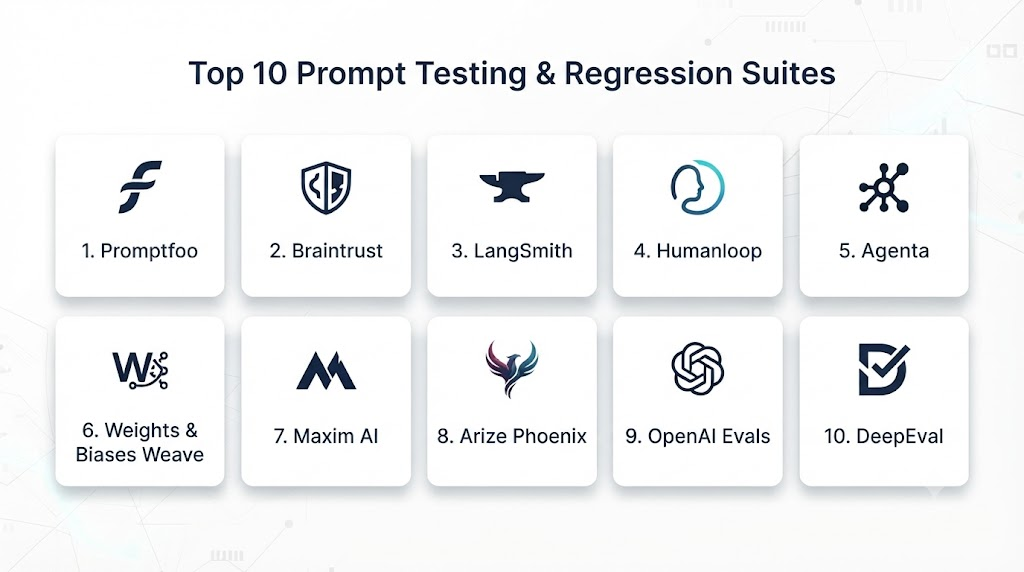
Top 10 Prompt Testing & Regression Suites
1. LangSmith
LangSmith provides testing, tracing, and evaluation capabilities for LLM applications.
Key Features
- Prompt testing
- Regression evaluation
- Dataset management
- LLM tracing
- Experiment comparison
- Output evaluation
- Application monitoring
- Agent testing
- Collaboration
- Developer APIs
Pros
- Strong LLM workflow support
- Good debugging
- Agent support
- Developer-friendly
- Evaluation features
Cons
- Best with LangChain ecosystem
- Requires technical knowledge
- Enterprise features may require upgrades
Platforms
Cloud environments.
Deployment or Support
LLM application teams.
Security & Compliance
Platform security controls.
Integrations & Ecosystem
LLM frameworks and providers.
Support & Community
Developer community.
2. Promptfoo
Promptfoo is an open-source prompt testing and evaluation framework.
Key Features
- Prompt comparison
- Regression testing
- Test cases
- Model comparison
- Automated evaluations
- CI/CD integration
- Output analysis
- Configuration management
- Developer workflows
- Local deployment
Pros
- Open source
- Easy testing workflow
- Developer-friendly
- Flexible
- Good automation
Cons
- Requires technical knowledge
- Limited enterprise features
- Manual configuration needed
Platforms
Cloud and local environments.
Deployment or Support
AI developers.
Security & Compliance
Depends on deployment.
Integrations & Ecosystem
LLM providers.
Support & Community
Developer community.
3. Braintrust
Braintrust provides AI evaluation and testing infrastructure.
Key Features
- Prompt experiments
- Regression testing
- Evaluation datasets
- Quality scoring
- AI testing workflows
- Collaboration
- Analytics
- Model comparison
- Reporting
- Developer tools
Pros
- Strong evaluation capabilities
- Good analytics
- Flexible workflows
- Developer-friendly
- Experiment support
Cons
- Requires technical knowledge
- Newer ecosystem
- Enterprise pricing
Platforms
Cloud environments.
Deployment or Support
AI engineering teams.
Security & Compliance
Enterprise controls.
Integrations & Ecosystem
AI platforms.
Support & Community
Developer community.
4. DeepEval
DeepEval provides open-source LLM evaluation and testing tools.
Key Features
- LLM testing
- Evaluation metrics
- Regression testing
- Test cases
- RAG evaluation
- AI quality scoring
- CI/CD integration
- Custom metrics
- Developer tools
- Open-source framework
Pros
- Open source
- Flexible
- Developer-friendly
- Strong evaluation support
- Easy integration
Cons
- Requires setup
- Technical knowledge needed
- Limited enterprise features
Platforms
Cloud and local environments.
Deployment or Support
AI developers.
Security & Compliance
Depends on deployment.
Integrations & Ecosystem
LLM applications.
Support & Community
Open-source community.
5. Langfuse
Langfuse provides open-source LLM observability and evaluation.
Key Features
- Prompt testing
- Tracing
- Evaluation
- Dataset management
- Performance analysis
- Regression tracking
- Analytics
- Collaboration
- Self-hosting
- API support
Pros
- Open source
- Flexible deployment
- Strong observability
- Good community
- Cost tracking
Cons
- Setup required
- Technical expertise needed
- Enterprise features vary
Platforms
Cloud and self-hosted environments.
Deployment or Support
LLM application teams.
Security & Compliance
Self-managed security.
Integrations & Ecosystem
AI frameworks.
Support & Community
Open-source community.
6. Humanloop
Humanloop provides prompt testing and evaluation workflows.
Key Features
- Prompt experiments
- Testing
- Human feedback
- Evaluation
- Collaboration
- Dataset management
- Model comparison
- Version tracking
- Analytics
- Deployment workflows
Pros
- User-friendly
- Strong evaluation
- Human feedback support
- Good collaboration
- Enterprise workflows
Cons
- Premium pricing
- Smaller ecosystem
- Requires integration
Platforms
Cloud environments.
Deployment or Support
AI product teams.
Security & Compliance
Enterprise controls.
Integrations & Ecosystem
LLM providers.
Support & Community
Developer community.
7. Arize Phoenix
Arize Phoenix provides AI observability and evaluation capabilities.
Key Features
- LLM evaluation
- Regression monitoring
- Tracing
- Debugging
- Quality analysis
- Performance monitoring
- Experiment tracking
- Visualization
- Open-source support
- AI diagnostics
Pros
- Strong observability
- Open source
- Good debugging
- AI-focused
- Evaluation support
Cons
- Monitoring-focused
- Requires setup
- Technical knowledge needed
Platforms
Cloud and local environments.
Deployment or Support
AI engineering teams.
Security & Compliance
Depends on deployment.
Integrations & Ecosystem
AI frameworks.
Support & Community
Developer community.
8. OpenAI Evals
OpenAI Evals provides evaluation frameworks for testing AI model behavior.
Key Features
- Evaluation datasets
- Benchmark testing
- Model comparison
- Custom evaluations
- Performance measurement
- AI quality testing
- Experiment tracking
- Developer tools
- Research workflows
- Open framework
Pros
- AI-focused
- Flexible evaluations
- Research support
- Developer-friendly
- Custom testing
Cons
- Requires development skills
- Limited UI workflows
- Requires customization
Platforms
Cloud and local environments.
Deployment or Support
AI developers and researchers.
Security & Compliance
Implementation dependent.
Integrations & Ecosystem
AI models.
Support & Community
Developer community.
9. TruLens
TruLens provides evaluation and feedback tools for LLM applications.
Key Features
- LLM evaluation
- Feedback functions
- RAG testing
- Quality metrics
- Monitoring
- Experiment tracking
- Application analysis
- Developer tools
- AI reliability testing
- Reporting
Pros
- Strong evaluation
- RAG support
- Open source
- Developer-friendly
- Good feedback system
Cons
- Requires setup
- Technical knowledge needed
- Limited enterprise features
Platforms
Cloud and local environments.
Deployment or Support
AI development teams.
Security & Compliance
Depends on deployment.
Integrations & Ecosystem
LLM applications.
Support & Community
Developer community.
10. Weights & Biases Weave
Weights & Biases Weave supports AI evaluation and experiment tracking.
Key Features
- Prompt evaluation
- Experiment tracking
- Output comparison
- Visualization
- Dataset tracking
- Collaboration
- AI monitoring
- Model comparison
- Analytics
- Workflow management
Pros
- Excellent tracking
- Strong visualization
- ML ecosystem
- Collaboration support
- Developer-friendly
Cons
- Requires setup
- Enterprise features cost more
- Broad ML focus
Platforms
Cloud environments.
Deployment or Support
AI engineering teams.
Security & Compliance
Enterprise controls.
Integrations & Ecosystem
ML frameworks.
Support & Community
Developer community.
Comparison Table
| Tool Name | Best For | Platform(s) Supported | Deployment | Standout Feature | Public Rating |
|---|---|---|---|---|---|
| LangSmith | LLM testing | Cloud | Flexible | Prompt evaluation | |
| Promptfoo | Prompt regression | Cloud/Local | Flexible | Automated testing | |
| Braintrust | AI evaluation | Cloud | Flexible | Quality scoring | |
| DeepEval | Open-source testing | Cloud/Local | Flexible | LLM metrics | |
| Langfuse | LLM observability | Cloud/Self-hosted | Flexible | Open-source | |
| Humanloop | Team evaluation | Cloud | Business | Human feedback | |
| Arize Phoenix | AI debugging | Cloud/Local | Flexible | Observability | |
| OpenAI Evals | AI benchmarks | Cloud/Local | Flexible | Custom evaluations | |
| TruLens | RAG testing | Cloud/Local | Flexible | Feedback evaluation | |
| W&B Weave | AI experiments | Cloud | Flexible | Tracking |
Weighted Evaluation
| Tool Name | Core Features 25% | Ease of Use 15% | Integrations & Ecosystem 15% | Security & Compliance 10% | Performance & Reliability 10% | Support & Community 10% | Price/Value 15% | Total |
|---|---|---|---|---|---|---|---|---|
| LangSmith | 25 | 15 | 14 | 10 | 10 | 10 | 14 | 98 |
| Promptfoo | 24 | 15 | 14 | 10 | 10 | 10 | 15 | 98 |
| Braintrust | 24 | 14 | 14 | 10 | 10 | 10 | 14 | 96 |
| DeepEval | 23 | 14 | 14 | 10 | 10 | 10 | 15 | 96 |
| Langfuse | 24 | 14 | 15 | 10 | 10 | 10 | 15 | 98 |
| Humanloop | 23 | 15 | 13 | 10 | 10 | 10 | 14 | 95 |
| Arize Phoenix | 23 | 14 | 14 | 10 | 10 | 10 | 15 | 96 |
| OpenAI Evals | 23 | 13 | 14 | 10 | 10 | 10 | 15 | 95 |
| TruLens | 23 | 14 | 14 | 10 | 10 | 10 | 15 | 96 |
| W&B Weave | 24 | 14 | 15 | 10 | 10 | 10 | 14 | 97 |
Which Prompt Testing & Regression Suite Is Right for You?
Choose LangSmith for complete LLM application testing.
Choose Promptfoo for open-source prompt regression testing.
Choose Braintrust for AI evaluation workflows.
Choose DeepEval for developer-focused testing.
Choose Langfuse for open-source LLMOps.
Choose Humanloop for human feedback evaluation.
Choose Arize Phoenix for AI observability.
Choose OpenAI Evals for custom benchmarks.
Choose TruLens for RAG evaluation.
Choose Weights & Biases Weave for experiment tracking.
Implementation Playbook
Phase 1: Define Testing Strategy
- Identify AI workflows
- Create test datasets
- Define quality metrics
Phase 2: Build Evaluation Pipeline
- Connect models
- Run prompt tests
- Measure results
Phase 3: Enable Regression Testing
- Compare versions
- Detect failures
- Approve changes
Phase 4: Integrate CI/CD
- Automate testing
- Validate releases
- Monitor updates
Phase 5: Improve Continuously
- Analyze failures
- Optimize prompts
- Update evaluations
Common Mistakes
- Deploying prompts without testing
- No evaluation datasets
- Ignoring regression failures
- Poor quality metrics
- No monitoring strategy
- Manual testing only
- Lack of version control
FAQs
1. What are Prompt Testing & Regression Suites?
They are tools that test and validate prompts used in AI applications.
2. Why is prompt regression testing important?
It prevents AI quality problems after prompt updates.
3. What can prompt testing measure?
It can measure accuracy, relevance, safety, and response quality.
4. Who uses prompt testing platforms?
AI engineers, developers, and product teams use them.
5. Can prompt testing work with different LLMs?
Yes, many platforms support multiple AI models.
6. Do prompt testing tools support RAG applications?
Yes, many provide RAG evaluation capabilities.
7. Can testing be automated?
Yes, many support CI/CD automation.
8. Are open-source prompt testing tools available?
Yes, tools like Promptfoo and DeepEval are open source.
9. How do regression suites improve AI reliability?
They identify unexpected quality changes before deployment.
10. What is the future of prompt testing?
Prompt testing will become a standard practice for enterprise AI development.
Conclusion
Prompt Testing & Regression Suites are becoming essential for building reliable generative AI applications. They allow organizations to evaluate prompts, detect performance changes, and maintain consistent AI quality.Platforms such as LangSmith, Promptfoo, Braintrust, DeepEval, Langfuse, and Weights & Biases Weave help teams create structured testing workflows for modern AI applications.As LLMs and AI agents become more widely adopted, automated prompt testing and regression management will become critical parts of LLMOps and AI quality engineering.