Introduction
Knowledge Graph Construction Tools are AI-powered platforms designed to create, organize, connect, and manage structured networks of information by representing entities, relationships, and concepts in a graph-based format.
Knowledge graphs help organizations transform unstructured data from documents, databases, websites, and applications into connected knowledge systems that machines can understand.
These tools are becoming increasingly important with the growth of:
- Generative AI
- Retrieval-Augmented Generation (RAG)
- AI agents
- Enterprise search
- Data intelligence platforms
Knowledge Graph Construction Tools help organizations:
- Extract meaningful information from data
- Discover relationships between entities
- Build intelligent search systems
- Improve AI reasoning capabilities
- Create enterprise knowledge bases
These platforms are used by:
- AI engineers
- Data scientists
- Knowledge engineers
- Machine learning teams
- Enterprise architects
- Data governance teams
Modern knowledge graph construction platforms provide capabilities such as:
- Entity extraction
- Relationship discovery
- Ontology management
- Graph creation
- Data integration
- Knowledge enrichment
- Semantic reasoning
- Graph analytics
- AI model integration
- Automated knowledge discovery
The goal of Knowledge Graph Construction Tools is to convert disconnected information into structured knowledge that supports intelligent decision-making.
What Is a Knowledge Graph?
A Knowledge Graph is a structured representation of information where data is stored as connected entities and relationships.
It usually contains:
- Entities
- Attributes
- Relationships
Example:
Traditional database:
Company → Employee Name
Knowledge graph:
Employee
   |
works_for
   |
Company
   |
located_in
   |
Country
This structure allows AI systems to understand relationships and context.
Why Organizations Need Knowledge Graph Construction Tools
Modern organizations manage massive amounts of information:
- Documents
- Customer records
- Research data
- Product information
- Business processes
Traditional data systems often fail to capture relationships between information.
Knowledge graph tools help organizations:
- Connect fragmented data
- Improve AI reasoning
- Build intelligent search systems
- Create trusted knowledge sources
How Knowledge Graph Construction Works
Data Collection
Information is collected from:
- Documents
- Databases
- Websites
- APIs
- Enterprise systems
Entity Extraction
AI identifies:
- People
- Organizations
- Locations
- Products
- Concepts
Relationship Extraction
The system discovers connections between entities.
Example:
Person → Works At → Organization
Knowledge Modeling
Information is organized using:
- Ontologies
- Schemas
- Taxonomies
Graph Creation
Entities and relationships are stored as:
- Nodes
- Edges
Knowledge Enrichment
AI improves the graph using:
- Additional sources
- Reasoning
- External information
Key Components of Knowledge Graph Construction Platforms
Entity Recognition
Identifies:
- Names
- Objects
- Concepts
Relation Extraction
Discovers:
- Connections
- Dependencies
- Associations
Ontology Management
Defines:
- Data structure
- Knowledge rules
Graph Database Engine
Stores:
- Nodes
- Relationships
- Properties
Semantic Reasoning
Enables:
- Knowledge discovery
- Inference
Data Integration Layer
Connects:
- Multiple data sources
- Enterprise systems
Types of Knowledge Graph Construction Tools
Enterprise Knowledge Graph Platforms
Designed for:
- Large organizations
- Business intelligence
Examples:
- Neo4j
- Stardog
- Ontotext GraphDB
Open Source Graph Platforms
Designed for:
- Custom development
Examples:
- Apache Jena
- RDF4J
AI Knowledge Extraction Platforms
Focused on:
- Automated graph creation
Examples:
- Diffbot
- Google Cloud Knowledge Graph
Graph Database Platforms
Focused on:
- Storage and querying
Examples:
- Neo4j
- Amazon Neptune
Key Features of Knowledge Graph Construction Tools
Automated Entity Extraction
Supports:
- Text analysis
- Information extraction
Relationship Discovery
Identifies:
- Hidden connections
- Data relationships
Ontology Support
Provides:
- Knowledge modeling
- Semantic organization
Graph Visualization
Allows:
- Relationship exploration
- Data analysis
AI Integration
Connects with:
- LLMs
- RAG systems
- AI agents
Query Capabilities
Supports:
- Graph queries
- Semantic search
Common Use Cases
Enterprise Knowledge Management
Creating:
- Internal knowledge systems
- Employee assistants
Generative AI Applications
Improving:
- RAG accuracy
- AI reasoning
Healthcare Intelligence
Connecting:
- Medical research
- Patient knowledge
- Treatments
Financial Services
Supporting:
- Fraud detection
- Risk analysis
Customer Intelligence
Understanding:
- Customer relationships
- Behavior patterns
Research Platforms
Connecting:
- Scientific information
- Publications
Why Knowledge Graph Construction Tools Matter
Better AI Understanding
AI systems gain deeper context.
Improved Search
Users find connected information faster.
Enhanced RAG Applications
LLMs receive structured knowledge.
Data Integration
Organizations connect multiple information sources.
Better Decision Making
Businesses discover hidden relationships.
Evaluation Criteria for Buyers
Data Extraction Capabilities
Evaluate:
- Entity recognition
- Relationship extraction
Graph Management
Consider:
- Storage
- Query performance
- Scalability
AI Integration
Evaluate:
- LLM compatibility
- RAG support
Data Connectivity
Consider:
- APIs
- Databases
- Documents
Security
Evaluate:
- Access control
- Data governance
Developer Experience
Consider:
- APIs
- Documentation
- Community
Key Trends
AI-Powered Knowledge Graph Creation
Generative AI is automating graph building.
Knowledge Graph + RAG
Organizations are combining graphs with LLM applications.
Enterprise Data Intelligence
Companies are using graphs for better insights.
Graph-Based AI Agents
AI agents are using knowledge graphs for reasoning.
Automated Ontology Generation
AI is helping create knowledge structures automatically.
Real-Time Knowledge Graphs
Organizations are moving toward continuously updated knowledge systems.
Methodology
The following Knowledge Graph Construction Tools were evaluated based on:
- Knowledge extraction
- Graph capabilities
- AI integration
- Scalability
- Data connectivity
- Security
- Developer experience
- Enterprise readiness
- Performance
- Value
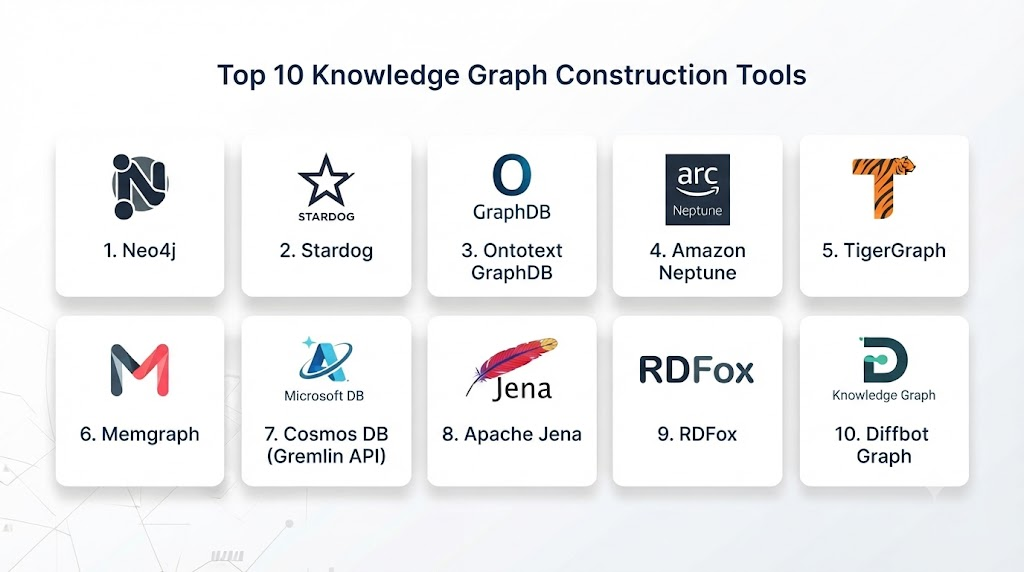
Top 10 Knowledge Graph Construction Tools
1. Neo4j
Neo4j is one of the most popular graph database platforms for building knowledge graphs.
Key Features
- Graph database
- Relationship modeling
- Cypher query language
- Graph analytics
- Data visualization
- AI integration
- Knowledge graph support
- Graph algorithms
- Enterprise security
- Cloud deployment
Pros
- Mature ecosystem
- Powerful graph queries
- Strong community
- Enterprise adoption
- Excellent visualization
Cons
- Licensing complexity
- Requires graph expertise
- Enterprise features can be expensive
Platforms
Cloud and local environments.
Deployment or Support
Enterprise organizations.
Security & Compliance
Enterprise security features.
Integrations & Ecosystem
AI and data platforms.
Support & Community
Large developer community.
2. Amazon Neptune
Amazon Neptune provides managed graph database capabilities.
Key Features
- Graph storage
- RDF support
- Property graphs
- Knowledge graph creation
- AWS integration
- Analytics
- Security
- Scalability
- Data management
- AI workflows
Pros
- Managed service
- AWS integration
- Enterprise security
- Scalable
Cons
- AWS dependency
- Requires graph knowledge
- Complex pricing
3. Stardog
Stardog provides enterprise knowledge graph and data virtualization capabilities.
Key Features
- Knowledge graph management
- Semantic reasoning
- Data integration
- Ontology support
- Graph queries
- AI integration
- Data governance
- Enterprise workflows
- Visualization
- Reasoning engine
Pros
- Strong semantic capabilities
- Enterprise focused
- Good governance
- AI support
Cons
- Premium pricing
- Complex implementation
4. Ontotext GraphDB
GraphDB is an RDF database platform for semantic knowledge management.
Key Features
- RDF storage
- SPARQL queries
- Ontology management
- Semantic reasoning
- Data integration
- Knowledge graph creation
- Search capabilities
- Visualization
- Enterprise deployment
- Analytics
Pros
- Strong semantic technology
- Research adoption
- Flexible
- Good reasoning
Cons
- Requires RDF knowledge
- Learning curve
5. Diffbot Knowledge Graph
Diffbot provides automated knowledge graph creation using AI.
Key Features
- Web data extraction
- Entity recognition
- Automated graph creation
- AI extraction
- Knowledge discovery
- Data enrichment
- APIs
- Search
- Real-time updates
Pros
- Automated extraction
- AI-powered
- Reduces manual work
- Large-scale web intelligence
Cons
- Commercial platform
- Limited customization
- Dependency on external service
6. Google Cloud Knowledge Graph
Google provides knowledge graph capabilities through its AI ecosystem.
Key Features
- Entity understanding
- Knowledge discovery
- AI integration
- Search capabilities
- Data connections
- Machine learning support
- Cloud scalability
- Semantic understanding
- APIs
- Enterprise integration
Pros
- Google AI ecosystem
- Strong search technology
- Scalable
- Managed services
Cons
- Google Cloud dependency
- Limited customization
7. Azure Cosmos DB Gremlin API
Azure Cosmos DB supports graph-based applications.
Key Features
- Graph database support
- Gremlin queries
- Global scalability
- Azure integration
- Data management
- Enterprise security
- Distributed architecture
- Application support
- Analytics
- Cloud deployment
Pros
- Microsoft ecosystem
- Global scaling
- Enterprise security
Cons
- Azure dependency
- Complex configuration
8. Apache Jena
Apache Jena is an open-source framework for semantic web applications.
Key Features
- RDF processing
- Ontology management
- SPARQL support
- Semantic reasoning
- Graph modeling
- Java integration
- Open-source framework
- Knowledge processing
- Data management
- Developer tools
Pros
- Open source
- Flexible
- Research friendly
- Powerful semantic tools
Cons
- Requires technical expertise
- Manual setup
9. RDF4J
RDF4J provides tools for RDF data management.
Key Features
- RDF storage
- SPARQL queries
- Semantic processing
- Graph management
- Data integration
- Open-source framework
- API support
- Knowledge modeling
- Query processing
- Developer tools
Pros
- Open source
- Flexible
- Semantic web support
Cons
- Technical learning curve
- Limited enterprise features
10. TigerGraph
TigerGraph provides scalable graph analytics and knowledge graph capabilities.
Key Features
- Graph database
- Real-time analytics
- Relationship analysis
- Machine learning integration
- Graph visualization
- Data loading
- Enterprise deployment
- Query engine
- AI workflows
- Scalability
Pros
- High performance
- Strong analytics
- Enterprise ready
- Real-time processing
Cons
- Complex architecture
- Requires expertise
Comparison Table
| Tool Name | Best For | Platform(s) Supported | Deployment | Standout Feature | Public Rating |
|---|---|---|---|---|---|
| Neo4j | Enterprise graphs | Cloud/Local | Flexible | Graph database | |
| Amazon Neptune | AWS graph apps | AWS | Managed | Cloud graph | |
| Stardog | Enterprise knowledge graphs | Cloud/Local | Enterprise | Semantic reasoning | |
| GraphDB | RDF knowledge systems | Cloud/Local | Flexible | Ontology support | |
| Diffbot | Automated graph creation | Cloud | Managed | AI extraction | |
| Google Knowledge Graph | AI knowledge | Cloud | Managed | Search intelligence | |
| Cosmos DB Gremlin | Cloud graph apps | Azure | Managed | Global scale | |
| Apache Jena | Semantic development | Local | Flexible | Open source | |
| RDF4J | RDF applications | Local | Flexible | Semantic framework | |
| TigerGraph | Graph analytics | Cloud/Local | Enterprise | Performance |
Which Knowledge Graph Construction Tool Is Right for You?
Choose Neo4j for enterprise graph applications.
Choose Amazon Neptune for AWS-based graph solutions.
Choose Stardog for semantic enterprise knowledge graphs.
Choose GraphDB for RDF and ontology-based systems.
Choose Diffbot for automated knowledge extraction.
Choose Google Knowledge Graph for AI search applications.
Choose Cosmos DB Gremlin for Azure environments.
Choose Apache Jena for open-source semantic projects.
Choose RDF4J for RDF development.
Choose TigerGraph for large-scale graph analytics.
Implementation Playbook
Phase 1: Define Knowledge Model
- Identify entities
- Define relationships
- Create ontology
Phase 2: Collect Data
- Connect data sources
- Extract information
- Clean datasets
Phase 3: Build Graph
- Create nodes
- Add relationships
- Validate knowledge
Phase 4: Integrate AI Systems
- Connect LLMs
- Support RAG
- Enable reasoning
Phase 5: Maintain Knowledge
- Update information
- Monitor quality
- Improve relationships
Common Mistakes
- Poor ontology design
- Incorrect entity extraction
- Missing data validation
- Ignoring governance
- No update strategy
- Poor graph modeling
- Lack of security controls
FAQs
1. What are Knowledge Graph Construction Tools?
They are platforms used to create structured networks of entities and relationships.
2. Why are knowledge graphs important for AI?
They provide context and relationships that improve AI reasoning.
3. Are knowledge graphs used in RAG systems?
Yes, they improve retrieval quality and contextual understanding.
4. Who uses knowledge graph tools?
AI engineers, data teams, researchers, and enterprises use them.
5. What is an ontology in knowledge graphs?
An ontology defines concepts, categories, and relationships.
6. Can AI automatically create knowledge graphs?
Yes, modern tools use AI for entity and relationship extraction.
7. What databases are used for knowledge graphs?
Graph databases such as Neo4j, Neptune, and GraphDB are commonly used.
8. Can knowledge graphs support AI agents?
Yes, they help agents reason over structured information.
9. Are open-source knowledge graph tools available?
Yes, Apache Jena and RDF4J are open-source options.
10. What is the future of knowledge graphs?
Knowledge graphs will become an important foundation for enterprise AI, RAG, and intelligent agents.
Conclusion
Knowledge Graph Construction Tools are becoming a critical technology for building intelligent AI systems. They transform disconnected information into connected knowledge structures that improve search, reasoning, and decision-making.Platforms such as Neo4j, Amazon Neptune, Stardog, GraphDB, Diffbot, and open-source semantic frameworks help organizations create powerful knowledge-driven applications.As Generative AI and AI agents continue evolving, knowledge graphs will play a major role in creating accurate, explainable, and context-aware AI systems.