Introduction
RAG Evaluation & Benchmarking Tools are AI testing platforms designed to measure, analyze, and improve the performance of Retrieval-Augmented Generation (RAG) systems.
RAG applications combine retrieval systems with Large Language Models (LLMs) to generate answers using external knowledge sources. While RAG improves AI accuracy, its performance depends heavily on multiple components such as:
- Document retrieval quality
- Context relevance
- Answer accuracy
- Response completeness
- Hallucination control
- Retrieval speed
RAG evaluation tools help organizations test whether their AI systems are providing reliable and useful responses.
These platforms are used by:
- AI engineers
- Machine learning engineers
- MLOps teams
- Data scientists
- LLM application developers
- Enterprise AI teams
Modern RAG evaluation platforms provide capabilities such as:
- Retrieval evaluation
- Answer quality measurement
- Context relevance scoring
- Hallucination detection
- Benchmark datasets
- Automated testing
- LLM evaluation
- Performance monitoring
- Experiment tracking
- Regression testing
The goal of RAG Evaluation & Benchmarking Tools is to ensure AI applications deliver accurate, relevant, and trustworthy responses.
What Is RAG Evaluation?
RAG evaluation is the process of measuring the quality and effectiveness of a Retrieval-Augmented Generation system.
A RAG pipeline includes:
- User query
- Document retrieval
- Context selection
- LLM generation
- Final answer
Evaluation checks each stage to identify problems.
For example:
A user asks:
“How does the company refund policy work?”
The evaluation system checks:
- Was the correct document retrieved?
- Was the context relevant?
- Did the AI answer correctly?
- Did the response contain unsupported information?
Why RAG Evaluation Matters
RAG systems can fail because of:
- Incorrect document retrieval
- Poor chunking
- Weak embeddings
- Irrelevant context
- Model hallucinations
Without evaluation, organizations cannot understand:
- Why answers fail
- Which components need improvement
- Whether changes improve performance
RAG evaluation tools help organizations:
- Improve AI accuracy
- Reduce hallucinations
- Optimize retrieval
- Build reliable AI applications
Key Metrics in RAG Evaluation
Context Relevance
Measures whether retrieved information matches the user query.
Context Precision
Evaluates whether retrieved documents contain useful information.
Context Recall
Checks whether important information was retrieved.
Answer Correctness
Measures whether the generated response is accurate.
Faithfulness
Checks whether answers are supported by retrieved information.
Response Quality
Measures:
- Clarity
- Completeness
- Usefulness
How RAG Evaluation Works
Step 1: Create Evaluation Dataset
Teams prepare:
- Questions
- Expected answers
- Relevant documents
Step 2: Run RAG Pipeline
The system generates:
- Retrieved documents
- AI responses
Step 3: Measure Performance
Evaluation tools analyze:
- Retrieval quality
- Answer quality
- Context relevance
Step 4: Compare Results
Teams compare:
- Different models
- Different prompts
- Different retrieval methods
Step 5: Improve System
Developers optimize:
- Chunking
- Embeddings
- Retrieval
- Prompts
Key Components of RAG Evaluation Platforms
Evaluation Framework
Measures:
- Accuracy
- Relevance
- Quality
Benchmark Dataset Management
Stores:
- Test queries
- Expected results
- Evaluation examples
Automated Scoring
Provides:
- AI-based evaluation
- Performance metrics
Experiment Tracking
Tracks:
- Model changes
- Pipeline improvements
Monitoring System
Observes:
- Production performance
- User feedback
Reporting Dashboard
Displays:
- Evaluation results
- Trends
- Issues
Types of RAG Evaluation Tools
Open-Source Evaluation Frameworks
Examples:
- Ragas
- DeepEval
- TruLens
LLM Monitoring Platforms
Examples:
- LangSmith
- Arize Phoenix
Enterprise AI Testing Platforms
Examples:
- WhyLabs
- Galileo
ML Experiment Platforms
Examples:
- Weights & Biases
Key Features of RAG Evaluation Tools
Automated Testing
Allows teams to test AI systems continuously.
Retrieval Evaluation
Measures:
- Search quality
- Document relevance
Answer Evaluation
Checks:
- Accuracy
- Completeness
- Faithfulness
Benchmark Support
Provides:
- Standard datasets
- Performance comparison
Regression Testing
Detects:
- Performance degradation
- Model issues
Production Monitoring
Tracks:
- Real-world AI behavior
Common Use Cases
Enterprise AI Assistants
Testing:
- Employee knowledge systems
- Internal chatbots
Customer Support AI
Evaluating:
- Automated responses
- Helpdesk assistants
Healthcare AI
Checking:
- Medical information accuracy
Legal AI Systems
Evaluating:
- Document-based answers
AI Search Applications
Improving:
- Retrieval quality
AI Agents
Testing:
- Knowledge retrieval
- Decision-making
Benefits of RAG Evaluation Tools
Better AI Reliability
Organizations understand system performance.
Reduced Hallucinations
Evaluation identifies unsupported responses.
Improved Retrieval Quality
Teams optimize search pipelines.
Faster Development
Automated testing speeds improvement.
Better Enterprise Confidence
Reliable AI systems are easier to deploy.
Evaluation Criteria
Metrics Coverage
Evaluate support for:
- Retrieval metrics
- Generation metrics
- Quality metrics
Integration Support
Consider:
- LLM frameworks
- Vector databases
- RAG platforms
Automation
Evaluate:
- Continuous testing
- Automated scoring
Scalability
Consider:
- Large datasets
- Production workloads
Developer Experience
Check:
- APIs
- Documentation
- SDKs
Monitoring Capabilities
Evaluate:
- Real-time insights
- Feedback tracking
Key Trends
Automated AI Evaluation
AI systems are increasingly evaluating other AI systems.
Continuous RAG Testing
Organizations are moving toward automated quality monitoring.
LLM-Based Evaluation
Large models are being used as evaluation judges.
Production Feedback Loops
User feedback is becoming part of evaluation.
AI Agent Benchmarking
Evaluation is expanding beyond chatbots into autonomous agents.
Methodology
The following RAG Evaluation & Benchmarking Tools were evaluated based on:
- Evaluation capabilities
- Metrics support
- AI integration
- Benchmarking features
- Monitoring
- Scalability
- Developer experience
- Enterprise readiness
- Community support
- Value
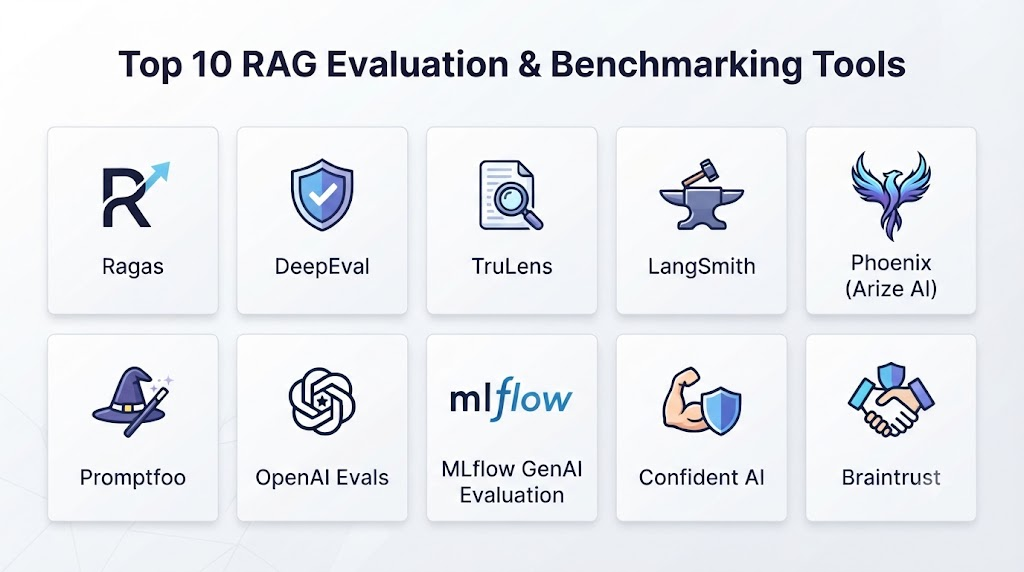
Top 10 RAG Evaluation & Benchmarking Tools
1. Ragas
Ragas is an open-source framework focused on evaluating RAG applications.
Key Features
- RAG evaluation metrics
- Context relevance scoring
- Answer correctness evaluation
- Faithfulness measurement
- Dataset evaluation
- Benchmarking
- LLM evaluation
- Experiment comparison
- API integration
- Open-source framework
Pros
- RAG-focused
- Easy integration
- Open source
- Strong community
Cons
- Requires technical knowledge
- Limited enterprise monitoring
2. DeepEval
DeepEval provides testing and evaluation tools for LLM applications.
Key Features
- RAG evaluation
- Test cases
- Quality metrics
- Hallucination testing
- Automated scoring
- Regression testing
- CI/CD integration
- Benchmarking
- Developer tools
Pros
- Developer friendly
- Strong testing approach
- Open source
Cons
- Requires setup
- Advanced features need configuration
3. LangSmith
LangSmith provides observability and evaluation for LLM applications.
Key Features
- RAG tracing
- Evaluation datasets
- Performance monitoring
- Experiment tracking
- Feedback collection
- Debugging
- Testing workflows
- LLM analytics
- Integration with LangChain
Pros
- Strong LLM ecosystem
- Excellent visualization
- Developer friendly
Cons
- Best suited for LangChain workflows
4. TruLens
TruLens provides evaluation and monitoring for AI applications.
Key Features
- RAG evaluation
- Feedback functions
- Quality measurement
- Groundedness checks
- Monitoring
- Experiment comparison
- AI testing
- Production insights
Pros
- Strong evaluation framework
- Open source
- Good monitoring
Cons
- Requires configuration
5. Arize Phoenix
Arize Phoenix provides open-source observability and evaluation.
Key Features
- LLM tracing
- RAG evaluation
- Embedding analysis
- Retrieval monitoring
- Performance tracking
- Debugging
- Experiment analysis
- AI observability
Pros
- Strong observability
- Open source
- Developer focused
Cons
- Requires technical setup
6. Weights & Biases Weave
Weave provides AI application tracking and evaluation.
Key Features
- LLM monitoring
- Evaluation workflows
- Experiment tracking
- Dataset management
- Model comparison
- Visualization
- AI application monitoring
Pros
- Excellent analytics
- Strong ecosystem
- Collaboration support
Cons
- Commercial platform
- Pricing complexity
7. Galileo AI
Galileo provides enterprise AI evaluation and monitoring.
Key Features
- RAG evaluation
- LLM quality monitoring
- Hallucination detection
- Data analysis
- AI quality scoring
- Enterprise dashboards
- Production monitoring
Pros
- Enterprise focused
- Strong monitoring
- AI quality insights
Cons
- Commercial pricing
8. WhyLabs
WhyLabs provides AI observability and monitoring.
Key Features
- AI monitoring
- Data quality tracking
- Model monitoring
- LLM monitoring
- Drift detection
- Alerts
- Analytics
Pros
- Strong monitoring
- Enterprise ready
- Good observability
Cons
- More monitoring focused
9. Promptfoo
Promptfoo provides testing tools for LLM applications.
Key Features
- Prompt testing
- Model comparison
- Evaluation datasets
- Regression testing
- Automated benchmarks
- CI/CD support
- Security testing
Pros
- Easy testing
- Developer friendly
- Open source
Cons
- Limited production monitoring
10. OpenAI Evals
OpenAI Evals provides evaluation frameworks for AI systems.
Key Features
- Custom evaluations
- Benchmark creation
- Model testing
- Performance comparison
- Dataset management
- Automated scoring
- AI evaluation workflows
Pros
- Flexible
- Strong evaluation framework
- Developer focused
Cons
- Requires customization
- Technical knowledge needed
Comparison Table: Top 10 RAG Evaluation & Benchmarking Tools
| No. | Tool Name | Best For | Platform(s) Supported | Deployment | Standout Feature | Public Rating |
|---|---|---|---|---|---|---|
| 1 | Ragas | RAG evaluation | Cloud / Local | Open Source | RAG metrics | 4.8/5 |
| 2 | DeepEval | AI testing | Cloud / Local | Open Source | Automated testing | 4.7/5 |
| 3 | LangSmith | LLM monitoring | Cloud | Managed | Tracing & evaluation | 4.7/5 |
| 4 | TruLens | AI quality evaluation | Cloud / Local | Open Source | Feedback evaluation | 4.6/5 |
| 5 | Arize Phoenix | AI observability | Cloud / Local | Open Source | LLM tracing | 4.6/5 |
| 6 | W&B Weave | Experiment tracking | Cloud | Managed | Analytics | 4.5/5 |
| 7 | Galileo AI | Enterprise evaluation | Cloud | Managed | AI quality monitoring | 4.5/5 |
| 8 | WhyLabs | AI monitoring | Cloud | Managed | Drift monitoring | 4.4/5 |
| 9 | Promptfoo | Prompt testing | Cloud / Local | Open Source | Regression testing | 4.4/5 |
| 10 | OpenAI Evals | Custom benchmarks | Cloud / Local | Flexible | Evaluation framework | 4.4/5 |
Weighted Evaluation Table
| No. | Tool Name | Evaluation Features 25% | Ease of Use 15% | RAG Support 15% | Security 10% | Performance 10% | Community 10% | Value 15% | Total |
|---|---|---|---|---|---|---|---|---|---|
| 1 | Ragas | 25 | 14 | 15 | 9 | 10 | 10 | 15 | 98 |
| 2 | DeepEval | 24 | 15 | 15 | 9 | 10 | 10 | 14 | 97 |
| 3 | LangSmith | 24 | 15 | 15 | 10 | 10 | 10 | 12 | 96 |
| 4 | TruLens | 24 | 14 | 15 | 9 | 10 | 10 | 14 | 96 |
| 5 | Arize Phoenix | 24 | 13 | 15 | 9 | 10 | 10 | 14 | 95 |
| 6 | W&B Weave | 24 | 15 | 14 | 10 | 10 | 10 | 12 | 95 |
| 7 | Galileo AI | 23 | 14 | 15 | 10 | 10 | 10 | 12 | 94 |
| 8 | WhyLabs | 23 | 14 | 13 | 10 | 10 | 10 | 13 | 93 |
| 9 | Promptfoo | 23 | 15 | 14 | 9 | 10 | 10 | 14 | 95 |
| 10 | OpenAI Evals | 24 | 12 | 14 | 10 | 10 | 10 | 14 | 94 |
Which RAG Evaluation Tool Is Right for You?
Choose Ragas for dedicated RAG evaluation.
Choose DeepEval for automated AI testing.
Choose LangSmith for LLM application monitoring.
Choose TruLens for quality evaluation.
Choose Arize Phoenix for AI observability.
Choose Weights & Biases Weave for experiment tracking.
Choose Galileo AI for enterprise AI quality.
Choose WhyLabs for monitoring and drift detection.
Choose Promptfoo for prompt testing.
Choose OpenAI Evals for custom benchmarks.
Implementation Playbook
Phase 1: Define Evaluation Goals
- Select quality metrics
- Create test datasets
- Define success criteria
Phase 2: Evaluate Retrieval
- Measure document relevance
- Check context quality
- Improve search
Phase 3: Evaluate Responses
- Measure accuracy
- Check faithfulness
- Analyze quality
Phase 4: Automate Testing
- Add regression tests
- Integrate CI/CD
- Track changes
Phase 5: Monitor Production
- Collect feedback
- Detect issues
- Improve continuously
Common Mistakes
- Testing only final answers
- Ignoring retrieval quality
- No benchmark dataset
- No regression testing
- Poor evaluation metrics
- Lack of monitoring
FAQs
1. What are RAG Evaluation Tools?
They are platforms used to measure and improve Retrieval-Augmented Generation system performance.
2. Why is RAG evaluation important?
It helps improve accuracy, reliability, and user trust.
3. What metrics are used in RAG evaluation?
Common metrics include context relevance, faithfulness, precision, recall, and answer correctness.
4. Can RAG evaluation reduce hallucinations?
Yes, evaluation helps identify unsupported AI responses.
5. Are RAG evaluation tools used in production?
Yes, enterprises use them for continuous AI quality monitoring.
6. What is benchmark testing in RAG?
It compares system performance using standard datasets and metrics.
7. Can these tools test AI agents?
Many can evaluate retrieval and reasoning workflows.
8. Are open-source RAG evaluation tools available?
Yes, Ragas, DeepEval, TruLens, and Phoenix provide open-source options.
9. How often should RAG systems be evaluated?
Organizations should evaluate continuously as data and models change.
10. What is the future of RAG evaluation?
AI-driven automated evaluation will become essential for reliable enterprise AI systems.
Conclusion
RAG Evaluation & Benchmarking Tools are essential for building reliable AI applications. They help organizations measure retrieval quality, improve response accuracy, reduce hallucinations, and maintain consistent AI performance.ools such as Ragas, DeepEval, LangSmith, TruLens, Arize Phoenix, and Weights & Biases Weave provide powerful capabilities for testing and monitoring RAG systems.As enterprise AI adoption grows, continuous evaluation will become a critical requirement for building trustworthy, scalable, and high-quality AI applications.