Introduction
Retrieval-Augmented Generation (RAG) Frameworks are AI development platforms designed to improve the accuracy, reliability, and usefulness of large language model (LLM) applications by combining language generation with external knowledge retrieval.
Large language models can generate human-like responses but may struggle with outdated information, missing domain knowledge, or incorrect answers. RAG frameworks solve this problem by allowing AI systems to retrieve relevant information from external sources before generating responses.
These frameworks help organizations build AI applications that can work with:
- Company documents
- Knowledge bases
- Databases
- Websites
- Research papers
- Product information
- Internal business data
RAG frameworks help teams:
- Reduce AI hallucinations
- Improve response accuracy
- Build domain-specific AI assistants
- Connect LLMs with private data
- Create enterprise knowledge systems
Retrieval-Augmented Generation Frameworks are used by:
- AI engineers
- Machine learning engineers
- Data scientists
- Software developers
- Enterprise AI teams
- MLOps engineers
Modern RAG frameworks provide capabilities such as:
- Document ingestion
- Text chunking
- Embedding generation
- Vector search
- Retrieval pipelines
- Prompt management
- LLM integration
- Knowledge indexing
- Evaluation workflows
- Production deployment support
The goal of RAG frameworks is to create intelligent AI applications that can provide accurate, context-aware, and knowledge-grounded responses.
What Is Retrieval-Augmented Generation (RAG)?
Retrieval-Augmented Generation is an AI architecture that combines two major components:
- Retrieval System
- Generative Language Model
The retrieval system searches relevant information from external sources.
The language model uses that retrieved information to generate a response.
Example:
A company creates an AI customer support assistant.
Without RAG:
User asks:
“How can I reset my enterprise account?”
The LLM may not know the company’s specific process.
With RAG:
- The system searches company documentation.
- Finds the correct reset procedure.
- Provides the answer using retrieved information.
Why Organizations Need RAG Frameworks
Businesses increasingly want AI systems that understand their own information.
Traditional LLM applications face challenges such as:
- Limited training knowledge
- Outdated information
- Hallucinated answers
- Lack of business context
- Difficult customization
RAG frameworks help organizations:
- Connect AI with private knowledge
- Improve response quality
- Reduce incorrect answers
- Build specialized AI applications
How RAG Architecture Works
Data Collection
The system collects:
- Documents
- PDFs
- Databases
- Websites
- Knowledge sources
Document Processing
Content is prepared through:
- Cleaning
- Splitting
- Formatting
Embedding Generation
Documents are converted into:
- Numerical vectors
- Semantic representations
Knowledge Storage
Embeddings are stored in:
- Vector databases
- Search systems
User Query Processing
The system analyzes:
- User question
- Search intent
- Required context
Retrieval
Relevant information is retrieved from:
- Vector databases
- Knowledge sources
Generation
The LLM creates a response using:
- User query
- Retrieved information
- Prompt instructions
Key Components of RAG Frameworks
Document Loaders
Handle:
- Files
- Websites
- Databases
- APIs
Text Splitters
Convert large documents into:
- Searchable chunks
- Manageable sections
Embedding Models
Create:
- Semantic vectors
- Search representations
Vector Databases
Store:
- Document embeddings
- Metadata
Retrieval Engines
Find:
- Relevant information
- Contextual data
LLM Integration
Connects:
- GPT models
- Open-source models
- Enterprise models
Evaluation System
Measures:
- Accuracy
- Retrieval quality
- Response relevance
Types of RAG Frameworks
Developer Frameworks
Designed for:
- Building custom AI applications
Examples:
- LangChain
- LlamaIndex
- Haystack
Enterprise RAG Platforms
Designed for:
- Business AI applications
Examples:
- Databricks Mosaic AI
- Amazon Bedrock Knowledge Bases
Open-Source RAG Frameworks
Designed for:
- Custom deployment
Examples:
- Haystack
- Verba
- RAGFlow
Cloud RAG Services
Designed for:
- Managed AI development
Examples:
- Azure AI Search
- Google Vertex AI Search
Key Features of RAG Frameworks
Document Ingestion
Supports:
- Multiple formats
- Data connectors
- Automated processing
Semantic Search
Provides:
- Meaning-based retrieval
- Better context matching
Vector Database Integration
Supports:
- Embedding storage
- Similarity search
Prompt Management
Controls:
- Instructions
- Context formatting
Multi-Source Retrieval
Connects:
- Multiple knowledge sources
- Enterprise systems
RAG Evaluation
Measures:
- Retrieval accuracy
- Answer quality
- Hallucination reduction
Common Use Cases
Enterprise Knowledge Assistants
Helping employees access:
- Internal documents
- Policies
- Business information
Customer Support AI
Improving:
- Automated responses
- Support workflows
Healthcare AI
Supporting:
- Medical knowledge retrieval
- Research assistance
Legal AI Applications
Working with:
- Legal documents
- Case information
Education Platforms
Creating:
- Learning assistants
- Research tools
Software Development Assistants
Using:
- Code repositories
- Technical documentation
Why RAG Frameworks Matter
Better AI Accuracy
Models answer using relevant information.
Reduced Hallucinations
Responses are grounded in retrieved data.
Domain Customization
Organizations can use private knowledge.
Updated Information
AI systems can access current data.
Enterprise AI Adoption
Businesses can safely use LLM applications.
Evaluation Criteria for Buyers
Retrieval Quality
Evaluate:
- Search accuracy
- Context relevance
LLM Support
Consider:
- Open-source models
- Commercial APIs
- Custom models
Data Integration
Evaluate:
- Connectors
- Document support
- Database access
Scalability
Consider:
- Large knowledge bases
- Enterprise workloads
Security
Evaluate:
- Data privacy
- Access control
Developer Experience
Consider:
- APIs
- Documentation
- Community support
Key Trends
Enterprise RAG Adoption
Companies are building internal AI assistants.
Multimodal RAG
Systems are supporting:
- Images
- Videos
- Audio
- Documents
Agentic RAG
AI agents are combining retrieval with autonomous actions.
Graph-Based RAG
Knowledge graphs are improving retrieval quality.
Real-Time RAG
AI systems are connecting with live data sources.
RAG Evaluation Growth
Organizations are focusing on measuring AI quality.
Methodology
The following Retrieval-Augmented Generation Frameworks were evaluated based on:
- Retrieval capabilities
- LLM integration
- Developer experience
- Scalability
- Data connectors
- Evaluation support
- Security
- Enterprise readiness
- Community
- Value
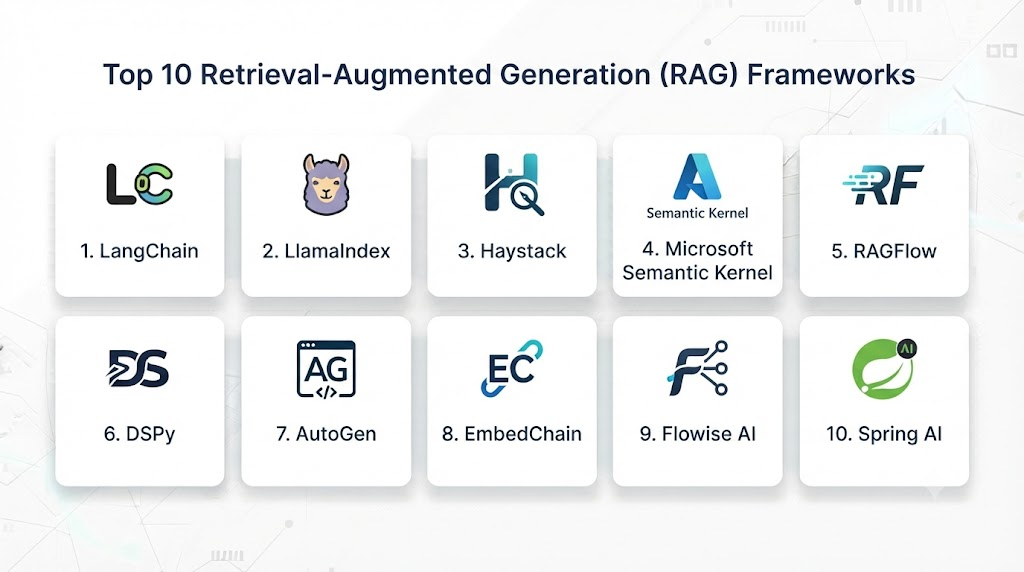
Top 10 Retrieval-Augmented Generation (RAG) Frameworks
1. LangChain
LangChain is one of the most popular frameworks for building LLM-powered applications.
Key Features
- RAG pipelines
- LLM integration
- Document loaders
- Vector database support
- Prompt templates
- Agent workflows
- Memory management
- Retrieval chains
- Tool integration
- Application development
Pros
- Large ecosystem
- Strong community
- Flexible
- Many integrations
- Developer friendly
Cons
- Can become complex
- Rapid changes
- Requires learning
Platforms
Cloud and local environments.
Deployment or Support
AI application developers.
Security & Compliance
Implementation dependent.
Integrations & Ecosystem
LLM providers and databases.
Support & Community
Large developer community.
2. LlamaIndex
LlamaIndex specializes in connecting LLMs with external data.
Key Features
- Data connectors
- Document indexing
- Retrieval pipelines
- Vector search
- Query engines
- Knowledge management
- RAG workflows
- Agent integration
- Evaluation tools
- Data framework
Pros
- RAG focused
- Excellent data integration
- Developer friendly
- Strong indexing capabilities
- Open source
Cons
- Requires technical knowledge
- Complex advanced workflows
- Additional infrastructure needed
Platforms
Cloud and local environments.
Deployment or Support
AI developers.
Security & Compliance
Implementation dependent.
Integrations & Ecosystem
Data sources and LLMs.
Support & Community
Developer community.
3. Haystack
Haystack provides open-source RAG application development capabilities.
Key Features
- Search pipelines
- Document processing
- Retrieval systems
- LLM integration
- Evaluation tools
- Vector database support
- NLP workflows
- Deployment support
- API services
- Modular architecture
Pros
- Open source
- Flexible
- Enterprise friendly
- Strong search capabilities
- Modular design
Cons
- Requires setup
- Smaller ecosystem
- Learning curve
Platforms
Cloud and local environments.
Deployment or Support
Enterprise AI teams.
Security & Compliance
Implementation dependent.
Integrations & Ecosystem
Search systems and LLMs.
Support & Community
Developer community.
4. Microsoft Semantic Kernel
Semantic Kernel provides AI orchestration and RAG capabilities.
Key Features
- AI workflows
- Memory integration
- Plugin support
- LLM connection
- Retrieval workflows
- Enterprise integration
- Agent capabilities
- Prompt management
- Application development
- Cloud support
Pros
- Microsoft ecosystem
- Enterprise focused
- Strong integration
- Developer friendly
- Supports agents
Cons
- Microsoft ecosystem preference
- Learning curve
- Less RAG-specific
Platforms
Cloud and local environments.
Deployment or Support
Enterprise developers.
Security & Compliance
Microsoft security framework.
Integrations & Ecosystem
Microsoft AI services.
Support & Community
Enterprise support.
5. Amazon Bedrock Knowledge Bases
Amazon Bedrock provides managed RAG capabilities.
Key Features
- Managed retrieval
- Document ingestion
- Vector search
- Foundation model integration
- Enterprise security
- Data connectors
- Knowledge management
- Monitoring
- Cloud scaling
- Production workflows
Pros
- Fully managed
- AWS integration
- Enterprise security
- Scalable
- Production ready
Cons
- AWS dependency
- Cost complexity
- Less customization
Platforms
AWS Cloud.
Deployment or Support
Enterprise AI teams.
Security & Compliance
AWS security framework.
Integrations & Ecosystem
AWS services.
Support & Community
Enterprise support.
6. Google Vertex AI Search
Vertex AI Search provides managed enterprise search and RAG capabilities.
Key Features
- Enterprise search
- Retrieval workflows
- Document indexing
- Generative AI integration
- Data connectors
- Security
- Cloud integration
- AI applications
- Monitoring
- Enterprise deployment
Pros
- Managed service
- Google AI integration
- Scalable
- Strong search
- Enterprise ready
Cons
- Google Cloud dependency
- Pricing complexity
- Configuration learning
Platforms
Google Cloud.
Deployment or Support
Enterprise AI teams.
Security & Compliance
Google Cloud security.
Integrations & Ecosystem
Google AI services.
Support & Community
Enterprise support.
7. Databricks Mosaic AI
Mosaic AI provides enterprise RAG and AI application capabilities.
Key Features
- RAG development
- Vector search
- Model management
- Data integration
- Governance
- Evaluation
- Deployment
- Monitoring
- Enterprise workflows
- AI lifecycle support
Pros
- Strong data integration
- Enterprise ready
- Governance support
- Scalable
- Unified platform
Cons
- Premium pricing
- Platform complexity
- Enterprise focused
Platforms
Cloud environments.
Deployment or Support
Enterprise AI teams.
Security & Compliance
Enterprise controls.
Integrations & Ecosystem
Data platforms.
Support & Community
Enterprise support.
8. RAGFlow
RAGFlow provides open-source RAG application development.
Key Features
- Document understanding
- Retrieval pipelines
- Knowledge bases
- Search
- LLM integration
- Workflow management
- Document processing
- Enterprise applications
- Open-source deployment
- AI workflows
Pros
- Open source
- RAG focused
- Document intelligence
- Flexible
- Community driven
Cons
- Growing ecosystem
- Requires setup
- Enterprise maturity developing
Platforms
Cloud and local environments.
Deployment or Support
AI developers.
Security & Compliance
Implementation dependent.
Integrations & Ecosystem
LLM platforms.
Support & Community
Open-source community.
9. deepset Cloud
deepset Cloud provides managed RAG application development.
Key Features
- RAG pipelines
- Search components
- Document processing
- Deployment workflows
- Evaluation
- Monitoring
- Enterprise security
- API access
- Collaboration
- Scaling
Pros
- Enterprise RAG focus
- Good tooling
- Strong search
- Managed platform
- Production ready
Cons
- Commercial platform
- Pricing complexity
- Smaller ecosystem
Platforms
Cloud environments.
Deployment or Support
Enterprise AI teams.
Security & Compliance
Enterprise controls.
Integrations & Ecosystem
AI platforms.
Support & Community
Enterprise support.
10. Chroma
Chroma provides an open-source vector database for RAG applications.
Key Features
- Vector storage
- Similarity search
- Embedding management
- Developer APIs
- Local deployment
- AI application support
- Metadata filtering
- Retrieval workflows
- LLM integration
- Lightweight architecture
Pros
- Simple
- Open source
- Developer friendly
- Easy integration
- Fast setup
Cons
- Not full RAG framework
- Limited enterprise features
- Requires additional components
Platforms
Cloud and local environments.
Deployment or Support
Developers.
Security & Compliance
Implementation dependent.
Integrations & Ecosystem
AI development tools.
Support & Community
Developer community.
Comparison Table
| Tool Name | Best For | Platform(s) Supported | Deployment | Standout Feature | Public Rating |
|---|---|---|---|---|---|
| LangChain | AI applications | Cloud/Local | Flexible | Large ecosystem | |
| LlamaIndex | Data-connected AI | Cloud/Local | Flexible | Data indexing | |
| Haystack | Enterprise RAG | Cloud/Local | Flexible | Search pipelines | |
| Semantic Kernel | Enterprise AI apps | Cloud/Local | Enterprise | AI orchestration | |
| Bedrock Knowledge Bases | AWS RAG | AWS | Enterprise | Managed RAG | |
| Vertex AI Search | Google RAG | GCP | Enterprise | Enterprise search | |
| Mosaic AI | Enterprise AI | Cloud | Enterprise | Data integration | |
| RAGFlow | Open-source RAG | Cloud/Local | Flexible | Document intelligence | |
| deepset Cloud | Managed RAG | Cloud | Enterprise | Production pipelines | |
| Chroma | Vector search | Cloud/Local | Flexible | Lightweight database |
Weighted Evaluation
| Tool Name | Core Features 25% | Ease of Use 15% | Integrations & Ecosystem 15% | Security & Compliance 10% | Performance & Reliability 10% | Support & Community 10% | Price/Value 15% | Total |
|---|---|---|---|---|---|---|---|---|
| LangChain | 25 | 15 | 15 | 10 | 10 | 10 | 15 | 100 |
| LlamaIndex | 25 | 14 | 15 | 10 | 10 | 10 | 15 | 99 |
| Haystack | 24 | 13 | 14 | 10 | 10 | 10 | 15 | 96 |
| Semantic Kernel | 24 | 14 | 15 | 10 | 10 | 10 | 13 | 96 |
| Bedrock Knowledge Bases | 24 | 13 | 15 | 10 | 10 | 10 | 12 | 94 |
| Vertex AI Search | 24 | 13 | 15 | 10 | 10 | 10 | 12 | 94 |
| Mosaic AI | 25 | 13 | 15 | 10 | 10 | 10 | 12 | 95 |
| RAGFlow | 23 | 13 | 14 | 10 | 10 | 10 | 15 | 95 |
| deepset Cloud | 24 | 14 | 14 | 10 | 10 | 10 | 12 | 94 |
| Chroma | 22 | 15 | 14 | 10 | 10 | 10 | 15 | 96 |
Which RAG Framework Is Right for You?
Choose LangChain for flexible AI application development.
Choose LlamaIndex for data-focused RAG applications.
Choose Haystack for enterprise search workflows.
Choose Semantic Kernel for Microsoft AI ecosystems.
Choose Amazon Bedrock Knowledge Bases for AWS environments.
Choose Vertex AI Search for Google Cloud.
Choose Databricks Mosaic AI for enterprise data platforms.
Choose RAGFlow for open-source RAG systems.
Choose deepset Cloud for managed RAG deployments.
Choose Chroma for lightweight vector search applications.
Implementation Playbook
Phase 1: Prepare Knowledge Sources
- Collect documents
- Clean data
- Define access rules
Phase 2: Build Retrieval Pipeline
- Create embeddings
- Configure vector storage
- Optimize search
Phase 3: Connect LLM
- Select language model
- Design prompts
- Configure responses
Phase 4: Evaluate System
- Test retrieval quality
- Measure response accuracy
- Improve prompts
Phase 5: Deploy and Monitor
- Release application
- Track performance
- Improve continuously
Common Mistakes
- Poor document preparation
- Incorrect chunking strategy
- Weak retrieval configuration
- Ignoring evaluation
- No security controls
- Poor data governance
- Not monitoring responses
FAQs
1. What are Retrieval-Augmented Generation Frameworks?
They are frameworks that connect LLMs with external knowledge sources to improve AI responses.
2. Why is RAG important for AI applications?
RAG helps models provide more accurate and context-aware answers.
3. How does RAG reduce hallucinations?
It provides the model with relevant external information before generating responses.
4. Who uses RAG frameworks?
Developers, AI engineers, and enterprises use RAG frameworks.
5. Can RAG work with private company data?
Yes, RAG is commonly used with internal business knowledge.
6. Do RAG frameworks support LLMs?
Yes, they integrate with both commercial and open-source models.
7. What is a vector database in RAG?
It stores document embeddings used for similarity search.
8. Can RAG applications support real-time information?
Yes, when connected with updated data sources.
9. Are RAG frameworks open source?
Many frameworks such as LangChain, LlamaIndex, and Haystack are open source.
10. What is the future of RAG technology?
RAG will become more intelligent through multimodal retrieval, agents, and real-time knowledge integration.
Conclusion
Retrieval-Augmented Generation Frameworks are becoming a foundation for modern enterprise AI applications. They allow organizations to combine powerful language models with trusted information sources, creating more accurate, reliable, and useful AI systems.Frameworks such as LangChain, LlamaIndex, Haystack, Semantic Kernel, and cloud-based RAG platforms provide powerful capabilities for building knowledge-driven AI applications.As organizations continue adopting generative AI, RAG frameworks will play a critical role in reducing hallucinations, improving AI reliability, and enabling practical enterprise AI solutions.