Introduction
AI Agent Marketplaces are platforms where organizations, developers, and users can discover, create, share, deploy, and manage AI agents designed for different tasks and business needs.
Unlike traditional software marketplaces that distribute applications, AI Agent Marketplaces focus on intelligent digital workers capable of performing tasks, interacting with tools, accessing knowledge sources, and automating workflows.
AI agents available through these marketplaces can help with:
- Customer support
- Data analysis
- Research
- Marketing automation
- Software development
- Business operations
- Productivity tasks
- Enterprise workflows
As agentic AI adoption grows, organizations need easier ways to find reliable AI agents without building every solution from scratch. AI Agent Marketplaces provide a centralized ecosystem where users can access pre-built agents, customize them, and integrate them into existing systems.
These platforms help organizations:
- Reduce AI development time
- Discover specialized agents
- Improve productivity
- Accelerate automation
- Share AI solutions
- Manage agent deployments
AI Agent Marketplaces are used by:
- Enterprises
- Developers
- AI engineers
- Business teams
- Automation specialists
- SaaS companies
- Research organizations
Modern AI Agent Marketplaces provide capabilities such as:
- Agent discovery
- Agent templates
- AI workflows
- Tool integrations
- Agent publishing
- Security controls
- Performance tracking
- Customization options
- Enterprise deployment
The goal of AI Agent Marketplaces is to create an ecosystem where intelligent agents can be easily discovered, deployed, and improved.
What Is an AI Agent Marketplace?
An AI Agent Marketplace is an online platform that allows users to find and use AI agents created by developers, companies, or communities.
Similar to application stores, these platforms provide:
- AI agent listings
- Agent descriptions
- Usage instructions
- Integration options
- Deployment methods
Users can select an agent based on their requirements and connect it with their workflows.
Why AI Agent Marketplaces Matter
Building AI agents requires:
- Model selection
- Prompt engineering
- Tool integration
- Workflow design
- Testing
- Security management
AI Agent Marketplaces simplify this process by providing ready-to-use solutions.
Benefits include:
- Faster AI adoption
- Lower development costs
- Access to specialized agents
- Community innovation
- Easier experimentation
How AI Agent Marketplaces Work
Agent Discovery
Users search for agents based on:
- Business needs
- Industry
- Functionality
- Technology
Examples:
- Sales agents
- Research agents
- Coding agents
Agent Evaluation
Users review:
- Capabilities
- Performance
- Ratings
- Security information
Agent Deployment
Agents are connected with:
- Business applications
- APIs
- Data sources
- Workflows
Agent Customization
Organizations modify agents by adding:
- Custom instructions
- Knowledge sources
- Tools
- Permissions
Agent Management
Organizations monitor:
- Usage
- Performance
- Costs
- Security
Types of AI Agents Available in Marketplaces
Productivity Agents
Help with:
- Scheduling
- Writing
- Research
- Documentation
Business Agents
Automate:
- Sales
- Marketing
- Operations
Customer Support Agents
Handle:
- Customer questions
- Ticket management
- Knowledge retrieval
Developer Agents
Support:
- Coding
- Testing
- Debugging
Data Agents
Perform:
- Analysis
- Reporting
- Insights generation
Enterprise Workflow Agents
Automate:
- Business processes
- Approvals
- Internal operations
Key Features of AI Agent Marketplaces
Agent Discovery System
Allows users to find relevant AI agents quickly.
Benefits:
- Faster selection
- Better adoption
Agent Templates
Provides reusable agent designs.
Benefits:
- Faster development
- Easier customization
Integration Support
Connects agents with:
- APIs
- SaaS applications
- Databases
- Enterprise systems
Agent Publishing
Allows developers to share their agents.
Benefits:
- Community growth
- Collaboration
Security and Governance
Provides:
- Permission management
- Access controls
- Monitoring
Performance Analytics
Tracks:
- Agent usage
- Success rates
- User feedback
Common Use Cases
Enterprise Automation
Organizations deploy agents for:
- Operations
- Customer service
- Reporting
Software Development
Developers use:
- Coding agents
- Testing agents
- Documentation agents
Marketing Operations
AI agents help with:
- Content creation
- Campaign analysis
- Customer research
Sales Teams
Agents support:
- Lead research
- Customer insights
- Follow-ups
Education
AI agents assist with:
- Learning support
- Research
- Training
Internal Knowledge Management
Organizations deploy agents for:
- Document search
- Employee assistance
- Information retrieval
Why AI Agent Marketplaces Matter for Businesses
Faster AI Adoption
Businesses can deploy AI solutions quickly.
Reduced Development Costs
Ready-made agents reduce engineering effort.
Better Collaboration
Developers can share reusable solutions.
Scalable AI Deployment
Organizations can manage multiple agents.
Innovation Growth
Communities create new AI solutions.
Evaluation Criteria for Buyers
Agent Quality
Evaluate:
- Accuracy
- Reliability
- Performance
Integration Capabilities
Look for support for:
- APIs
- Enterprise software
- Data sources
Security Features
Consider:
- Permissions
- Privacy
- Compliance
Customization Options
Important features:
- Custom prompts
- Knowledge integration
- Tool configuration
Marketplace Ecosystem
Evaluate:
- Number of agents
- Developer community
- Available categories
Management Features
Look for:
- Analytics
- Monitoring
- Version control
Key Trends
Growth of Agent Economy
AI agents are becoming reusable digital products.
Enterprise Agent Adoption
Companies are building internal agent ecosystems.
Specialized AI Agents
Marketplaces are moving toward industry-specific agents.
Agent Collaboration
Multiple agents will work together through shared ecosystems.
AI Governance
Marketplaces will require stronger security and compliance.
Agent Monetization
Developers may distribute and monetize specialized agents.
Methodology
The following AI Agent Marketplaces were evaluated based on:
- Agent availability
- Marketplace ecosystem
- Integration support
- Security features
- Customization options
- Developer experience
- Enterprise readiness
- Scalability
- Community adoption
- Value
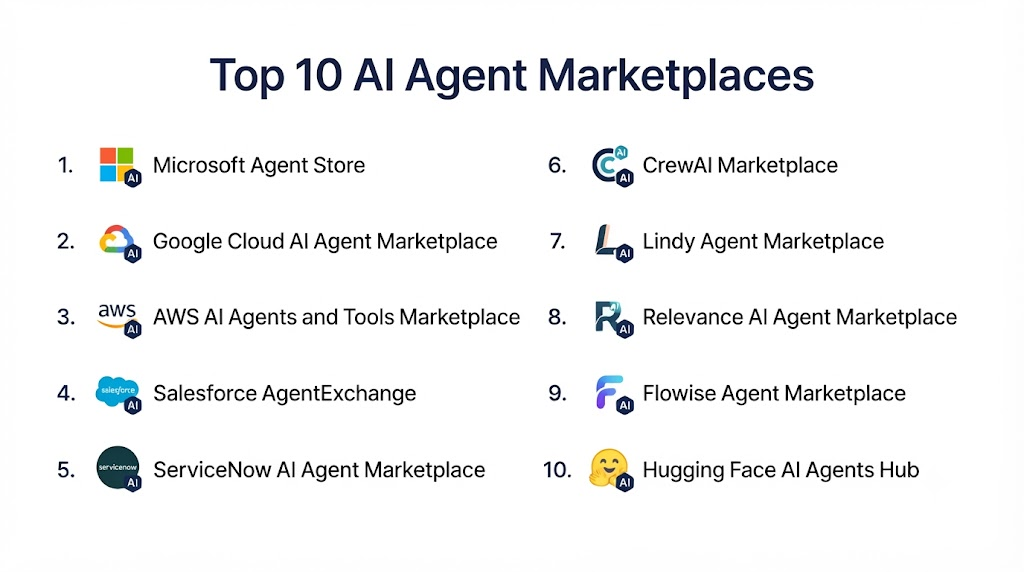
Top 10 AI Agent Marketplaces
1. OpenAI GPT Store
OpenAI GPT Store provides a marketplace for discovering and using custom AI assistants created with GPT technology.
Key Features
- Custom AI assistants
- Agent discovery
- GPT-based workflows
- Knowledge integration
- Custom instructions
- Sharing capabilities
- Community agents
- Productivity tools
- AI applications
- User ratings
Pros
- Large user ecosystem
- Easy access
- Simple customization
- Wide variety of assistants
- Strong AI capabilities
Cons
- Platform dependency
- Limited enterprise customization
- Requires ecosystem adoption
Platforms
Cloud environments.
Deployment or Support
Consumer and business AI applications.
Security & Compliance
Platform-based controls.
Integrations & Ecosystem
AI applications and GPT ecosystem.
Support & Community
Large user community.
2. Microsoft Copilot Studio Marketplace
Microsoft Copilot Studio enables organizations to build and share AI agents.
Key Features
- Enterprise AI agents
- Agent templates
- Business connectors
- Workflow automation
- Knowledge sources
- Microsoft integration
- Agent publishing
- Security controls
- Analytics
- Governance
Pros
- Enterprise-ready
- Strong business integrations
- Low-code development
- Security features
- Microsoft ecosystem
Cons
- Microsoft dependency
- Licensing complexity
- Requires enterprise setup
Platforms
Cloud environments.
Deployment or Support
Enterprise deployment.
Security & Compliance
Microsoft security framework.
Integrations & Ecosystem
Microsoft 365 and enterprise systems.
Support & Community
Enterprise support.
3. Salesforce AgentExchange
Salesforce AgentExchange provides AI agents and solutions for CRM and business workflows.
Key Features
- AI agent solutions
- CRM integration
- Business workflows
- Sales automation
- Customer service agents
- Enterprise applications
- Agent management
- Security controls
- Analytics
- Customization
Pros
- Strong CRM ecosystem
- Enterprise adoption
- Business-focused agents
- Secure platform
- Scalable
Cons
- Salesforce dependency
- Higher cost
- CRM-focused
Platforms
Cloud environments.
Deployment or Support
Enterprise business applications.
Security & Compliance
Salesforce security.
Integrations & Ecosystem
Salesforce ecosystem.
Support & Community
Enterprise support.
4. Google Vertex AI Agent Marketplace
Google Vertex AI provides AI agent development and deployment capabilities.
Key Features
- AI agents
- Model integration
- Enterprise deployment
- Data connections
- Agent workflows
- Cloud infrastructure
- AI tools
- Monitoring
- Security
- Developer support
Pros
- Strong cloud infrastructure
- Enterprise-ready
- AI capabilities
- Scalable
- Google ecosystem
Cons
- Google Cloud dependency
- Requires technical expertise
- Complex deployment
Platforms
Google Cloud.
Deployment or Support
Enterprise AI applications.
Security & Compliance
Google Cloud security.
Integrations & Ecosystem
Google AI services.
Support & Community
Enterprise support.
5. AWS Marketplace AI Agents
AWS provides marketplace capabilities for AI solutions and agent-based applications.
Key Features
- AI solutions
- Cloud deployment
- Enterprise integrations
- AI services
- Security controls
- Marketplace discovery
- Infrastructure support
- Application deployment
- Monitoring
- Cloud management
Pros
- Large cloud ecosystem
- Enterprise security
- Scalable infrastructure
- Wide integrations
- Trusted platform
Cons
- AWS dependency
- Requires cloud knowledge
- Complex services
Platforms
AWS Cloud.
Deployment or Support
Enterprise cloud deployment.
Security & Compliance
AWS security framework.
Integrations & Ecosystem
AWS services.
Support & Community
Enterprise support.
6. Hugging Face Spaces
Hugging Face Spaces provides a community platform for sharing AI applications and agent experiences.
Key Features
- AI application hosting
- Open-source models
- Agent demos
- Community sharing
- Model integration
- Developer collaboration
- Experimentation
- AI tools
- Public projects
- Research support
Pros
- Open-source ecosystem
- Large AI community
- Easy experimentation
- Many models
- Developer-friendly
Cons
- Limited enterprise governance
- Community quality varies
- Requires technical skills
Platforms
Cloud environments.
Deployment or Support
AI development and research.
Security & Compliance
Depends on implementation.
Integrations & Ecosystem
Open-source AI ecosystem.
Support & Community
Large developer community.
7. LangChain Hub
LangChain Hub provides reusable AI components and resources for developers.
Key Features
- Agent templates
- Prompt sharing
- AI workflows
- Developer resources
- Agent examples
- Community contributions
- LLM integrations
- Workflow patterns
- Testing resources
- Collaboration
Pros
- Developer-focused
- Large ecosystem
- Reusable components
- Open collaboration
- AI framework support
Cons
- Requires development skills
- Limited enterprise marketplace features
- Technical focus
Platforms
Cloud and local environments.
Deployment or Support
AI development.
Security & Compliance
Depends on implementation.
Integrations & Ecosystem
LangChain and LLM platforms.
Support & Community
Developer community.
8. CrewAI Marketplace
CrewAI provides resources and components for building multi-agent systems.
Key Features
- Agent templates
- Multi-agent workflows
- AI collaboration
- Task automation
- Agent tools
- Workflow sharing
- Developer resources
- AI automation
- Community ecosystem
- Agent development
Pros
- Multi-agent focused
- Developer-friendly
- Flexible workflows
- Growing ecosystem
- Open approach
Cons
- New ecosystem
- Requires technical knowledge
- Limited enterprise features
Platforms
Cloud and local environments.
Deployment or Support
AI development.
Security & Compliance
Depends on implementation.
Integrations & Ecosystem
AI frameworks and tools.
Support & Community
Developer community.
9. IBM watsonx AI Marketplace
IBM provides AI solutions and enterprise AI resources through watsonx ecosystem.
Key Features
- Enterprise AI solutions
- AI governance
- Model resources
- Agent workflows
- Business applications
- Security controls
- Data integration
- Analytics
- Enterprise deployment
- AI management
Pros
- Enterprise-focused
- Strong governance
- Security capabilities
- Business solutions
- IBM ecosystem
Cons
- Complex setup
- Enterprise pricing
- Requires expertise
Platforms
Cloud environments.
Deployment or Support
Enterprise AI deployment.
Security & Compliance
Enterprise security.
Integrations & Ecosystem
IBM technologies.
Support & Community
Enterprise support.
10. Botpress Hub
Botpress Hub provides AI agent building resources and conversational AI components.
Key Features
- AI chatbot agents
- Templates
- Workflow tools
- Integrations
- Agent sharing
- Conversation management
- Developer tools
- Automation features
- Knowledge integration
- Community resources
Pros
- Easy chatbot development
- Good templates
- Developer-friendly
- Flexible workflows
- Fast deployment
Cons
- More conversational focused
- Limited enterprise depth
- Requires customization
Platforms
Cloud environments.
Deployment or Support
Business chatbot applications.
Security & Compliance
Platform security controls.
Integrations & Ecosystem
Business applications and APIs.
Support & Community
Developer community.
Comparison Table
| Tool Name | Best For | Platform(s) Supported | Deployment | Standout Feature | Public Rating |
|---|---|---|---|---|---|
| OpenAI GPT Store | Custom assistants | Cloud | Flexible | Large agent ecosystem | |
| Copilot Studio | Enterprise agents | Cloud | Enterprise | Business integrations | |
| AgentExchange | CRM agents | Cloud | Enterprise | Salesforce workflows | |
| Vertex AI Marketplace | Cloud AI agents | Google Cloud | Enterprise | AI infrastructure | |
| AWS Marketplace | Cloud solutions | AWS | Enterprise | Cloud ecosystem | |
| Hugging Face Spaces | Open AI projects | Cloud | Flexible | Community models | |
| LangChain Hub | Developer agents | Cloud/Local | Development | Agent resources | |
| CrewAI Marketplace | Multi-agent systems | Cloud/Local | Development | Agent collaboration | |
| watsonx Marketplace | Enterprise AI | Cloud | Enterprise | AI governance | |
| Botpress Hub | Conversational agents | Cloud | Flexible | Chatbot workflows |
Weighted Evaluation
| Tool Name | Core Features 25% | Ease of Use 15% | Integrations & Ecosystem 15% | Security & Compliance 10% | Performance & Reliability 10% | Support & Community 10% | Price/Value 15% | Total |
|---|---|---|---|---|---|---|---|---|
| OpenAI GPT Store | 25 | 15 | 15 | 10 | 10 | 10 | 14 | 99 |
| Copilot Studio | 25 | 14 | 15 | 10 | 10 | 10 | 13 | 97 |
| Salesforce AgentExchange | 24 | 13 | 15 | 10 | 10 | 10 | 12 | 94 |
| Vertex AI Marketplace | 24 | 12 | 15 | 10 | 10 | 10 | 13 | 94 |
| AWS Marketplace | 24 | 12 | 15 | 10 | 10 | 10 | 13 | 94 |
| Hugging Face Spaces | 23 | 15 | 15 | 10 | 10 | 10 | 15 | 98 |
| LangChain Hub | 23 | 14 | 15 | 10 | 10 | 10 | 15 | 97 |
| CrewAI Marketplace | 23 | 14 | 14 | 10 | 10 | 10 | 15 | 96 |
| watsonx Marketplace | 24 | 12 | 14 | 10 | 10 | 10 | 12 | 92 |
| Botpress Hub | 22 | 15 | 14 | 10 | 10 | 10 | 15 | 96 |
Which AI Agent Marketplace Is Right for You?
Choose OpenAI GPT Store for discovering custom AI assistants.
Choose Microsoft Copilot Studio Marketplace for enterprise AI agents.
Choose Salesforce AgentExchange for CRM automation.
Choose Google Vertex AI Marketplace for cloud AI solutions.
Choose AWS Marketplace for enterprise cloud agents.
Choose Hugging Face Spaces for open-source AI projects.
Choose LangChain Hub for developer-focused agents.
Choose CrewAI Marketplace for multi-agent workflows.
Choose IBM watsonx Marketplace for governed enterprise AI.
Choose Botpress Hub for conversational AI agents.
Implementation Playbook
Phase 1: Identify Business Requirements
- Define automation goals
- Identify required agent capabilities
- Select workflows
Phase 2: Explore Marketplace Options
- Compare agents
- Review capabilities
- Check security requirements
Phase 3: Customize Agents
- Add business knowledge
- Configure tools
- Set permissions
Phase 4: Test and Deploy
- Evaluate performance
- Monitor behavior
- Deploy gradually
Phase 5: Optimize
- Improve workflows
- Update agents
- Measure results
Common Mistakes
- Choosing agents without evaluation
- Ignoring security requirements
- Giving excessive permissions
- Not testing before deployment
- Poor integration planning
- Ignoring monitoring
- Lack of governance
FAQs
1. What are AI Agent Marketplaces?
AI Agent Marketplaces are platforms where users can discover and deploy AI agents.
2. Why are AI Agent Marketplaces important?
They help organizations quickly access ready-made AI solutions.
3. Who uses AI Agent Marketplaces?
Businesses, developers, enterprises, and AI teams use them.
4. Can organizations customize marketplace agents?
Yes, many platforms allow customization.
5. Are AI marketplace agents secure?
Security depends on platform controls and implementation.
6. What types of agents are available?
Customer service, productivity, coding, research, and business agents.
7. Can businesses create their own agents?
Many marketplaces allow organizations to publish custom agents.
8. How do marketplaces evaluate agents?
Through reviews, testing, ratings, and performance metrics.
9. Can AI agents integrate with business software?
Yes, many support APIs and enterprise integrations.
10. What is the future of AI Agent Marketplaces?
They will become major ecosystems for discovering and deploying intelligent digital workers.
Conclusion
AI Agent Marketplaces are becoming an important foundation for the future of intelligent automation. They allow organizations to discover, customize, and deploy AI agents without building every solution from the beginning.Platforms such as OpenAI GPT Store, Microsoft Copilot Studio Marketplace, Salesforce AgentExchange, Hugging Face Spaces, LangChain Hub, and CrewAI Marketplace are helping create a growing ecosystem of reusable AI agents.As agentic AI continues expanding, AI Agent Marketplaces will play a major role in enabling faster adoption, collaboration, and innovation across industries.