Introduction
Data and Model Lineage for AI Pipelines tools are platforms designed to track, document, and visualize the complete history of data, features, experiments, and machine learning models throughout the AI lifecycle.
As organizations build complex AI systems, understanding where data comes from, how it changes, and how it influences model outcomes becomes increasingly important. Data and model lineage provides visibility into every step of an AI pipeline, from raw data collection to final model deployment.
These platforms help organizations:
- Track data origins
- Understand model dependencies
- Monitor pipeline changes
- Improve AI transparency
- Support compliance requirements
- Debug production issues
- Maintain reliable AI workflows
Data and Model Lineage platforms are used by:
- Data scientists
- MLOps engineers
- Machine learning engineers
- Data engineers
- AI governance teams
- Enterprise AI organizations
Modern lineage solutions provide capabilities such as:
- Data tracking
- Model version tracking
- Feature lineage
- Pipeline visualization
- Metadata management
- Dependency mapping
- Experiment tracking
- Audit history
- Governance support
- AI lifecycle visibility
The goal of Data/Model Lineage for AI Pipelines is to create transparent, traceable, and manageable AI systems where teams can understand every decision, change, and dependency.
What Is Data and Model Lineage?
Data lineage is the process of tracking how data moves through different systems, transformations, and workflows.
Model lineage tracks the complete history of machine learning models, including:
- Training datasets
- Features used
- Experiments performed
- Model versions
- Deployment history
- Performance changes
Example:
A company builds a customer churn prediction model.
Lineage tracking shows:
- Which customer data was used
- Which features influenced training
- Which experiment created the model
- Which version is deployed
- Which applications depend on it
Why Organizations Need Data/Model Lineage Tools
Modern AI systems involve:
- Multiple datasets
- Feature pipelines
- Training experiments
- Model versions
- Deployment environments
Without lineage, organizations struggle with:
- Finding data sources
- Understanding model behavior
- Reproducing experiments
- Managing compliance
- Debugging failures
Data and model lineage tools help organizations:
- Improve transparency
- Accelerate troubleshooting
- Support responsible AI
- Maintain reliable pipelines
How Data/Model Lineage Works
Data Collection
The system captures:
- Data sources
- Tables
- Files
- Features
- Transformations
Pipeline Tracking
The platform records:
- Data processing steps
- Workflow executions
- Dependencies
Model Training Tracking
The system stores:
- Training datasets
- Parameters
- Experiments
- Metrics
Model Registration
Models are tracked with:
- Versions
- Metadata
- Owners
- Deployment status
Dependency Mapping
The platform creates relationships between:
- Data
- Features
- Models
- Applications
Continuous Updates
Lineage information updates as pipelines change.
Key Components of Data/Model Lineage Platforms
Metadata Management
Stores:
- Dataset information
- Model details
- Pipeline metadata
Dependency Graph
Visualizes:
- Data relationships
- Model dependencies
- Workflow connections
Feature Lineage
Tracks:
- Feature creation
- Feature usage
- Feature impact
Model Registry Integration
Connects with:
- Model versions
- Deployment workflows
Audit Tracking
Records:
- Changes
- Users
- Pipeline events
Governance Layer
Supports:
- Compliance
- Documentation
- Risk management
Types of Lineage Platforms
Data Governance Platforms
Focused on:
- Enterprise data management
- Metadata control
Examples:
- Collibra
- Alation
Open Source Lineage Tools
Focused on:
- Developer workflows
- Custom AI systems
Examples:
- OpenLineage
- Marquez
MLOps Platforms
Focused on:
- ML lifecycle management
Examples:
- MLflow
- Kubeflow
Cloud AI Platforms
Focused on:
- Managed AI workflows
Examples:
- Vertex AI
- SageMaker
Key Features of Data/Model Lineage Tools
End-to-End Tracking
Tracks:
- Data sources
- Pipelines
- Models
- Applications
Metadata Capture
Collects:
- Versions
- Ownership
- Configurations
Visualization
Provides:
- Lineage graphs
- Dependency maps
Reproducibility Support
Helps teams:
- Recreate experiments
- Rebuild models
Governance Support
Enables:
- Audits
- Compliance reporting
Change Impact Analysis
Shows:
- What will be affected by changes
Common Use Cases
Machine Learning Development
Tracking:
- Training datasets
- Model experiments
- Feature pipelines
Financial AI Systems
Managing:
- Risk models
- Compliance requirements
Healthcare AI
Tracking:
- Medical datasets
- AI decisions
Enterprise Data Platforms
Managing:
- Data workflows
- Business intelligence systems
Generative AI Applications
Tracking:
- Training data
- Prompt versions
- AI workflows
Regulatory Compliance
Providing:
- Audit trails
- Transparency
Why Data/Model Lineage Matters
Improves AI Transparency
Teams understand how models are created.
Enables Better Debugging
Problems can be traced quickly.
Supports Compliance
Organizations maintain records.
Improves Collaboration
Teams share better understanding.
Enables Responsible AI
Organizations manage AI risks effectively.
Evaluation Criteria for Buyers
Tracking Capabilities
Evaluate:
- Data tracking
- Model tracking
- Feature lineage
Integration Support
Consider:
- ML frameworks
- Data platforms
- Cloud services
Visualization
Evaluate:
- Dependency graphs
- Search capabilities
Governance Features
Consider:
- Audit support
- Compliance reporting
Scalability
Evaluate:
- Data volume
- Number of models
- Enterprise requirements
Security
Consider:
- Access controls
- Metadata protection
Key Trends
AI Governance Growth
Organizations need better AI transparency.
Automated Metadata Collection
Lineage tracking is becoming more automated.
Generative AI Lineage
Companies are tracking:
- Prompts
- RAG sources
- LLM workflows
Data Fabric Adoption
Organizations are connecting distributed data systems.
MLOps Integration
Lineage is becoming a core part of ML lifecycle management.
Responsible AI Requirements
Regulations are increasing demand for traceability.
Methodology
The following Data/Model Lineage for AI Pipelines tools were evaluated based on:
- Lineage tracking capabilities
- Metadata management
- MLOps integration
- Governance support
- Scalability
- Visualization
- Security
- Developer experience
- Enterprise readiness
- Value
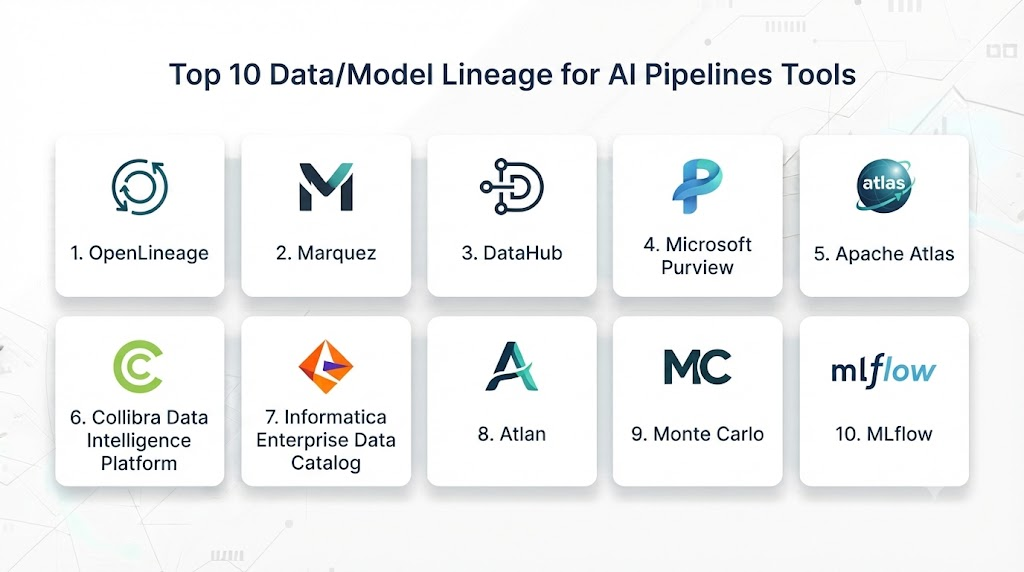
Top 10 Data/Model Lineage for AI Pipelines Tools
1. OpenLineage
OpenLineage provides an open standard for tracking data pipeline lineage.
Key Features
- Pipeline lineage tracking
- Metadata collection
- Event-based tracking
- Integration support
- Workflow visibility
- Data dependency mapping
- Open standard
- Pipeline monitoring
- Audit information
- Ecosystem support
Pros
- Open source
- Flexible
- Vendor neutral
- Strong ecosystem
- Easy integration
Cons
- Requires implementation
- Needs supporting tools
- Limited UI alone
Platforms
Cloud and local environments.
Deployment or Support
Data and ML engineering teams.
Security & Compliance
Implementation dependent.
Integrations & Ecosystem
Data platforms and orchestration tools.
Support & Community
Open-source community.
2. Marquez
Marquez provides metadata management and lineage visualization.
Key Features
- Data lineage graphs
- Metadata storage
- Pipeline tracking
- OpenLineage support
- Workflow monitoring
- Dependency visualization
- Dataset tracking
- API access
- Search capabilities
- Data governance support
Pros
- Open source
- Visual lineage
- Good integration
- Lightweight
- Developer-friendly
Cons
- Requires setup
- Limited enterprise features
- Needs integrations
Platforms
Cloud and local environments.
Deployment or Support
Data engineering teams.
Security & Compliance
Implementation dependent.
Integrations & Ecosystem
Data workflow tools.
Support & Community
Open-source community.
3. MLflow
MLflow provides machine learning lifecycle management.
Key Features
- Experiment tracking
- Model lineage
- Model registry
- Artifact tracking
- Version management
- Deployment tracking
- Metadata storage
- Collaboration
- API support
- MLOps integration
Pros
- Popular open source
- Strong ML support
- Flexible
- Large ecosystem
- Easy adoption
Cons
- Limited data lineage
- Requires extensions
- Infrastructure management needed
Platforms
Cloud and local environments.
Deployment or Support
ML teams.
Security & Compliance
Depends on deployment.
Integrations & Ecosystem
ML frameworks.
Support & Community
Large community.
4. Kubeflow Metadata
Kubeflow Metadata manages ML workflow metadata.
Key Features
- Experiment tracking
- Pipeline metadata
- Artifact tracking
- Model information
- Kubernetes integration
- Workflow visibility
- Reproducibility
- ML lifecycle support
- Metadata storage
- Pipeline tracking
Pros
- Kubernetes native
- ML focused
- Open source
- Scalable
- Good MLOps integration
Cons
- Complex setup
- Requires Kubernetes expertise
- Operational overhead
Platforms
Kubernetes environments.
Deployment or Support
Enterprise MLOps teams.
Security & Compliance
Kubernetes security.
Integrations & Ecosystem
Cloud-native ML tools.
Support & Community
Open-source community.
5. DataHub
DataHub provides metadata management and data lineage capabilities.
Key Features
- Data lineage
- Metadata catalog
- Search
- Governance workflows
- Dataset discovery
- Ownership tracking
- Data quality
- Impact analysis
- Integrations
- Collaboration
Pros
- Strong metadata platform
- Open source
- Good visualization
- Enterprise features
- Large ecosystem
Cons
- Requires setup
- Data-focused
- Operational complexity
Platforms
Cloud and local environments.
Deployment or Support
Enterprise data teams.
Security & Compliance
Enterprise controls.
Integrations & Ecosystem
Data platforms.
Support & Community
Developer community.
6. Amundsen
Amundsen provides data discovery and metadata management.
Key Features
- Data catalog
- Metadata search
- Data discovery
- Ownership information
- Dataset tracking
- Documentation
- Integration support
- Collaboration
- Search tools
- Governance support
Pros
- Open source
- User-friendly
- Good discovery
- Flexible
- Community support
Cons
- Limited ML lineage
- Requires configuration
- Smaller ecosystem
Platforms
Cloud and local environments.
Deployment or Support
Data teams.
Security & Compliance
Implementation dependent.
Integrations & Ecosystem
Data platforms.
Support & Community
Open-source community.
7. Collibra Data Intelligence Platform
Collibra provides enterprise data governance and lineage management.
Key Features
- Data lineage
- Metadata management
- Governance workflows
- Compliance reporting
- Data catalog
- Policy management
- Collaboration
- Data quality
- Enterprise controls
- AI governance support
Pros
- Enterprise governance
- Strong compliance
- Mature platform
- Good workflows
- Large organizations
Cons
- Expensive
- Complex implementation
- Enterprise focused
Platforms
Cloud environments.
Deployment or Support
Enterprise organizations.
Security & Compliance
Enterprise controls.
Integrations & Ecosystem
Data platforms.
Support & Community
Enterprise support.
8. Alation Data Intelligence Platform
Alation provides enterprise data catalog and intelligence capabilities.
Key Features
- Data catalog
- Lineage tracking
- Search
- Governance
- Data stewardship
- Collaboration
- Metadata management
- Compliance support
- Data quality
- Analytics
Pros
- Strong data intelligence
- Enterprise ready
- Good usability
- Collaboration features
- Governance support
Cons
- Premium pricing
- Data focused
- Setup complexity
Platforms
Cloud environments.
Deployment or Support
Enterprise data teams.
Security & Compliance
Enterprise controls.
Integrations & Ecosystem
Data platforms.
Support & Community
Enterprise support.
9. Google Vertex AI Metadata
Vertex AI Metadata tracks AI workflow information.
Key Features
- ML metadata tracking
- Pipeline lineage
- Experiment tracking
- Artifact management
- Model tracking
- Cloud integration
- Monitoring support
- Governance support
- Version management
- AI lifecycle visibility
Pros
- Managed service
- Google AI integration
- Scalable
- Enterprise ready
- Strong ML support
Cons
- Google Cloud dependency
- Pricing complexity
- Limited outside ecosystem
Platforms
Google Cloud.
Deployment or Support
Enterprise AI teams.
Security & Compliance
Google Cloud security.
Integrations & Ecosystem
Google AI services.
Support & Community
Enterprise support.
10. AWS SageMaker Model Registry
AWS SageMaker provides model lifecycle and metadata tracking.
Key Features
- Model versions
- Metadata tracking
- Approval workflows
- Deployment history
- Model lineage
- Monitoring integration
- Security controls
- Governance support
- Cloud integration
- MLOps workflows
Pros
- AWS integration
- Enterprise security
- Scalable
- Managed service
- Production ready
Cons
- AWS dependency
- Cost complexity
- Requires expertise
Platforms
AWS Cloud.
Deployment or Support
Enterprise AI teams.
Security & Compliance
AWS security framework.
Integrations & Ecosystem
AWS services.
Support & Community
Enterprise support.
Comparison Table
| Tool Name | Best For | Platform(s) Supported | Deployment | Standout Feature | Public Rating |
|---|---|---|---|---|---|
| OpenLineage | Pipeline lineage | Cloud/Local | Flexible | Open standard | |
| Marquez | Visualization | Cloud/Local | Flexible | Lineage graphs | |
| MLflow | ML lineage | Cloud/Local | Flexible | Model registry | |
| Kubeflow Metadata | MLOps lineage | Kubernetes | Enterprise | ML metadata | |
| DataHub | Data intelligence | Cloud/Local | Enterprise | Metadata catalog | |
| Amundsen | Data discovery | Cloud/Local | Flexible | Search | |
| Collibra | Enterprise governance | Cloud | Enterprise | Governance | |
| Alation | Data intelligence | Cloud | Enterprise | Data catalog | |
| Vertex AI Metadata | Google AI | GCP | Enterprise | ML tracking | |
| SageMaker Registry | AWS ML | AWS | Enterprise | Model lifecycle |
Weighted Evaluation
| Tool Name | Core Features 25% | Ease of Use 15% | Integrations & Ecosystem 15% | Security & Compliance 10% | Performance & Reliability 10% | Support & Community 10% | Price/Value 15% | Total |
|---|---|---|---|---|---|---|---|---|
| OpenLineage | 24 | 14 | 15 | 10 | 10 | 10 | 15 | 98 |
| Marquez | 23 | 14 | 14 | 10 | 10 | 10 | 15 | 96 |
| MLflow | 24 | 15 | 15 | 10 | 10 | 10 | 15 | 99 |
| Kubeflow Metadata | 24 | 12 | 15 | 10 | 10 | 10 | 15 | 96 |
| DataHub | 24 | 13 | 15 | 10 | 10 | 10 | 14 | 96 |
| Amundsen | 22 | 14 | 14 | 10 | 10 | 10 | 15 | 95 |
| Collibra | 25 | 12 | 14 | 10 | 10 | 10 | 12 | 93 |
| Alation | 24 | 13 | 14 | 10 | 10 | 10 | 12 | 93 |
| Vertex AI Metadata | 24 | 13 | 15 | 10 | 10 | 10 | 12 | 94 |
| SageMaker Registry | 24 | 13 | 15 | 10 | 10 | 10 | 12 | 94 |
Which Data/Model Lineage Tool Is Right for You?
Choose OpenLineage for open lineage standards.
Choose Marquez for lineage visualization.
Choose MLflow for machine learning lifecycle tracking.
Choose Kubeflow Metadata for Kubernetes MLOps.
Choose DataHub for enterprise metadata management.
Choose Amundsen for data discovery.
Choose Collibra for enterprise governance.
Choose Alation for data intelligence.
Choose Vertex AI Metadata for Google Cloud AI.
Choose AWS SageMaker Model Registry for AWS environments.
Implementation Playbook
Phase 1: Identify Data Sources
- Map datasets
- Identify pipelines
- Define ownership
Phase 2: Enable Tracking
- Capture metadata
- Connect workflows
- Track models
Phase 3: Build Lineage Maps
- Visualize dependencies
- Document relationships
- Improve transparency
Phase 4: Integrate Governance
- Add policies
- Enable audits
- Monitor changes
Phase 5: Maintain Lineage
- Update metadata
- Track new models
- Review dependencies
Common Mistakes
- No metadata collection
- Missing model history
- Poor documentation
- Ignoring dependencies
- No governance process
- Manual tracking only
- Lack of ownership
FAQs
1. What is Data and Model Lineage for AI Pipelines?
It is the process of tracking data, models, and workflows throughout the AI lifecycle.
2. Why is lineage important for AI systems?
It improves transparency, debugging, compliance, and reproducibility.
3. What does model lineage track?
It tracks training data, experiments, versions, and deployment history.
4. Who uses lineage tools?
Data scientists, MLOps teams, and AI governance teams use them.
5. Can lineage tools support ML models?
Yes, many are designed specifically for machine learning workflows.
6. Do lineage tools help with compliance?
Yes, they provide audit trails and documentation.
7. Can lineage track LLM applications?
Modern platforms can track prompts, datasets, and AI workflows.
8. Are open-source lineage tools available?
Yes, OpenLineage, Marquez, and MLflow are open-source options.
9. How does lineage improve debugging?
Teams can identify where data or model issues originated.
10. What is the future of AI lineage?
Lineage will become a core requirement for transparent and responsible AI systems.
Conclusion
Data and Model Lineage for AI Pipelines are becoming essential for organizations building reliable and governed AI systems. They provide visibility into data movement, model creation, and production dependenciePlatforms such as MLflow, OpenLineage, DataHub, Kubeflow Metadata, Collibra, and cloud AI governance solutions help organizations create transparent and manageable AI ecosystems.As AI systems become more complex, complete lineage tracking will play a critical role in responsible AI development, MLOps automation, and enterprise AI governance.