Introduction
Human-in-the-Loop (HITL) Review Systems are AI quality management platforms that combine human expertise with artificial intelligence workflows to improve accuracy, reliability, and decision-making.
While AI models can process large amounts of information quickly, they may still produce incorrect predictions, biased outputs, or unexpected results. Human-in-the-Loop systems introduce human review and feedback into AI workflows to validate, correct, and improve AI-generated results.
These systems are widely used for:
- AI model evaluation
- Data quality improvement
- Content moderation
- Machine learning training
- Generative AI review
- RAG response validation
- Autonomous system monitoring
Human-in-the-Loop Review Systems help organizations create safer and more reliable AI applications by allowing humans to review AI decisions before they are deployed or acted upon.
These platforms are used by:
- AI engineers
- Data scientists
- MLOps teams
- Quality assurance teams
- Enterprise AI developers
- Data annotation specialists
Modern HITL platforms provide capabilities such as:
- Human feedback collection
- AI output review
- Annotation workflows
- Quality scoring
- Approval processes
- Model improvement loops
- Collaboration tools
- Audit tracking
- Workflow automation
The goal of Human-in-the-Loop systems is to combine AI efficiency with human judgment.
What Is Human-in-the-Loop (HITL)?
Human-in-the-Loop is an approach where humans participate in AI workflows to review, correct, or guide machine learning systems.
Instead of allowing AI systems to make every decision automatically, HITL introduces human validation.
Example:
AI Model:
Customer email → AI classification → Refund Request
Human Review:
Reviewer checks prediction → Approves or Corrects
The feedback helps improve future AI performance.
Why Human-in-the-Loop Systems Matter
AI models can face challenges such as:
- Incorrect predictions
- Bias
- Lack of context
- Hallucinations
- Unexpected outputs
HITL systems help organizations:
- Improve AI accuracy
- Reduce risks
- Maintain quality standards
- Collect valuable feedback
- Train better models
How Human-in-the-Loop Review Works
Step 1: AI Generates Output
The AI system produces:
- Prediction
- Classification
- Recommendation
- Generated response
Step 2: Human Review
A reviewer evaluates:
- Accuracy
- Relevance
- Quality
- Safety
Step 3: Feedback Collection
The system records:
- Corrections
- Approvals
- Comments
- Ratings
Step 4: Model Improvement
Feedback is used for:
- Retraining
- Fine-tuning
- Prompt improvement
Step 5: Continuous Monitoring
Teams track:
- Model quality
- Errors
- Performance changes
Key Components of HITL Review Systems
Review Interface
Allows humans to:
- Inspect AI outputs
- Provide feedback
- Approve decisions
Workflow Management
Controls:
- Task assignment
- Review stages
- Approval processes
Quality Control System
Measures:
- Reviewer accuracy
- Feedback consistency
Feedback Collection Engine
Captures:
- Corrections
- Preferences
- Ratings
Analytics Dashboard
Tracks:
- Model performance
- Review results
Integration Layer
Connects with:
- AI models
- ML pipelines
- Data platforms
Types of Human-in-the-Loop Systems
AI Model Review Platforms
Used for:
- Model validation
- AI testing
Data Annotation Review Systems
Used for:
- Dataset improvement
- Label verification
Generative AI Review Platforms
Used for:
- LLM output evaluation
- Content approval
Content Moderation Systems
Used for:
- Safety review
- Policy enforcement
RAG Quality Review Systems
Used for:
- Retrieval validation
- Response evaluation
Key Features of HITL Review Platforms
Human Feedback Collection
Supports:
- Ratings
- Corrections
- Comments
AI Output Validation
Reviews:
- Generated text
- Predictions
- Recommendations
Workflow Automation
Provides:
- Task routing
- Review queues
- Approvals
Quality Management
Includes:
- Reviewer scoring
- Error tracking
Model Improvement Support
Helps with:
- Fine-tuning
- Training data creation
Security and Compliance
Provides:
- Access control
- Audit logs
- Data protection
Common Use Cases
Generative AI Applications
Reviewing:
- AI-generated content
- Chatbot responses
- AI assistants
Healthcare AI
Validating:
- Medical predictions
- Clinical recommendations
Financial AI
Reviewing:
- Fraud detection
- Risk decisions
Autonomous Systems
Monitoring:
- Machine decisions
- Sensor outputs
Customer Support AI
Improving:
- Chatbot responses
- Customer interactions
Machine Learning Development
Creating:
- Better training datasets
- Improved models
Benefits of Human-in-the-Loop Systems
Improved AI Accuracy
Human feedback helps correct errors.
Better AI Safety
Review reduces harmful outputs.
Higher Trust
Users gain confidence in AI systems.
Continuous Improvement
Models improve through feedback.
Better Data Quality
Human validation improves datasets.
Evaluation Criteria
Workflow Management
Evaluate:
- Review processes
- Task assignment
AI Integration
Consider:
- Model support
- ML pipeline compatibility
Feedback Capabilities
Evaluate:
- Rating systems
- Correction workflows
Scalability
Consider:
- Number of reviewers
- Data volume
Security
Evaluate:
- Access controls
- Audit features
Analytics
Check:
- Performance reporting
- Quality insights
Key Trends
AI-Assisted Human Review
AI is helping reviewers work faster.
Human Feedback for LLMs
HITL is becoming essential for:
- RLHF
- AI alignment
- Model improvement
Automated Quality Routing
AI automatically sends uncertain cases for human review.
Enterprise AI Governance
Organizations are using HITL for responsible AI adoption.
AI Agent Supervision
Human oversight is becoming important for autonomous agents.
Methodology
The following Human-in-the-Loop Review Systems were evaluated based on:
- Review capabilities
- Workflow management
- AI integration
- Quality control
- Scalability
- Security
- Enterprise readiness
- User experience
- Automation
- Value
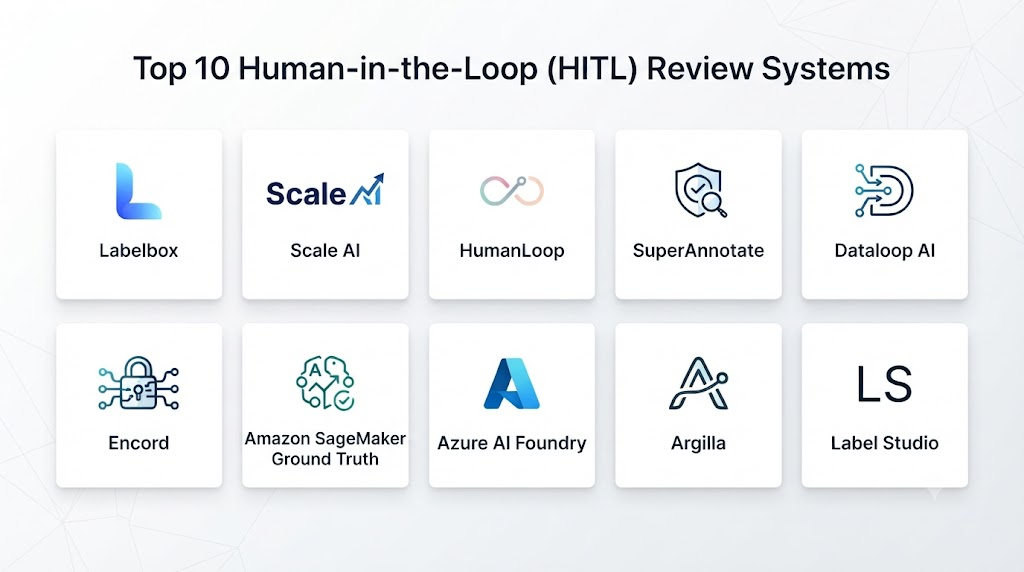
Top 10 Human-in-the-Loop Review Systems
1. Labelbox
Labelbox provides enterprise AI data and human review workflows.
Key Features
- Human review workflows
- Data annotation
- AI-assisted labeling
- Quality management
- Collaboration tools
- Dataset management
- Model evaluation
- Feedback collection
- Enterprise security
- ML integration
Pros
- Enterprise ready
- Strong workflow automation
- Good quality control
Cons
- Premium pricing
- Requires setup
2. Scale AI
Scale AI provides managed human feedback and AI data services.
Key Features
- Human evaluation
- Data annotation
- AI model testing
- Quality assurance
- Data generation
- RLHF support
- Enterprise workflows
- Expert review teams
- Model improvement
Pros
- Large expert workforce
- High-quality reviews
- Enterprise scale
Cons
- Expensive
- Less customization
3. Appen
Appen provides global human data services.
Key Features
- Human evaluation
- Data annotation
- Search relevance review
- AI training data
- Language services
- Quality management
- Global workforce
- Data collection
- AI improvement workflows
Pros
- Global reviewers
- Large-scale operations
- Multiple data types
Cons
- Managed service cost
- Less platform flexibility
4. Humanloop
Humanloop provides human feedback workflows for LLM applications.
Key Features
- LLM evaluation
- Human feedback collection
- Prompt testing
- AI output review
- Model comparison
- Annotation workflows
- Experiment tracking
- Quality analysis
- Collaboration
Pros
- LLM focused
- Strong feedback workflows
- Developer friendly
Cons
- Focused mainly on language models
5. Label Studio
Label Studio is an open-source annotation and review platform.
Key Features
- Text review
- Image annotation
- Audio labeling
- Video annotation
- Custom workflows
- Human feedback
- ML integration
- APIs
- Collaboration
Pros
- Open source
- Flexible
- Supports multiple data types
Cons
- Requires configuration
6. Prodigy
Prodigy provides machine learning annotation workflows.
Key Features
- Human feedback
- Active learning
- NLP review
- Annotation workflows
- Model-assisted labeling
- Dataset creation
- Python integration
Pros
- Efficient workflows
- Developer friendly
- Strong NLP support
Cons
- Technical users required
7. Amazon SageMaker Ground Truth
SageMaker Ground Truth provides managed human review workflows.
Key Features
- Human labeling
- Automated labeling
- Review workflows
- AWS integration
- Quality controls
- Dataset management
- ML pipeline integration
- Security features
Pros
- AWS ecosystem
- Enterprise security
- Scalable
Cons
- AWS dependency
8. SuperAnnotate
SuperAnnotate provides AI data management and review workflows.
Key Features
- Human review
- Annotation management
- Quality control
- AI-assisted labeling
- Collaboration
- Dataset management
- Workflow automation
Pros
- User-friendly
- Good collaboration
- Automation support
Cons
- Premium features require paid plans
9. Dataloop
Dataloop provides AI data operations and human review workflows.
Key Features
- Human feedback
- Data management
- Annotation workflows
- AI automation
- Quality monitoring
- Collaboration
- Model integration
Pros
- Complete AI data platform
- Strong automation
Cons
- Learning curve
10. Argilla
Argilla provides open-source feedback and data curation tools.
Key Features
- Human feedback collection
- NLP datasets
- LLM evaluation
- Annotation workflows
- Data curation
- Collaboration
- Machine learning integration
Pros
- Open source
- LLM focused
- Flexible
Cons
- Smaller ecosystem
Comparison Table: Top 10 Human-in-the-Loop Review Systems
| No. | Tool Name | Best For | Platform(s) Supported | Deployment | Standout Feature | Public Rating |
|---|---|---|---|---|---|---|
| 1 | Labelbox | Enterprise AI review | Cloud | Managed | AI data workflows | 4.8/5 |
| 2 | Scale AI | Managed human feedback | Cloud | Managed | Expert reviewers | 4.7/5 |
| 3 | Appen | Global AI evaluation | Cloud | Managed | Human workforce | 4.6/5 |
| 4 | Humanloop | LLM feedback | Cloud | Managed | LLM evaluation | 4.6/5 |
| 5 | Label Studio | Flexible review workflows | Cloud / Local | Open Source | Multi-data support | 4.6/5 |
| 6 | Prodigy | ML annotation | Local | Paid | Active learning | 4.5/5 |
| 7 | SageMaker Ground Truth | AWS AI workflows | AWS | Managed | AWS integration | 4.5/5 |
| 8 | SuperAnnotate | AI data review | Cloud | Managed | Collaboration | 4.5/5 |
| 9 | Dataloop | AI data operations | Cloud | Managed | Data lifecycle management | 4.4/5 |
| 10 | Argilla | LLM feedback | Cloud / Local | Open Source | Data curation | 4.4/5 |
Weighted Evaluation Table
| No. | Tool Name | Review Features 25% | Ease of Use 15% | AI Integration 15% | Security 10% | Scalability 10% | Community 10% | Value 15% | Total Score |
|---|---|---|---|---|---|---|---|---|---|
| 1 | Labelbox | 25 | 15 | 15 | 10 | 10 | 10 | 14 | 99 |
| 2 | Scale AI | 25 | 14 | 15 | 10 | 10 | 10 | 13 | 97 |
| 3 | Appen | 24 | 14 | 14 | 10 | 10 | 10 | 13 | 95 |
| 4 | Humanloop | 24 | 15 | 15 | 9 | 10 | 10 | 13 | 96 |
| 5 | Label Studio | 24 | 14 | 14 | 9 | 10 | 10 | 14 | 95 |
| 6 | Prodigy | 23 | 15 | 14 | 9 | 9 | 10 | 14 | 94 |
| 7 | SageMaker Ground Truth | 24 | 13 | 14 | 10 | 10 | 10 | 13 | 94 |
| 8 | SuperAnnotate | 24 | 15 | 14 | 9 | 10 | 10 | 14 | 96 |
| 9 | Dataloop | 24 | 14 | 15 | 10 | 10 | 10 | 13 | 96 |
| 10 | Argilla | 23 | 14 | 14 | 9 | 10 | 10 | 14 | 94 |
Which Human-in-the-Loop Review System Is Right for You?
Choose Labelbox for enterprise AI workflows.
Choose Scale AI for managed human evaluation.
Choose Appen for global review teams.
Choose Humanloop for LLM feedback workflows.
Choose Label Studio for flexible open-source annotation.
Choose Prodigy for NLP development.
Choose SageMaker Ground Truth for AWS environments.
Choose SuperAnnotate for collaborative review.
Choose Dataloop for AI data operations.
Choose Argilla for open-source LLM feedback.
Implementation Playbook
Phase 1: Define Review Process
- Identify AI outputs
- Create review guidelines
- Define quality metrics
Phase 2: Setup Workflow
- Assign reviewers
- Create approval stages
- Configure feedback collection
Phase 3: Review AI Results
- Validate outputs
- Correct errors
- Add feedback
Phase 4: Improve AI Models
- Use feedback for training
- Update prompts
- Improve workflows
Phase 5: Monitor Quality
- Track performance
- Measure improvements
- Maintain standards
Common Mistakes
- No clear review guidelines
- Poor reviewer training
- Ignoring feedback quality
- Lack of monitoring
- No integration with ML pipelines
- Poor data security
FAQs
1. What are Human-in-the-Loop Review Systems?
They are platforms that combine human feedback with AI workflows to improve accuracy.
2. Why is HITL important for AI?
It helps reduce errors and improves AI reliability.
3. Are HITL systems used for LLMs?
Yes, they support LLM evaluation, RLHF, and AI alignment.
4. What industries use HITL systems?
Healthcare, finance, technology, automotive, and customer support industries use them.
5. Can HITL improve AI models?
Yes, human feedback helps train and improve models.
6. What is RLHF?
RLHF uses human feedback to improve AI model behavior.
7. Are open-source HITL tools available?
Yes, Label Studio and Argilla provide open-source options.
8. Can HITL systems review AI-generated content?
Yes, they can evaluate text, images, and other AI outputs.
9. How does HITL improve AI safety?
Human review helps detect harmful or incorrect outputs.
10. What is the future of HITL systems?
Human oversight will remain important as AI systems become more autonomous.
Conclusion
Human-in-the-Loop Review Systems are becoming essential for building safe, accurate, and trustworthy AI applications. They combine machine efficiency with human judgment to improve model quality and reduce AI risks.Platforms such as Labelbox, Scale AI, Humanloop, Label Studio, SuperAnnotate, and Dataloop help organizations create effective AI feedback and review workflows.Generative AI, AI agents, and enterprise automation continue growing, human feedback will remain a critical part of responsible AI development.