Introduction
Active Learning Data Selection Tools are AI data optimization platforms that help machine learning teams identify the most valuable data samples for labeling and model improvement.
Traditional machine learning workflows often require large amounts of labeled data. However, manually labeling every available data point can be expensive, slow, and inefficient.
Active learning solves this challenge by allowing AI models to select the most informative examples that require human annotation.
These tools help organizations:
- Reduce data labeling costs
- Improve model performance faster
- Select high-value training examples
- Remove unnecessary annotation work
- Build better datasets efficiently
Active Learning Data Selection Tools are widely used in:
- Computer vision
- Natural language processing
- Generative AI
- Autonomous systems
- Healthcare AI
- Enterprise machine learning
These platforms are used by:
- Data scientists
- ML engineers
- AI researchers
- MLOps teams
- Data annotation specialists
Modern active learning platforms provide capabilities such as:
- Uncertainty sampling
- Data ranking
- Model feedback loops
- Annotation prioritization
- Dataset optimization
- Human-in-the-loop workflows
- Automated sample selection
- Model improvement tracking
The goal of Active Learning Data Selection Tools is to maximize AI model performance while reducing unnecessary labeling efforts.
What Is Active Learning?
Active Learning is a machine learning approach where an AI model identifies which data samples would provide the most learning value.
Instead of labeling all available data, the model selects the most useful examples.
Example:
Traditional approach:
100,000 images → Label all images → Train model
Active learning approach:
100,000 images → AI selects important images → Label selected data → Improve model
This reduces:
- Annotation cost
- Time requirements
- Manual effort
Why Active Learning Matters for AI
High-quality labeled data is one of the biggest challenges in AI development.
Organizations often face:
- Expensive annotation processes
- Large amounts of unused data
- Difficult edge cases
- Slow model improvement
Active learning helps organizations:
- Focus on valuable samples
- Improve training efficiency
- Reduce labeling workload
- Create better datasets
How Active Learning Data Selection Works
Step 1: Initial Model Training
A model is trained using a small labeled dataset.
Step 2: Model Analysis
The AI system identifies:
- Uncertain predictions
- Difficult examples
- Missing patterns
Step 3: Data Selection
The system selects samples that provide maximum learning value.
Step 4: Human Annotation
Selected samples are labeled by humans.
Step 5: Model Improvement
The updated dataset improves model performance.
Step 6: Continuous Loop
The process repeats until the model reaches desired accuracy.
Active Learning Strategies
Uncertainty Sampling
Selects examples where the model is unsure.
Example:
AI confidence:
Dog: 51%
Cat: 49%
This image is valuable for labeling.
Diversity Sampling
Selects different examples to increase dataset variety.
Query by Committee
Multiple models evaluate data and select disagreements.
Density-Based Selection
Chooses samples representing important data patterns.
Error-Based Selection
Focuses on examples where the model performs poorly.
Key Components of Active Learning Platforms
Data Selection Engine
Identifies:
- Important samples
- Difficult examples
- Data gaps
Model Integration
Connects with:
- Machine learning models
- Training pipelines
Annotation Workflow
Supports:
- Human labeling
- Review processes
Dataset Management
Handles:
- Versioning
- Organization
- Quality tracking
Analytics Dashboard
Provides:
- Model improvement insights
- Data performance metrics
Automation Layer
Manages:
- Selection cycles
- Feedback loops
Types of Active Learning Tools
Annotation Platforms With Active Learning
Examples:
- Labelbox
- SuperAnnotate
Open-Source Active Learning Frameworks
Examples:
- ModAL
- ALiPy
ML Data Management Platforms
Examples:
- Scale AI
- Dataloop
Experiment-Based Platforms
Examples:
- Weights & Biases
Key Features of Active Learning Data Selection Tools
Intelligent Data Sampling
Selects the most valuable training examples.
Uncertainty Detection
Identifies:
- Model confusion
- Prediction errors
Automated Labeling Prioritization
Helps teams focus on important data.
Human Feedback Integration
Combines:
- AI selection
- Human annotation
Dataset Optimization
Improves:
- Training efficiency
- Data quality
ML Pipeline Integration
Connects with:
- Training systems
- Data platforms
Common Use Cases
Computer Vision
Selecting:
- Difficult images
- Object detection samples
- Medical images
Autonomous Vehicles
Improving:
- Edge-case detection
- Road scenario understanding
Healthcare AI
Selecting:
- Important medical scans
- Rare conditions
NLP Systems
Improving:
- Text classification
- Entity recognition
Generative AI
Creating:
- Better instruction datasets
- Preference data
Fraud Detection
Finding:
- Unusual transactions
- Risk patterns
Benefits of Active Learning Tools
Lower Annotation Costs
Only valuable samples are labeled.
Faster Model Improvement
Models learn from important examples.
Better Dataset Quality
Training data becomes more meaningful.
Reduced Manual Work
Automation improves efficiency.
Better AI Performance
Models handle difficult cases better.
Evaluation Criteria
Data Selection Quality
Evaluate:
- Sample importance
- Selection accuracy
Integration Support
Consider:
- ML frameworks
- Annotation platforms
Automation Features
Evaluate:
- Automated selection
- Feedback loops
Scalability
Consider:
- Large datasets
- Enterprise workloads
Annotation Support
Check:
- Human review workflows
- Labeling integration
Developer Experience
Evaluate:
- APIs
- Documentation
- SDK support
Key Trends
AI-Assisted Dataset Creation
AI is reducing manual labeling requirements.
Active Learning for Generative AI
Organizations are using active learning for:
- LLM training
- Preference optimization
- Instruction datasets
Automated Data Quality Management
AI systems identify poor-quality samples automatically.
Human-AI Collaboration
Future workflows will combine:
- AI selection
- Human expertise
Continuous Model Improvement
Active learning is becoming part of MLOps pipelines.
Methodology
The following Active Learning Data Selection Tools were evaluated based on:
- Data selection capabilities
- Automation
- ML integration
- Annotation workflows
- Scalability
- Developer experience
- Dataset management
- Enterprise readiness
- Performance
- Value
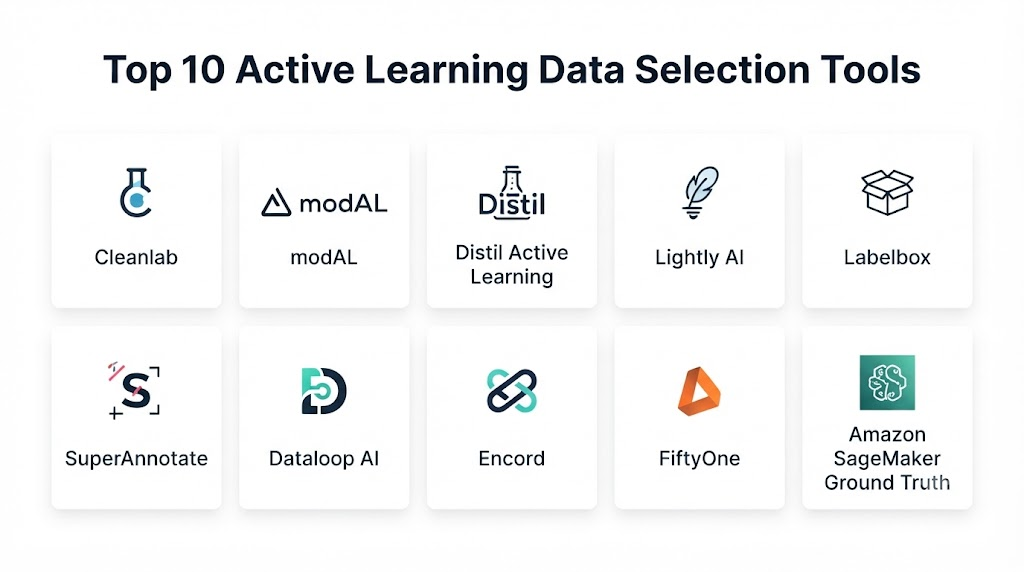
Top 10 Active Learning Data Selection Tools
1. Labelbox Active Learning
Labelbox provides AI data workflows with active learning capabilities.
Key Features
- Data selection
- Model-assisted labeling
- Annotation workflows
- Dataset management
- Quality control
- AI feedback loops
- Model evaluation
- Collaboration
- Data analytics
- Enterprise security
Pros
- Enterprise ready
- Strong annotation workflow
- AI-assisted labeling
Cons
- Premium pricing
- Requires configuration
2. Scale AI Data Engine
Scale AI provides data management and active learning workflows.
Key Features
- Data selection
- Human annotation
- Model improvement
- Dataset creation
- Quality control
- AI evaluation
- Enterprise workflows
- Data management
Pros
- Large-scale operations
- High-quality data
- Managed services
Cons
- Expensive
- Less customization
3. SuperAnnotate
SuperAnnotate provides annotation and active learning workflows.
Key Features
- AI-assisted annotation
- Data selection
- Dataset management
- Quality review
- Collaboration
- Model integration
- Automation
Pros
- User-friendly
- Strong workflow management
Cons
- Advanced features require paid plans
4. Dataloop
Dataloop provides AI data operations and active learning capabilities.
Key Features
- Dataset management
- Automated selection
- Annotation workflows
- AI pipelines
- Quality monitoring
- Model integration
Pros
- Complete data platform
- Strong automation
Cons
- Learning curve
5. ModAL
ModAL is an open-source active learning framework for Python.
Key Features
- Active learning algorithms
- Query strategies
- Model integration
- Sampling methods
- Python support
- Research workflows
Pros
- Open source
- Flexible
- Developer friendly
Cons
- Requires coding knowledge
6. ALiPy
ALiPy is an open-source active learning library.
Key Features
- Query strategies
- Evaluation tools
- Dataset management
- Active learning experiments
- Research support
- Python integration
Pros
- Free
- Research focused
- Flexible
Cons
- Limited enterprise features
7. Prodigy
Prodigy provides machine learning annotation workflows.
Key Features
- Active learning
- Human feedback
- NLP annotation
- Model-assisted labeling
- Dataset creation
- Workflow customization
Pros
- Efficient labeling
- Strong NLP support
Cons
- Technical setup required
8. Snorkel Flow
Snorkel Flow provides AI data development workflows.
Key Features
- Data labeling automation
- Weak supervision
- Dataset creation
- Model improvement
- Data quality management
- Enterprise workflows
Pros
- Reduces manual labeling
- Enterprise ready
- Powerful automation
Cons
- Complex implementation
9. Humanloop
Humanloop provides feedback and evaluation workflows for AI systems.
Key Features
- Human feedback
- Data selection
- LLM evaluation
- Annotation workflows
- Experiment tracking
- Model improvement
Pros
- LLM focused
- Good feedback workflows
Cons
- Mainly focused on language models
10. Weights & Biases Weave
Weights & Biases provides AI experiment tracking and evaluation.
Key Features
- Experiment tracking
- Dataset analysis
- Model comparison
- AI evaluation
- Workflow monitoring
- Collaboration
Pros
- Strong analytics
- Good ML ecosystem
Cons
- Commercial platform
Comparison Table: Top 10 Active Learning Data Selection Tools
| No. | Tool Name | Best For | Platform(s) Supported | Deployment | Standout Feature | Public Rating |
|---|---|---|---|---|---|---|
| 1 | Labelbox Active Learning | Enterprise datasets | Cloud | Managed | AI-assisted selection | 4.8/5 |
| 2 | Scale AI Data Engine | Large-scale AI data | Cloud | Managed | Data operations | 4.7/5 |
| 3 | SuperAnnotate | Annotation workflows | Cloud | Managed | AI-assisted labeling | 4.7/5 |
| 4 | Dataloop | AI data management | Cloud | Managed | Data lifecycle tools | 4.6/5 |
| 5 | ModAL | Research projects | Local | Open Source | Active learning algorithms | 4.5/5 |
| 6 | ALiPy | Academic research | Local | Open Source | Query strategies | 4.5/5 |
| 7 | Prodigy | NLP workflows | Local | Paid | Human feedback loops | 4.5/5 |
| 8 | Snorkel Flow | Automated labeling | Cloud | Enterprise | Weak supervision | 4.6/5 |
| 9 | Humanloop | LLM improvement | Cloud | Managed | Human feedback | 4.6/5 |
| 10 | W&B Weave | ML experiments | Cloud | Managed | Analytics | 4.5/5 |
Weighted Evaluation Table
| No. | Tool Name | Data Selection 25% | Ease of Use 15% | ML Integration 15% | Security 10% | Scalability 10% | Community 10% | Value 15% | Total Score |
|---|---|---|---|---|---|---|---|---|---|
| 1 | Labelbox | 25 | 15 | 15 | 10 | 10 | 10 | 14 | 99 |
| 2 | Scale AI | 25 | 14 | 15 | 10 | 10 | 10 | 13 | 97 |
| 3 | SuperAnnotate | 24 | 15 | 15 | 9 | 10 | 10 | 14 | 97 |
| 4 | Dataloop | 24 | 14 | 15 | 10 | 10 | 10 | 13 | 96 |
| 5 | ModAL | 23 | 14 | 15 | 9 | 9 | 10 | 15 | 95 |
| 6 | ALiPy | 23 | 13 | 14 | 9 | 9 | 10 | 15 | 93 |
| 7 | Prodigy | 23 | 15 | 14 | 9 | 9 | 10 | 14 | 94 |
| 8 | Snorkel Flow | 24 | 13 | 15 | 10 | 10 | 10 | 13 | 95 |
| 9 | Humanloop | 24 | 15 | 15 | 9 | 10 | 10 | 13 | 96 |
| 10 | W&B Weave | 23 | 15 | 14 | 10 | 10 | 10 | 13 | 95 |
Which Active Learning Tool Is Right for You?
Choose Labelbox for enterprise AI data workflows.
Choose Scale AI for large-scale managed operations.
Choose SuperAnnotate for annotation-focused projects.
Choose Dataloop for complete AI data management.
Choose ModAL for research and development.
Choose ALiPy for academic experiments.
Choose Prodigy for NLP workflows.
Choose Snorkel Flow for automated labeling.
Choose Humanloop for LLM feedback workflows.
Choose W&B Weave for ML experiment tracking.
Implementation Playbook
Phase 1: Prepare Dataset
- Collect raw data
- Define labeling goals
- Create initial dataset
Phase 2: Train Initial Model
- Label small dataset
- Build baseline model
Phase 3: Select Valuable Data
- Identify uncertain samples
- Rank important examples
Phase 4: Human Annotation
- Label selected samples
- Review quality
Phase 5: Retrain and Improve
- Update model
- Repeat selection cycle
Common Mistakes
- Selecting irrelevant samples
- Poor labeling guidelines
- Ignoring data diversity
- No quality review
- Weak model feedback loops
- Lack of monitoring
FAQs
1. What are Active Learning Data Selection Tools?
They are platforms that identify the most valuable data samples for AI training.
2. Why is active learning useful?
It reduces labeling costs and improves model efficiency.
3. How does active learning select data?
It selects samples based on uncertainty, diversity, or model errors.
4. Can active learning reduce annotation costs?
Yes, teams label fewer but more valuable examples.
5. Are active learning tools used for LLMs?
Yes, they support instruction tuning and preference data creation.
6. What industries use active learning?
Healthcare, automotive, finance, and technology companies use it.
7. Is human review required in active learning?
Most workflows combine AI selection with human annotation.
8. Are open-source active learning tools available?
Yes, ModAL and ALiPy provide open-source options.
9. How does active learning improve AI models?
It focuses training on challenging and informative examples.
10. What is the future of active learning?
AI-driven data selection will become an important part of automated ML pipelines.
Conclusion
Active Learning Data Selection Tools help organizations build better AI models by focusing on the most valuable training examples. Instead of labeling massive datasets manually, these platforms optimize the data preparation process through intelligent sample selection and human feedback.Tools such as Labelbox, Scale AI, SuperAnnotate, Dataloop, ModAL, Snorkel Flow, and Humanloop provide powerful capabilities for improving AI training efficiency.As AI development continues expanding, active learning will become a key technology for reducing data costs, improving model accuracy, and accelerating machine learning innovation.