Introduction
LLMOps Lifecycle Management Platforms are specialized AI platforms designed to manage the complete lifecycle of Large Language Models (LLMs), including development, testing, deployment, monitoring, optimization, and governance.
As organizations increasingly adopt generative AI applications, managing LLM systems has become more complex. Businesses need reliable ways to track prompts, evaluate model responses, manage versions, monitor performance, control costs, and maintain security.
Unlike traditional MLOps platforms that focus mainly on machine learning models, LLMOps platforms are built specifically for:
- Large language model applications
- Generative AI workflows
- AI agents
- Retrieval-Augmented Generation (RAG) systems
- Prompt engineering
- Model evaluation
- AI application monitoring
LLMOps Lifecycle Management Platforms help organizations:
- Manage LLM applications
- Track prompts and experiments
- Evaluate model quality
- Monitor AI performance
- Reduce hallucination risks
- Optimize inference costs
- Maintain AI governance
These platforms are used by:
- AI engineers
- Machine learning teams
- Data scientists
- Software developers
- Enterprise AI teams
- Product teams
Modern LLMOps platforms provide capabilities such as:
- Prompt management
- LLM evaluation
- Model monitoring
- Trace tracking
- Version control
- RAG management
- Deployment workflows
- Security controls
- Cost monitoring
- Collaboration features
The goal of LLMOps Lifecycle Management Platforms is to help organizations build reliable, scalable, and production-ready generative AI applications.
What Are LLMOps Lifecycle Management Platforms?
LLMOps Lifecycle Management Platforms are tools that manage the complete operational lifecycle of large language model applications.
The lifecycle includes:
- Model selection
- Prompt development
- Data preparation
- Application building
- Testing and evaluation
- Deployment
- Monitoring
- Optimization
- Governance
Example:
A company builds an AI customer support assistant.
LLMOps platform helps:
- Select an LLM
- Manage prompts
- Test responses
- Monitor accuracy
- Track user feedback
- Improve performance
Why Organizations Need LLMOps Platforms
Large language model applications introduce new challenges:
- Unpredictable responses
- Prompt changes
- Model updates
- High inference costs
- Data privacy concerns
- Hallucination management
Without LLMOps, organizations face:
- Poor AI reliability
- Difficult debugging
- Security risks
- Increasing operational costs
LLMOps platforms help businesses:
- Improve AI quality
- Deploy faster
- Monitor applications
- Control expenses
- Scale generative AI safely
How LLMOps Lifecycle Management Platforms Work
Model Management
Organizations manage:
- Foundation models
- Custom models
- Fine-tuned models
Prompt Management
Teams track:
- Prompt versions
- Instructions
- Templates
- Performance results
Data and Knowledge Management
Platforms manage:
- Training data
- RAG sources
- Knowledge bases
Evaluation
AI applications are tested for:
- Accuracy
- Relevance
- Safety
- Quality
Deployment
LLM applications are deployed through:
- APIs
- Cloud services
- Enterprise systems
Monitoring
Platforms track:
- Latency
- Cost
- Errors
- User feedback
Optimization
Teams improve:
- Prompts
- Models
- Workflows
Key Components of LLMOps Platforms
Prompt Management System
Provides:
- Prompt versioning
- Testing
- Collaboration
- Optimization
LLM Evaluation Framework
Measures:
- Response quality
- Accuracy
- Safety
- Relevance
Model Registry
Manages:
- Model versions
- Deployments
- Metadata
AI Observability
Tracks:
- Model behavior
- User interactions
- Performance
RAG Management
Handles:
- Document sources
- Retrieval pipelines
- Knowledge updates
Security and Governance
Controls:
- Access
- Data privacy
- Compliance
Types of LLMOps Lifecycle Management Platforms
Developer-Focused Platforms
Designed for:
- AI engineers
- Developers
- Researchers
Examples:
- LangSmith
- Weights & Biases
Enterprise AI Platforms
Designed for:
- Large organizations
- Governance
- Security
Examples:
- Databricks
- Azure AI Studio
Model Management Platforms
Focus on:
- Deployment
- Monitoring
- Evaluation
AI Application Platforms
Support:
- RAG
- Agents
- Generative AI applications
Key Features of LLMOps Lifecycle Management Platforms
Prompt Version Control
Tracks:
- Prompt changes
- Experiments
- Performance
Benefits:
- Better collaboration
- Easier debugging
LLM Evaluation
Measures:
- Accuracy
- Reliability
- Safety
AI Application Monitoring
Tracks:
- Response quality
- Latency
- Failures
Model Deployment Management
Supports:
- APIs
- Cloud deployment
- Enterprise applications
Cost Monitoring
Helps manage:
- Token usage
- Infrastructure costs
- Model selection
Security Controls
Protects:
- Data
- Models
- Applications
Common Use Cases
AI Chatbots
LLMOps helps manage:
- Customer assistants
- Enterprise chatbots
RAG Applications
Supports:
- Document-based AI
- Knowledge assistants
AI Agents
Manages:
- Agent workflows
- Tool usage
- Agent performance
Content Generation
Optimizes:
- Marketing AI
- Writing assistants
Enterprise Search
Improves:
- Knowledge discovery
- Internal search
Software Development Assistants
Supports:
- Coding assistants
- Developer tools
Why LLMOps Platforms Matter
Reliable AI Applications
Organizations can monitor and improve AI systems.
Better Model Performance
Teams optimize responses continuously.
Faster Development
Developers build AI applications efficiently.
Reduced AI Risks
Organizations manage security and compliance.
Enterprise AI Scaling
Companies can operate many AI applications.
Evaluation Criteria for Buyers
LLM Management Features
Evaluate:
- Model tracking
- Prompt management
- Version control
Evaluation Capabilities
Consider:
- Automated testing
- Quality measurement
- Safety checks
Integration Support
Look for:
- Cloud platforms
- AI frameworks
- Data systems
Monitoring
Evaluate:
- Tracing
- Analytics
- Performance tracking
Security
Consider:
- Data protection
- Access control
- Compliance
Scalability
Evaluate:
- Application volume
- User traffic
- Enterprise workloads
Key Trends
LLM Observability Growth
Organizations are investing in better AI monitoring.
AI Governance Expansion
Companies are focusing on responsible AI usage.
Agentic AI Operations
LLMOps platforms are expanding to support AI agents.
Automated Evaluation
AI testing is becoming more automated.
Enterprise RAG Management
Companies are improving knowledge-based AI systems.
Cost Optimization
Businesses are focusing on efficient LLM usage.
Methodology
The following LLMOps Lifecycle Management Platforms were evaluated based on:
- LLM lifecycle capabilities
- Prompt management
- Evaluation features
- Monitoring
- Deployment support
- Security
- Integration ecosystem
- Scalability
- Enterprise readiness
- Value
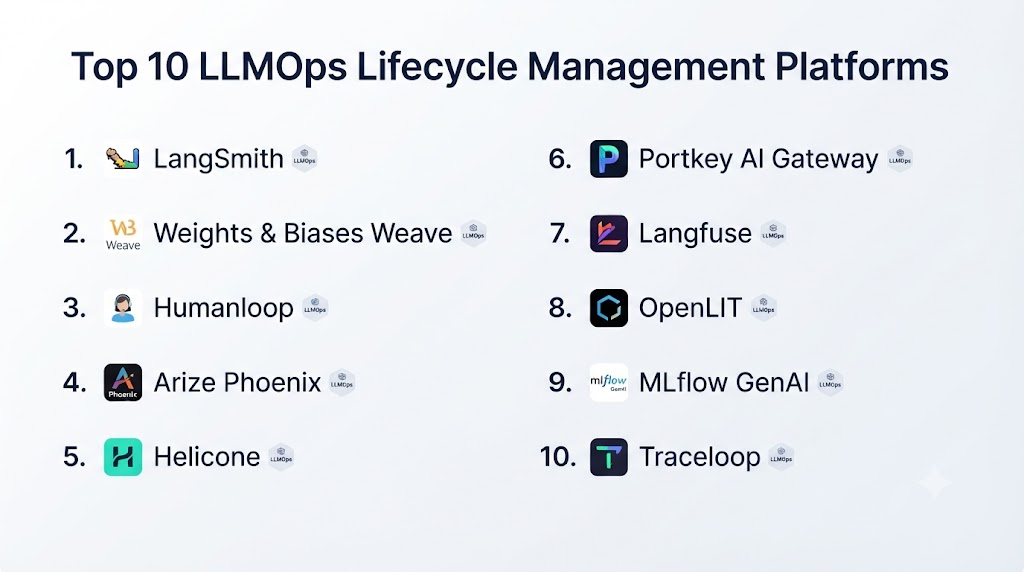
Top 10 LLMOps Lifecycle Management Platforms
1. LangSmith
LangSmith provides observability, evaluation, and lifecycle management for LLM applications.
Key Features
- LLM tracing
- Prompt management
- Evaluation workflows
- Dataset testing
- Application monitoring
- Debugging tools
- Experiment tracking
- Agent monitoring
- Collaboration
- Developer APIs
Pros
- Strong LLM observability
- Developer-friendly
- Good debugging
- Agent support
- Easy integration
Cons
- Best suited for LangChain ecosystem
- Requires technical knowledge
- Enterprise features may require upgrades
Platforms
Cloud environments.
Deployment or Support
LLM application development.
Security & Compliance
Platform security controls.
Integrations & Ecosystem
AI frameworks and LLM providers.
Support & Community
Developer community.
2. Weights & Biases Weave
Weights & Biases Weave provides tracking and evaluation capabilities for AI applications.
Key Features
- LLM tracing
- Experiment tracking
- Evaluation
- Dataset management
- Model monitoring
- Visualization
- Collaboration
- Performance analysis
- AI workflows
- Developer tools
Pros
- Strong experiment tracking
- Good visualization
- Developer-friendly
- ML ecosystem support
- Collaboration features
Cons
- Requires technical expertise
- Enterprise features cost more
- Setup required
Platforms
Cloud environments.
Deployment or Support
AI development teams.
Security & Compliance
Enterprise controls.
Integrations & Ecosystem
Machine learning frameworks.
Support & Community
Developer community.
3. Databricks Mosaic AI
Databricks Mosaic AI provides enterprise generative AI lifecycle management.
Key Features
- Model management
- LLM evaluation
- RAG workflows
- AI governance
- Model serving
- Data integration
- Monitoring
- AI applications
- Security controls
- Enterprise deployment
Pros
- Strong enterprise platform
- Data integration
- Governance features
- Scalable
- Production-ready
Cons
- Complex platform
- Expensive
- Requires expertise
Platforms
Cloud environments.
Deployment or Support
Enterprise AI applications.
Security & Compliance
Enterprise security.
Integrations & Ecosystem
Databricks ecosystem.
Support & Community
Enterprise support.
4. Azure AI Studio
Azure AI Studio provides tools for building and managing generative AI applications.
Key Features
- Prompt management
- Model catalog
- Evaluation
- AI workflows
- Deployment
- Monitoring
- Responsible AI tools
- Security
- Enterprise integration
- Collaboration
Pros
- Strong enterprise support
- Microsoft ecosystem
- Security features
- Scalable
- Good governance
Cons
- Azure dependency
- Complex pricing
- Learning curve
Platforms
Microsoft Azure.
Deployment or Support
Enterprise AI development.
Security & Compliance
Microsoft security framework.
Integrations & Ecosystem
Azure AI services.
Support & Community
Enterprise support.
5. Google Vertex AI
Google Vertex AI supports generative AI application lifecycle management.
Key Features
- Model management
- Prompt design
- Evaluation
- Deployment
- Monitoring
- RAG support
- AI governance
- Data integration
- Model tuning
- Enterprise scaling
Pros
- Strong AI infrastructure
- Google ecosystem
- Enterprise capabilities
- Generative AI support
- Scalable
Cons
- Google Cloud dependency
- Requires expertise
- Pricing complexity
Platforms
Google Cloud.
Deployment or Support
Enterprise AI applications.
Security & Compliance
Google Cloud security.
Integrations & Ecosystem
Google AI services.
Support & Community
Enterprise support.
6. Amazon SageMaker AI
Amazon SageMaker provides AI lifecycle management including LLM workflows.
Key Features
- Model management
- Deployment
- Monitoring
- Evaluation
- Data management
- AI workflows
- Cloud infrastructure
- Security
- Automation
- Enterprise integration
Pros
- AWS ecosystem
- Scalable infrastructure
- Enterprise-ready
- Strong deployment
- Flexible
Cons
- AWS complexity
- Cost management needed
- Learning curve
Platforms
AWS Cloud.
Deployment or Support
Enterprise AI systems.
Security & Compliance
AWS security framework.
Integrations & Ecosystem
AWS services.
Support & Community
Enterprise support.
7. MLflow
MLflow provides open-source lifecycle management for machine learning and LLM applications.
Key Features
- Experiment tracking
- Model registry
- Prompt management
- Evaluation
- Deployment
- Version control
- AI workflows
- Collaboration
- Open-source support
- Framework integration
Pros
- Open source
- Flexible
- Large community
- Framework independent
- Cost-effective
Cons
- Requires setup
- Infrastructure management needed
- Enterprise features require configuration
Platforms
Cloud and local environments.
Deployment or Support
AI development teams.
Security & Compliance
Depends on deployment.
Integrations & Ecosystem
ML and AI frameworks.
Support & Community
Large community.
8. Arize AI
Arize AI provides AI observability and evaluation solutions.
Key Features
- LLM monitoring
- AI evaluation
- Tracing
- Model performance analysis
- Drift detection
- Quality monitoring
- Analytics
- Debugging
- Collaboration
- Enterprise controls
Pros
- Strong observability
- AI quality monitoring
- Good analytics
- Enterprise-ready
- Evaluation capabilities
Cons
- Focused on monitoring
- Requires setup
- Enterprise pricing
Platforms
Cloud environments.
Deployment or Support
Enterprise AI monitoring.
Security & Compliance
Enterprise controls.
Integrations & Ecosystem
AI applications.
Support & Community
Enterprise support.
9. Humanloop
Humanloop focuses on prompt management and LLM evaluation workflows.
Key Features
- Prompt management
- Evaluation
- Testing
- Collaboration
- Feedback collection
- Dataset management
- Model comparison
- AI workflows
- Version control
- Developer tools
Pros
- Strong prompt workflows
- Good evaluation tools
- User-friendly
- Collaboration support
- AI-focused
Cons
- Smaller ecosystem
- Requires integration
- Enterprise pricing
Platforms
Cloud environments.
Deployment or Support
AI application teams.
Security & Compliance
Enterprise controls.
Integrations & Ecosystem
LLM providers.
Support & Community
Developer community.
10. Helicone
Helicone provides LLM observability and analytics.
Key Features
- Request tracking
- LLM analytics
- Cost monitoring
- Performance tracking
- Logging
- Model comparison
- Debugging
- API monitoring
- Developer tools
- Reporting
Pros
- Easy setup
- Strong analytics
- Cost tracking
- Developer-friendly
- Lightweight
Cons
- Limited full lifecycle features
- Monitoring-focused
- Requires integrations
Platforms
Cloud environments.
Deployment or Support
LLM application monitoring.
Security & Compliance
Platform controls.
Integrations & Ecosystem
LLM APIs.
Support & Community
Developer community.
Comparison Table
| Tool Name | Best For | Platform(s) Supported | Deployment | Standout Feature | Public Rating |
|---|---|---|---|---|---|
| LangSmith | LLM tracing | Cloud | Flexible | Agent observability | |
| W&B Weave | AI experiments | Cloud | Flexible | Evaluation tracking | |
| Mosaic AI | Enterprise AI | Cloud | Enterprise | Governance | |
| Azure AI Studio | Enterprise GenAI | Azure | Enterprise | Responsible AI | |
| Vertex AI | Google AI | GCP | Enterprise | AI infrastructure | |
| SageMaker AI | AWS AI | AWS | Enterprise | Cloud ML | |
| MLflow | Open-source LLMOps | Cloud/Local | Flexible | Lifecycle tracking | |
| Arize AI | Monitoring | Cloud | Enterprise | AI observability | |
| Humanloop | Prompt management | Cloud | Business | Prompt evaluation | |
| Helicone | LLM analytics | Cloud | Flexible | Cost tracking |
Weighted Evaluation
| Tool Name | Core Features 25% | Ease of Use 15% | Integrations & Ecosystem 15% | Security & Compliance 10% | Performance & Reliability 10% | Support & Community 10% | Price/Value 15% | Total |
|---|---|---|---|---|---|---|---|---|
| LangSmith | 25 | 15 | 14 | 10 | 10 | 10 | 14 | 98 |
| W&B Weave | 24 | 14 | 15 | 10 | 10 | 10 | 14 | 97 |
| Mosaic AI | 25 | 12 | 15 | 10 | 10 | 10 | 12 | 94 |
| Azure AI Studio | 24 | 13 | 15 | 10 | 10 | 10 | 13 | 95 |
| Vertex AI | 25 | 13 | 15 | 10 | 10 | 10 | 12 | 95 |
| SageMaker AI | 25 | 12 | 15 | 10 | 10 | 10 | 12 | 94 |
| MLflow | 24 | 14 | 15 | 10 | 10 | 10 | 15 | 98 |
| Arize AI | 24 | 13 | 14 | 10 | 10 | 10 | 12 | 93 |
| Humanloop | 23 | 15 | 13 | 10 | 10 | 10 | 14 | 95 |
| Helicone | 22 | 15 | 13 | 10 | 10 | 10 | 15 | 95 |
Which LLMOps Lifecycle Management Platform Is Right for You?
Choose LangSmith for LLM application tracing and debugging.
Choose Weights & Biases Weave for AI experiment management.
Choose Databricks Mosaic AI for enterprise AI operations.
Choose Azure AI Studio for Microsoft environments.
Choose Google Vertex AI for Google Cloud AI.
Choose Amazon SageMaker AI for AWS-based systems.
Choose MLflow for open-source LLMOps workflows.
Choose Arize AI for AI observability.
Choose Humanloop for prompt management.
Choose Helicone for LLM analytics.
Implementation Playbook
Phase 1: Define LLM Application Goals
- Identify AI use cases
- Select models
- Define success metrics
Phase 2: Build Development Workflow
- Manage prompts
- Prepare datasets
- Create evaluation methods
Phase 3: Deploy AI Applications
- Configure infrastructure
- Connect models
- Enable monitoring
Phase 4: Monitor Performance
- Track quality
- Measure costs
- Analyze user feedback
Phase 5: Improve Continuously
- Optimize prompts
- Update models
- Improve AI reliability
Common Mistakes
- Deploying LLM apps without evaluation
- Ignoring prompt versioning
- Not monitoring costs
- Poor security practices
- Lack of user feedback
- No governance strategy
- Ignoring model changes
FAQs
1. What are LLMOps Lifecycle Management Platforms?
They are platforms that manage the complete lifecycle of large language model applications.
2. Why is LLMOps important?
LLMOps helps organizations build reliable, scalable, and secure generative AI systems.
3. How is LLMOps different from MLOps?
LLMOps focuses specifically on LLM applications, prompts, evaluations, and generative AI workflows.
4. Who uses LLMOps platforms?
AI engineers, developers, data scientists, and enterprise teams use them.
5. Can LLMOps platforms manage prompts?
Yes, prompt versioning and testing are core capabilities.
6. Can LLMOps monitor AI responses?
Yes, many platforms provide tracing and quality monitoring.
7. Do LLMOps platforms support RAG applications?
Yes, many support retrieval workflows and knowledge management.
8. Are LLMOps platforms useful for AI agents?
Yes, they help monitor and manage agent-based applications.
9. How do LLMOps platforms reduce AI costs?
They track usage, optimize models, and improve efficiency.
10. What is the future of LLMOps?
LLMOps will become essential for managing enterprise generative AI and autonomous AI systems.
Conclusion
LLMOps Lifecycle Management Platforms are becoming essential for organizations building production-grade generative AI applications. They provide tools for prompt management, model evaluation, monitoring, deployment, and governance.Platforms such as LangSmith, MLflow, Databricks Mosaic AI, Azure AI Studio, Google Vertex AI, and Amazon SageMaker AI help organizations create reliable and scalable AI solutions.As businesses continue adopting LLM-powered applications and AI agents, LLMOps will play a critical role in ensuring performance, security, and long-term AI success.