Introduction
Model Registry & Artifact Stores are essential components of modern MLOps infrastructure that help organizations manage, version, store, track, and deploy machine learning models and their associated artifacts.
As organizations build more AI applications, managing multiple models, datasets, configurations, and deployment versions becomes increasingly complex. Model registries provide a centralized system for tracking model lifecycle stages, while artifact stores manage the files and resources required to reproduce and deploy models.
These platforms help organizations:
- Store trained machine learning models
- Manage model versions
- Track model metadata
- Maintain experiment artifacts
- Control model deployments
- Improve collaboration
- Support AI governance
Model Registry & Artifact Stores are used by:
- Data scientists
- Machine learning engineers
- MLOps teams
- AI platform engineers
- DevOps teams
- Enterprise AI organizations
Modern platforms provide capabilities such as:
- Model version management
- Artifact storage
- Metadata tracking
- Model approval workflows
- Deployment management
- Experiment tracking
- Access control
- Model lineage
- Collaboration tools
- Governance features
The goal of Model Registry & Artifact Stores is to provide a reliable foundation for managing AI assets throughout the complete machine learning lifecycle.
What Are Model Registry & Artifact Stores?
A Model Registry is a centralized repository that stores information about machine learning models, including:
- Model versions
- Performance metrics
- Metadata
- Deployment status
- Ownership information
An Artifact Store manages files generated during ML workflows, such as:
- Model files
- Training outputs
- Dataset versions
- Configuration files
- Logs
- Evaluation results
Together, they create a complete system for managing machine learning assets.
Why Organizations Need Model Registry & Artifact Stores
Machine learning teams often manage:
- Multiple model versions
- Different experiments
- Various deployment environments
- Large amounts of generated data
Without proper model management, organizations face:
- Difficulty reproducing models
- Deployment mistakes
- Poor collaboration
- Lack of governance
- Version confusion
Model registries and artifact stores help organizations:
- Track every model change
- Improve deployment reliability
- Maintain compliance
- Enable collaboration
- Scale AI operations
How Model Registry & Artifact Stores Work
Model Creation
Data scientists train models and generate:
- Model files
- Metrics
- Configuration details
Artifact Storage
The system stores:
- Model binaries
- Training results
- Dependencies
- Logs
Model Registration
The model is added to the registry with:
- Version number
- Metadata
- Performance information
Validation Process
Teams evaluate:
- Accuracy
- Reliability
- Security
Approval Workflow
Models move through stages:
- Development
- Testing
- Production
Deployment
Approved models are deployed to:
- Applications
- APIs
- Production systems
Monitoring
Teams track:
- Model performance
- Version changes
- Usage
Key Components of Model Registry Platforms
Model Repository
Stores:
- Model versions
- Metadata
- Deployment information
Artifact Storage Layer
Manages:
- Files
- Dependencies
- Training outputs
Version Control System
Tracks:
- Changes
- History
- Releases
Metadata Management
Stores:
- Model descriptions
- Metrics
- Ownership
Approval Workflow
Supports:
- Review processes
- Production promotion
Security and Governance
Controls:
- Access
- Permissions
- Compliance
Types of Model Registry & Artifact Stores
Open Source Model Registries
Used for:
- Flexible ML workflows
- Custom infrastructure
Examples:
- MLflow Model Registry
- DVC
Cloud-Based Model Registries
Designed for:
- Managed AI environments
Examples:
- Amazon SageMaker Model Registry
- Vertex AI Model Registry
Enterprise AI Asset Platforms
Support:
- Governance
- Large-scale AI management
Data and ML Platform Registries
Integrated with:
- Data platforms
- Analytics systems
Key Features of Model Registry & Artifact Stores
Model Versioning
Tracks:
- Model changes
- Different releases
- Historical versions
Benefits:
- Easy rollback
- Better control
Artifact Management
Stores:
- Model files
- Training data references
- Evaluation outputs
Model Lineage Tracking
Shows:
- Data sources
- Training process
- Dependencies
Deployment Management
Supports:
- Production releases
- Testing workflows
- Rollbacks
Collaboration
Allows teams to:
- Share models
- Review changes
- Manage ownership
Governance
Provides:
- Approval workflows
- Audit history
- Compliance tracking
Common Use Cases
Machine Learning Operations
Managing:
- Production models
- Model releases
- Deployment workflows
Fraud Detection
Tracking:
- Risk models
- Model updates
- Performance changes
Recommendation Systems
Managing:
- Ranking models
- Personalization models
Healthcare AI
Supporting:
- Clinical models
- Validation workflows
Financial Services
Managing:
- Credit models
- Risk prediction systems
Generative AI Applications
Managing:
- LLM versions
- Fine-tuned models
- AI artifacts
Why Model Registry & Artifact Stores Matter
Better Model Governance
Organizations maintain control over AI assets.
Improved Reproducibility
Teams can recreate previous models.
Faster Deployment
Approved models move quickly into production.
Better Collaboration
Multiple teams work from a shared system.
Enterprise AI Scaling
Organizations manage thousands of models efficiently.
Evaluation Criteria for Buyers
Version Management
Evaluate:
- Model tracking
- Version history
- Rollback support
Artifact Storage
Consider:
- Storage capacity
- Integration options
- Performance
Deployment Integration
Look for:
- Cloud support
- API integration
- MLOps compatibility
Security
Evaluate:
- Permissions
- Authentication
- Compliance
Metadata Management
Consider:
- Documentation
- Lineage
- Search capabilities
Scalability
Evaluate:
- Number of models
- Storage requirements
- Enterprise workloads
Key Trends
AI Asset Governance
Organizations are improving control over AI models.
Generative AI Model Management
Registries are expanding to support LLMs and AI agents.
Automated Model Promotion
AI workflows are becoming more automated.
Model Supply Chain Security
Companies are focusing on secure AI assets.
Unified AI Lifecycle Platforms
MLOps platforms are combining training, storage, and deployment.
Enterprise AI Catalogs
Organizations are building centralized AI asset libraries.
Methodology
The following Model Registry & Artifact Stores were evaluated based on:
- Model lifecycle management
- Artifact storage
- Version control
- Deployment integration
- Governance
- Security
- Scalability
- Developer experience
- Enterprise readiness
- Value
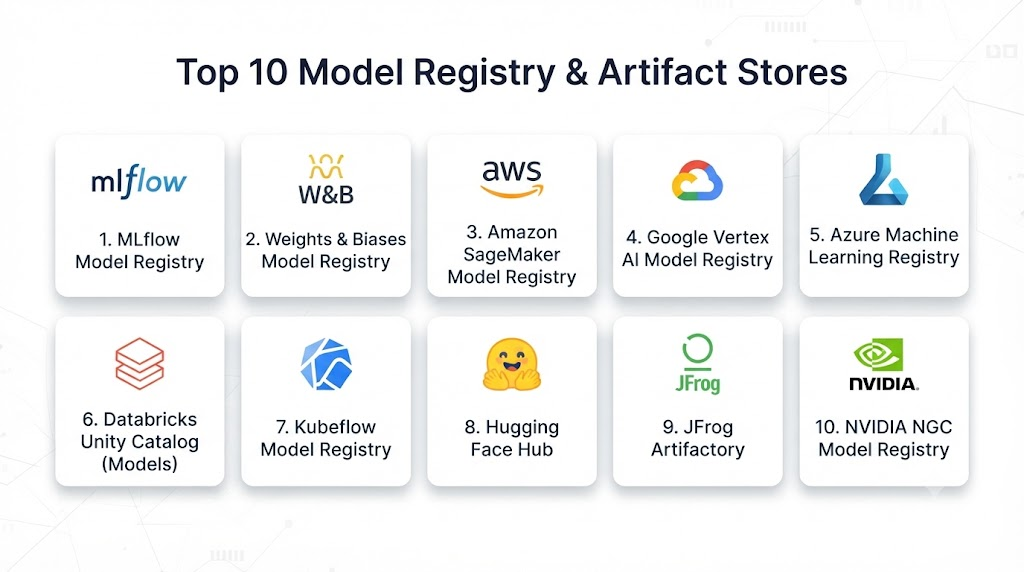
Top 10 Model Registry & Artifact Stores
1. MLflow Model Registry
MLflow Model Registry provides open-source model lifecycle management capabilities.
Key Features
- Model versioning
- Model metadata
- Artifact tracking
- Stage transitions
- Model lineage
- Experiment integration
- Deployment support
- Access control
- Collaboration
- Framework compatibility
Pros
- Open source
- Large ecosystem
- Flexible
- Framework independent
- Widely adopted
Cons
- Requires setup
- Infrastructure management needed
- Enterprise features need configuration
Platforms
Cloud and local environments.
Deployment or Support
ML development teams.
Security & Compliance
Depends on deployment.
Integrations & Ecosystem
ML frameworks and MLOps tools.
Support & Community
Large developer community.
2. Amazon SageMaker Model Registry
Amazon SageMaker Model Registry provides managed model lifecycle management.
Key Features
- Model versioning
- Model approval workflows
- Deployment integration
- Metadata tracking
- Model monitoring
- Security controls
- ML pipeline integration
- Artifact management
- Automation
- Cloud integration
Pros
- Fully managed
- AWS integration
- Enterprise security
- Scalable
- Production ready
Cons
- AWS dependency
- Cost complexity
- Requires AWS expertise
Platforms
AWS Cloud.
Deployment or Support
Enterprise ML teams.
Security & Compliance
AWS security framework.
Integrations & Ecosystem
AWS services.
Support & Community
Enterprise support.
3. Google Vertex AI Model Registry
Google Vertex AI Model Registry provides centralized model management.
Key Features
- Model versioning
- Deployment support
- Metadata tracking
- Model evaluation
- Monitoring
- AI workflow integration
- Governance
- Security
- Cloud deployment
- Collaboration
Pros
- Google Cloud integration
- Managed service
- Enterprise-ready
- Scalable
- AI ecosystem
Cons
- Google Cloud dependency
- Pricing complexity
- Learning curve
Platforms
Google Cloud.
Deployment or Support
Enterprise AI applications.
Security & Compliance
Google Cloud security.
Integrations & Ecosystem
Google AI services.
Support & Community
Enterprise support.
4. Azure Machine Learning Model Registry
Azure ML provides model registry capabilities for enterprise AI workflows.
Key Features
- Model management
- Version tracking
- Artifact storage
- Deployment integration
- Governance
- Security
- Monitoring
- ML pipelines
- Collaboration
- Enterprise workflows
Pros
- Microsoft ecosystem
- Strong governance
- Enterprise security
- Scalable
- Managed platform
Cons
- Azure dependency
- Configuration complexity
- Pricing considerations
Platforms
Microsoft Azure.
Deployment or Support
Enterprise AI teams.
Security & Compliance
Microsoft security framework.
Integrations & Ecosystem
Azure services.
Support & Community
Enterprise support.
5. Databricks Model Registry
Databricks provides model management through its ML platform.
Key Features
- Model versioning
- Artifact tracking
- Governance
- Deployment workflows
- Collaboration
- Experiment integration
- Model lineage
- Access control
- AI lifecycle management
- Enterprise support
Pros
- Strong data integration
- Unified AI platform
- Enterprise-ready
- Good governance
- Scalable
Cons
- Expensive
- Platform dependency
- Requires expertise
Platforms
Cloud environments.
Deployment or Support
Enterprise AI teams.
Security & Compliance
Enterprise controls.
Integrations & Ecosystem
Databricks ecosystem.
Support & Community
Enterprise support.
6. Weights & Biases Artifacts
Weights & Biases provides artifact tracking and experiment management.
Key Features
- Artifact versioning
- Dataset tracking
- Model tracking
- Experiment management
- Collaboration
- Visualization
- Metadata tracking
- AI workflow support
- Team management
- Integration support
Pros
- Excellent tracking
- Developer-friendly
- Strong visualization
- Easy collaboration
- Large community
Cons
- Requires integration
- Enterprise features cost more
- Not a full deployment platform
Platforms
Cloud environments.
Deployment or Support
ML development teams.
Security & Compliance
Enterprise controls.
Integrations & Ecosystem
ML frameworks.
Support & Community
Developer community.
7. DVC (Data Version Control)
DVC provides version control for machine learning data and artifacts.
Key Features
- Data versioning
- Model tracking
- Pipeline management
- Artifact storage
- Reproducibility
- Git integration
- Experiment tracking
- Collaboration
- Cloud storage support
- Automation
Pros
- Open source
- Git-based workflow
- Flexible
- Developer-friendly
- Cost-effective
Cons
- Requires technical knowledge
- Limited UI features
- Manual setup
Platforms
Cloud and local environments.
Deployment or Support
ML engineering teams.
Security & Compliance
Depends on storage setup.
Integrations & Ecosystem
Git and cloud storage.
Support & Community
Developer community.
8. Neptune AI
Neptune provides experiment and model metadata management.
Key Features
- Model tracking
- Metadata management
- Experiment tracking
- Artifact storage
- Collaboration
- Visualization
- Version management
- AI workflow support
- Monitoring
- Team management
Pros
- Strong metadata tracking
- Good visualization
- Easy collaboration
- ML-focused
- User-friendly
Cons
- Requires subscription
- Limited deployment features
- Integration required
Platforms
Cloud environments.
Deployment or Support
ML teams.
Security & Compliance
Enterprise controls.
Integrations & Ecosystem
ML frameworks.
Support & Community
Developer community.
9. ClearML Model Registry
ClearML provides open-source MLOps capabilities including model management.
Key Features
- Model versioning
- Artifact storage
- Experiment tracking
- Pipeline management
- Deployment support
- Automation
- Collaboration
- Monitoring
- Dataset management
- Governance
Pros
- Complete MLOps platform
- Open source
- Flexible
- Good automation
- Strong community
Cons
- Requires setup
- Platform complexity
- Learning curve
Platforms
Cloud and local environments.
Deployment or Support
MLOps teams.
Security & Compliance
Depends on deployment.
Integrations & Ecosystem
ML frameworks.
Support & Community
Developer community.
10. H2O MLOps Model Registry
H2O MLOps provides enterprise model management.
Key Features
- Model registry
- Deployment management
- Monitoring
- Governance
- Model validation
- Version control
- AI workflows
- Security
- Automation
- Enterprise integration
Pros
- Enterprise-ready
- Strong governance
- Good deployment support
- Scalable
- AI-focused
Cons
- Enterprise pricing
- Requires expertise
- Complex setup
Platforms
Cloud and enterprise environments.
Deployment or Support
Enterprise AI operations.
Security & Compliance
Enterprise controls.
Integrations & Ecosystem
AI platforms.
Support & Community
Enterprise support.
Comparison Table
| Tool Name | Best For | Platform(s) Supported | Deployment | Standout Feature | Public Rating |
|---|---|---|---|---|---|
| MLflow Registry | Open-source MLOps | Cloud/Local | Flexible | Model lifecycle | |
| SageMaker Registry | AWS ML | AWS | Enterprise | Managed workflows | |
| Vertex AI Registry | Google AI | GCP | Enterprise | Cloud integration | |
| Azure ML Registry | Microsoft AI | Azure | Enterprise | Governance | |
| Databricks Registry | Data teams | Cloud | Enterprise | Unified platform | |
| W&B Artifacts | Experiment tracking | Cloud | Flexible | Artifact tracking | |
| DVC | Data versioning | Cloud/Local | Flexible | Git workflow | |
| Neptune AI | Metadata tracking | Cloud | Business | Visualization | |
| ClearML Registry | Complete MLOps | Cloud/Local | Flexible | Automation | |
| H2O MLOps Registry | Enterprise AI | Cloud | Enterprise | Governance |
Weighted Evaluation
| Tool Name | Core Features 25% | Ease of Use 15% | Integrations & Ecosystem 15% | Security & Compliance 10% | Performance & Reliability 10% | Support & Community 10% | Price/Value 15% | Total |
|---|---|---|---|---|---|---|---|---|
| MLflow Registry | 25 | 14 | 15 | 10 | 10 | 10 | 15 | 99 |
| SageMaker Registry | 25 | 13 | 15 | 10 | 10 | 10 | 12 | 95 |
| Vertex AI Registry | 25 | 13 | 15 | 10 | 10 | 10 | 12 | 95 |
| Azure ML Registry | 24 | 13 | 15 | 10 | 10 | 10 | 13 | 95 |
| Databricks Registry | 25 | 12 | 15 | 10 | 10 | 10 | 12 | 94 |
| W&B Artifacts | 23 | 15 | 14 | 10 | 10 | 10 | 14 | 96 |
| DVC | 23 | 14 | 14 | 10 | 10 | 10 | 15 | 96 |
| Neptune AI | 22 | 15 | 13 | 10 | 10 | 10 | 14 | 94 |
| ClearML Registry | 24 | 13 | 14 | 10 | 10 | 10 | 14 | 95 |
| H2O MLOps Registry | 24 | 12 | 14 | 10 | 10 | 10 | 12 | 92 |
Which Model Registry & Artifact Store Is Right for You?
Choose MLflow Model Registry for open-source ML lifecycle management.
Choose Amazon SageMaker Model Registry for AWS environments.
Choose Google Vertex AI Model Registry for Google Cloud AI.
Choose Azure ML Model Registry for Microsoft ecosystems.
Choose Databricks Model Registry for unified data and AI platforms.
Choose Weights & Biases Artifacts for experiment tracking.
Choose DVC for Git-based ML version control.
Choose Neptune AI for metadata management.
Choose ClearML Model Registry for complete MLOps workflows.
Choose H2O MLOps Registry for enterprise AI governance.
Implementation Playbook
Phase 1: Define Model Management Process
- Identify model requirements
- Define ownership
- Establish lifecycle stages
Phase 2: Configure Storage
- Setup artifact repositories
- Connect data sources
- Configure access policies
Phase 3: Register Models
- Upload models
- Add metadata
- Track versions
Phase 4: Establish Governance
- Create approval workflows
- Monitor deployments
- Manage permissions
Phase 5: Scale AI Operations
- Automate releases
- Improve collaboration
- Manage model portfolios
Common Mistakes
- No model version tracking
- Poor metadata management
- Lack of governance
- Missing artifact backups
- No approval process
- Ignoring security
- Poor deployment integration
FAQs
1. What are Model Registry & Artifact Stores?
They are systems used to manage, version, and store machine learning models and related artifacts.
2. Why is a model registry important?
It helps teams track models, manage versions, and control deployments.
3. What are ML artifacts?
Artifacts include model files, datasets, configurations, logs, and experiment outputs.
4. Who uses model registries?
Data scientists, ML engineers, and MLOps teams use them.
5. Can model registries support AI governance?
Yes, many provide approvals, access control, and audit tracking.
6. How do model registries improve collaboration?
They provide a shared location for teams to manage AI assets.
7. Do model registries support LLMs?
Many modern platforms support large language models and generative AI artifacts.
8. Are open-source model registries available?
Yes, MLflow and DVC provide open-source solutions.
9. Can model registries integrate with deployment systems?
Yes, most connect with MLOps and cloud deployment tools.
10. What is the future of model registries?
Model registries will become central AI asset management systems for enterprise AI operations.
Conclusion
Model Registry & Artifact Stores are essential building blocks of modern MLOps infrastructure. They provide organizations with the ability to manage AI models, track versions, store artifacts, and maintain reliable deployment workflows.Platforms such as MLflow Model Registry, Amazon SageMaker Model Registry, Google Vertex AI Model Registry, Azure Machine Learning Registry, and Databricks Model Registry help businesses build scalable and governed AI systems.As organizations continue expanding machine learning and generative AI adoption, model registry and artifact management will become critical for maintaining secure, reliable, and efficient AI operations.