Introduction
Domain-Specific Language Model Platforms are AI systems designed to build, fine-tune, and deploy language models optimized for a particular industry or knowledge domain such as healthcare, finance, legal, retail, or engineering. Unlike general-purpose models that aim to answer broadly across topics, these platforms specialize in improving accuracy, relevance, and compliance within a defined context.
Their importance has grown because organizations are realizing that generic AI models often fail in high-stakes environments where precision, traceability, and domain alignment matter more than broad conversational ability. Domain-specific platforms solve this by combining curated datasets, retrieval systems, fine-tuning pipelines, and governance layers.
These platforms are now central to building production-grade AI systems that must operate under strict constraints such as regulatory compliance, internal knowledge dependency, or technical accuracy.
Common real-world use cases:
- Legal document analysis and contract intelligence
- Healthcare clinical decision support systems
- Financial risk analysis and fraud detection
- Insurance claim processing automation
- Enterprise knowledge assistants trained on internal data
- Engineering documentation and troubleshooting systems
- Customer support bots trained on product-specific knowledge
What to evaluate when choosing a platform:
- Domain adaptation quality (fine-tuning vs retrieval-based learning)
- Data ingestion and knowledge pipeline support
- Model flexibility (open-source vs proprietary vs hybrid)
- Evaluation and benchmarking tools
- Security, privacy, and compliance controls
- Explainability and traceability of outputs
- Latency and cost efficiency
- Integration with enterprise systems
- Deployment flexibility (cloud, hybrid, on-premise)
- Governance and audit capabilities
Best for: Enterprises, regulated industries, and organizations with large proprietary knowledge bases or domain-heavy workflows.
Not ideal for: Casual chatbot use, general content generation, or lightweight automation where domain accuracy is not critical.
What’s Changed in Domain-Specific Language Model Platforms
- Shift from static fine-tuning to retrieval-augmented domain systems (RAG-first design)
- Increased adoption of agent-based workflows for domain decision-making
- Stronger emphasis on evaluation frameworks for domain accuracy
- Growth of hybrid architectures combining fine-tuning + retrieval + tools
- Rising importance of data governance and lineage tracking
- Expansion of on-premise and private deployment requirements
- Integration of structured enterprise knowledge graphs
- Emergence of domain-specific small language models (SLMs)
- Increased focus on hallucination detection in regulated industries
- Stronger auditability and explainability requirements
- Cost optimization using model routing and selective inference
- Growing need for continuous learning pipelines instead of static models
Quick Buyer Checklist
- Does it support domain-specific fine-tuning or only generic models?
- Can it ingest structured and unstructured enterprise data?
- Does it support retrieval-augmented generation pipelines?
- Are evaluation tools available for domain accuracy testing?
- How strong are hallucination mitigation mechanisms?
- Does it support explainability and traceability?
- Can it run in secure or on-premise environments?
- Is there vendor lock-in risk?
- How are updates and model improvements managed?
- Does it integrate with enterprise knowledge systems?
- What level of observability is available?
- Are governance and compliance controls built-in?
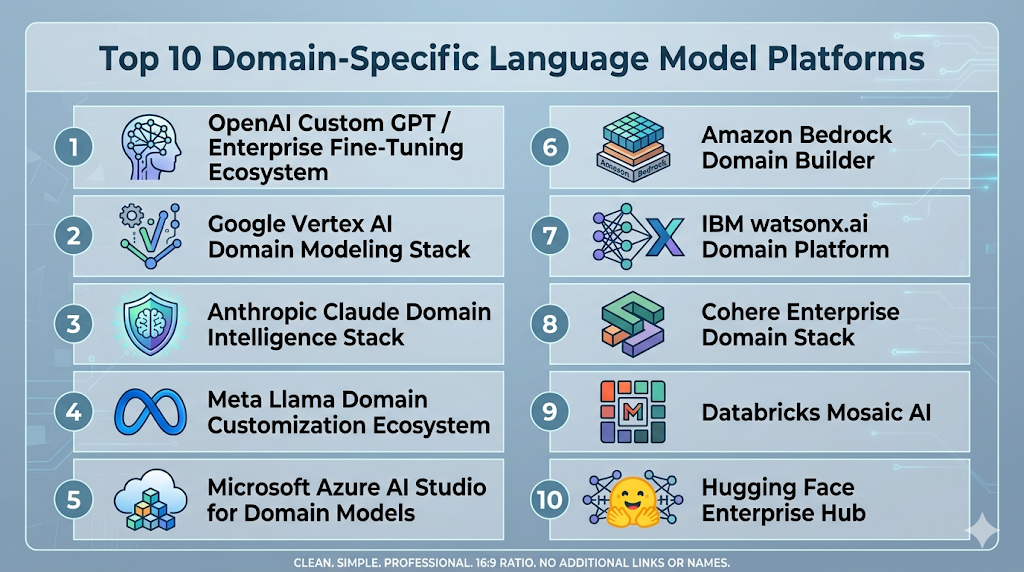
Top 10 Domain-Specific Language Model Platforms
#1 — OpenAI Custom GPT / Enterprise Fine-Tuning Ecosystem
One-line verdict: Best for fast deployment of domain-aware assistants with strong general intelligence foundation.
Short description:
A platform enabling customization of general-purpose models using fine-tuning and retrieval-based methods to adapt to enterprise-specific knowledge domains.
Standout Capabilities
- Strong base model reasoning capability
- Fine-tuning support for domain adaptation
- Retrieval-augmented knowledge integration
- Tool and function calling support
- Scalable cloud deployment
- Rapid prototyping of domain assistants
- Multimodal extension capabilities
AI-Specific Depth
- Model support: Proprietary
- RAG / knowledge integration: Native API support
- Evaluation: External tooling required
- Guardrails: Built-in moderation and policy filters
- Observability: Basic usage tracking
Pros
- Fast time-to-deploy
- Strong reasoning foundation
- Flexible integration options
Cons
- Limited low-level model control
- Vendor dependency risk
- Fine-tuning constraints vary by model
Security & Compliance
- Enterprise-grade controls available depending on deployment tier
- Data retention policies vary
Deployment & Platforms
- Cloud-based API ecosystem
Integrations & Ecosystem
- APIs and SDKs
- Strong integration with enterprise applications
- Compatible with RAG pipelines
Pricing Model
Usage-based with enterprise contracts
Best-Fit Scenarios
- Enterprise knowledge assistants
- Internal support systems
- Rapid domain chatbot deployment
#2 — Google Vertex AI Domain Modeling Stack
One-line verdict: Best for large-scale enterprise domain systems with deep data integration.
Standout Capabilities
- Strong integration with enterprise data warehouses
- Advanced model training pipelines
- Scalable MLOps infrastructure
- Retrieval and vector search integration
- Support for custom model deployment
AI-Specific Depth
- Model support: Proprietary + BYO models
- RAG / knowledge integration: Native support
- Evaluation: Built-in MLOps tools
- Guardrails: Cloud safety and policy controls
- Observability: Strong monitoring and logging
Pros
- Highly scalable infrastructure
- Strong data ecosystem integration
- Enterprise-ready tooling
Cons
- Complex configuration
- Requires cloud expertise
- Ecosystem lock-in potential
Security & Compliance
- Enterprise compliance features available
Deployment & Platforms
- Cloud-native platform
Integrations & Ecosystem
- Data warehouses and analytics systems
- Enterprise workflow tools
Pricing Model
Usage-based cloud pricing
Best-Fit Scenarios
- Enterprise analytics systems
- Large-scale domain AI pipelines
- Data-driven decision systems
#3 — Anthropic Claude Domain Intelligence Stack
One-line verdict: Best for safe, structured domain reasoning in high-trust environments.
Standout Capabilities
- Strong structured reasoning
- High-quality long document understanding
- Safety-first architecture
- Reliable output consistency
- API-first deployment
AI-Specific Depth
- Model support: Proprietary
- RAG / knowledge integration: API-based
- Evaluation: External tools required
- Guardrails: Strong alignment systems
- Observability: Basic metrics
Pros
- Highly reliable reasoning
- Strong safety alignment
- Excellent for structured domains
Cons
- Limited customization depth
- Less flexible multimodal support
Security & Compliance
- Enterprise controls available depending on plan
Deployment & Platforms
- Cloud API
Integrations & Ecosystem
- Enterprise workflow integrations
- Knowledge systems support
Pricing Model
Usage-based
Best-Fit Scenarios
- Legal and compliance systems
- Policy-driven AI workflows
- Structured enterprise knowledge systems
#4 — Meta Llama Domain Customization Ecosystem
One-line verdict: Best open-source foundation for fully controlled domain-specific AI systems.
Standout Capabilities
- Fully open-source model architecture
- Fine-tuning flexibility
- Self-hosting capability
- Strong developer ecosystem
- Custom pipeline design
AI-Specific Depth
- Model support: Open-source
- RAG / knowledge integration: Fully customizable
- Evaluation: User-defined
- Guardrails: Implementation-based
- Observability: External tooling required
Pros
- Maximum control and flexibility
- No vendor lock-in
- Strong research adoption
Cons
- Requires engineering expertise
- No built-in enterprise governance
- Infrastructure overhead
Security & Compliance
- Fully dependent on deployment design
Deployment & Platforms
- Cloud, hybrid, or on-premise
Integrations & Ecosystem
- Open-source ML ecosystem
- Custom enterprise pipelines
Pricing Model
Free with infrastructure costs
Best-Fit Scenarios
- Private enterprise AI systems
- Research and experimentation
- Highly customized domain models
#5 — Microsoft Azure AI Studio for Domain Models
One-line verdict: Best for enterprise-grade domain AI with strong governance and hybrid deployment.
Standout Capabilities
- End-to-end AI lifecycle management
- Enterprise knowledge integration
- Strong security and compliance controls
- Hybrid deployment support
- Multi-model orchestration
AI-Specific Depth
- Model support: Multi-model ecosystem
- RAG / knowledge integration: Strong native support
- Evaluation: Built-in tools
- Guardrails: Enterprise safety layer
- Observability: Advanced monitoring
Pros
- Strong enterprise adoption
- Flexible deployment architecture
- Deep integration with business systems
Cons
- Complex setup
- Higher operational overhead
Security & Compliance
- Enterprise-grade governance features
Deployment & Platforms
- Cloud and hybrid
Integrations & Ecosystem
- Enterprise software ecosystems
- Data and analytics platforms
Pricing Model
Tiered usage-based
Best-Fit Scenarios
- Large enterprises
- Regulated industries
- Hybrid AI systems
#6 — Amazon Bedrock Domain Builder
One-line verdict: Best for flexible domain AI using multiple foundation models.
Standout Capabilities
- Multi-model access
- Scalable inference infrastructure
- Strong enterprise cloud integration
- RAG pipeline support
- Model routing capabilities
AI-Specific Depth
- Model support: Multi-provider
- RAG / knowledge integration: Strong support
- Evaluation: External tools
- Guardrails: Cloud-native controls
- Observability: Cloud monitoring
Pros
- High flexibility
- Strong infrastructure
- Multi-model ecosystem
Cons
- AWS complexity
- Learning curve
Security & Compliance
- Enterprise AWS compliance systems
Deployment & Platforms
- Cloud-only
Integrations & Ecosystem
- AWS services ecosystem
Pricing Model
Usage-based
Best-Fit Scenarios
- Scalable enterprise AI systems
- Multi-model experimentation
#7 — IBM watsonx.ai Domain Platform
One-line verdict: Best for regulated industries requiring strong governance and explainability.
Standout Capabilities
- Governance-first AI architecture
- Domain-specific model tuning
- Enterprise workflow integration
- Compliance-focused design
- Hybrid deployment support
AI-Specific Depth
- Model support: Mixed
- RAG / knowledge integration: Supported
- Evaluation: Built-in tools
- Guardrails: Strong compliance controls
- Observability: Enterprise monitoring
Pros
- Strong governance
- Compliance-ready
- Enterprise trust focus
Cons
- Slower innovation cycle
- Complex setup
Security & Compliance
- Strong enterprise compliance features
Deployment & Platforms
- Cloud and hybrid
Integrations & Ecosystem
- Enterprise IT systems
Pricing Model
Enterprise contracts
Best-Fit Scenarios
- Healthcare systems
- Government platforms
- Financial compliance systems
#8 — Cohere Enterprise Domain Stack
One-line verdict: Best for retrieval-heavy domain intelligence systems.
Standout Capabilities
- Strong semantic search systems
- Enterprise-grade RAG pipelines
- Scalable API infrastructure
- Efficient embedding models
- Document understanding tools
AI-Specific Depth
- Model support: Hosted
- RAG / knowledge integration: Strong
- Evaluation: External tools
- Guardrails: Basic safety layers
- Observability: API metrics
Pros
- Excellent retrieval performance
- Strong enterprise APIs
- Efficient domain search systems
Cons
- Limited multimodal support
- Smaller ecosystem
Security & Compliance
- Enterprise options available
Deployment & Platforms
- Cloud API
Integrations & Ecosystem
- Knowledge bases and search systems
Pricing Model
Usage-based
Best-Fit Scenarios
- Enterprise search systems
- Knowledge assistants
#9 — Databricks Mosaic AI
One-line verdict: Best for data-driven domain AI built directly on enterprise data lakes.
Standout Capabilities
- Deep data lake integration
- End-to-end ML pipeline support
- Strong governance tools
- RAG-native architecture
- Scalable training systems
AI-Specific Depth
- Model support: BYO + open models
- RAG / knowledge integration: Native support
- Evaluation: Built-in ML tools
- Guardrails: Governance policies
- Observability: Strong data tracking
Pros
- Excellent for data-centric AI
- Strong scalability
- Unified ML and AI stack
Cons
- Requires data engineering expertise
- Complex setup
Security & Compliance
- Enterprise governance controls
Deployment & Platforms
- Cloud and hybrid
Integrations & Ecosystem
- Data lake platforms
- Enterprise analytics systems
Pricing Model
Usage-based enterprise pricing
Best-Fit Scenarios
- Data-heavy AI systems
- Enterprise analytics AI
#10 — Hugging Face Enterprise Hub
One-line verdict: Best open ecosystem for building and hosting custom domain-specific models.
Standout Capabilities
- Massive model ecosystem
- Fine-tuning and deployment tools
- Strong open-source integration
- Flexible hosting options
- Community-driven innovation
AI-Specific Depth
- Model support: Open-source + BYO
- RAG / knowledge integration: Supported via tools
- Evaluation: External frameworks
- Guardrails: Community or custom
- Observability: External tooling
Pros
- Extremely flexible
- Strong ecosystem
- Fast experimentation
Cons
- Requires engineering maturity
- Enterprise features vary
Security & Compliance
- Varies by deployment
Deployment & Platforms
- Cloud and self-hosted
Integrations & Ecosystem
- Open ML ecosystem
- Model libraries and pipelines
Pricing Model
Freemium + enterprise plans
Best-Fit Scenarios
- Research and prototyping
- Custom domain model development
Comparison Table
| Tool | Best For | Deployment | Model Flexibility | Strength | Watch-Out | Rating |
|---|---|---|---|---|---|---|
| OpenAI | Rapid assistants | Cloud | Hosted | Reasoning power | Lock-in | N/A |
| Vertex AI | Data-driven AI | Cloud | Multi/BYO | Scale | Complexity | N/A |
| Claude | Safe reasoning | Cloud | Hosted | Reliability | Limited flexibility | N/A |
| Llama | Custom AI | Self/Cloud | Open | Control | Infra effort | N/A |
| Azure AI | Enterprise AI | Hybrid | Multi-model | Integration | Complexity | N/A |
| Bedrock | Multi-model AI | Cloud | Multi-model | Flexibility | AWS learning curve | N/A |
| watsonx | Governance AI | Hybrid | Mixed | Compliance | Slower updates | N/A |
| Cohere | Search AI | Cloud | Hosted | Retrieval | Limited vision | N/A |
| Databricks | Data AI | Cloud | BYO/Open | Data integration | Complexity | N/A |
| Hugging Face | Open ecosystem | Cloud/Self | Open | Flexibility | Setup effort | N/A |
Scoring & Evaluation
Evaluation is based on domain adaptability, reliability, governance, integrations, usability, performance, and ecosystem maturity.
Top 3 for Enterprise
- Azure AI Studio
- Vertex AI
- watsonx.ai
Top 3 for SMB
- OpenAI ecosystem
- Cohere
- Hugging Face
Top 3 for Developers
- Hugging Face
- Llama ecosystem
- Databricks Mosaic AI
Which Domain-Specific Language Model Platform Is Right for You?
Solo / Freelancer
Lightweight hosted systems with easy APIs and minimal setup overhead.
SMB
Balanced platforms offering retrieval + basic customization.
Mid-Market
Platforms with scalable data integration and moderate governance.
Enterprise
Governance-heavy, hybrid or cloud-native systems with compliance controls.
Regulated industries
Systems with strong auditability, explainability, and data residency support.
Budget vs premium
- Budget: open-source ecosystems
- Premium: enterprise cloud platforms
Build vs buy
- Build when domain control and customization are critical
- Buy when speed, scalability, and reliability matter more
Implementation Playbook
30 Days
- Select base model and domain dataset
- Build small RAG or fine-tuned prototype
- Define evaluation benchmarks
60 Days
- Add safety filters and governance controls
- Implement logging and monitoring
- Expand dataset coverage
90 Days
- Optimize performance and cost
- Introduce multi-model routing
- Scale to production workloads
Common Mistakes & How to Avoid Them
- Skipping domain evaluation benchmarks
- Relying only on fine-tuning without retrieval
- Ignoring data quality issues
- No observability or logging
- Weak hallucination detection
- Overfitting to narrow datasets
- Lack of governance policies
- Vendor lock-in without abstraction layer
- No fallback model strategy
- Poor cost tracking at scale
- Ignoring real-world edge cases
- No human-in-the-loop validation
FAQs
What is a domain-specific language model platform?
It is a system designed to adapt AI models to specific industries or knowledge areas for higher accuracy.
Why not just use general AI models?
General models are broad but often lack precision in specialized fields.
What is RAG in domain AI?
It connects AI models to external knowledge sources for improved accuracy and grounding.
Do these platforms support fine-tuning?
Yes, many support fine-tuning or hybrid approaches with retrieval systems.
Are they secure enough for enterprise use?
Enterprise-grade platforms include governance and compliance features, depending on deployment.
Can they run on-premise?
Some open-source and hybrid systems support on-premise deployment.
What industries use them most?
Healthcare, finance, legal, insurance, and enterprise IT.
Are they expensive?
Costs vary depending on scale, model choice, and infrastructure.
What is the biggest risk?
Poor data quality leading to incorrect or biased domain outputs.
Can I combine multiple platforms?
Yes, hybrid architectures are common in enterprise systems.
Do I need ML expertise?
Not always, but advanced customization requires technical knowledge.
What is the difference between RAG and fine-tuning?
RAG uses external knowledge at runtime, while fine-tuning changes model behavior.
Conclusion
Domain-Specific Language Model Platforms are essential for building reliable AI systems in high-stakes environments. They move AI from general intelligence toward specialized expertise tailored to industries and enterprise knowledge.
There is no single best platform:
- Enterprise governance → Azure AI, watsonx
- Data-driven systems → Vertex AI, Databricks
- Flexible development → OpenAI, Hugging Face
- Retrieval-focused AI → Cohere
- Custom systems → Llama ecosystem
The best strategy is to combine retrieval, evaluation, and governance rather than relying on a single model approach.
Next steps:
Validate before scaling production
Define your domain clearly
Choose 2–3 platforms to test
Build a small evaluation benchmark