Introduction
Parameter-Efficient Fine-Tuning (PEFT) tooling refers to techniques and platforms that allow you to adapt large AI models—especially large language models (LLMs)—without retraining the entire model. Instead of updating billions of parameters, PEFT modifies only a small portion of them, making the process significantly faster, more affordable, and accessible.
As AI models continue to grow in size and complexity, full fine-tuning becomes expensive and impractical for many teams. PEFT solves this by enabling customization while keeping compute costs low and preserving the original model’s capabilities. It’s now a foundational approach for building scalable, domain-specific AI systems.
Real-world use cases include:
- Customizing LLMs for internal knowledge assistants
- Fine-tuning models for industry-specific applications (legal, healthcare, finance)
- Personalizing AI agents and copilots
- Adapting models for multilingual or regional needs
- Improving performance with small datasets
- Running optimized models on local or edge devices
What to evaluate:
- Supported PEFT methods (LoRA, QLoRA, adapters, prefix tuning)
- Model compatibility (open-source, proprietary, BYO)
- Training efficiency and hardware requirements
- Integration with ML pipelines
- Evaluation and benchmarking tools
- Deployment flexibility (cloud vs local)
- Observability (metrics, cost tracking)
- Security and data privacy
- Ease of use and documentation
- Cost optimization capabilities
Best for: AI engineers, ML teams, startups, and enterprises building customized AI systems where cost, speed, and data control are critical.
Not ideal for: Teams looking for no-code or fully managed AI solutions, or those who don’t require model customization and can rely solely on prompt engineering.
What’s Changed in Parameter-Efficient Fine-Tuning (PEFT) Tooling
- Broad adoption of QLoRA and low-memory fine-tuning techniques
- Integration with agent-based workflows and tool-calling systems
- Support for multimodal fine-tuning (text, image, audio)
- Built-in evaluation pipelines for reliability and regression testing
- Increased focus on guardrails and prompt injection resistance
- Native support for BYO models and private deployments
- Emergence of dynamic adapter switching and model routing
- Improved observability (training metrics, cost tracking, latency)
- Stronger governance and version control for fine-tuned models
- Better support for low-resource environments and edge devices
- Growing ecosystem of shared adapters and reusable components
- Increased emphasis on privacy-first fine-tuning workflows
Quick Buyer Checklist (Scan-Friendly)
- Does it support LoRA, QLoRA, adapters, and prefix tuning?
- Can you fine-tune open-source and BYO models?
- Is your training data secure and private?
- Are evaluation and testing tools included?
- Does it support multimodal models?
- Can you track training cost, latency, and performance?
- Are guardrails and safety controls available?
- Does it integrate with RAG pipelines or vector databases?
- Can you deploy models locally, in cloud, or hybrid setups?
- Are experiment tracking and versioning supported?
- What are the hardware requirements (GPU/CPU)?
- How high is the vendor lock-in risk?
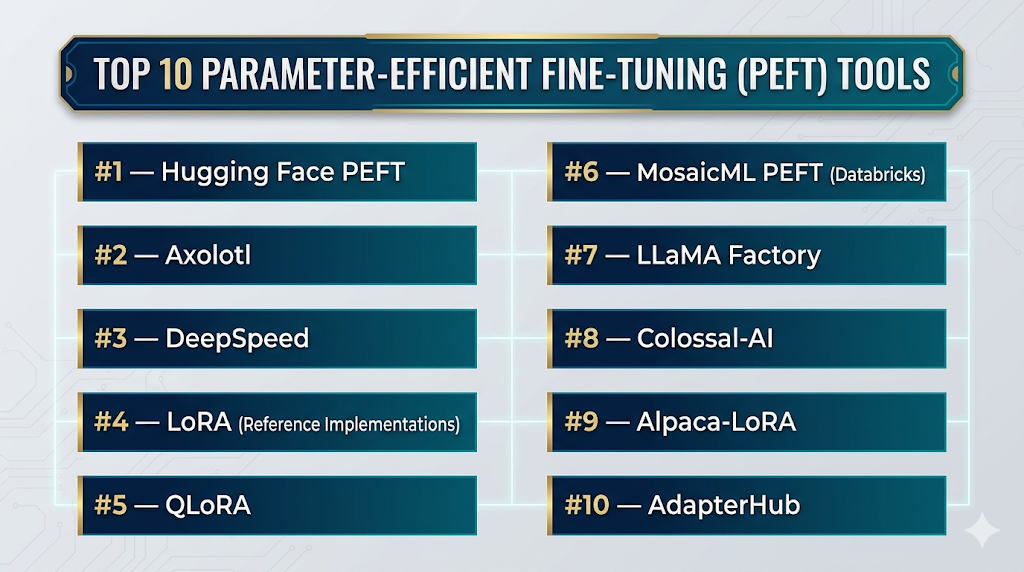
Top 10 Parameter-Efficient Fine-Tuning (PEFT) Tools
#1 — Hugging Face PEFT
One-line verdict: Best open-source PEFT library for flexible and production-ready fine-tuning across multiple model types.
Short description:
A widely adopted library that implements key PEFT methods like LoRA and prefix tuning. It integrates seamlessly with the Transformers ecosystem.
Standout Capabilities
- Supports LoRA, QLoRA, prefix tuning
- Seamless integration with Transformers
- Lightweight fine-tuning workflows
- Active community support
- Works across multiple architectures
AI-Specific Depth
- Model support: Open-source + BYO
- RAG / knowledge integration: Compatible
- Evaluation: External tools required
- Guardrails: N/A
- Observability: Limited
Pros
- Highly flexible
- Strong ecosystem
- Widely used
Cons
- Requires coding skills
- No built-in UI
- Limited native evaluation
Deployment & Platforms
Linux, macOS; Local + cloud
Integrations & Ecosystem
- Transformers
- Accelerate
- Datasets
- PyTorch
Pricing Model
Open-source
Best-Fit Scenarios
- Custom fine-tuning pipelines
- Research and experimentation
- Production ML workflows
#2 — Axolotl
One-line verdict: Best for quick and efficient fine-tuning with minimal setup and configuration overhead.
Short description:
A developer-friendly tool designed to simplify LLM fine-tuning using modern PEFT techniques.
Standout Capabilities
- Configuration-based training
- QLoRA support
- Optimized workflows
- Lightweight setup
AI-Specific Depth
- Model support: Open-source
- RAG / knowledge integration: N/A
- Evaluation: Limited
- Guardrails: N/A
- Observability: Basic
Pros
- Easy to use
- Fast setup
- Efficient training
Cons
- Smaller ecosystem
- Limited enterprise features
- Documentation varies
Deployment & Platforms
Linux; Local + cloud
Integrations & Ecosystem
- PyTorch
- Hugging Face
Pricing Model
Open-source
Best-Fit Scenarios
- Rapid prototyping
- Small teams
- Experimental workflows
#3 — DeepSpeed
One-line verdict: Best for large-scale distributed fine-tuning with strong optimization and performance capabilities.
Short description:
A deep learning optimization library that enables efficient training and scaling of large models.
Standout Capabilities
- Distributed training
- Memory optimization
- Large model support
- Performance tuning
AI-Specific Depth
- Model support: BYO
- RAG / knowledge integration: N/A
- Evaluation: Limited
- Guardrails: N/A
- Observability: Metrics tracking
Pros
- Highly scalable
- Efficient for large models
- Enterprise-ready
Cons
- Complex setup
- Requires expertise
- Not beginner-friendly
Deployment & Platforms
Cloud, self-hosted
Integrations & Ecosystem
- PyTorch
- ML pipelines
Pricing Model
Open-source
Best-Fit Scenarios
- Enterprise-scale training
- Distributed systems
- High-performance workloads
#4 — LoRA (Reference Implementations)
One-line verdict: Best foundational PEFT method for lightweight fine-tuning across multiple frameworks and ecosystems.
Short description:
A core technique that enables efficient model adaptation with minimal parameter updates.
Standout Capabilities
- Minimal parameter updates
- High efficiency
- Widely supported
- Easy integration
AI-Specific Depth
- Model support: Open-source + BYO
- RAG / knowledge integration: N/A
- Evaluation: N/A
- Guardrails: N/A
- Observability: N/A
Pros
- Extremely efficient
- Flexible integration
- Industry standard
Cons
- Not a standalone tool
- Requires integration
- Limited features alone
Deployment & Platforms
Varies / N/A
Integrations & Ecosystem
- PyTorch
- Transformers
- Multiple frameworks
Pricing Model
Open-source
Best-Fit Scenarios
- Lightweight fine-tuning
- Research use
- Pipeline integration
#5 — QLoRA
One-line verdict: Best for ultra-efficient fine-tuning using quantization to reduce memory and hardware requirements.
Short description:
An advanced PEFT approach that enables training large models with limited GPU memory.
Standout Capabilities
- Quantization-based tuning
- Reduced memory usage
- High performance retention
- Scalable workflows
AI-Specific Depth
- Model support: Open-source
- RAG / knowledge integration: N/A
- Evaluation: N/A
- Guardrails: N/A
- Observability: N/A
Pros
- Cost-efficient
- Works on smaller GPUs
- Maintains performance
Cons
- Technical complexity
- Not standalone
- Setup effort required
Deployment & Platforms
Varies / N/A
Integrations & Ecosystem
- PyTorch
- Transformers
Pricing Model
Open-source
Best-Fit Scenarios
- Low-resource environments
- Cost-sensitive teams
- Experimental setups
#6 — MosaicML PEFT (Databricks)
One-line verdict: Best for enterprise-grade fine-tuning integrated with large-scale data and ML workflows.
Short description:
A platform offering scalable fine-tuning capabilities integrated into broader ML pipelines.
Standout Capabilities
- Enterprise workflows
- Scalable training
- Data pipeline integration
- Managed infrastructure
AI-Specific Depth
- Model support: BYO
- RAG / knowledge integration: Compatible
- Evaluation: Available
- Guardrails: Limited
- Observability: Strong
Pros
- Enterprise-ready
- Integrated ecosystem
- Scalable
Cons
- Requires infrastructure
- Less flexible than pure open-source
- Pricing unclear
Deployment & Platforms
Cloud
Integrations & Ecosystem
- ML pipelines
- APIs
- Data platforms
Pricing Model
Varies / N/A
Best-Fit Scenarios
- Enterprise AI workflows
- Data-heavy environments
- Large teams
#7 — LLaMA Factory
One-line verdict: Best for simplified fine-tuning workflows with support for multiple PEFT techniques in one interface.
Short description:
A tool designed to streamline LLM fine-tuning with minimal configuration.
Standout Capabilities
- Multi-PEFT support
- Easy configuration
- Lightweight setup
- Community-driven
AI-Specific Depth
- Model support: Open-source
- RAG / knowledge integration: Limited
- Evaluation: Basic
- Guardrails: N/A
- Observability: Limited
Pros
- Easy to use
- Flexible
- Good for experimentation
Cons
- Limited enterprise features
- Smaller ecosystem
- Documentation varies
Deployment & Platforms
Local, cloud
Integrations & Ecosystem
- PyTorch
- Hugging Face
Pricing Model
Open-source
Best-Fit Scenarios
- Prototyping
- Small teams
- Research
#8 — Colossal-AI
One-line verdict: Best for large-scale efficient training with advanced parallelism and performance optimization.
Short description:
A system for scalable deep learning training with strong performance capabilities.
Standout Capabilities
- Hybrid parallelism
- Memory optimization
- Large model support
- Performance tuning
AI-Specific Depth
- Model support: BYO
- RAG / knowledge integration: N/A
- Evaluation: Limited
- Guardrails: N/A
- Observability: Metrics
Pros
- Scalable
- High performance
- Advanced features
Cons
- Complex setup
- Requires expertise
- Not beginner-friendly
Deployment & Platforms
Cloud, self-hosted
Integrations & Ecosystem
- PyTorch
- HPC systems
Pricing Model
Open-source
Best-Fit Scenarios
- Large-scale AI
- HPC environments
- Enterprise workloads
#9 — Alpaca-LoRA
One-line verdict: Best for lightweight experimentation and learning PEFT techniques using LoRA-based instruction tuning.
Short description:
A project demonstrating LoRA-based fine-tuning on instruction-following models.
Standout Capabilities
- Simple implementation
- Instruction tuning
- Lightweight setup
AI-Specific Depth
- Model support: Open-source
- RAG / knowledge integration: N/A
- Evaluation: Limited
- Guardrails: N/A
- Observability: N/A
Pros
- Easy to experiment
- Lightweight
- Educational
Cons
- Not production-ready
- Limited features
- Small ecosystem
Deployment & Platforms
Local
Integrations & Ecosystem
- PyTorch
- LLM ecosystems
Pricing Model
Open-source
Best-Fit Scenarios
- Learning PEFT
- Prototyping
- Research
#10 — AdapterHub
One-line verdict: Best for reusable adapter-based fine-tuning with modular architecture and strong research backing.
Short description:
A framework that enables sharing and reusing adapter modules across models.
Standout Capabilities
- Adapter sharing
- Modular fine-tuning
- Reusability
- Research-focused
AI-Specific Depth
- Model support: Open-source
- RAG / knowledge integration: N/A
- Evaluation: Limited
- Guardrails: N/A
- Observability: N/A
Pros
- Modular design
- Reusable components
- Strong academic support
Cons
- Limited enterprise features
- Smaller ecosystem
- Setup complexity
Deployment & Platforms
Local, cloud
Integrations & Ecosystem
- Transformers
- PyTorch
Pricing Model
Open-source
Best-Fit Scenarios
- Research
- Modular systems
- Academic projects
Comparison Table (Top 10)
| Tool Name | Best For | Deployment | Model Flexibility | Strength | Watch-Out | Public Rating |
|---|---|---|---|---|---|---|
| Hugging Face PEFT | All users | Hybrid | Open-source + BYO | Ecosystem | Complexity | N/A |
| Axolotl | Fast tuning | Local/Cloud | Open-source | Simplicity | Limited features | N/A |
| DeepSpeed | Enterprise | Cloud | BYO | Scalability | Complexity | N/A |
| LoRA | Method | Varies | Open-source | Efficiency | Not standalone | N/A |
| QLoRA | Low-cost tuning | Varies | Open-source | Memory efficiency | Setup complexity | N/A |
| MosaicML | Enterprise | Cloud | BYO | Integration | Pricing clarity | N/A |
| LLaMA Factory | Easy tuning | Hybrid | Open-source | Ease of use | Limited features | N/A |
| Colossal-AI | HPC | Cloud | BYO | Performance | Complexity | N/A |
| Alpaca-LoRA | Learning | Local | Open-source | Simplicity | Not production-ready | N/A |
| AdapterHub | Modular tuning | Hybrid | Open-source | Reusability | Smaller ecosystem | N/A |
Scoring & Evaluation (Transparent Rubric)
Scoring is comparative and reflects how each tool performs relative to others across key criteria, not an absolute measure of quality.
| Tool | Core | Reliability/Eval | Guardrails | Integrations | Ease | Perf/Cost | Security/Admin | Support | Weighted Total |
|---|---|---|---|---|---|---|---|---|---|
| Hugging Face PEFT | 9 | 7 | 5 | 9 | 7 | 8 | 7 | 9 | 7.9 |
| Axolotl | 7 | 5 | 4 | 6 | 8 | 8 | 5 | 6 | 6.6 |
| DeepSpeed | 9 | 7 | 5 | 8 | 5 | 9 | 8 | 7 | 7.8 |
| LoRA | 8 | 6 | 4 | 8 | 7 | 9 | 6 | 7 | 7.4 |
| QLoRA | 8 | 6 | 4 | 7 | 6 | 10 | 6 | 6 | 7.3 |
| MosaicML | 8 | 7 | 6 | 8 | 6 | 8 | 8 | 7 | 7.6 |
| LLaMA Factory | 7 | 5 | 4 | 6 | 8 | 7 | 5 | 6 | 6.4 |
| Colossal-AI | 9 | 6 | 5 | 7 | 5 | 9 | 7 | 6 | 7.2 |
| Alpaca-LoRA | 6 | 5 | 4 | 5 | 7 | 7 | 5 | 5 | 5.9 |
| AdapterHub | 7 | 6 | 4 | 7 | 6 | 7 | 6 | 6 | 6.5 |
Top 3 for Enterprise: DeepSpeed, MosaicML, Hugging Face PEFT
Top 3 for SMB: Axolotl, LLaMA Factory, Hugging Face PEFT
Top 3 for Developers: Hugging Face PEFT, LoRA, QLoRA
Which Parameter-Efficient Fine-Tuning (PEFT) Tool Is Right for You?
Solo / Freelancer
Choose Axolotl or LLaMA Factory for simplicity and minimal setup.
SMB
Hugging Face PEFT offers flexibility without requiring heavy infrastructure.
Mid-Market
Combine Hugging Face PEFT with DeepSpeed for scalability and efficiency.
Enterprise
MosaicML or DeepSpeed provide robust, scalable, and integrated solutions.
Regulated industries (finance/healthcare/public sector)
Prefer self-hosted pipelines with strict data governance and privacy controls.
Budget vs premium
Open-source tools provide cost efficiency, while managed platforms offer convenience and support.
Build vs buy (when to DIY)
Build if you need full control and customization; buy if speed and ease of use are priorities.
Implementation Playbook (30 / 60 / 90 Days)
30 Days
- Identify use case and success metrics
- Select 2–3 PEFT tools
- Run pilot with sample datasets
- Build initial fine-tuning pipeline
60 Days
- Implement evaluation framework (accuracy, hallucination testing)
- Add guardrails and safety checks
- Integrate with existing ML workflows
- Begin limited production rollout
90 Days
- Optimize training cost and latency
- Scale deployment across teams
- Implement governance (versioning, audit logs)
- Set up monitoring and incident handling
Common Mistakes & How to Avoid Them
- Skipping evaluation and relying only on subjective results
- Ignoring prompt injection risks during fine-tuning
- Using poor-quality or biased datasets
- Overfitting on small datasets
- Not tracking training cost and resource usage
- Lack of observability and monitoring
- Weak version control for models and datasets
- Ignoring data privacy and retention policies
- Over-automating without human validation
- Choosing tools without considering scalability
- Vendor lock-in without abstraction layers
- Poor documentation and reproducibility
FAQs
1. What is PEFT?
PEFT is a technique that allows you to fine-tune large AI models by updating only a small subset of parameters, making the process efficient.
2. Why use PEFT instead of full fine-tuning?
It reduces cost, training time, and hardware requirements while still achieving strong performance.
3. Can I use PEFT with any model?
Most open-source models support it, and some proprietary systems may allow limited customization.
4. Do I need GPUs for PEFT?
Yes in most cases, but techniques like QLoRA allow usage on smaller GPUs.
5. Is PEFT suitable for small datasets?
Yes, it is particularly effective when data is limited.
6. Can I deploy fine-tuned models locally?
Yes, many PEFT workflows support local or edge deployment.
7. Are evaluation tools included?
Some tools provide them, but many require external evaluation frameworks.
8. What are guardrails in PEFT?
They are safety mechanisms that help prevent harmful or incorrect outputs.
9. How do I manage costs?
Use efficient methods like QLoRA, monitor usage, and optimize training pipelines.
10. Can I switch between PEFT tools?
Yes, but it depends on compatibility and architecture choices.
11. Is PEFT secure for sensitive data?
It can be, especially when deployed in self-hosted or private environments.
12. What are alternatives to PEFT?
Prompt engineering, full fine-tuning, or retrieval-based approaches can be alternatives.
Conclusion
Parameter-efficient fine-tuning (PEFT) tooling enables teams to customize powerful AI models without the heavy cost and complexity of full retraining, making it a practical foundation for modern AI systems; however, the best choice depends on your technical needs, scale, and infrastructure—so start by shortlisting a few tools, run a focused pilot with real data, and validate evaluation, security, and performance before scaling into production.
The article clearly explains the trade-offs between flexibility, performance, and training cost in PEFT tools.It is useful for both beginners and experienced ML engineers.