Introduction
Model distillation toolkits are platforms and frameworks that help transfer knowledge from large, complex AI models (often called “teacher models”) into smaller, faster, and more efficient models (“student models”). In simple terms, instead of deploying a massive model that’s expensive and slow, distillation allows you to create a lightweight version that performs similarly for specific tasks.
This has become critical as AI systems move from experimentation to production—especially in edge devices, real-time applications, and cost-sensitive environments. With the rise of AI agents, multimodal systems, and continuous inference workloads, reducing latency and cost while maintaining accuracy is now a top priority.
Real-world use cases include:
- Deploying LLM-powered chatbots with lower latency and cost
- Running AI models on mobile, IoT, or edge devices
- Optimizing inference for real-time applications
- Reducing infrastructure costs for large-scale AI deployments
- Customizing smaller models for domain-specific tasks
- Improving performance consistency in production pipelines
What to evaluate:
- Supported distillation methods (logit matching, feature distillation, task-specific distillation)
- Compatibility with large models (LLMs, vision, multimodal)
- Integration with training pipelines
- Evaluation and benchmarking capabilities
- Latency and cost optimization features
- Deployment flexibility (edge, cloud, hybrid)
- Observability and performance tracking
- Security and data handling
- Ease of implementation
- Support for BYO models
- Scalability and automation
- Vendor lock-in risk
Best for: AI engineers, ML teams, and enterprises optimizing model performance for production, especially in cost-sensitive or latency-critical environments.
Not ideal for: Teams that don’t deploy models at scale or those who can afford full-size models without performance or cost constraints; simpler inference optimization techniques may be sufficient.
What’s Changed in Model Distillation Toolkits
- Rise of LLM distillation pipelines for production AI agents
- Support for multimodal distillation (text, image, audio)
- Integration with agentic workflows and tool-calling systems
- Focus on real-time inference optimization and latency reduction
- Built-in evaluation frameworks for accuracy vs efficiency trade-offs
- Increased adoption of synthetic data for distillation training
- Improved model routing and dynamic model selection
- Stronger emphasis on privacy-preserving distillation workflows
- Enhanced observability (latency, cost, throughput metrics)
- Growing support for edge deployment and on-device AI
- Integration with RAG pipelines for efficient retrieval-based systems
- Expansion of automated distillation pipelines in MLOps stacks
Quick Buyer Checklist (Scan-Friendly)
- Does it support LLM and multimodal distillation?
- Can you use BYO models or only hosted models?
- Are evaluation tools available to compare teacher vs student models?
- Does it provide latency and cost optimization insights?
- Are guardrails and safety checks preserved after distillation?
- Can it integrate with RAG pipelines or vector databases?
- Is data privacy and retention clearly defined?
- Does it support edge or on-device deployment?
- Are there observability tools for performance tracking?
- How easy is it to automate distillation workflows?
- Does it integrate with existing ML pipelines and frameworks?
- What is the risk of vendor lock-in?
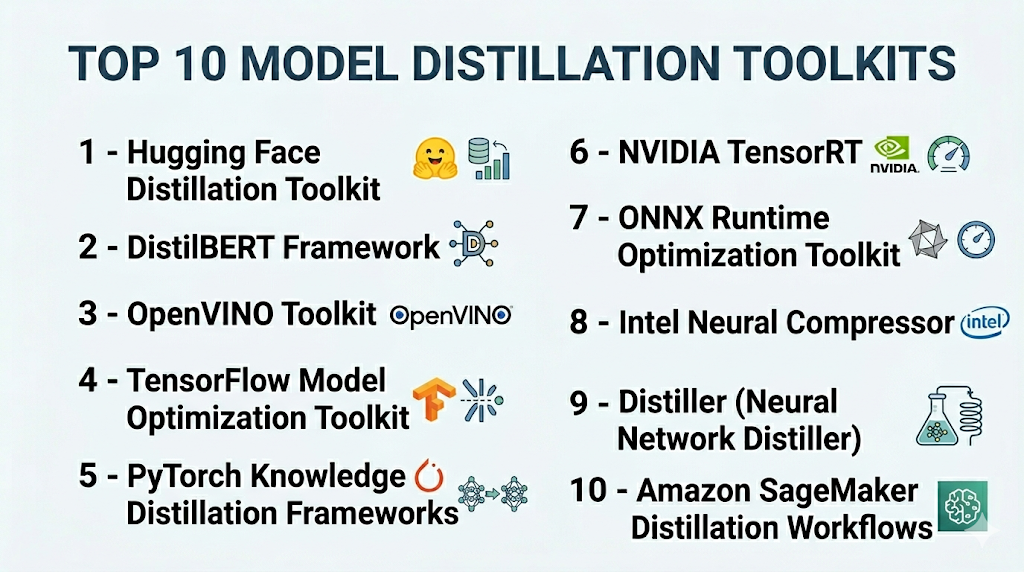
Top 10 Model Distillation Toolkits
1 — Hugging Face Distillation Toolkit
One-line verdict: Best open-source toolkit for flexible and scalable distillation across NLP, vision, and multimodal models.
Short description:
A widely used ecosystem enabling model compression and distillation through integration with Transformers and training pipelines.
Standout Capabilities
- Native support for distillation workflows
- Integration with Transformers ecosystem
- Multi-task and multimodal support
- Strong community and documentation
- Flexible training configurations
- Works with various architectures
AI-Specific Depth
- Model support: Open-source + BYO
- RAG / knowledge integration: Compatible
- Evaluation: External tools required
- Guardrails: N/A
- Observability: Limited
Pros
- Highly flexible
- Strong ecosystem
- Widely adopted
Cons
- Requires coding expertise
- Limited built-in evaluation
- No native UI
Deployment & Platforms
Linux, macOS; Cloud + self-hosted
Integrations & Ecosystem
- Transformers
- Datasets
- PyTorch
- Accelerate
Pricing Model
Open-source
Best-Fit Scenarios
- Custom distillation pipelines
- Research and production
- Multi-model workflows
2 — DistilBERT Framework
One-line verdict: Best for lightweight NLP distillation with proven efficiency and performance trade-offs.
Short description:
A pre-distilled model and framework designed for efficient NLP applications with reduced model size.
Standout Capabilities
- Pre-distilled architecture
- Faster inference
- Reduced memory footprint
- Strong NLP performance
AI-Specific Depth
- Model support: Open-source
- RAG / knowledge integration: Compatible
- Evaluation: Pre-benchmarked
- Guardrails: N/A
- Observability: N/A
Pros
- Easy to deploy
- Efficient
- Well-tested
Cons
- Limited customization
- NLP-focused
- Not a full toolkit
Deployment & Platforms
Cloud, local
Integrations & Ecosystem
- Transformers
- PyTorch
- NLP pipelines
Pricing Model
Open-source
Best-Fit Scenarios
- NLP applications
- Lightweight inference
- Rapid deployment
3 — OpenVINO Toolkit
One-line verdict: Best for edge deployment and hardware-optimized model distillation and inference acceleration.
Short description:
A toolkit focused on optimizing AI models for Intel hardware and edge environments.
Standout Capabilities
- Hardware optimization
- Edge deployment support
- Model compression tools
- Performance tuning
AI-Specific Depth
- Model support: BYO
- RAG / knowledge integration: N/A
- Evaluation: Performance metrics
- Guardrails: N/A
- Observability: Latency tracking
Pros
- Excellent edge performance
- Hardware optimization
- Production-ready
Cons
- Hardware-specific
- Setup complexity
- Limited flexibility
Deployment & Platforms
Windows, Linux; Edge + cloud
Integrations & Ecosystem
- Intel hardware
- APIs
- ML pipelines
Pricing Model
Open-source
Best-Fit Scenarios
- Edge AI
- Real-time inference
- Hardware optimization
4 — TensorFlow Model Optimization Toolkit
One-line verdict: Best for TensorFlow-based distillation, pruning, and quantization in production ML pipelines.
Short description:
A toolkit for optimizing models through distillation, pruning, and quantization.
Standout Capabilities
- Multiple optimization techniques
- TensorFlow integration
- Production-ready tools
- Performance tuning
AI-Specific Depth
- Model support: BYO
- RAG / knowledge integration: N/A
- Evaluation: Metrics
- Guardrails: N/A
- Observability: Basic
Pros
- Strong ecosystem
- Production-ready
- Flexible
Cons
- TensorFlow-specific
- Requires expertise
- Limited UI
Deployment & Platforms
Cloud, self-hosted
Integrations & Ecosystem
- TensorFlow
- Keras
- ML pipelines
Pricing Model
Open-source
Best-Fit Scenarios
- TensorFlow users
- Production pipelines
- Model optimization
5 — PyTorch Knowledge Distillation Frameworks
One-line verdict: Best for custom, research-grade distillation workflows with maximum flexibility and control.
Short description:
A collection of frameworks and libraries enabling distillation workflows within PyTorch.
Standout Capabilities
- Full customization
- Flexible architectures
- Research-friendly
- Integration with ML pipelines
AI-Specific Depth
- Model support: BYO + open-source
- RAG / knowledge integration: Compatible
- Evaluation: External
- Guardrails: N/A
- Observability: Metrics via tools
Pros
- Highly flexible
- Widely used
- Strong community
Cons
- Requires expertise
- No standardization
- Setup effort
Deployment & Platforms
Cloud, self-hosted
Integrations & Ecosystem
- PyTorch
- ML frameworks
- APIs
Pricing Model
Open-source
Best-Fit Scenarios
- Research
- Custom pipelines
- Advanced use cases
6 — NVIDIA TensorRT
One-line verdict: Best for GPU-optimized inference with advanced model compression and distillation support.
Short description:
A high-performance inference optimizer designed for NVIDIA GPUs.
Standout Capabilities
- GPU optimization
- Low-latency inference
- Model compression
- High throughput
AI-Specific Depth
- Model support: BYO
- RAG / knowledge integration: N/A
- Evaluation: Performance metrics
- Guardrails: N/A
- Observability: Latency and throughput
Pros
- High performance
- Production-ready
- GPU optimization
Cons
- GPU-dependent
- Complex setup
- Limited flexibility
Deployment & Platforms
Linux, cloud
Integrations & Ecosystem
- NVIDIA ecosystem
- APIs
- ML frameworks
Pricing Model
Varies / N/A
Best-Fit Scenarios
- GPU workloads
- Real-time systems
- High-performance inference
7 — ONNX Runtime Optimization Toolkit
One-line verdict: Best for cross-platform model distillation and optimization with strong interoperability support.
Short description:
A runtime and toolkit for optimizing and deploying models across platforms.
Standout Capabilities
- Cross-platform support
- Model optimization
- Interoperability
- Performance tuning
AI-Specific Depth
- Model support: BYO
- RAG / knowledge integration: N/A
- Evaluation: Metrics
- Guardrails: N/A
- Observability: Performance metrics
Pros
- Flexible
- Cross-platform
- Efficient
Cons
- Requires conversion
- Setup complexity
- Limited UI
Deployment & Platforms
Windows, Linux, cloud
Integrations & Ecosystem
- ONNX
- ML frameworks
- APIs
Pricing Model
Open-source
Best-Fit Scenarios
- Cross-platform deployment
- Optimization workflows
- Interoperability needs
8 — Intel Neural Compressor
One-line verdict: Best for automated model compression and distillation with minimal manual intervention.
Short description:
A toolkit for optimizing models using compression techniques including distillation.
Standout Capabilities
- Automated optimization
- Distillation + quantization
- Performance tuning
- Ease of use
AI-Specific Depth
- Model support: BYO
- RAG / knowledge integration: N/A
- Evaluation: Metrics
- Guardrails: N/A
- Observability: Performance metrics
Pros
- Easy automation
- Efficient
- Good performance
Cons
- Hardware bias
- Limited customization
- Documentation varies
Deployment & Platforms
Cloud, local
Integrations & Ecosystem
- Intel ecosystem
- APIs
- ML frameworks
Pricing Model
Open-source
Best-Fit Scenarios
- Automated optimization
- Edge deployment
- Cost reduction
9 — Distiller (Neural Network Distiller)
One-line verdict: Best for research-focused model compression and distillation experiments with detailed control.
Short description:
A framework for experimenting with compression and distillation techniques.
Standout Capabilities
- Research tools
- Fine-grained control
- Compression techniques
- Experimentation
AI-Specific Depth
- Model support: BYO
- RAG / knowledge integration: N/A
- Evaluation: Metrics
- Guardrails: N/A
- Observability: Basic
Pros
- Flexible
- Research-friendly
- Detailed control
Cons
- Not production-ready
- Limited ecosystem
- Requires expertise
Deployment & Platforms
Local
Integrations & Ecosystem
- PyTorch
- ML frameworks
Pricing Model
Open-source
Best-Fit Scenarios
- Research
- Experimentation
- Academic use
10 — Amazon SageMaker Distillation Workflows
One-line verdict: Best for managed distillation pipelines within a cloud-native ML ecosystem.
Short description:
A cloud-based platform enabling scalable model training, optimization, and distillation workflows.
Standout Capabilities
- Managed infrastructure
- Scalable pipelines
- Integration with ML workflows
- Automation
AI-Specific Depth
- Model support: BYO + hosted
- RAG / knowledge integration: Compatible
- Evaluation: Built-in
- Guardrails: Limited
- Observability: Strong
Pros
- Scalable
- Integrated ecosystem
- Managed services
Cons
- Vendor lock-in
- Pricing varies
- Less flexibility
Security & Compliance
Encryption, IAM controls; certifications: Not publicly stated
Deployment & Platforms
Cloud
Integrations & Ecosystem
- ML pipelines
- APIs
- Data services
Pricing Model
Usage-based
Best-Fit Scenarios
- Enterprise pipelines
- Cloud-native AI
- Scalable deployment
Comparison Table (Top 10)
| Tool Name | Best For | Deployment | Model Flexibility | Strength | Watch-Out | Public Rating |
|---|---|---|---|---|---|---|
| Hugging Face | General use | Hybrid | Open-source + BYO | Ecosystem | Complexity | N/A |
| DistilBERT | NLP | Local/Cloud | Open-source | Efficiency | Limited scope | N/A |
| OpenVINO | Edge AI | Hybrid | BYO | Hardware optimization | Hardware dependency | N/A |
| TensorFlow Toolkit | TF users | Hybrid | BYO | Integration | TF-only | N/A |
| PyTorch Frameworks | Custom workflows | Hybrid | BYO | Flexibility | Setup effort | N/A |
| TensorRT | GPU inference | Cloud | BYO | Performance | GPU dependency | N/A |
| ONNX Runtime | Interoperability | Hybrid | BYO | Cross-platform | Conversion needed | N/A |
| Neural Compressor | Automation | Hybrid | BYO | Ease | Limited customization | N/A |
| Distiller | Research | Local | BYO | Control | Not production-ready | N/A |
| SageMaker | Enterprise | Cloud | Hosted + BYO | Scalability | Lock-in | N/A |
Scoring & Evaluation (Transparent Rubric)
Scoring is comparative and reflects how tools perform relative to each other across key criteria, not absolute quality.
| Tool | Core | Reliability/Eval | Guardrails | Integrations | Ease | Perf/Cost | Security/Admin | Support | Weighted Total |
|---|---|---|---|---|---|---|---|---|---|
| Hugging Face | 9 | 7 | 5 | 9 | 7 | 8 | 7 | 9 | 7.9 |
| DistilBERT | 7 | 7 | 4 | 7 | 9 | 9 | 6 | 8 | 7.6 |
| OpenVINO | 8 | 7 | 5 | 7 | 6 | 9 | 7 | 7 | 7.5 |
| TensorFlow Toolkit | 8 | 7 | 5 | 8 | 6 | 8 | 7 | 7 | 7.4 |
| PyTorch | 9 | 7 | 5 | 8 | 6 | 8 | 7 | 8 | 7.7 |
| TensorRT | 8 | 7 | 5 | 7 | 5 | 10 | 7 | 7 | 7.5 |
| ONNX Runtime | 8 | 7 | 5 | 9 | 6 | 9 | 7 | 7 | 7.6 |
| Neural Compressor | 7 | 6 | 5 | 7 | 8 | 9 | 6 | 6 | 7.2 |
| Distiller | 7 | 6 | 4 | 6 | 6 | 7 | 6 | 6 | 6.5 |
| SageMaker | 8 | 8 | 6 | 9 | 8 | 7 | 8 | 8 | 8.0 |
Top 3 for Enterprise: SageMaker, TensorRT, Hugging Face
Top 3 for SMB: Hugging Face, ONNX Runtime, Neural Compressor
Top 3 for Developers: PyTorch Frameworks, Hugging Face, Distiller
Which Model Distillation Toolkit Is Right for You?
Solo / Freelancer
Use Hugging Face or PyTorch frameworks for flexibility and experimentation.
SMB
ONNX Runtime or Neural Compressor offer efficiency and ease of use.
Mid-Market
Combine Hugging Face with TensorRT or OpenVINO for performance optimization.
Enterprise
SageMaker or TensorRT provide scalable and production-ready solutions.
Regulated industries (finance/healthcare/public sector)
Prefer self-hosted or hybrid deployments with strict data governance.
Budget vs premium
Open-source tools reduce costs, while managed platforms offer convenience and scalability.
Build vs buy (when to DIY)
Build if you need full control; buy if speed and managed infrastructure are priorities.
Implementation Playbook (30 / 60 / 90 Days)
30 Days
- Define performance goals (latency, cost)
- Select teacher and student models
- Run pilot distillation experiments
60 Days
- Evaluate model accuracy vs efficiency
- Add guardrails and testing
- Integrate into pipelines
90 Days
- Optimize deployment
- Scale usage
- Implement monitoring and governance
Common Mistakes & How to Avoid Them
- Ignoring evaluation metrics
- Over-compressing models
- Losing critical performance
- Poor teacher model selection
- Lack of observability
- No cost tracking
- Weak testing
- Ignoring guardrails
- Data leakage risks
- Vendor lock-in
- Poor documentation
- Over-automation
FAQs
1. What is model distillation?
Model distillation transfers knowledge from a large model to a smaller one for efficiency.
2. Why use distillation?
To reduce cost, latency, and resource usage.
3. Does distillation reduce accuracy?
Sometimes slightly, but often acceptable for production.
4. Can I use any model?
Most frameworks support BYO models.
5. Is distillation suitable for LLMs?
Yes, it is widely used for LLM optimization.
6. Can I deploy distilled models on edge devices?
Yes, that’s a key use case.
7. Are evaluation tools included?
Varies by toolkit.
8. What are guardrails?
Safety mechanisms to control outputs.
9. How do I reduce costs?
Use smaller models and optimize inference.
10. Can I automate distillation?
Yes, many tools support automation.
11. Is data privacy a concern?
Yes, especially during training.
12. What are alternatives?
Quantization, pruning, or model optimization.
Conclusion
Model distillation toolkits are essential for transforming large, resource-heavy AI models into efficient, production-ready systems, especially as organizations prioritize cost, latency, and scalability; however, the right toolkit depends on your infrastructure, model ecosystem, and deployment needs—so start by shortlisting tools that fit your stack, run controlled distillation experiments, and validate performance, security, and cost trade-offs before scaling into full production.
Very insightful breakdown of how knowledge distillation improves model efficiency without heavily compromising performance.It is especially useful for understanding real-world AI optimization strategies.