Introduction
Edge LLM deployment toolkits are software frameworks that help developers run large language models closer to where data is generated—on edge devices such as mobile phones, laptops, IoT systems, industrial machines, and local servers. Instead of relying entirely on cloud-based inference, these toolkits optimize models to run efficiently in constrained environments with limited compute, memory, and power.
This category is becoming essential as AI systems move toward real-time, privacy-first, and offline-capable applications. By deploying LLMs at the edge, organizations can reduce latency, improve data security, and enable AI experiences even in disconnected environments.
Common real-world use cases include:
- Offline AI copilots for mobile and desktop apps
- Industrial edge monitoring with natural language interfaces
- Privacy-first document processing and summarization
- On-device customer support assistants
- Smart IoT systems with embedded conversational AI
- Real-time translation and speech interfaces
Key evaluation criteria include:
- Model compression and quantization support
- Hardware acceleration (CPU, GPU, NPU)
- Latency and token throughput performance
- Offline execution capabilities
- Memory efficiency and footprint optimization
- RAG (retrieval-augmented generation) support at the edge
- Security and local data handling
- Deployment flexibility across devices
- Observability and debugging tools
- Ecosystem maturity and integration support
Best for: AI engineers, mobile developers, edge computing teams, and enterprises building privacy-sensitive or low-latency AI applications.
Not ideal for: workloads requiring massive multi-model orchestration, high-throughput cloud inference, or centralized AI training pipelines.
What’s Changed in Edge LLM Deployment Toolkits
- Shift toward hybrid edge-cloud AI architectures
- Widespread adoption of quantized small language models
- Hardware NPUs becoming standard in consumer devices
- Real-time token streaming on low-power devices
- Increased focus on offline-first AI applications
- Growth of multimodal edge AI (text + vision + audio)
- Energy-efficient inference as a primary design constraint
- Edge-native RAG using local vector databases
- Stronger privacy guarantees through local processing
- Toolkits optimized for mobile-first AI experiences
- Runtime-level model switching and orchestration
- Growing ecosystem of lightweight inference engines
Quick Buyer Checklist (Scan-Friendly)
- Does it support quantized and compressed models efficiently?
- Can it run fully offline without cloud dependency?
- Does it support multiple hardware accelerators (CPU/GPU/NPU)?
- How well does it handle memory-constrained environments?
- Does it support edge-based RAG workflows?
- What is the latency for real-time inference?
- Is cross-device portability supported?
- Are debugging and observability tools available?
- How easy is model deployment and updates?
- Does it avoid vendor lock-in?
- Can it scale across heterogeneous edge environments?
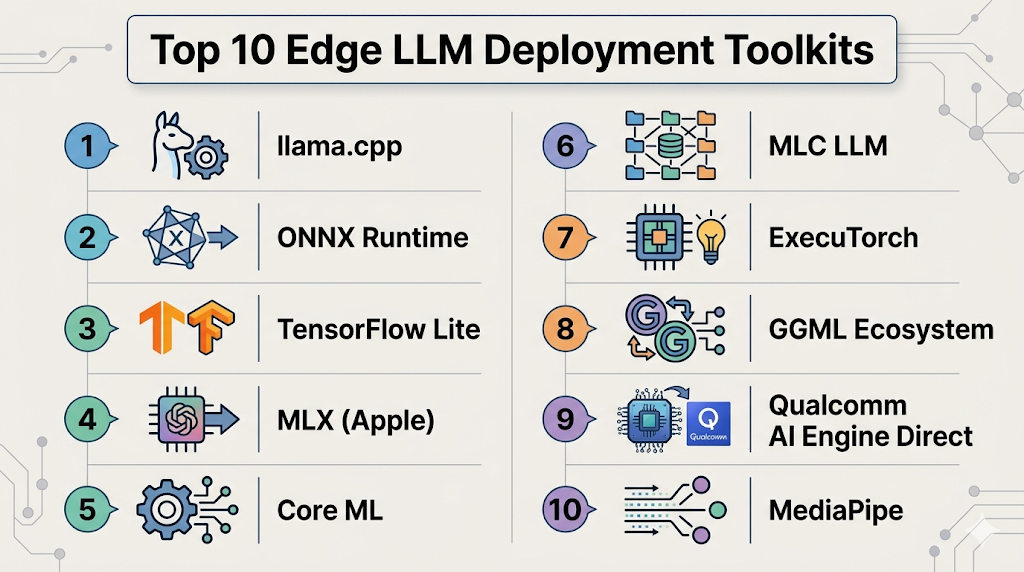
Top 10 Edge LLM Deployment Toolkits
#1 — llama.cpp
One-line verdict: Best lightweight toolkit for running optimized LLMs efficiently on CPU-based edge systems.
Short description:
An open-source inference toolkit designed for highly efficient execution of quantized language models across devices. Widely used in offline AI and embedded systems.
Standout Capabilities
- Highly optimized CPU inference engine
- Strong support for quantized models
- Minimal dependencies for deployment
- Works across laptops and embedded devices
- Efficient memory usage for constrained environments
- Active open-source ecosystem
- Flexible model format support
AI-Specific Depth
- Model support: Open-source quantized models
- RAG / knowledge integration: External only
- Evaluation: Not built-in
- Guardrails: Not built-in
- Observability: Basic logging only
Pros
- Extremely efficient on CPU-only hardware
- Lightweight and portable
- Strong community adoption
Cons
- No enterprise orchestration features
- Requires manual optimization
- Limited built-in tooling
Security & Compliance
Not publicly stated
Deployment & Platforms
- Linux, Windows, macOS
- Edge devices and embedded systems
Integrations & Ecosystem
- Model converters
- Python bindings
- Community tooling
- Edge AI pipelines
Pricing Model
Open-source
Best-Fit Scenarios
- Offline AI applications
- Edge IoT devices
- Lightweight AI assistants
#2 — ONNX Runtime
One-line verdict: Best cross-platform runtime for deploying optimized models across diverse edge hardware.
Short description:
A high-performance inference engine supporting multiple frameworks and hardware backends, widely used in production AI systems.
Standout Capabilities
- Multi-framework model compatibility
- Hardware acceleration support
- Graph optimization engine
- Cross-platform deployment
- Strong performance tuning capabilities
- Enterprise adoption at scale
AI-Specific Depth
- Model support: Multi-framework
- RAG / knowledge integration: External
- Evaluation: Not built-in
- Guardrails: Not built-in
- Observability: Basic metrics support
Pros
- Extremely flexible deployment
- Strong performance optimization
- Broad hardware compatibility
Cons
- Complex configuration
- Not LLM-specific
- Requires tuning for best results
Security & Compliance
Not publicly stated
Deployment & Platforms
- Cloud, edge, hybrid
- Windows, Linux, macOS
Integrations & Ecosystem
- PyTorch
- TensorFlow
- Azure ML ecosystem
- Custom pipelines
Pricing Model
Open-source
Best-Fit Scenarios
- Enterprise edge deployments
- Multi-device AI systems
- Cross-platform AI applications
#3 — TensorFlow Lite
One-line verdict: Best production-ready mobile and edge toolkit for scalable AI deployment.
Short description:
A lightweight ML runtime optimized for mobile and embedded devices with strong hardware acceleration support.
Standout Capabilities
- Mobile-first AI optimization
- Hardware acceleration support
- Model quantization tools
- Stable production deployment
- Wide device compatibility
- Strong tooling ecosystem
AI-Specific Depth
- Model support: TensorFlow-based models
- RAG / knowledge integration: External
- Evaluation: Not built-in
- Guardrails: Not built-in
- Observability: Basic support
Pros
- Mature and stable ecosystem
- Strong mobile integration
- High performance on edge devices
Cons
- Not LLM-native
- Requires model conversion
- Limited generative AI tooling
Security & Compliance
Not publicly stated
Deployment & Platforms
- Android
- Embedded systems
- Edge devices
Integrations & Ecosystem
- TensorFlow ecosystem
- Mobile SDKs
- Edge accelerators
- Model optimization tools
Pricing Model
Open-source
Best-Fit Scenarios
- Mobile AI apps
- Embedded systems
- Production edge pipelines
#4 — MLX (Apple)
One-line verdict: Best toolkit for optimized LLM deployment on Apple Silicon devices.
Short description:
A machine learning framework designed specifically for efficient computation on Apple hardware.
Standout Capabilities
- Deep Apple Silicon optimization
- Efficient memory handling
- Native GPU acceleration
- Developer-friendly APIs
- Fast local inference execution
- Tight OS integration
AI-Specific Depth
- Model support: Converted/open models
- RAG / knowledge integration: External
- Evaluation: Not built-in
- Guardrails: Not built-in
- Observability: Limited
Pros
- Excellent performance on Apple devices
- Energy efficient execution
- Strong hardware integration
Cons
- Apple ecosystem dependency
- Limited portability
- Smaller ecosystem
Security & Compliance
Not publicly stated
Deployment & Platforms
- macOS
- Apple Silicon devices
Integrations & Ecosystem
- Swift + Python APIs
- Apple ML ecosystem
- Local inference tools
Pricing Model
Open-source
Best-Fit Scenarios
- macOS AI apps
- On-device copilots
- Private AI workflows
#5 — Core ML
One-line verdict: Best native Apple framework for secure and efficient on-device AI inference.
Short description:
Apple’s production-grade machine learning framework for deploying models directly on iOS and macOS devices.
Standout Capabilities
- Native Apple integration
- High-performance inference
- Strong privacy model
- Hardware acceleration
- Low-latency execution
- Energy-efficient design
AI-Specific Depth
- Model support: Converted models
- RAG / knowledge integration: External
- Evaluation: Not built-in
- Guardrails: Not built-in
- Observability: Limited
Pros
- Seamless Apple ecosystem integration
- Strong privacy guarantees
- Excellent performance
Cons
- Apple-only ecosystem
- Requires model conversion
- Limited flexibility
Security & Compliance
Not publicly stated
Deployment & Platforms
- iOS
- macOS
Integrations & Ecosystem
- Apple ML tools
- Swift APIs
- Mobile app frameworks
Pricing Model
System-level framework (no direct cost)
Best-Fit Scenarios
- iOS AI applications
- Mobile assistants
- Privacy-first apps
#6 — MLC LLM
One-line verdict: Best for running LLMs efficiently in browsers and edge environments.
Short description:
A compiler-based runtime designed for deploying optimized LLMs across web and mobile platforms.
Standout Capabilities
- Web-based LLM execution
- GPU acceleration via WebGPU
- Compiler-level optimization
- Cross-platform portability
- Lightweight runtime design
- Open-source flexibility
AI-Specific Depth
- Model support: Open-source models
- RAG / knowledge integration: External
- Evaluation: Not built-in
- Guardrails: Not built-in
- Observability: Limited
Pros
- Runs in browser environments
- Highly portable
- Efficient execution model
Cons
- Early-stage ecosystem
- Requires technical setup
- Limited enterprise tooling
Security & Compliance
Not publicly stated
Deployment & Platforms
- Web
- Mobile
- Edge systems
Integrations & Ecosystem
- WebGPU
- JavaScript SDKs
- Compiler toolchain
Pricing Model
Open-source
Best-Fit Scenarios
- Browser AI apps
- Offline web assistants
- Lightweight edge deployments
#7 — ExecuTorch
One-line verdict: Best PyTorch-native toolkit for mobile and edge AI inference.
Short description:
A lightweight runtime designed to deploy PyTorch models efficiently on mobile and edge devices.
Standout Capabilities
- PyTorch-native execution
- Mobile optimization
- Modular runtime architecture
- Hardware acceleration support
- Efficient inference pipeline
- Edge-first design
AI-Specific Depth
- Model support: PyTorch models
- RAG / knowledge integration: External
- Evaluation: Not built-in
- Guardrails: Not built-in
- Observability: Basic
Pros
- Strong PyTorch ecosystem alignment
- Efficient mobile execution
- Flexible architecture
Cons
- Early-stage maturity
- Limited tooling
- Requires optimization effort
Security & Compliance
Not publicly stated
Deployment & Platforms
- iOS
- Android
- Edge devices
Integrations & Ecosystem
- PyTorch ecosystem
- Mobile SDKs
- Hardware acceleration tools
Pricing Model
Open-source
Best-Fit Scenarios
- Mobile AI applications
- PyTorch-based workflows
- Edge inference systems
#8 — GGML Ecosystem
One-line verdict: Best low-level toolkit for highly efficient CPU-based LLM inference.
Short description:
A foundational ecosystem enabling optimized inference for quantized models in constrained environments.
Standout Capabilities
- CPU-optimized inference
- Quantized model support
- Lightweight execution layer
- Edge-friendly architecture
- Flexible deployment options
AI-Specific Depth
- Model support: Quantized open models
- RAG / knowledge integration: External
- Evaluation: Not built-in
- Guardrails: Not built-in
- Observability: Basic
Pros
- Extremely lightweight
- High CPU efficiency
- Flexible usage
Cons
- Low-level complexity
- Minimal tooling
- Requires expertise
Security & Compliance
Not publicly stated
Deployment & Platforms
- CPU-based systems
- Edge devices
Integrations & Ecosystem
- Model converters
- Inference frameworks
- Community tools
Pricing Model
Open-source
Best-Fit Scenarios
- Embedded systems
- Research environments
- Lightweight deployments
#9 — Qualcomm AI Engine Direct
One-line verdict: Best toolkit for optimized inference on Snapdragon-powered edge devices.
Short description:
A hardware-optimized AI runtime for Qualcomm chipsets enabling high-performance mobile AI workloads.
Standout Capabilities
- NPU acceleration support
- Mobile-first optimization
- Low-power inference
- Hardware-aware execution
- Edge deployment focus
AI-Specific Depth
- Model support: Vendor-optimized models
- RAG / knowledge integration: External
- Evaluation: Not built-in
- Guardrails: Not built-in
- Observability: Limited
Pros
- High performance on Snapdragon devices
- Energy efficient
- Strong mobile optimization
Cons
- Hardware dependency
- Limited portability
- Vendor ecosystem lock-in
Security & Compliance
Not publicly stated
Deployment & Platforms
- Snapdragon-based devices
- Mobile and embedded systems
Integrations & Ecosystem
- Qualcomm SDKs
- Mobile AI pipelines
- Edge tooling
Pricing Model
Not publicly stated
Best-Fit Scenarios
- Mobile AI apps
- Embedded AI systems
- Edge inference workloads
#10 — MediaPipe
One-line verdict: Best real-time multimodal edge AI toolkit for vision, audio, and language pipelines.
Short description:
A framework for building real-time AI pipelines that combine multiple modalities on edge devices.
Standout Capabilities
- Real-time pipeline execution
- Multimodal AI support
- Cross-platform deployment
- Efficient graph-based processing
- Mobile optimization
- Edge-ready architecture
AI-Specific Depth
- Model support: Multi-framework
- RAG / knowledge integration: External
- Evaluation: Not built-in
- Guardrails: Not built-in
- Observability: Basic
Pros
- Real-time performance
- Strong multimodal capabilities
- Cross-platform support
Cons
- Not LLM-focused
- Complex setup
- Limited generative AI tooling
Security & Compliance
Not publicly stated
Deployment & Platforms
- Android
- iOS
- Web
- Edge systems
Integrations & Ecosystem
- Google ML ecosystem
- Vision pipelines
- Mobile SDKs
Pricing Model
Open-source
Best-Fit Scenarios
- Real-time AI applications
- Vision-based edge systems
- Multimodal pipelines
Comparison Table (Top 10)
| Tool Name | Best For | Deployment | Model Flexibility | Strength | Watch-Out | Public Rating |
|---|---|---|---|---|---|---|
| llama.cpp | CPU inference | Edge | Open-source | Efficiency | Low-level tuning | N/A |
| ONNX Runtime | Cross-platform AI | Hybrid | Multi-framework | Flexibility | Complexity | N/A |
| TensorFlow Lite | Mobile AI | Edge | Open-source | Stability | Not LLM-native | N/A |
| MLX | Apple devices | On-device | Open-source | Apple optimization | Ecosystem lock | N/A |
| Core ML | iOS/macOS AI | On-device | Converted models | Native performance | Apple-only | N/A |
| MLC LLM | Browser AI | Edge | Open-source | Web deployment | Early stage | N/A |
| ExecuTorch | PyTorch mobile | Edge | PyTorch | Mobile efficiency | Early ecosystem | N/A |
| GGML | CPU inference | Edge | Open-source | Lightweight | Technical complexity | N/A |
| Qualcomm AI Engine | Snapdragon AI | Edge | Vendor models | NPU acceleration | Hardware lock-in | N/A |
| MediaPipe | Multimodal AI | Edge | Multi-framework | Real-time pipelines | Not LLM-focused | N/A |
Scoring & Evaluation (Transparent Rubric)
These scores compare how well each toolkit performs across real-world edge LLM deployment requirements such as efficiency, portability, and production readiness.
| Tool | Core | Reliability | Guardrails | Integrations | Ease | Perf/Cost | Security | Support | Weighted Total |
|---|---|---|---|---|---|---|---|---|---|
| llama.cpp | 9 | 7 | 4 | 7 | 8 | 10 | 7 | 8 | 7.9 |
| ONNX Runtime | 9 | 8 | 5 | 9 | 7 | 9 | 8 | 9 | 8.2 |
| TensorFlow Lite | 9 | 8 | 5 | 9 | 7 | 9 | 8 | 9 | 8.2 |
| MLX | 8 | 7 | 4 | 7 | 8 | 9 | 8 | 7 | 7.8 |
| Core ML | 8 | 8 | 6 | 8 | 9 | 9 | 9 | 8 | 8.3 |
| MLC LLM | 8 | 7 | 4 | 7 | 7 | 9 | 7 | 7 | 7.5 |
| ExecuTorch | 8 | 7 | 4 | 8 | 7 | 9 | 7 | 7 | 7.6 |
| GGML | 8 | 6 | 4 | 6 | 7 | 10 | 7 | 7 | 7.4 |
| Qualcomm AI Engine | 8 | 7 | 5 | 7 | 7 | 10 | 8 | 7 | 7.7 |
| MediaPipe | 8 | 7 | 5 | 8 | 8 | 9 | 8 | 8 | 7.9 |
Top 3 for Enterprise: ONNX Runtime, Core ML, TensorFlow Lite
Top 3 for SMB: llama.cpp, MLX, MLC LLM
Top 3 for Developers: llama.cpp, ONNX Runtime, ExecuTorch
Which Edge LLM Deployment Toolkit Is Right for You?
Solo / Freelancer
llama.cpp and MLC LLM are best for experimentation and lightweight local AI apps.
SMB
ONNX Runtime and TensorFlow Lite offer scalable deployment across multiple devices.
Mid-Market
ExecuTorch and TensorFlow Lite provide strong mobile and production balance.
Enterprise
ONNX Runtime, Core ML, and TensorFlow Lite are best for governance, scale, and stability.
Regulated industries
Core ML and TensorFlow Lite are preferred due to strong local execution and reduced data exposure.
Budget vs premium
- Budget: llama.cpp, GGML, MLC LLM
- Premium: Core ML, Qualcomm AI Engine Direct
Build vs buy (when to DIY)
Build custom edge stacks when you need extreme optimization or hardware-specific tuning; otherwise use established toolkits for faster deployment.
Implementation Playbook (30 / 60 / 90 Days)
30 Days
- Define target edge hardware
- Benchmark runtimes with sample models
- Test latency and memory usage
- Validate offline inference capability
60 Days
- Integrate runtime into application pipeline
- Optimize quantized model performance
- Add edge RAG workflows if needed
- Improve inference stability
90 Days
- Scale deployment across devices
- Optimize cost and energy usage
- Add monitoring and fallback strategies
- Harden production-grade reliability
Common Mistakes & How to Avoid Them
- Deploying non-quantized models on edge devices
- Ignoring memory and power constraints
- Not benchmarking real-world latency
- Over-reliance on cloud fallback
- Poor model format compatibility planning
- Lack of offline-first design
- Not optimizing token streaming
- Ignoring hardware acceleration options
- Weak testing on actual edge hardware
- Over-engineering early prototypes
- No fallback strategy for failures
- Underestimating energy consumption
- Vendor lock-in without abstraction layer
FAQs
What are Edge LLM Deployment Toolkits?
They are frameworks that enable running large language models directly on local or edge devices instead of cloud servers.
Why use edge deployment for LLMs?
To reduce latency, improve privacy, and enable offline AI capabilities.
Can large models run on edge devices?
Yes, but typically through quantization and optimization.
Do edge toolkits work offline?
Yes, most are designed for full offline execution.
What hardware is required?
CPUs, GPUs, or NPUs depending on optimization level.
What is model quantization?
A technique that reduces model size to improve speed and efficiency.
Are these toolkits production-ready?
Yes, many like ONNX Runtime and TensorFlow Lite are widely used in production.
Can I switch models dynamically?
Some toolkits support runtime model switching, others require reloads.
Is GPU required?
Not always; many toolkits support CPU-only execution.
What is the main limitation?
Hardware constraints like memory, compute power, and energy consumption.
Are these secure?
Generally yes, since data stays on-device, but implementation matters.
What is the biggest advantage?
Privacy, low latency, and offline capability.
Conclusion
Edge LLM deployment toolkits are enabling a major shift in AI architecture—from centralized cloud inference to distributed, local intelligence. This transformation unlocks faster, more private, and more resilient AI systems across industries.
The right toolkit depends on your hardware environment, performance needs, and deployment scale. Some prioritize efficiency, others flexibility, and some are deeply integrated into specific ecosystems.
Next steps:
- Shortlist toolkits based on target devices
- Benchmark real-world performance
- Validate offline, latency, and memory constraints before production rollout