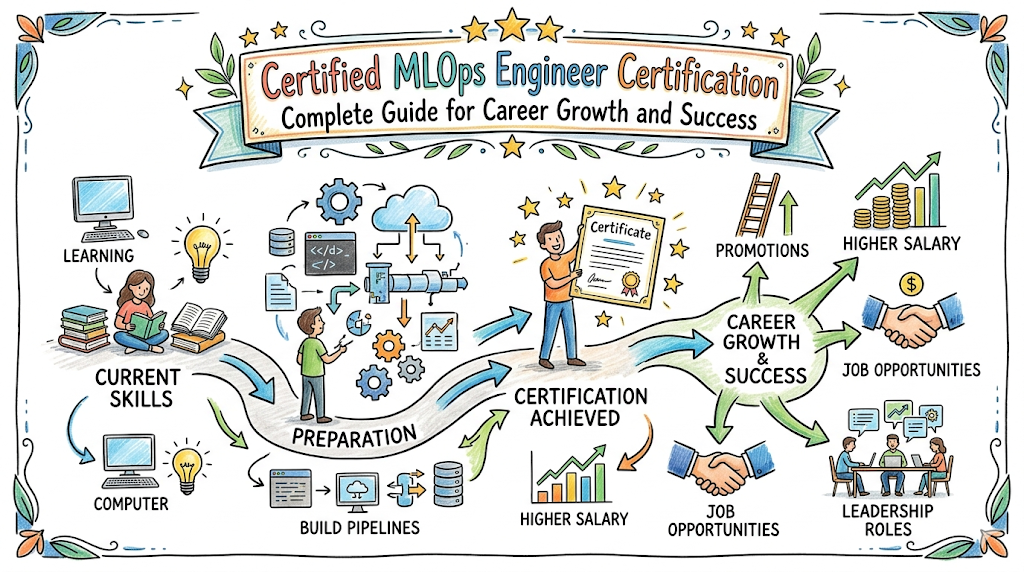
Introduction
The Certified MLOps Engineer is recognized as a vital credential for professionals who aim to master the intersection of machine learning and production operations. This guide is curated for engineers and managers who are responsible for building, deploying, and maintaining machine learning models within enterprise environments.
As organizations move away from manual experimentation toward automated pipelines, specialized skills are required to ensure reliability and scalability. This comprehensive resource is provided by aiopsschool.com to help professionals evaluate their learning options and make informed career decisions in the evolving technology landscape.
What is the Certified MLOps Engineer?
The Certified MLOps Engineer represents a formal validation of the technical skills needed to operationalize machine learning at scale. It is designed to bridge the gap between data science and traditional DevOps by focusing on the continuous delivery and monitoring of models.
A focus is placed on the automation of the entire lifecycle, ensuring that machine learning assets are treated with the same rigor as software code. This program aligns with modern enterprise practices, emphasizing the importance of stability, security, and reproducibility in production-grade AI systems.
Who Should Pursue Certified MLOps Engineer?
This certification is intended for a broad range of technical professionals, including DevOps engineers, SREs, and cloud architects who support data-driven applications. Data scientists and machine learning engineers who wish to improve their operational capabilities will also find significant value in this curriculum.
Engineering managers and technical leads in India and the global market can utilize this program to standardize the skill sets of their teams. It is suitable for both mid-career professionals looking to pivot into AI operations and senior architects who oversee complex platform engineering strategies.
Why Certified MLOps Engineer is Valuable Today and Beyond
The longevity of this certification is secured by the increasing integration of machine learning into core business processes across all sectors. As enterprises scale their AI efforts, the need for standardized operational frameworks becomes a critical requirement for maintaining a competitive edge.
By obtaining this credential, professionals are helped to remain relevant in a market that is shifting toward intelligent automation and data-centric infrastructure. A strong return on career investment is provided through the focus on durable principles of automation and monitoring that remain applicable regardless of specific tool changes.
Certified MLOps Engineer Certification Overview
The program is delivered through a structured learning path that covers the essential domains of machine learning operations. It is designed to evaluate a candidate’s ability to handle real-world scenarios, ranging from data ingestion to model inference and drift detection.
Certification levels are offered to accommodate different stages of professional growth, ensuring a logical progression from foundational knowledge to expert-level architecture. The assessment methodology is focused on practical outcomes, ensuring that those who are certified can contribute immediately to production environments.
Certified MLOps Engineer Certification Tracks & Levels
Multiple tracks are provided within the program to cater to various professional specializations, including DevOps, SRE, and data-centric roles. Each track is divided into foundation, professional, and expert levels to provide a clear roadmap for career advancement.
The foundation level focuses on core concepts and terminology, while the professional level addresses the implementation of automated pipelines and monitoring. The expert level is reserved for those who design large-scale, multi-cloud architectures and govern the entire MLOps lifecycle at an enterprise scale.
Complete Certified MLOps Engineer Certification Table
| Track | Level | Who it’s for | Prerequisites | Skills Covered | Recommended Order |
| MLOps Core | Foundation | Beginners / Managers | Basic IT Awareness | ML Lifecycle, DevOps Basics | 1st |
| MLOps Core | Professional | Systems Engineers | Foundation Level | CI/CD, Model Monitoring | 2nd |
| MLOps Core | Expert | Principal Architects | Professional Level | Scaling, Governance, Security | 3rd |
| DataOps | Specialist | Data Engineers | SQL / Python Basics | Data Pipelines, Versioning | Concurrent |
| SRE Ops | Specialist | SRE / Platform Team | Cloud Knowledge | Reliability, Drift Detection | Optional |
Detailed Guide for Each Certified MLOps Engineer Certification
Certified MLOps Engineer – Foundation
What it is
The fundamental principles of machine learning operations are validated at this entry level. It is designed to ensure that the candidate understands how ML projects differ from standard software projects in terms of lifecycle and maintenance.
Who should take it
This track is recommended for junior engineers, project managers, and business analysts who need to understand the technical requirements of supporting an AI team. It serves as the starting point for those new to the field.
Skills you’ll gain
- Understanding of the machine learning pipeline stages.
- Knowledge of basic automation principles.
- Familiarity with the roles involved in an MLOps team.
- Ability to identify key metrics for model success.
Real-world projects you should be able to do
- Documenting a high-level model deployment workflow.
- Identifying bottlenecks in a manual data science process.
- Communicating technical requirements between data and ops teams.
Preparation plan
- 7–14 days: Core definitions and lifecycle phases are studied.
- 30 days: Online modules and case studies are completed.
- 60 days: Practice exams are taken to ensure conceptual mastery.
Common mistakes
- Ignoring the data component of the pipeline.
- Confusing MLOps with traditional software DevOps.
Best next certification after this
- Same-track option: Certified MLOps Engineer – Professional
- Cross-track option: AIOps Foundation
- Leadership option: Technical Product Management for AI
Certified MLOps Engineer – Professional
What it is
The ability to implement and manage automated machine learning pipelines is validated at this level. A focus is placed on the technical execution of continuous integration and continuous deployment for models.
Who should take it
This is intended for DevOps engineers, ML engineers, and cloud practitioners who are actively building infrastructure for data science teams. Practical experience is required.
Skills you’ll gain
- Implementation of automated CI/CD for models.
- Management of model registries and metadata.
- Configuration of container orchestration for ML.
- Setup of performance monitoring and logging.
Real-world projects you should be able to do
- Building a full pipeline from data ingestion to deployment.
- Implementing automated model retraining based on drift.
- Managing GPU resources in a shared cluster environment.
Preparation plan
- 7–14 days: Lab environments are configured for practice.
- 30 days: End-to-end pipelines are built using common tools.
- 60 days: Advanced monitoring and security layers are integrated.
Common mistakes
- Failing to automate the data validation step.
- Neglecting the security of the model artifacts.
Best next certification after this
- Same-track option: Certified MLOps Engineer – Expert
- Cross-track option: Kubernetes Certification (CKA)
- Leadership option: MLOps Lead Engineer
Certified MLOps Engineer – Expert
What it is
Architectural mastery of complex machine learning systems is validated at the expert level. The focus is shifted toward enterprise governance, compliance, and multi-cloud strategy.
Who should take it
This level is designed for senior architects and infrastructure leads who are responsible for the MLOps maturity of an entire organization.
Skills you’ll gain
- Designing scalable multi-tenant ML platforms.
- Implementing enterprise-grade model governance.
- Optimizing costs for large-scale GPU workloads.
- Leading organizational changes for MLOps adoption.
Real-world projects you should be able to do
- Architecting a global MLOps platform for a multinational corporation.
- Implementing an automated compliance audit for all deployed models.
- Designing disaster recovery strategies for real-time AI services.
Preparation plan
- 7–14 days: Governance frameworks and ethics guidelines are studied.
- 30 days: Complex multi-cloud architectures are diagrammed.
- 60 days: Deep analysis of enterprise failure scenarios is performed.
Common mistakes
- Over-engineering for small or simple ML use cases.
- Ignoring the financial impact of unmanaged cloud resources.
Best next certification after this
- Same-track option: Advanced AI Security Specialist
- Cross-track option: FinOps Certified Professional
- Leadership option: CTO or Head of AI Infrastructure
Choose Your Learning Path
DevOps Path
The extension of traditional DevOps practices into the realm of machine learning is emphasized in this path. Existing skills in CI/CD and infrastructure as code are utilized to build robust environments for data science. This route is ideal for those who want to apply their automation expertise to the unique challenges of model versioning and data dependency.
DevSecOps Path
The protection of the machine learning lifecycle is the primary focus of this learning trajectory. Security measures are integrated into the pipeline to ensure the integrity of data and the safety of model artifacts. This path is essential for organizations operating in regulated industries where compliance and data privacy are mandatory requirements.
SRE Path
Reliability and stability of AI services in production are prioritized in the SRE path. Methods for monitoring model health, identifying drift, and ensuring high availability are studied in detail. This route is designed for professionals who are responsible for the uptime and performance of critical machine learning applications at scale.
AIOps Path
Artificial intelligence is applied to the management of IT operations and infrastructure. This path focuses on using machine learning to analyze logs, predict system failures, and automate incident response. It is a specialized track for those who wish to build intelligent, self-healing systems that improve operational efficiency through data.
MLOps Path
The operational lifecycle of machine learning is the core subject of this dedicated path. Automation is applied to every stage, from data preparation to model hosting and evaluation. This route is intended for those who seek to become specialists in the field, ensuring that machine learning can be delivered with speed and consistency.
DataOps Path
The management of data quality and the automation of data delivery are highlighted in this track. It focuses on the data engineering aspects of the machine learning pipeline, ensuring that models have access to high-quality inputs. This path is suitable for those coming from a database or data warehouse background who want to support AI.
FinOps Path
Financial accountability and cost optimization for machine learning workloads are the focus of this path. Strategies for managing expensive GPU resources and cloud expenditures are developed to ensure the sustainability of AI projects. This route is critical for managers who must balance innovation with budget constraints in an enterprise.
Role → Recommended Certified MLOps Engineer Certifications
| Role | Recommended Certifications |
| DevOps Engineer | Foundation + Professional (MLOps Core) |
| SRE | Professional (MLOps Core) + SRE Ops Specialist |
| Platform Engineer | Professional + Expert (MLOps Core) |
| Cloud Engineer | Foundation + SRE Ops Specialist |
| Security Engineer | Professional (MLOps Core) + DevSecOps Focus |
| Data Engineer | Foundation + DataOps Specialist |
| FinOps Practitioner | Foundation + FinOps Path |
| Engineering Manager | Foundation + Leadership Track |
Next Certifications to Take After Certified MLOps Engineer
Same Track Progression
Deep specialization is pursued by moving into the Expert level of the MLOps certification. This allows professionals to move beyond implementation and into the strategic design of entire platforms. Mastery at this level ensures that an engineer can lead large-scale initiatives and handle the governance requirements of major enterprises.
Cross-Track Expansion
Skill broadening is achieved by exploring certifications in related infrastructure fields. Pursuing a Kubernetes administrator credential or a cloud security specialist certification provides a more rounded technical profile. This approach ensures that the engineer can manage the underlying infrastructure as effectively as the ML pipelines.
Leadership & Management Track
The transition into technical leadership is supported by certifications focused on team management and strategy. As an engineer moves away from daily coding tasks, the ability to manage budgets and stakeholders becomes more important. This track prepares professionals for roles such as Director of AI Operations or Lead Infrastructure Architect.
Training & Certification Support Providers for Certified MLOps Engineer
DevOpsSchool
The training programs provided by DevOpsSchool are recognized for their deep technical focus and industry alignment. A wide range of certification preparation courses is offered, covering everything from basic automation to advanced platform engineering. The curriculum is often led by experts who ensure that students receive guidance based on real-world experience. A strong community presence is maintained, allowing learners to connect with peers and mentors throughout their journey. The institution is frequently recommended for its hands-on labs and comprehensive study materials that cater to both Indian and global audiences. This support is vital for those aiming for professional-level mastery.
Cotocus
The services provided by Cotocus focus on enterprise-grade training and professional certification support. Specialized tracks are developed to meet the needs of modern IT departments, including MLOps, SRE, and DevSecOps. A practical approach is taken, ensuring that students are not just learning theory but are also building production-ready skills. The institution is known for its customized training modules that can be tailored to the specific requirements of corporate teams. High success rates are reported by candidates who utilize their structured learning paths and expert-led workshops for certification preparation. This provider is considered a leader in corporate technical upskilling.
Scmgalaxy
The resources provided by Scmgalaxy are highly valued by the software configuration management and DevOps community. A vast library of tutorials, guides, and technical articles is maintained to support continuous learning. The platform serves as a hub for professionals to stay updated on the latest trends in automation and CI/CD. Training sessions are designed to be interactive, focusing on the practical application of tools in real-world scenarios. It is considered an essential resource for engineers who are preparing for certifications and looking for reliable technical documentation and community support. The platform emphasizes the importance of sharing knowledge and best practices.
BestDevOps
The training solutions offered by BestDevOps are designed to streamline the learning process for busy professionals. A focus is placed on delivering high-impact content that directly correlates with certification exam objectives. Short, intensive courses are provided to help engineers quickly gain the skills needed for career advancement. The instructors are chosen for their ability to explain complex technical concepts in simple, understandable terms. It is a preferred choice for individuals who require a focused and efficient study plan to achieve their certification goals in a short period of time. Their methodology focuses on efficiency without sacrificing the depth of technical knowledge.
devsecopsschool.com
The integration of security into the development lifecycle is the primary focus of devsecopsschool.com. Training programs are developed to help engineers master the tools and techniques required for modern DevSecOps roles. A comprehensive curriculum is offered, covering security automation, compliance as code, and vulnerability management. The courses are designed to bridge the gap between traditional security practices and rapid software delivery. It is a leading provider for those who want to specialize in the protection of automated pipelines and cloud-native applications across various industries. Security is treated as a foundational element of all technical training provided.
sreschool.com
The principles of Site Reliability Engineering are taught with a focus on practical implementation at sreschool.com. Students are guided through the process of defining SLOs, managing error budgets, and implementing robust monitoring systems. The training is intended to help engineers transition into SRE roles with confidence. A strong emphasis is placed on reducing toil and improving system reliability through automation. The curriculum is updated regularly to reflect the evolving standards of the SRE community, making it a reliable source for professional development in the field of reliability engineering. The school focus on high availability for all modern enterprise applications.
The niche field of AI-driven operations is the specialty of aiopsschool.com. Training programs are provided to help professionals understand how artificial intelligence can be leveraged to improve IT infrastructure. A focus is placed on the Certified MLOps Engineer track, ensuring that candidates are well-prepared for the challenges of operationalizing machine learning. The instructors provide deep insights into data science and operations, helping students bridge the gap between the two domains. It is the primary destination for those seeking to become experts in the intersection of AI and systems engineering. The school is highly regarded for its specialized focus and technical depth.
dataopsschool.com
The management of data pipelines and data quality is the core focus at dataopsschool.com. Training is offered to help engineers master the principles of DataOps, ensuring that data is delivered reliably and efficiently to those who need it. The curriculum covers data versioning, automated testing for data, and the orchestration of complex data workflows. The courses are designed to support the growing demand for data-centric roles in the MLOps ecosystem. It is a key resource for professionals coming from a database or data engineering background looking to modernize their skills. Data integrity is emphasized as the cornerstone of every successful AI project.
finopsschool.com
The financial management of cloud resources is the primary subject taught at finopsschool.com. Training programs are developed to help professionals master the FinOps framework, focusing on cost transparency and optimization. The curriculum is designed to help organizations maximize the value of their cloud investment while minimizing waste. Students are taught how to build a culture of financial accountability within their technical teams. It is an essential provider for anyone responsible for the budget and efficiency of large-scale cloud and AI operations in the modern enterprise. The school helps bridge the gap between technical operations and financial management.
Frequently Asked Questions (General)
- How long does it typically take to prepare for the exam?
Most professionals find that 30 to 60 days of dedicated study are sufficient to cover the material. This timeframe allows for the completion of the theoretical modules and sufficient hands-on lab practice. - Is coding knowledge a requirement for this certification?
A basic understanding of scripting, particularly in Python, is highly recommended for the technical tracks. For the foundation level, a conceptual understanding of the technology is usually enough. - What is the format of the certification exam?
The exam is generally conducted in an online, proctored environment and consists of a mix of questions and scenarios. It is designed to test both theoretical knowledge and practical application skills. - Is this certification recognized by global enterprises?
Yes, the certification is recognized across various industries and geographic regions, including major tech hubs in India. It is valued by companies that are scaling their AI and machine learning initiatives. - Does the program focus on a specific cloud provider?
The program is designed to be vendor-neutral, focusing on open-source tools and universal principles. This allows the skills to be applied to any platform, such as AWS, Azure, or Google Cloud. - Are there any prerequisites for the Professional level?
Candidates are typically expected to have completed the foundation level or have equivalent industry experience. A working knowledge of DevOps and basic cloud infrastructure is very beneficial. - What is the passing score for the assessment?
A passing score of 70% or higher is generally required to earn the credential. This ensures that a high standard of technical proficiency is maintained among all certified individuals. - How often are the course materials updated?
The curriculum is reviewed and updated at least once a year to reflect changes in the industry. This ensures that the training remains relevant as new tools and methodologies emerge. - Can I pursue this certification if I am in a management role?
Yes, the foundation and leadership tracks are specifically designed for managers and technical leads. These tracks focus on strategy, governance, and team structure rather than deep coding. - Is there a community or support network for students?
Most training providers offer access to forums and alumni groups where students can share knowledge. This community support is an important part of the long-term learning process. - Are practice exams provided as part of the training?
Yes, practice exams are usually included to help candidates gauge their readiness for the actual assessment. These are excellent tools for identifying areas that require further study. - What is the validity period of the certification?
The certification is typically valid for two to three years, after which recertification is required. This practice ensures that professionals keep their skills current in a fast-moving field.
FAQs on Certified MLOps Engineer
- How is the Certified MLOps Engineer track different from a standard DevOps course?
The curriculum is focused specifically on the challenges of machine learning, such as data versioning and model drift. Traditional DevOps focuses on code, whereas this track integrates the data and model components. - Does the training cover automated model monitoring in production?
Yes, model monitoring and performance tracking are core elements of the professional level. Candidates learn how to detect when a model’s accuracy is declining and how to automate the response. - What role does Kubernetes play in the certification?
Kubernetes is often used as the primary orchestration tool for deploying and scaling models. The training includes instructions on how to manage ML workloads using containerized environments. - Is the Certified MLOps Engineer suitable for data scientists?
Data scientists find this certification valuable for understanding how to move their models into production. It helps them collaborate more effectively with operations and infrastructure teams. - Are real-world case studies included in the curriculum?
The program utilizes various case studies to illustrate how MLOps is implemented in different industries. This helps students understand the practical application of the concepts they are learning. - Can the skills from this certification be applied to small-scale AI projects?
The principles taught in the program are scalable and can be applied to projects of any size. Even small teams benefit from the improved organization and automation provided by MLOps. - What is the focus of the Expert level in this certification?
The expert level focuses on high-level architecture, multi-cloud strategies, and enterprise governance. It is designed for those who manage the infrastructure for dozens or hundreds of models. - Does the program include information on security for ML models?
Yes, the DevSecOps path and the advanced levels cover the security of data and artifacts. This is a critical component for ensuring that AI systems are safe from external threats.
Final Thoughts: Is Certified MLOps Engineer Worth It?
The decision to pursue the Certified MLOps Engineer should be viewed as a strategic investment in professional growth. As machine learning becomes a standard component of modern software, the ability to manage these systems effectively is a skill that will remain in high demand. The program provides a structured and reliable way to gain this expertise in a field that can otherwise be difficult to master.
By focusing on practical outcomes and industry-standard tools, the certification ensures that the knowledge gained is immediately useful in a production environment. For any engineer or manager looking to lead in the field of AI operations, this credential offers a clear path toward technical mastery and career advancement. It is an essential step for those who want to ensure that machine learning is delivered with the same reliability as any other mission-critical service.