Introduction
AI Model Marketplace Platforms are ecosystems where developers, enterprises, and researchers can discover, compare, deploy, and manage machine learning and large language models from multiple providers in one place. Instead of building models from scratch or locking into a single vendor, these platforms act as a centralized hub for accessing proprietary, open-source, and fine-tuned models.
These platforms matter because organizations are increasingly adopting multi-model strategies—choosing the best model for each task based on performance, cost, latency, and compliance needs. As AI systems become more agentic and multimodal, the ability to seamlessly switch, test, and orchestrate models becomes a competitive advantage.
Real-world use cases:
- Running A/B tests across multiple LLMs for customer support automation
- Switching models dynamically based on cost or latency constraints in production
- Deploying domain-specific fine-tuned models for healthcare or finance workflows
- Managing private model registries for internal AI development teams
- Building AI agents that route tasks across specialized models
What to evaluate:
- Model variety and ecosystem depth
- Support for proprietary vs open-source vs BYO models
- Model routing and fallback capabilities
- Evaluation and benchmarking tools
- Guardrails and safety features
- Observability (latency, token usage, errors)
- Cost control and optimization
- Security, privacy, and data residency
- API reliability and developer experience
- Vendor lock-in risk
Best for: AI engineers, platform teams, CTOs, and enterprises building multi-model AI systems or agent-based workflows.
Not ideal for: Small teams using a single API or simple applications where model orchestration is unnecessary.
What’s Changed in AI Model Marketplace Platforms
- Multi-model routing is now core, enabling automatic switching between models based on cost, latency, or accuracy.
- Agent frameworks increasingly rely on marketplaces for tool selection and model orchestration.
- Multimodal model availability (text, image, audio, video) has expanded significantly.
- Built-in evaluation frameworks are becoming standard for benchmarking model outputs.
- Guardrails are evolving to include prompt injection detection and policy enforcement.
- Enterprises demand stronger privacy controls, including data isolation and retention policies.
- Observability now includes token-level cost tracking and latency breakdowns.
- BYO (Bring Your Own) model support is expected, especially for open-source deployments.
- Fine-tuning and model customization are integrated directly into marketplaces.
- Governance features such as audit logs and access controls are increasingly required.
Quick Buyer Checklist (Scan-Friendly)
- Does the platform support both proprietary and open-source models?
- Can you route requests dynamically between models?
- Are evaluation and benchmarking tools built-in?
- What guardrails exist for safety and compliance?
- Does it support multimodal inputs (text, image, audio)?
- How transparent are cost and latency metrics?
- Can you bring your own models or fine-tuned variants?
- Are there strong access controls and audit logs?
- How easy is it to integrate via APIs or SDKs?
- What is the risk of vendor lock-in?
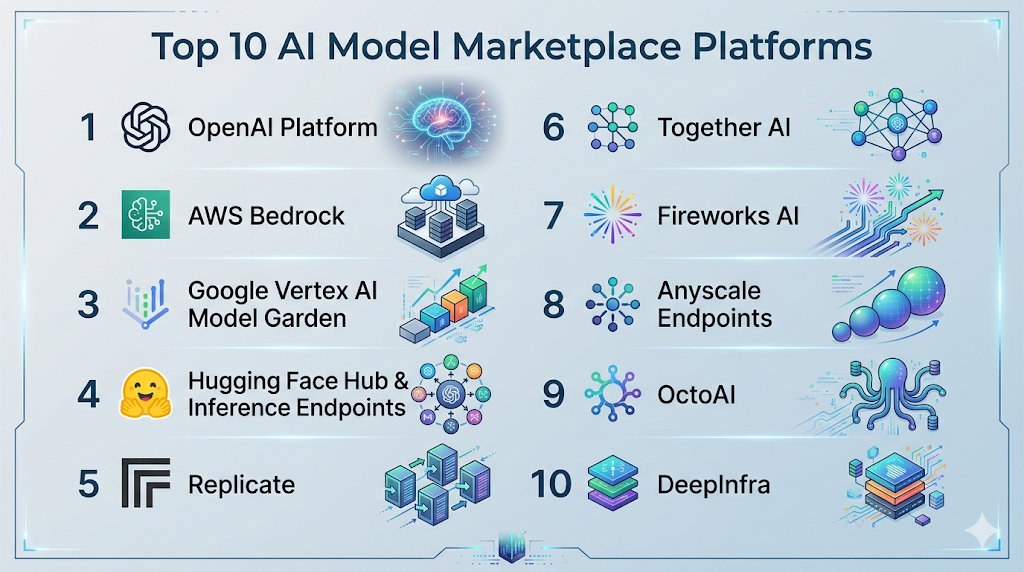
Top 10 AI Model Marketplace Platforms
1 — OpenAI Platform
One-line verdict: Best for developers needing reliable, high-performance proprietary models with strong ecosystem support.
Short description :
Provides access to advanced proprietary models along with APIs for deployment, fine-tuning, and evaluation. Widely used across startups and enterprises for production-grade AI applications.
Standout Capabilities
- High-quality proprietary LLMs with consistent performance across tasks
- Built-in tools for fine-tuning and prompt optimization workflows
- Strong developer ecosystem with extensive SDKs and documentation
- Native support for multimodal inputs including text and images
- Integrated safety systems and usage policies for production environments
- Scalable infrastructure for high-throughput applications
- Continuous model updates without requiring user-side changes
AI-Specific Depth
- Model support: Proprietary
- RAG / knowledge integration: Basic integration support via APIs
- Evaluation: Basic prompt testing; advanced eval varies
- Guardrails: Built-in safety filters and moderation
- Observability: Token usage and latency metrics
Pros
- High reliability and performance consistency
- Strong developer experience and tooling
- Regular updates and improvements
Cons
- Limited flexibility compared to open marketplaces
- Vendor lock-in risk
- Pricing can scale quickly with usage
Security & Compliance
SSO/SAML, encryption, and data controls available. Certifications: Not publicly stated.
Deployment & Platforms
Web, API-based; Cloud.
Integrations & Ecosystem
Integrates with major frameworks and developer tools.
- REST APIs
- SDKs (Python, JavaScript)
- Integration with orchestration tools
- Plugin ecosystem
- Third-party app integrations
Pricing Model
Usage-based pricing.
Best-Fit Scenarios
- Production-grade AI applications
- High-reliability chatbot systems
- Enterprise AI deployments
2 — AWS Bedrock
One-line verdict: Best for enterprises needing multi-model access within a secure cloud-native ecosystem.
Short description :
Offers access to multiple foundation models within AWS, enabling secure deployment and integration with cloud services.
Standout Capabilities
- Access to multiple model providers in one platform
- Deep integration with cloud infrastructure and services
- Fine-tuning and customization capabilities
- Enterprise-grade security and compliance features
- Scalable deployment across regions
- Strong support for hybrid and private deployments
AI-Specific Depth
- Model support: Multi-model
- RAG / knowledge integration: Strong integration with AWS services
- Evaluation: Basic evaluation tools
- Guardrails: Policy enforcement tools
- Observability: Integrated cloud monitoring
Pros
- Enterprise-grade infrastructure
- Strong security features
- Flexible model selection
Cons
- Complex setup
- Requires AWS expertise
- Potential cost complexity
Security & Compliance
Strong enterprise controls; certifications vary.
Deployment & Platforms
Cloud, Hybrid.
Integrations & Ecosystem
Deep integration with cloud ecosystem.
- Data storage services
- ML pipelines
- Monitoring tools
- Identity management
- Serverless compute
Pricing Model
Usage-based.
Best-Fit Scenarios
- Enterprise AI systems
- Secure deployments
- Multi-model experimentation
3 — Google Vertex AI Model Garden
One-line verdict: Best for teams leveraging Google Cloud for scalable AI experimentation and deployment.
Short description :
Provides access to a wide range of models, including Google-developed and open-source options, with strong integration into cloud workflows.
Standout Capabilities
- Broad selection of models including open-source
- Integration with data pipelines and ML workflows
- Built-in tools for training and fine-tuning
- Scalable infrastructure
- Support for multimodal AI
AI-Specific Depth
- Model support: Multi-model
- RAG / knowledge integration: Strong
- Evaluation: Integrated tools
- Guardrails: Basic
- Observability: Advanced metrics
Pros
- Strong scalability
- Flexible model options
- Integration with analytics tools
Cons
- Learning curve
- Requires cloud expertise
- Pricing complexity
Security & Compliance
Enterprise-grade controls; certifications vary.
Deployment & Platforms
Cloud.
Integrations & Ecosystem
- Data pipelines
- ML workflows
- APIs
- SDKs
- Analytics tools
Pricing Model
Usage-based.
Best-Fit Scenarios
- Data-driven AI applications
- Large-scale deployments
- Research experimentation
4 — Hugging Face Hub & Inference Endpoints
One-line verdict: Best for open-source-first teams needing flexibility and community-driven models.
Short description :
A massive repository of open-source models with tools for deployment, sharing, and collaboration.
Standout Capabilities
- Large open-source model library
- Community contributions and sharing
- Easy deployment via endpoints
- Support for custom models
- Strong developer ecosystem
AI-Specific Depth
- Model support: Open-source + BYO
- RAG / knowledge integration: Compatible with vector DBs
- Evaluation: Community tools
- Guardrails: Limited
- Observability: Basic
Pros
- Massive model variety
- Open ecosystem
- Flexible deployment
Cons
- Quality varies
- Requires expertise
- Limited built-in guardrails
Security & Compliance
Not publicly stated.
Deployment & Platforms
Cloud, Self-hosted.
Integrations & Ecosystem
- APIs
- SDKs
- ML frameworks
- Community tools
- Dataset integration
Pricing Model
Freemium + usage-based.
Best-Fit Scenarios
- Research projects
- Open-source experimentation
- Custom model deployment
5 — Replicate
One-line verdict: Best for quickly deploying and experimenting with community and custom AI models.
Short description:
Simplifies running models via API without infrastructure setup.
Standout Capabilities
- Easy API-based model deployment
- Community-driven models
- Quick experimentation workflows
- Minimal setup
AI-Specific Depth
- Model support: Open-source
- RAG: N/A
- Evaluation: Limited
- Guardrails: Minimal
- Observability: Basic
Pros
- Easy to use
- Fast setup
- Good for prototyping
Cons
- Limited enterprise features
- Less control
- Not ideal for large-scale systems
Security & Compliance
Not publicly stated.
Deployment & Platforms
Cloud.
Integrations & Ecosystem
- APIs
- SDKs
- Dev tools
Pricing Model
Usage-based.
Best-Fit Scenarios
- Prototyping
- AI demos
- Experimental apps
6 — Together AI
One-line verdict: Best for cost-efficient open-source model access with scalable inference infrastructure.
Short description:
Provides high-performance inference for open-source models with competitive pricing.
Standout Capabilities
- Optimized inference for open models
- Cost-efficient scaling
- Multi-model access
- API-first design
AI-Specific Depth
- Model support: Open-source
- RAG: Compatible
- Evaluation: Limited
- Guardrails: Basic
- Observability: Metrics available
Pros
- Cost efficiency
- Good performance
- Open ecosystem
Cons
- Limited enterprise features
- Fewer guardrails
- Smaller ecosystem
Best-Fit Scenarios
- Cost-sensitive deployments
- Open-source projects
- AI experimentation
7 — Fireworks AI
One-line verdict: Best for teams needing ultra-fast inference with optimized serving for high-throughput AI applications.
Short description :
Focuses on high-performance inference infrastructure for both proprietary and open-source models. Designed for teams that prioritize speed, scalability, and efficient GPU utilization in production environments.
Standout Capabilities
- Optimized inference engine for low-latency, high-throughput workloads across large-scale applications
- Support for fine-tuned and custom models with performance tuning baked into deployment workflows
- Advanced batching and caching mechanisms to reduce cost and improve response times
- GPU optimization techniques that improve utilization efficiency across workloads
- Scalable infrastructure designed for real-time applications and streaming use cases
- API-first platform that simplifies integration into existing AI systems
AI-Specific Depth
- Model support: Open-source + BYO + limited proprietary integrations
- RAG / knowledge integration: Compatible with external pipelines and vector databases
- Evaluation: Limited built-in evaluation; external integration required
- Guardrails: Basic controls; relies on external safety layers
- Observability: Latency and performance metrics available
Pros
- Excellent performance for real-time inference
- Efficient cost optimization through batching and GPU tuning
- Strong fit for high-scale production systems
Cons
- Limited built-in evaluation and governance tools
- Smaller ecosystem compared to hyperscalers
- Requires technical expertise for optimization
Security & Compliance
Not publicly stated.
Deployment & Platforms
Cloud.
Integrations & Ecosystem
Primarily designed for developer-first workflows with strong API integrations.
- REST APIs
- SDK support
- Integration with ML pipelines
- Compatibility with orchestration frameworks
- External monitoring tools
Pricing Model
Usage-based, optimized around compute and inference workloads.
Best-Fit Scenarios
- Real-time AI applications requiring low latency
- High-volume inference workloads
- Performance-critical AI systems
8 — Anyscale Endpoints
One-line verdict: Best for teams building scalable, distributed AI systems with full control over model deployment.
Short description :
Built on Ray, Anyscale enables distributed model serving and scalable AI infrastructure. Ideal for teams that want flexibility and control over large-scale deployments.
Standout Capabilities
- Distributed model serving using Ray for scalable and resilient AI systems
- Support for custom and fine-tuned models with flexible deployment options
- Strong orchestration capabilities for complex AI pipelines and workflows
- Integration with data processing and training pipelines in a unified environment
- High scalability across clusters and cloud environments
- Advanced workload scheduling and resource allocation
AI-Specific Depth
- Model support: BYO + open-source
- RAG / knowledge integration: Compatible with custom pipelines
- Evaluation: External tools required
- Guardrails: Limited native features
- Observability: Advanced system-level metrics
Pros
- High scalability and flexibility
- Strong control over infrastructure
- Ideal for complex AI pipelines
Cons
- Steeper learning curve
- Requires infrastructure expertise
- Limited built-in guardrails
Security & Compliance
Not publicly stated.
Deployment & Platforms
Cloud, Self-hosted, Hybrid.
Integrations & Ecosystem
Designed for deep integration with distributed systems and ML workflows.
- Ray ecosystem
- Python SDKs
- Data processing pipelines
- Kubernetes integration
- Custom APIs
Pricing Model
Usage-based with enterprise options.
Best-Fit Scenarios
- Distributed AI systems
- Large-scale model serving
- Custom infrastructure control
9 — OctoAI
One-line verdict: Best for teams focused on optimizing model performance and reducing inference costs Short description :
Provides optimized inference infrastructure with a focus on performance tuning, cost efficiency, and scalable deployment for modern AI applications.cross workloads.
Standout Capabilities
- Performance optimization for model inference across different hardware configurations
- Cost-efficient serving strategies including batching and scaling
- Support for multiple model types and architectures
- Simplified deployment pipelines for production environments
- Tools for monitoring and improving inference efficiency
- Focus on reducing latency while maintaining output quality
AI-Specific Depth
- Model support: Multi-model + open-source
- RAG / knowledge integration: Compatible with external systems
- Evaluation: Limited native evaluation tools
- Guardrails: Basic
- Observability: Performance and cost metrics available
Pros
- Strong performance optimization
- Cost-efficient inference
- Developer-friendly deployment
Cons
- Limited ecosystem compared to larger platforms
- Basic governance features
- Evaluation tools not deeply integrated
Security & Compliance
Not publicly stated.
Deployment & Platforms
Cloud.
Integrations & Ecosystem
Focused on performance-oriented integrations for AI workloads.
- APIs
- SDKs
- ML frameworks
- Monitoring tools
- Data pipelines
Pricing Model
Usage-based.
Best-Fit Scenarios
- Cost-sensitive AI deployments
- Performance optimization projects
- Production inference systems
10 — DeepInfra
One-line verdict: Best for affordable and simple access to open-source models via API without infrastructure overhead.
Short description :
Offers API access to a range of open-source models with a focus on simplicity and cost-effectiveness, making it accessible for smaller teams and developers.
Standout Capabilities
- Easy API access to open-source models with minimal setup required
- Cost-effective inference for budget-conscious teams
- Supports a variety of model types including LLMs and multimodal models
- Scalable infrastructure without requiring user-managed hardware
- Simple deployment workflows for quick integration
- Lightweight platform suitable for rapid experimentation
AI-Specific Depth
- Model support: Open-source
- RAG / knowledge integration: Compatible externally
- Evaluation: Minimal
- Guardrails: Limited
- Observability: Basic usage metrics
Pros
- Affordable and accessible
- Easy to integrate
- Good for quick experimentation
Cons
- Limited enterprise features
- Basic observability and governance
- Smaller ecosystem
Security & Compliance
Not publicly stated.
Deployment & Platforms
Cloud.
Integrations & Ecosystem
Simple and developer-friendly integrations for quick adoption.
- REST APIs
- SDKs
- ML frameworks
- Lightweight tooling
- External pipeline compatibility
Pricing Model
Usage-based, optimized for affordability.
Best-Fit Scenarios
- Budget-conscious AI projects
- Rapid prototyping
- Small team deployments
Comparison Table (Top 10)
| Tool Name | Best For | Deployment | Model Flexibility | Strength | Watch-Out | Public Rating |
|---|---|---|---|---|---|---|
| OpenAI Platform | Production AI | Cloud | Hosted | Reliability | Lock-in | N/A |
| AWS Bedrock | Enterprise | Cloud/Hybrid | Multi-model | Security | Complexity | N/A |
| Vertex AI | Data-driven AI | Cloud | Multi-model | Scalability | Learning curve | N/A |
| Hugging Face | Open-source | Hybrid | Open-source | Variety | Quality variance | N/A |
| Replicate | Prototyping | Cloud | Open-source | Simplicity | Limited features | N/A |
| Together AI | Cost optimization | Cloud | Open-source | Cost | Fewer features | N/A |
| Fireworks AI | Performance | Cloud | Multi-model | Speed | Smaller ecosystem | N/A |
| Anyscale | Scalability | Hybrid | BYO | Flexibility | Setup complexity | N/A |
| OctoAI | Optimization | Cloud | Multi-model | Performance | Limited docs | N/A |
| DeepInfra | Budget access | Cloud | Open-source | Affordability | Limited controls | N/A |
Scoring & Evaluation (Transparent Rubric)
Scoring is comparative and based on feature depth, reliability, and enterprise readiness—not absolute performance.
| Tool | Core | Reliability/Eval | Guardrails | Integrations | Ease | Perf/Cost | Security/Admin | Support | Weighted Total |
|---|---|---|---|---|---|---|---|---|---|
| OpenAI | 9 | 8 | 8 | 9 | 9 | 7 | 8 | 8 | 8.4 |
| AWS Bedrock | 9 | 8 | 8 | 9 | 7 | 7 | 9 | 8 | 8.3 |
| Vertex AI | 9 | 8 | 7 | 9 | 7 | 8 | 9 | 8 | 8.2 |
| Hugging Face | 8 | 7 | 6 | 8 | 7 | 8 | 6 | 9 | 7.6 |
| Replicate | 6 | 6 | 5 | 6 | 9 | 7 | 5 | 6 | 6.5 |
| Together AI | 7 | 6 | 6 | 7 | 7 | 9 | 6 | 6 | 7.1 |
| Fireworks AI | 8 | 7 | 6 | 7 | 7 | 9 | 7 | 6 | 7.6 |
| Anyscale | 8 | 7 | 6 | 8 | 6 | 8 | 8 | 7 | 7.6 |
| OctoAI | 7 | 6 | 6 | 7 | 7 | 9 | 7 | 6 | 7.2 |
| DeepInfra | 7 | 6 | 5 | 7 | 8 | 9 | 6 | 6 | 7.0 |
Top 3 for Enterprise: AWS Bedrock, Vertex AI, OpenAI
Top 3 for SMB: OpenAI, Hugging Face, Together AI
Top 3 for Developers: Hugging Face, Replicate, Together AI
Conclusion
AI Model Marketplace Platforms are rapidly becoming the backbone of modern AI architecture, enabling teams to move beyond single-model dependency and adopt flexible, multi-model strategies. Whether you’re optimizing for performance, reducing costs, improving reliability, or experimenting with new capabilities, these platforms give you the ability to choose the right model for the right task—dynamically and at scale. They also play a critical role in enabling agentic workflows, where AI systems can intelligently select and switch between models based on context, complexity, or resource constraints.
The article effectively explains why organizations are moving toward multi-model strategies instead of relying on a single provider. It clearly highlights the importance of flexibility, routing, and evaluation capabilities.
Excellent overview of AI model marketplace platforms! The blog clearly explains how these ecosystems simplify access to multiple models while enabling better flexibility, routing, and experimentation for developers and enterprises.