Introduction
Model Benchmarking Suites are specialized tools used to evaluate, compare, and validate the performance of AI models across a range of tasks, datasets, and real-world scenarios. In simple terms, they help teams answer a critical question: “Is this model actually good enough for production?” These platforms go beyond basic accuracy metrics, offering structured testing for reliability, hallucinations, bias, latency, and cost efficiency.
As AI systems become more agentic, multimodal, and business-critical, benchmarking has shifted from a one-time evaluation step to a continuous process. Teams now need to test models across evolving prompts, workflows, and edge cases—especially in high-stakes environments.
Common use cases include:
- Comparing LLMs before deployment
- Regression testing after prompt or model updates
- Evaluating hallucination rates and factual accuracy
- Measuring latency and cost across providers
- Validating AI agents and workflows
What to evaluate:
- Evaluation depth (offline vs real-world scenarios)
- Dataset flexibility and customization
- Support for LLMs, multimodal models, and agents
- Observability and traceability
- Guardrails and safety testing
- Integration with pipelines and CI/CD
- Cost and latency benchmarking
- Human-in-the-loop review capabilities
- Version control for prompts and tests
- Reporting and auditability
Best for: AI engineers, ML teams, product leaders, and enterprises deploying LLMs or AI agents in production environments.
Not ideal for: Small teams running simple models without production-level evaluation needs, or projects where basic accuracy checks are sufficient.
What’s Changed in Model Benchmarking Suites
- Benchmarking now includes agent workflows, not just static prompts or outputs
- Rise of multimodal evaluation (text, image, audio inputs combined)
- Built-in hallucination detection and factual consistency scoring
- Strong focus on prompt injection and adversarial testing
- Support for BYO models and multi-model comparison pipelines
- Integration with RAG pipelines and knowledge base validation
- Advanced observability with trace-level debugging
- Cost and latency benchmarking across providers is now standard
- Shift toward continuous evaluation in CI/CD pipelines
- Increased demand for enterprise privacy controls and audit logs
- Emergence of human-in-the-loop evaluation workflows
- Standardization of evaluation datasets and benchmarks
Quick Buyer Checklist
- Does the tool support custom evaluation datasets?
- Can you benchmark multiple models side-by-side?
- Are hallucination and reliability metrics included?
- Does it integrate with your RAG or data pipeline?
- Are guardrails and adversarial tests supported?
- Can you track latency and cost metrics?
- Is there trace-level observability?
- Does it support BYO models or only hosted ones?
- Are there audit logs and version control?
- How easy is it to integrate into CI/CD workflows?
- Is there a risk of vendor lock-in?
- Are human review workflows available?
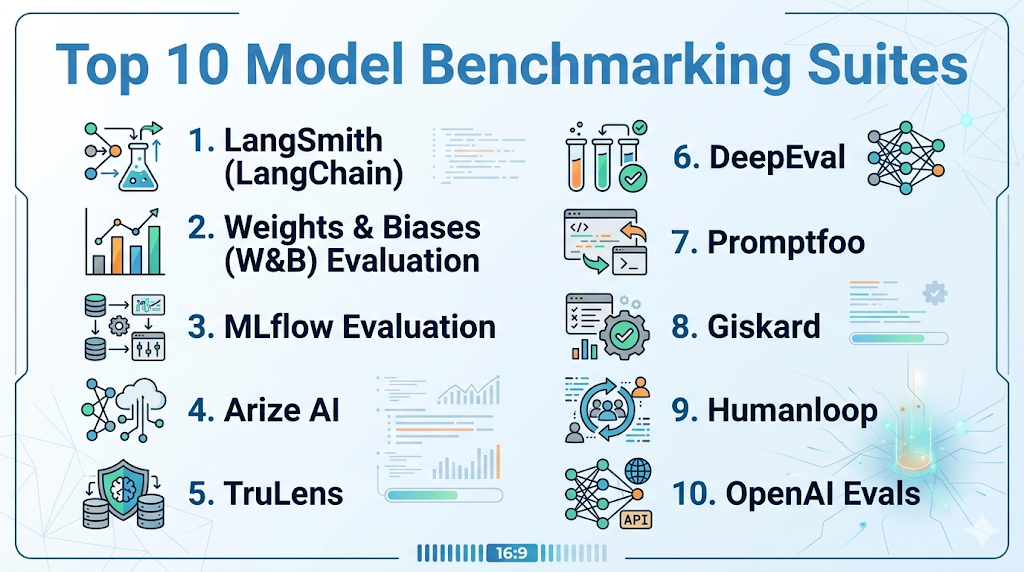
Top 10 Model Benchmarking Suites
1 — LangSmith (LangChain)
One-line verdict: Best for developers building LLM apps needing deep tracing, evaluation, and debugging workflows.
Short description :
LangSmith is an evaluation and observability platform designed for LLM applications built with LangChain or similar frameworks. It enables developers to test prompts, trace execution flows, and benchmark model outputs across different scenarios. It fits into both development and production monitoring workflows.
Standout Capabilities
- End-to-end tracing of LLM calls and workflows
- Dataset-driven evaluation pipelines
- Prompt versioning and experiment tracking
- Integration with agent workflows
- Debugging tools for complex chains
- Comparative evaluation across models
- Feedback loops for human evaluation
AI-Specific Depth
- Model support: BYO model, multi-model routing
- RAG / knowledge integration: Supports RAG evaluation via datasets
- Evaluation: Prompt testing, regression, human review
- Guardrails: Basic evaluation-based safeguards
- Observability: Deep traces, latency, token metrics
Pros
- Strong developer-focused tooling
- Excellent debugging and trace visibility
- Tight integration with LangChain ecosystem
Cons
- Best suited for LangChain users
- Learning curve for new users
- Limited standalone usage outside ecosystem
Security & Compliance
SSO/SAML, RBAC, encryption, audit logs. Certifications: Not publicly stated.
Deployment & Platforms
Web; Cloud-based.
Integrations & Ecosystem
LangSmith integrates deeply with modern LLM stacks and developer tools.
- LangChain
- APIs and SDKs
- Python/JS workflows
- Custom datasets
- CI/CD pipelines
Pricing Model
Tiered and usage-based.
Best-Fit Scenarios
- Debugging LLM pipelines
- Evaluating agent workflows
- Continuous model testing in production
2 — Weights & Biases (W&B) Evaluation
One-line verdict: Best for ML teams needing experiment tracking combined with robust model evaluation workflows.
Short description :
Weights & Biases provides experiment tracking and evaluation tools that extend into LLM benchmarking. It allows teams to compare models, track metrics, and manage evaluation datasets across training and deployment stages. It integrates well into ML pipelines.
Standout Capabilities
- Unified experiment tracking and evaluation
- Dataset versioning
- Visualization dashboards
- Model comparison tools
- Collaboration features
- Integration with training workflows
AI-Specific Depth
- Model support: Open-source, BYO
- RAG / knowledge integration: Limited / N/A
- Evaluation: Offline evaluation, regression
- Guardrails: N/A
- Observability: Metrics, experiment tracking
Pros
- Mature ML tooling ecosystem
- Strong visualization capabilities
- Widely adopted in ML workflows
Cons
- Less specialized for LLM-specific guardrails
- Setup complexity
- Some features require scaling plans
Security & Compliance
SSO/SAML, RBAC, encryption. Certifications: Not publicly stated.
Deployment & Platforms
Cloud / Self-hosted.
Integrations & Ecosystem
- Python SDK
- ML frameworks
- Data pipelines
- Experiment tracking APIs
- CI/CD integrations
Pricing Model
Freemium + enterprise tiers.
Best-Fit Scenarios
- Model experimentation tracking
- Comparing training runs
- Evaluating model performance over time
3 — MLflow Evaluation
One-line verdict: Best for teams already using MLflow for lifecycle management and wanting integrated evaluation.
Short description :
MLflow provides model lifecycle management with built-in evaluation capabilities for comparing models and tracking performance metrics. It helps teams manage experiments, versions, and evaluation workflows in a centralized system.
Standout Capabilities
- Model lifecycle tracking
- Experiment logging
- Evaluation metrics tracking
- Model registry
- Version control
AI-Specific Depth
- Model support: BYO model
- RAG / knowledge integration: N/A
- Evaluation: Offline evaluation
- Guardrails: N/A
- Observability: Metrics tracking
Pros
- Open-source and flexible
- Widely adopted
- Integrates with many ML tools
Cons
- Limited LLM-specific features
- Requires setup and customization
- Basic evaluation compared to newer tools
Security & Compliance
Varies / N/A.
Deployment & Platforms
Cloud / Self-hosted.
Integrations & Ecosystem
- ML pipelines
- Data tools
- APIs
- Experiment tracking
- Model registry
Pricing Model
Open-source + enterprise support.
Best-Fit Scenarios
- Traditional ML evaluation
- Lifecycle management
- Model comparison workflows
4 — Arize AI
One-line verdict: Best for production monitoring and evaluation of deployed AI models at scale.
Short description :
Arize AI focuses on monitoring and evaluating models in production environments. It helps teams detect drift, measure performance, and analyze model outputs in real-world usage scenarios.
Standout Capabilities
- Production monitoring
- Drift detection
- Performance analytics
- Data visualization
- Real-time evaluation
AI-Specific Depth
- Model support: BYO, multi-model
- RAG / knowledge integration: Limited
- Evaluation: Real-world evaluation
- Guardrails: N/A
- Observability: Strong monitoring and tracing
Pros
- Strong production insights
- Scalable for enterprise
- Real-time monitoring
Cons
- Less focus on pre-deployment testing
- Complex setup
- Pricing not transparent
Security & Compliance
Not publicly stated.
Deployment & Platforms
Cloud.
Integrations & Ecosystem
- APIs
- Data pipelines
- ML systems
- Monitoring tools
- Dashboards
Pricing Model
Enterprise-focused.
Best-Fit Scenarios
- Production monitoring
- Drift detection
- Real-time evaluation
5 — TruLens
One-line verdict: Best for evaluating LLM applications with feedback-based metrics and transparency.
Short description :
TruLens is designed for evaluating LLM applications with a focus on transparency and feedback-based scoring. It allows developers to define evaluation criteria and measure outputs accordingly.
Standout Capabilities
- Feedback-based evaluation
- Custom scoring metrics
- LLM app evaluation
- Transparency tools
- Integration with pipelines
AI-Specific Depth
- Model support: BYO
- RAG / knowledge integration: Supported
- Evaluation: Custom, feedback-based
- Guardrails: N/A
- Observability: Moderate
Pros
- Flexible evaluation metrics
- Transparent scoring
- Developer-friendly
Cons
- Smaller ecosystem
- Requires setup
- Limited enterprise features
Security & Compliance
Not publicly stated.
Deployment & Platforms
Varies / N/A.
Integrations & Ecosystem
- APIs
- LLM frameworks
- Evaluation pipelines
- Custom metrics
- Data tools
Pricing Model
Open-source.
Best-Fit Scenarios
- LLM evaluation
- Feedback-driven scoring
- Custom benchmarking
6 — DeepEval
One-line verdict: Best for automated LLM testing with unit-test-style evaluation workflows.
Short description :
DeepEval enables developers to write evaluation tests for LLM outputs similar to unit tests in software development. It helps ensure consistent performance and detect regressions.
Standout Capabilities
- Unit-test-style evaluations
- Automated testing
- Regression detection
- Custom test cases
- CI/CD integration
AI-Specific Depth
- Model support: BYO
- RAG / knowledge integration: Supported
- Evaluation: Automated testing
- Guardrails: Basic
- Observability: Limited
Pros
- Developer-friendly
- Easy automation
- CI/CD integration
Cons
- Limited visualization
- Early-stage ecosystem
- Requires manual setup
Security & Compliance
Not publicly stated.
Deployment & Platforms
Local / Cloud.
Integrations & Ecosystem
- Python
- CI/CD tools
- APIs
- Testing frameworks
- LLM pipelines
Pricing Model
Open-source.
Best-Fit Scenarios
- Automated testing
- Regression checks
- CI/CD integration
7 — Promptfoo
One-line verdict: Best for lightweight prompt testing and quick benchmarking across multiple models.
Short description :
Promptfoo is a simple yet powerful tool for testing prompts and comparing outputs across models. It is widely used for quick evaluations and experimentation workflows.
Standout Capabilities
- Prompt testing
- Model comparison
- CLI-based workflow
- Quick setup
- Lightweight evaluation
AI-Specific Depth
- Model support: Multi-model
- RAG / knowledge integration: N/A
- Evaluation: Prompt testing
- Guardrails: N/A
- Observability: Minimal
Pros
- Easy to use
- Fast setup
- Lightweight
Cons
- Limited enterprise features
- Minimal observability
- Basic evaluation
Security & Compliance
Varies / N/A.
Deployment & Platforms
Local / CLI.
Integrations & Ecosystem
- CLI
- APIs
- LLM providers
- Testing workflows
- Developer tools
Pricing Model
Open-source.
Best-Fit Scenarios
- Prompt testing
- Quick comparisons
- Lightweight workflows
8 — Giskard
One-line verdict: Best for AI testing with focus on bias, fairness, and risk detection.
Short description :
Giskard is an AI testing platform that emphasizes model validation, bias detection, and risk analysis. It helps teams ensure responsible AI deployment.
Standout Capabilities
- Bias detection
- Risk analysis
- Model testing
- Evaluation datasets
- Reporting tools
AI-Specific Depth
- Model support: BYO
- RAG / knowledge integration: Limited
- Evaluation: Risk-based evaluation
- Guardrails: Strong
- Observability: Moderate
Pros
- Strong focus on responsible AI
- Risk detection features
- Compliance-oriented
Cons
- Less focus on performance benchmarking
- Setup complexity
- Smaller ecosystem
Security & Compliance
Not publicly stated.
Deployment & Platforms
Cloud / Self-hosted.
Integrations & Ecosystem
- APIs
- ML tools
- Data pipelines
- Testing workflows
- Reporting tools
Pricing Model
Tiered.
Best-Fit Scenarios
- Bias detection
- Risk analysis
- Responsible AI validation
9 — Humanloop
One-line verdict: Best for teams combining human feedback with structured evaluation workflows for LLMs.
Short description :
Humanloop provides tools for prompt management and evaluation with human-in-the-loop workflows. It helps teams refine models based on real feedback.
Standout Capabilities
- Human feedback integration
- Prompt management
- Evaluation workflows
- Version control
- Collaboration tools
AI-Specific Depth
- Model support: BYO
- RAG / knowledge integration: Supported
- Evaluation: Human review
- Guardrails: Moderate
- Observability: Moderate
Pros
- Strong human-in-loop workflows
- Collaboration features
- Prompt versioning
Cons
- Less automation
- Limited deep observability
- Pricing not transparent
Security & Compliance
Not publicly stated.
Deployment & Platforms
Cloud.
Integrations & Ecosystem
- APIs
- LLM tools
- Data pipelines
- Prompt systems
- Collaboration tools
Pricing Model
Not publicly stated.
Best-Fit Scenarios
- Human evaluation
- Prompt refinement
- Feedback loops
10 — OpenAI Evals
One-line verdict: Best for developers evaluating models using standardized benchmarks and custom datasets.
Short description :
OpenAI Evals is an open framework for evaluating language models using structured benchmarks and datasets. It allows developers to create custom evaluations and compare results.
Standout Capabilities
- Open evaluation framework
- Custom benchmarks
- Dataset-based evaluation
- Community contributions
- Flexible setup
AI-Specific Depth
- Model support: OpenAI + BYO
- RAG / knowledge integration: N/A
- Evaluation: Benchmark-based
- Guardrails: N/A
- Observability: Limited
Pros
- Flexible and open
- Community-driven
- Custom evaluations
Cons
- Requires setup
- Limited UI
- Not enterprise-focused
Security & Compliance
Varies / N/A.
Deployment & Platforms
Local / Cloud.
Integrations & Ecosystem
- APIs
- Datasets
- LLM tools
- Testing frameworks
- Developer workflows
Pricing Model
Open-source.
Best-Fit Scenarios
- Benchmark testing
- Custom evaluation
- Research workflows
Comparison Table
| Tool Name | Best For | Deployment | Model Flexibility | Strength | Watch-Out | Public Rating |
|---|---|---|---|---|---|---|
| LangSmith | LLM debugging | Cloud | Multi-model | Deep tracing | Ecosystem lock-in | N/A |
| W&B | ML tracking | Cloud/Self | BYO | Visualization | Complexity | N/A |
| MLflow | Lifecycle mgmt | Cloud/Self | BYO | Flexibility | Limited LLM focus | N/A |
| Arize | Production eval | Cloud | Multi-model | Monitoring | Setup complexity | N/A |
| TruLens | LLM eval | N/A | BYO | Custom metrics | Smaller ecosystem | N/A |
| DeepEval | Testing | Local/Cloud | BYO | Automation | Limited UI | N/A |
| Promptfoo | Prompt testing | Local | Multi-model | Simplicity | Basic features | N/A |
| Giskard | Risk eval | Cloud/Self | BYO | Bias detection | Limited perf focus | N/A |
| Humanloop | Human eval | Cloud | BYO | Feedback loops | Limited automation | N/A |
| OpenAI Evals | Benchmarks | Local/Cloud | BYO | Flexibility | Setup effort | N/A |
Scoring & Evaluation
Scoring is comparative and based on practical usability, not absolute capability. Different tools excel in different scenarios depending on team size, workflow complexity, and deployment needs.
| Tool | Core | Reliability | Guardrails | Integrations | Ease | Perf/Cost | Security | Support | Total |
|---|---|---|---|---|---|---|---|---|---|
| LangSmith | 9 | 9 | 7 | 9 | 8 | 8 | 8 | 8 | 8.4 |
| W&B | 9 | 8 | 6 | 9 | 7 | 8 | 8 | 9 | 8.1 |
| MLflow | 8 | 7 | 5 | 8 | 7 | 8 | 7 | 8 | 7.5 |
| Arize | 9 | 9 | 6 | 8 | 7 | 8 | 8 | 8 | 8.2 |
| TruLens | 7 | 8 | 5 | 7 | 7 | 7 | 6 | 7 | 7.1 |
| DeepEval | 7 | 8 | 6 | 7 | 8 | 8 | 6 | 7 | 7.4 |
| Promptfoo | 6 | 7 | 4 | 6 | 9 | 8 | 5 | 6 | 6.8 |
| Giskard | 8 | 8 | 9 | 7 | 6 | 7 | 7 | 7 | 7.6 |
| Humanloop | 8 | 8 | 7 | 7 | 7 | 7 | 7 | 7 | 7.5 |
| OpenAI Evals | 7 | 7 | 5 | 7 | 6 | 7 | 6 | 7 | 6.9 |
Top 3 for Enterprise: LangSmith, Arize, Weights & Biases
Top 3 for SMB: DeepEval, Humanloop, TruLens
Top 3 for Developers: Promptfoo, OpenAI Evals, DeepEval
Which Tool Is Right for You?
Solo / Freelancer
Use lightweight tools like Promptfoo or OpenAI Evals for quick testing without heavy setup.
SMB
Choose DeepEval or Humanloop for balance between automation and usability.
Mid-Market
LangSmith or W&B provide strong evaluation with scalability.
Enterprise
Arize, LangSmith, and W&B offer full observability and governance.
Regulated industries
Giskard is better due to bias and risk analysis features.
Budget vs premium
Open-source tools (MLflow, DeepEval) vs enterprise platforms (Arize, W&B).
Build vs buy
DIY if you need flexibility; buy if you need speed and reliability.
Implementation Playbook
30 Days
- Define evaluation metrics
- Set up datasets
- Run pilot benchmarks
60 Days
- Add CI/CD evaluation
- Implement guardrails
- Expand datasets
90 Days
- Optimize cost/latency
- Add governance
- Scale evaluation workflows
Common Mistakes
- No evaluation pipeline
- Ignoring hallucinations
- No regression testing
- Poor dataset quality
- Lack of observability
- Over-automation
- Ignoring cost metrics
- No human review
- Weak guardrails
- Vendor lock-in
- No version control
- No audit logs
FAQs
1. What is a model benchmarking suite?
It is a tool used to evaluate and compare AI model performance across different metrics and scenarios.
2. Why is benchmarking important?
It ensures models are reliable, accurate, and safe before deployment.
3. Can I use open-source tools?
Yes, many tools like MLflow and DeepEval are open-source.
4. Do these tools support multiple models?
Most modern tools support multi-model evaluation.
5. What about privacy?
Varies by tool; enterprise tools offer better controls.
6. Can I self-host?
Some tools support self-hosting; others are cloud-only.
7. Are these tools expensive?
Costs vary from free open-source to enterprise pricing.
8. Do they support RAG?
Some tools support RAG evaluation workflows.
9. What metrics should I track?
Accuracy, latency, cost, hallucination rates.
10. Can I automate evaluations?
Yes, many tools integrate with CI/CD pipelines.
11. Do I need human evaluation?
For critical use cases, yes.
12. Can I switch tools later?
Possible, but migration effort varies.
Conclusion
Model benchmarking suites have become essential for building reliable AI systems, especially as models grow more complex and business-critical. The right tool depends on your team’s maturity, workflow, and evaluation depth requirements—there is no one-size-fits-all solution. Start by shortlisting tools that align with your stack, run a pilot to validate real-world performance, and prioritize strong evaluation and observability before scaling.
This post highlights how benchmarking tools now support agent workflows and multimodal evaluations. It is useful for understanding the shift from static testing to dynamic evaluation systems.
This blog provides strong insights into AI model evaluation ecosystems. The explanations are clear, structured, and very useful for building reliable and scalable AI systems.