Introduction
AI Marketing Attribution Modeling Tools are platforms that leverage artificial intelligence to assign credit to marketing touchpoints across customer journeys. These tools provide marketers with a clearer understanding of which channels, campaigns, or creatives contribute most to conversions and revenue. Unlike traditional rule-based attribution methods, AI models can analyze complex multi-channel interactions, detect non-linear effects, and provide predictive insights for budget allocation.
Why it matters
- Data-driven budget allocation: AI identifies high-performing campaigns and channels for optimized spend.
- Multi-touch attribution: Captures the influence of multiple interactions across complex customer journeys.
- Predictive insights: Forecasts conversion probability and revenue contribution per touchpoint.
- Cross-channel visibility: Tracks performance across digital, social, email, search, and offline channels.
- Reduced bias: AI models mitigate over-crediting single channels.
- Real-time optimization: Adjust marketing spend dynamically based on AI recommendations.
Real-World Use Cases
- E-commerce campaigns: Identify which social media platforms and search ads drive the highest revenue per product category.
- B2B SaaS: Analyze multi-touch lead journeys from content downloads, webinars, and email nurturing sequences.
- Retail marketing: Evaluate the contribution of in-store promotions versus online campaigns to total revenue.
- Cross-platform campaigns: Determine whether paid search or display ads are more effective in driving conversions.
- Omnichannel engagement: Combine mobile app, email, social, and website interactions for holistic attribution.
- Budget optimization: Adjust advertising spend across channels using predictive AI insights.
Evaluation Criteria for Buyers
- Multi-touch attribution modeling: Ability to capture complex interactions.
- Predictive analytics: Forecasting contribution and ROI per touchpoint.
- Integration flexibility: Compatibility with CRM, ad platforms, analytics, and ERP systems.
- Data handling and privacy: Secure storage, retention, and compliance.
- Model explainability: Transparency of AI-derived attribution recommendations.
- Automation & workflow: Ease of integrating into marketing operations.
- Cross-channel coverage: Support for digital and offline touchpoints.
- Real-time insights: Rapid recommendations for budget or campaign adjustments.
- Customization & scalability: Ability to handle enterprise-level data volumes.
- User interface & reporting: Dashboards for marketers, executives, and analysts.
- Guardrails & compliance: Prevent data misuse and maintain governance.
- Cost-efficiency: Performance versus subscription and usage fees.
Best for: Marketing analysts, CMOs, enterprise marketing teams, ad agencies, e-commerce companies, and multi-channel marketers.
Not ideal for: Small campaigns with limited touchpoints or organizations not leveraging multi-channel marketing.
What’s Changed in AI Marketing Attribution Modeling Tools
- Agentic workflows automate multi-channel attribution analysis.
- Integration of multimodal inputs including social, web, in-store, and call center interactions.
- Predictive conversion and revenue scoring for budget allocation.
- Guardrails to ensure ethical use, prevent overfitting, and maintain transparency.
- Real-time model updates to adjust marketing spend dynamically.
- Enterprise-grade privacy and data residency controls.
- Observability dashboards with token, cost, and latency metrics.
- BYO or multi-model AI routing for custom analytics.
- Advanced causal inference models for accurate ROI measurement.
- Automated anomaly detection for outlier campaigns.
- Enhanced explainability for non-technical stakeholders.
Quick Buyer Checklist
- Evaluate multi-touch and omni-channel coverage.
- Ensure predictive analytics capabilities.
- Integration support with CRM, ad platforms, analytics tools.
- Guardrails for compliance and bias prevention.
- Real-time budget and campaign optimization.
- Observability and reporting dashboards.
- Data privacy, retention, and security.
- Model flexibility: hosted, BYO, or open-source.
- Ease of adoption for marketing teams.
- Scalability for high-volume enterprise data.
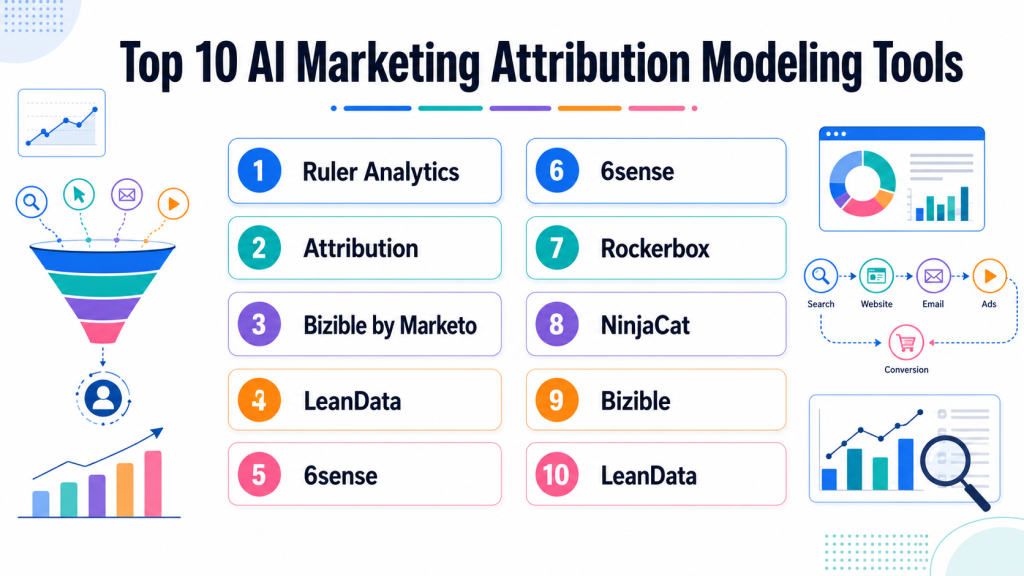
Top 10 AI Marketing Attribution Modeling Tools
1 — Ruler Analytics
One-line verdict: Best for marketing teams needing cross-channel revenue attribution with automation and predictive insights.
Short description: Ruler Analytics tracks customer touchpoints across channels, assigning AI-based revenue credit to optimize campaigns.
Standout Capabilities
- Multi-touch attribution across online/offline channels
- Predictive ROI scoring per campaign
- Automated lead-to-revenue tracking
- Customizable attribution models
- CRM and analytics integration
- Real-time dashboards
- Revenue-focused reporting
AI-Specific Depth
- Model support: Proprietary
- RAG / knowledge integration: CRM connectors
- Evaluation: Offline eval, regression checks
- Guardrails: Ethical attribution enforcement
- Observability: Revenue and touchpoint dashboards
Pros
- Clear cross-channel insights
- Automates complex attribution
- Supports marketing optimization
Cons
- Learning curve for setup
- Cloud-only deployment
- Premium pricing for advanced features
Security & Compliance
- SSO/SAML, encryption, RBAC
- Certifications: Not publicly stated
Deployment & Platforms
- Web
- Cloud
Integrations & Ecosystem
- Salesforce, HubSpot, Marketo, Google Analytics
Pricing Model
- Subscription-based tiered pricing
Best-Fit Scenarios
- Enterprise marketing teams
- Multi-channel campaign optimization
- Agencies tracking client ROI
2 — Attribution
One-line verdict: Ideal for B2B SaaS companies tracking multi-touch journeys and optimizing pipeline contribution.
Short description: Attribution assigns AI-driven credit to marketing touchpoints, providing predictive insights for revenue contribution.
Standout Capabilities
- AI-powered multi-touch attribution
- Predictive lead-to-revenue scoring
- Campaign ROI dashboards
- Multi-channel engagement tracking
- Account-based marketing support
- Historical performance analysis
AI-Specific Depth
- Model support: Proprietary
- RAG / knowledge integration: CRM connectors
- Evaluation: Predictive scoring, human review
- Guardrails: Compliance, ethical modeling
- Observability: Dashboards with campaign metrics
Pros
- Predictive pipeline insights
- Automated touchpoint tracking
- Supports ABM campaigns
Cons
- Cloud-only
- Premium pricing
- Requires CRM integration
Security & Compliance
- SSO, audit logs, encryption
- Certifications: Not publicly stated
Deployment & Platforms
- Web
- Cloud
Integrations & Ecosystem
- Salesforce, HubSpot, Marketo
Pricing Model
- Subscription
Best-Fit Scenarios
- B2B marketing teams
- SaaS growth campaigns
- Multi-channel tracking
3 — Bizible (by Marketo)
One-line verdict: Excellent for enterprises seeking integrated attribution across campaigns, sales, and marketing platforms.
Short description: Bizible provides AI-driven attribution for marketing touchpoints, enabling automated campaign ROI insights.
Standout Capabilities
- Multi-touch attribution modeling
- Predictive analytics for revenue contribution
- Pipeline and campaign ROI dashboards
- Integration with Marketo and Salesforce
- Cross-channel touchpoint tracking
- Customizable reporting
AI-Specific Depth
- Model support: Proprietary
- RAG / knowledge integration: CRM connectors
- Evaluation: Regression testing, predictive scoring
- Guardrails: Brand and data compliance
- Observability: Pipeline and campaign insights
Pros
- Integrated with Marketo
- Enterprise-scale insights
- Multi-channel support
Cons
- Limited flexibility outside Marketo
- Cloud-only
- Premium pricing
Security & Compliance
- Encryption, SSO/SAML, audit logs
- Certifications: Not publicly stated
Deployment & Platforms
- Web
- Cloud
Integrations & Ecosystem
- Salesforce, Marketo, CRM systems
Pricing Model
- Subscription
Best-Fit Scenarios
- Enterprise SaaS
- Large marketing teams
- Multi-channel ROI analysis
4 — LeanData
One-line verdict: Suited for teams optimizing lead routing and attribution to improve pipeline efficiency and marketing ROI.
Short description: LeanData combines AI attribution with lead management and routing to track revenue influence across touchpoints.
Standout Capabilities
- Multi-touch revenue attribution
- Lead-to-account matching
- AI routing and prioritization
- Predictive pipeline impact
- Multi-channel integration
- Analytics dashboards
AI-Specific Depth
- Model support: Proprietary
- RAG / knowledge integration: CRM connectors
- Evaluation: Regression checks, predictive scoring
- Guardrails: Compliance monitoring
- Observability: Pipeline dashboards
Pros
- Improves lead-to-account mapping
- Multi-channel attribution insights
- Pipeline-focused reporting
Cons
- Requires CRM integration
- Premium pricing
- Cloud-only
Security & Compliance
- SSO, encryption, audit logs
- Certifications: Not publicly stated
Deployment & Platforms
- Web
- Cloud
Integrations & Ecosystem
- Salesforce, Marketo, HubSpot
Pricing Model
- Subscription
Best-Fit Scenarios
- B2B marketing operations
- Lead-driven campaigns
- Pipeline optimization
5 — 6sense
One-line verdict: Enterprise platform leveraging AI to optimize multi-channel marketing attribution and predictive revenue insights.
Short description: 6sense uses AI to provide multi-touch attribution, predictive revenue, and buyer intent insights for enterprise marketing teams.
Standout Capabilities
- AI-driven attribution modeling
- Buyer intent scoring
- Revenue prediction and allocation
- Multi-channel campaign tracking
- Dashboard analytics for ROI
- Predictive recommendations
AI-Specific Depth
- Model support: Proprietary
- RAG / knowledge integration: CRM connectors
- Evaluation: Predictive scoring, regression
- Guardrails: Compliance and data safety
- Observability: Revenue dashboards, cost metrics
Pros
- Enterprise-grade insights
- Predictive attribution
- Multi-channel coverage
Cons
- Cloud-only
- Premium pricing
- Steep learning curve
Security & Compliance
- Encryption, SSO/SAML, audit logs
- Certifications: Not publicly stated
Deployment & Platforms
- Web
- Cloud
Integrations & Ecosystem
- Salesforce, Marketo, HubSpot, analytics platforms
Pricing Model
- Enterprise subscription
Best-Fit Scenarios
- Large B2B enterprises
- Complex multi-touch campaigns
- Revenue-driven marketing analysis
6 — Windsor.ai
One-line verdict: Best for marketers needing AI-driven multi-channel attribution with deep data visualization.
Short description: Windsor.ai connects marketing, sales, and analytics data to provide AI-powered attribution modeling and ROI insights.
Standout Capabilities
- Multi-channel attribution across online and offline touchpoints
- Predictive performance analytics
- Customizable dashboards and reports
- Data blending from multiple sources
- Automated KPI tracking
- AI-driven insights for budget allocation
AI-Specific Depth
- Model support: Proprietary
- RAG / knowledge integration: Connectors for CRM and analytics tools
- Evaluation: Predictive scoring, regression analysis
- Guardrails: Compliance monitoring and model transparency
- Observability: Dashboards with cost, conversion, and engagement metrics
Pros
- Integrates multiple data sources
- Provides predictive insights
- Scalable for enterprise campaigns
Cons
- Learning curve for setup
- Cloud-only deployment
- Premium plans for full features
Security & Compliance
- SSO/SAML, encryption, audit logs
- Certifications: Not publicly stated
Deployment & Platforms
- Web
- Cloud
Integrations & Ecosystem
- Salesforce, HubSpot, Google Analytics, marketing platforms
Pricing Model
- Subscription / enterprise pricing
Best-Fit Scenarios
- Multi-channel marketing teams
- Agencies managing large campaigns
- Revenue-focused enterprises
7 — Rockerbox
One-line verdict: Ideal for performance marketers seeking cross-channel attribution with real-time reporting.
Short description: Rockerbox provides AI-driven multi-touch attribution, channel ROI insights, and actionable recommendations for marketers.
Standout Capabilities
- Real-time multi-touch attribution
- Predictive ROI and conversion scoring
- Automated dashboard reporting
- Multi-channel performance analysis
- Historical trend comparison
- AI-driven recommendations
AI-Specific Depth
- Model support: Proprietary
- RAG / knowledge integration: CRM connectors
- Evaluation: Regression and predictive scoring
- Guardrails: Compliance, brand safety
- Observability: Dashboards and token metrics
Pros
- Real-time insights
- Accurate cross-channel attribution
- Predictive campaign optimization
Cons
- Cloud-only deployment
- Enterprise pricing
- Requires CRM integration
Security & Compliance
- Encryption, SSO, RBAC
- Certifications: Not publicly stated
Deployment & Platforms
- Web
- Cloud
Integrations & Ecosystem
- Salesforce, HubSpot, Google Analytics, advertising platforms
Pricing Model
- Subscription-based
Best-Fit Scenarios
- Performance marketing teams
- Multi-channel attribution campaigns
- Agencies optimizing client campaigns
8 — NinjaCat
One-line verdict: Best for agencies needing consolidated reporting and AI attribution insights across multiple clients.
Short description: NinjaCat consolidates marketing and attribution data across clients, providing AI-driven insights and performance dashboards.
Standout Capabilities
- Multi-client dashboard reporting
- AI-powered attribution modeling
- Cross-channel performance analysis
- Automated data aggregation
- Customizable KPIs and visualization
- Predictive conversion insights
AI-Specific Depth
- Model support: Proprietary
- RAG / knowledge integration: CRM, analytics connectors
- Evaluation: Predictive scoring, human review
- Guardrails: Data compliance and brand oversight
- Observability: Engagement and cost tracking dashboards
Pros
- Consolidated multi-client reporting
- Predictive insights for optimization
- Scales well for agencies
Cons
- Cloud-only
- Premium pricing
- Learning curve for setup
Security & Compliance
- Encryption, SSO, RBAC
- Certifications: Not publicly stated
Deployment & Platforms
- Web
- Cloud
Integrations & Ecosystem
- Google Ads, Facebook Ads, HubSpot, Salesforce, Analytics platforms
Pricing Model
- Subscription-based
Best-Fit Scenarios
- Digital marketing agencies
- Multi-client campaign management
- Performance and ROI-focused reporting
9 — Bizible
One-line verdict: Excellent for B2B SaaS teams combining attribution with pipeline analytics and marketing insights.
Short description: Bizible tracks multi-touch journeys, connects marketing to revenue, and uses AI to optimize campaigns.
Standout Capabilities
- Multi-touch attribution modeling
- Pipeline and campaign ROI dashboards
- Predictive engagement and conversion scoring
- Integration with Salesforce and Marketo
- Account-based marketing support
- Automated reporting
AI-Specific Depth
- Model support: Proprietary
- RAG / knowledge integration: CRM integration
- Evaluation: Regression analysis, predictive metrics
- Guardrails: Compliance and ethical attribution
- Observability: Dashboards with KPIs
Pros
- Integrated B2B attribution
- Supports ABM campaigns
- Predictive revenue insights
Cons
- Limited outside Salesforce/Marketo ecosystem
- Cloud-only
- Premium plans for advanced features
Security & Compliance
- SSO, encryption, audit logs
- Certifications: Not publicly stated
Deployment & Platforms
- Web
- Cloud
Integrations & Ecosystem
- Salesforce, Marketo, HubSpot
Pricing Model
- Subscription
Best-Fit Scenarios
- B2B SaaS marketers
- Multi-touch ABM campaigns
- Enterprise revenue attribution
10 — LeanData
One-line verdict: Best for enterprise marketing teams optimizing lead routing and attribution across multi-channel campaigns.
Short description: LeanData provides AI-powered attribution with automated lead-to-account matching and multi-channel tracking.
Standout Capabilities
- Multi-touch attribution and revenue assignment
- Lead-to-account matching
- Predictive pipeline insights
- Automated routing based on AI scoring
- Multi-channel engagement tracking
- Dashboard reporting
AI-Specific Depth
- Model support: Proprietary
- RAG / knowledge integration: CRM connectors
- Evaluation: Regression and predictive scoring
- Guardrails: Compliance and safe usage
- Observability: Pipeline dashboards and engagement metrics
Pros
- Accurate attribution for complex pipelines
- Multi-channel tracking
- Integration with lead management systems
Cons
- Requires CRM integration
- Cloud-only
- Premium pricing
Security & Compliance
- SSO, encryption, audit logs
- Certifications: Not publicly stated
Deployment & Platforms
- Web
- Cloud
Integrations & Ecosystem
- Salesforce, HubSpot, Marketo
Pricing Model
- Subscription
Best-Fit Scenarios
- Enterprise marketing operations
- B2B multi-touch campaigns
- Pipeline and lead-focused attribution
Comparison Table
| Tool Name | Best For | Deployment | Model Flexibility | Strength | Watch-Out | Public Rating |
|---|---|---|---|---|---|---|
| Ruler Analytics | Enterprise marketing teams | Cloud | Proprietary | Cross-channel attribution | Premium pricing | N/A |
| Attribution | B2B SaaS marketers | Cloud | Proprietary | Predictive revenue attribution | CRM required | N/A |
| Bizible | B2B SaaS, ABM campaigns | Cloud | Proprietary | Pipeline-integrated attribution | Limited outside Salesforce | N/A |
| LeanData | Enterprise lead-focused teams | Cloud | Proprietary | Lead-to-account attribution | CRM integration required | N/A |
| Windsor.ai | Multi-channel performance teams | Cloud | Proprietary | Data blending & visualization | Premium pricing | N/A |
| Rockerbox | Performance marketers | Cloud | Proprietary | Real-time attribution insights | CRM integration required | N/A |
| NinjaCat | Agencies | Cloud | Proprietary | Multi-client dashboards | Premium pricing | N/A |
| Bizible | B2B SaaS marketers | Cloud | Proprietary | Predictive revenue insights | Limited outside Salesforce | N/A |
| Attribution | Mid-market multi-touch teams | Cloud | Proprietary | Campaign ROI dashboards | CRM required | N/A |
| LeanData | Enterprise marketing ops | Cloud | Proprietary | Pipeline & revenue optimization | Cloud-only deployment | N/A |
Scoring & Evaluation
Scores are comparative and not absolute. Weighted total (0–10):
| Tool | Core | Reliability/Eval | Guardrails | Integrations | Ease | Perf/Cost | Security/Admin | Support | Weighted Total |
|---|---|---|---|---|---|---|---|---|---|
| Ruler Analytics | 9 | 8 | 8 | 8 | 8 | 7 | 8 | 7 | 7.9 |
| Attribution | 8 | 8 | 7 | 7 | 8 | 7 | 7 | 7 | 7.4 |
| Bizible | 8 | 8 | 8 | 7 | 7 | 7 | 7 | 7 | 7.4 |
| LeanData | 8 | 8 | 8 | 7 | 7 | 7 | 7 | 7 | 7.4 |
| Windsor.ai | 9 | 8 | 8 | 8 | 7 | 7 | 7 | 7 | 7.7 |
| Rockerbox | 8 | 8 | 8 | 7 | 7 | 7 | 7 | 7 | 7.4 |
| NinjaCat | 8 | 7 | 7 | 7 | 7 | 7 | 7 | 7 | 7.2 |
| Bizible | 8 | 8 | 8 | 7 | 7 | 7 | 7 | 7 | 7.4 |
| Attribution | 8 | 8 | 7 | 7 | 7 | 7 | 7 | 7 | 7.3 |
| LeanData | 8 | 8 | 8 | 7 | 7 | 7 | 7 | 7 | 7.4 |
Top 3 for Enterprise: Ruler Analytics, Windsor.ai, LeanData
Top 3 for SMB: Attribution, NinjaCat, Rockerbox
Top 3 for Developers / Technical Teams: LeanData, Bizible, Windsor.ai
Which AI Marketing Attribution Tool Is Right for You?
Solo / Freelancer
- Simple attribution tools for small campaigns; predictive scoring optional.
- Ruler Analytics Lite or SMB-focused tiers for basic insights.
SMB
- Attribution or Rockerbox for multi-channel campaigns and predictive optimization.
- Dashboards and KPIs for small marketing teams.
Mid-Market
- Windsor.ai or LeanData for pipeline-integrated insights.
- Supports multi-channel campaigns with predictive AI models.
Enterprise
- Ruler Analytics, LeanData, Windsor.ai for high-volume cross-channel attribution.
- Governance, compliance, and predictive insights are key.
Regulated industries
- LeanData or Bizible with audit trails and compliance enforcement.
Budget vs premium
- Attribution, NinjaCat for cost-conscious teams
- Ruler Analytics, Windsor.ai for enterprise-grade capabilities
Build vs buy
- Buy for standard campaigns and fast ROI
- Build custom models if proprietary multi-touch data is needed
Implementation Playbook (30 / 60 / 90 Days)
30 Days — Pilot & Metrics
- Select 1–2 AI attribution platforms
- Pilot multi-channel campaigns
- Define success metrics (ROI, conversion, engagement)
- Train teams on dashboards and reporting
60 Days — Harden & Optimize
- Integrate platforms with CRM, analytics, and ad platforms
- Set guardrails for data compliance and model usage
- Test multivariate attribution models
- Monitor dashboards and token/cost metrics
90 Days — Scale & Govern
- Expand to full marketing stack
- Automate alerts for anomalous attribution results
- Standardize reporting for executives and marketers
- Optimize model routing for cost and latency
- Conduct red-team reviews for bias and compliance
- Regularly update models based on new data streams
Common Mistakes & How to Avoid Them
- Using default models without calibration
- Ignoring multi-touch complexity
- Unmanaged data retention or privacy
- Lack of observability and dashboards
- Over-relying on AI predictions without human review
- Vendor lock-in without abstraction
- Misinterpreting model outputs
- Skipping cross-channel validation
- Failing to define success metrics
- Ignoring predictive insights for budget allocation
- Inadequate training for marketing teams
FAQs
1. What is multi-touch attribution?
It assigns credit to all touchpoints in a customer journey, reflecting their contribution to conversions.
2. Can I use my own AI models?
Some platforms support BYO models; most rely on proprietary AI.
3. How is predictive ROI calculated?
AI uses historical and current campaign data to forecast performance and revenue contribution.
4. Are these tools safe for regulated industries?
Enterprise-grade tools include audit trails, compliance, and guardrails.
5. Can offline touchpoints be included?
Yes, platforms often integrate CRM and offline conversion data for holistic attribution.
6. How frequently should models be updated?
Models should be recalibrated periodically to reflect changing campaigns and audience behaviors.
7. Can these tools integrate with ad platforms?
Yes — Salesforce, HubSpot, Google Ads, and other analytics systems are commonly supported.
8. What is the typical learning curve?
SMB-focused tools are intuitive; enterprise platforms may require training and setup.
9. Do these tools support multi-channel campaigns?
Yes, from digital ads and social to email, web, and offline channels.
10. Can these platforms generate actionable recommendations?
Most AI attribution tools provide predictive insights and budget optimization guidance.
11. Are dashboards customizable?
Yes, KPIs, reports, and visualizations can be tailored to marketing needs.
12. How scalable are these tools?
Designed to handle enterprise-level campaigns with thousands of touchpoints.
Conclusion
AI Marketing Attribution Modeling Tools in 2026 provide marketing teams with critical insights into campaign effectiveness, ROI, and cross-channel performance. They enable data-driven budget allocation, predictive analytics, and scalable attribution across complex customer journeys. Enterprises gain workflow governance and multi-touch insights, while SMBs and mid-market teams benefit from simplified dashboards and actionable AI recommendations. Selecting the right tool depends on campaign complexity, channel diversity, compliance requirements, and team expertise.
Next steps:
- Shortlist platforms based on campaign size, complexity, and data integration needs
- Pilot campaigns with defined KPIs and human oversight
- Verify compliance, evaluation, and observability before enterprise-wide rollout
A very informative article for businesses looking to improve marketing performance through smarter attribution and predictive analytics tools.