Introduction
AI Audience Segmentation with ML platforms leverage machine learning and artificial intelligence to automatically group audiences based on demographics, behavior, engagement, and predicted preferences. By using predictive algorithms, these platforms detect patterns that traditional rule-based segmentation would miss. Marketers and analysts gain the ability to dynamically create micro-segments, personalize campaigns, and optimize targeting for higher engagement and ROI.
Why it matters
- Predictive audience modeling: AI predicts behavior and conversion potential for each segment.
- Dynamic segmentation: Groups update automatically based on real-time interactions.
- Omnichannel targeting: Supports digital, email, social, in-app, and offline touchpoints.
- Resource optimization: Helps reduce wasted ad spend and marketing effort.
- Scalable insights: Handles millions of contacts with granular segmentation.
- Data-driven personalization: Drives tailored campaigns to increase engagement.
Real-World Use Cases
- E-commerce campaigns: Identify high-value customers for upselling and cross-selling.
- SaaS marketing: Predict which trial users are likely to convert to paying customers.
- Content personalization: Recommend targeted content based on predicted interests.
- Ad targeting: Optimize digital campaigns for micro-segments.
- Churn prevention: Detect audience segments at risk of disengagement.
- Event marketing: Target promotional materials to the most relevant attendee segments.
Evaluation Criteria for Buyers
- Segmentation granularity – Ability to define micro-segments automatically based on behavior, demographics, and engagement patterns.
- Predictive analytics – Forecast audience actions, conversion likelihood, and lifetime value for more informed targeting.
- Integration flexibility – Compatibility with CRM systems, marketing automation platforms, ad networks, analytics tools, and CDPs.
- Automation & workflow support – Ability to automatically update segments, trigger campaigns, and streamline marketing processes.
- Data privacy & security – Compliance with regulations (GDPR, CCPA), secure storage, and retention policies.
- Multi-channel coverage – Support for digital, social, email, mobile apps, and offline interactions.
- Observability & reporting – Dashboards that track segment performance, engagement metrics, and campaign ROI.
- Scalability – Ability to handle millions of records and high-frequency updates without performance loss.
- Model explainability – Transparency in AI-driven segment decisions to justify marketing strategies.
- Ease of adoption – User-friendly interface, collaboration features, and minimal setup complexity.
Best for: Marketing teams, digital agencies, enterprise marketing departments, e-commerce brands, SaaS companies, and omnichannel marketers.
Not ideal for: Small campaigns with limited data or minimal multi-channel engagement.
What’s Changed in AI Audience Segmentation with ML
- Agentic workflows for automated audience updates and segmentation
- Multimodal input integration (web, mobile, social, offline, and CRM data)
- Predictive analytics to forecast conversions and lifetime value
- Guardrails to prevent bias and maintain ethical segmentation
- Enterprise-grade privacy with data residency and retention controls
- Model routing for cost/latency optimization and BYO models
- Observability dashboards with token, cost, and latency metrics
- Real-time dynamic segmentation for adaptive marketing
- Integration with CRM, marketing automation, and analytics platforms
- Improved model explainability for stakeholder transparency
Quick Buyer Checklist
- Multi-channel segmentation capability
- Predictive analytics for conversions and engagement
- Model flexibility: hosted, BYO, or open-source
- Integration with CRM, ad platforms, and analytics
- Guardrails for bias and compliance
- Real-time updates and dynamic segmenting
- Observability and reporting dashboards
- Data privacy and retention controls
- Automation and workflow support
- Scalability for enterprise-level data
- Ease of adoption for marketing teams
- Cost efficiency for large datasets
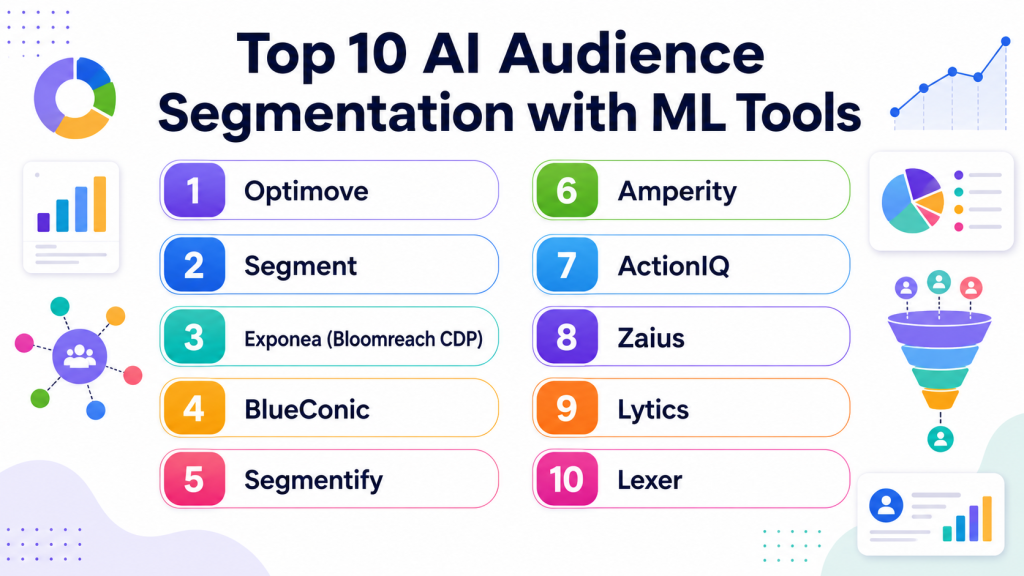
Top 10 AI Audience Segmentation with ML Tools
1 — Optimove
One-line verdict: Enterprise-focused tool for predictive, behavior-based audience segmentation and retention campaigns.
Short description: Optimove leverages ML to identify high-value customer segments, automate campaigns, and predict churn or conversion likelihood.
Standout Capabilities
- Predictive customer behavior modeling
- Multi-touch channel segmentation
- Campaign orchestration dashboards
- Behavioral and demographic analysis
- Customer lifetime value prediction
- Automated micro-segmentation
- Customizable reporting
AI-Specific Depth
- Model support: Proprietary
- RAG / knowledge integration: CRM connectors
- Evaluation: Regression tests, human review
- Guardrails: Bias and compliance enforcement
- Observability: Engagement and conversion dashboards
Pros
- Enterprise-grade predictive segmentation
- Supports multi-channel targeting
- Automates workflows
Cons
- Premium pricing
- Cloud-only
- Learning curve for new users
Security & Compliance
- SSO/SAML, audit logs, encryption
- Certifications: Not publicly stated
Deployment & Platforms
- Web
- Cloud
Integrations & Ecosystem
- Salesforce, HubSpot, Marketo
- Analytics dashboards and SDKs
- APIs for campaign activation
Pricing Model
- Subscription tiered by contact volume
Best-Fit Scenarios
- Enterprise marketing campaigns
- Multi-channel customer engagement
- Retention-focused marketing
2 — Segment
One-line verdict: Centralized data platform for developers and marketers needing AI-based audience segmentation.
Short description: Segment unifies customer data and applies ML models to create actionable, predictive audience segments.
Standout Capabilities
- Real-time data collection and normalization
- AI-powered segmentation
- Multi-channel activation
- Centralized CDP platform
- Predictive behavior scoring
- Flexible APIs for custom integration
AI-Specific Depth
- Model support: Proprietary + BYO
- RAG / knowledge integration: CRM connectors
- Evaluation: Predictive scoring, regression
- Guardrails: Data privacy compliance
- Observability: Dashboards and engagement metrics
Pros
- Centralized CDP for real-time segmentation
- Developer-friendly APIs
- Predictive insights for targeting
Cons
- Integration work required
- Premium pricing
- Complexity for non-technical users
Security & Compliance
- Encryption, SSO, audit logs
- Certifications: SOC 2
Deployment & Platforms
- Web
- Cloud
Integrations & Ecosystem
- Salesforce, HubSpot, advertising platforms
- Analytics tools
Pricing Model
- Subscription / usage-based
Best-Fit Scenarios
- SaaS marketing campaigns
- Real-time personalization
- Multi-channel campaigns
3 — Exponea (Bloomreach CDP)
One-line verdict: E-commerce-focused tool for AI-driven segmentation, personalization, and campaign orchestration.
Short description: Exponea (Bloomreach) provides predictive audience segmentation, multi-channel personalization, and automated campaigns for marketers.
Standout Capabilities
- Predictive customer segmentation
- Cross-channel personalization
- Behavior-based scoring
- Churn and conversion prediction
- Automated campaign workflows
- Custom dashboards
AI-Specific Depth
- Model support: Proprietary
- RAG / knowledge integration: CRM/CDP connectors
- Evaluation: Predictive scoring, human review
- Guardrails: Brand compliance and data privacy
- Observability: Engagement dashboards
Pros
- AI-powered personalization
- Multi-channel activation
- Predictive insights
Cons
- Cloud-only
- Learning curve
- Premium pricing
Security & Compliance
- SSO/SAML, encryption, audit logs
- Certifications: Not publicly stated
Deployment & Platforms
- Web
- Cloud
Integrations & Ecosystem
- Shopify, Magento, Salesforce, analytics tools
Pricing Model
- Enterprise subscription
Best-Fit Scenarios
- E-commerce campaigns
- Multi-channel marketing
- Upselling and churn reduction campaigns
4 — BlueConic
One-line verdict: Real-time AI segmentation platform for marketers needing dynamic, behavior-based audience targeting.
Short description: BlueConic leverages ML to dynamically segment audiences and optimize campaigns across multiple channels.
Standout Capabilities
- Real-time segmentation
- Multi-channel activation
- Behavioral scoring
- Lifecycle and engagement analysis
- Automated campaign recommendations
AI-Specific Depth
- Model support: Proprietary
- RAG / knowledge integration: CRM connectors
- Evaluation: Predictive scoring, human review
- Guardrails: Privacy and compliance
- Observability: Segment engagement dashboards
Pros
- Real-time segmentation
- Cross-channel personalization
- Automated workflows
Cons
- Cloud-only
- Premium pricing
- Limited offline support
Security & Compliance
- SSO/SAML, encryption
- Certifications: Not publicly stated
Deployment & Platforms
- Web
- Cloud
Integrations & Ecosystem
- Salesforce, HubSpot, Marketo, analytics platforms
Pricing Model
- Subscription
Best-Fit Scenarios
- Digital marketing teams
- Personalized campaigns
- Multi-channel engagement
5 — Segmentify
One-line verdict: E-commerce and retail tool for AI-driven real-time segmentation and personalized recommendations.
Short description: Segmentify provides behavior-based audience segmentation with predictive insights for personalization campaigns.
Standout Capabilities
- Real-time behavioral segmentation
- Predictive purchase likelihood
- Multi-channel activation
- Personalized content recommendations
- Dashboards for performance
AI-Specific Depth
- Model support: Proprietary
- RAG / knowledge integration: N/A
- Evaluation: Predictive scoring, regression
- Guardrails: Data privacy
- Observability: Analytics dashboards
Pros
- Personalization for e-commerce
- Real-time segmentation
- Multi-channel support
Cons
- Cloud-only
- Limited analytics depth
- Premium features for advanced segmentation
Security & Compliance
- SSO, encryption, audit logs
- Certifications: Not publicly stated
Deployment & Platforms
- Web
- Cloud
Integrations & Ecosystem
- Shopify, Magento, analytics tools
Pricing Model
- Subscription
Best-Fit Scenarios
- Retail marketers
- Conversion optimization campaigns
- Personalization strategies
6 — Amperity
One-line verdict: Enterprise-grade platform for customer data unification and AI-driven segmentation across complex datasets.
Short description: Amperity unifies fragmented customer data to create AI-driven audience segments for targeted marketing campaigns.
Standout Capabilities
- AI-powered customer segmentation
- Identity resolution and data unification
- Multi-channel activation and personalization
- Predictive churn and lifetime value modeling
- Real-time dashboards and insights
- Data cleaning and normalization
AI-Specific Depth
- Model support: Proprietary + BYO
- RAG / knowledge integration: CRM and analytics connectors
- Evaluation: Regression tests, predictive scoring
- Guardrails: Bias mitigation, privacy compliance
- Observability: Token usage, engagement metrics
Pros
- Handles large, complex datasets
- Predictive and real-time segmentation
- Integrates with enterprise marketing systems
Cons
- Enterprise pricing
- Steep learning curve
- Cloud-only deployment
Security & Compliance
- SSO/SAML, encryption, RBAC
- Certifications: SOC 2
Deployment & Platforms
- Web
- Cloud
Integrations & Ecosystem
- Salesforce, HubSpot, Marketo, analytics platforms
- APIs for automation
- SDKs for custom workflows
Pricing Model
- Enterprise subscription
Best-Fit Scenarios
- Large enterprises with fragmented customer data
- Multi-channel campaigns
- Predictive lifecycle marketing
7 — ActionIQ
One-line verdict: Suitable for enterprises needing unified customer profiles and AI-driven audience segmentation at scale.
Short description: ActionIQ consolidates data from multiple sources to enable AI-powered audience segmentation and campaign orchestration.
Standout Capabilities
- Centralized customer data platform
- AI-driven predictive segmentation
- Multi-channel personalization
- Real-time activation and analytics
- Churn prediction and retention modeling
- Flexible reporting dashboards
AI-Specific Depth
- Model support: Proprietary + BYO
- RAG / knowledge integration: CRM connectors
- Evaluation: Predictive scoring, offline evaluation
- Guardrails: Privacy, ethical modeling
- Observability: Engagement and performance metrics
Pros
- Enterprise-scale segmentation
- Real-time personalization
- Predictive behavior insights
Cons
- Premium pricing
- Requires CRM integrations
- Cloud-only deployment
Security & Compliance
- SSO/SAML, encryption, audit logs
- Certifications: SOC 2, ISO 27001
Deployment & Platforms
- Web
- Cloud
Integrations & Ecosystem
- Salesforce, Marketo, HubSpot, Google Analytics
- APIs for custom workflows
Pricing Model
- Subscription-based
Best-Fit Scenarios
- Enterprise marketers
- Multi-channel personalization campaigns
- Data-driven customer retention
8 — Zaius
One-line verdict: Best for e-commerce brands seeking AI-driven segmentation and lifecycle marketing automation.
Short description: Zaius combines ML segmentation with CRM and marketing automation for predictive audience targeting.
Standout Capabilities
- Predictive audience segmentation
- Behavior-based scoring
- Multi-channel campaign automation
- Churn and conversion prediction
- Dashboard analytics for engagement
- Lifecycle marketing automation
AI-Specific Depth
- Model support: Proprietary
- RAG / knowledge integration: CRM connectors
- Evaluation: Predictive scoring, human review
- Guardrails: Privacy enforcement, compliance
- Observability: Engagement dashboards, metrics
Pros
- Predictive insights for e-commerce
- Multi-channel automation
- Lifecycle optimization
Cons
- Cloud-only
- Premium pricing
- Learning curve for new users
Security & Compliance
- SSO, encryption, audit logs
- Certifications: Not publicly stated
Deployment & Platforms
- Web
- Cloud
Integrations & Ecosystem
- Shopify, Magento, Salesforce, analytics platforms
- API for custom workflows
Pricing Model
- Subscription
Best-Fit Scenarios
- E-commerce brands
- Lifecycle marketing teams
- Campaign personalization
9 — Lytics
One-line verdict: Ideal for mid-market to enterprise teams seeking predictive audience segmentation and behavioral insights.
Short description: Lytics analyzes customer data using AI to create dynamic segments and optimize marketing campaigns.
Standout Capabilities
- Behavioral-based AI segmentation
- Predictive scoring
- Real-time campaign activation
- Multi-channel marketing orchestration
- Engagement analytics and dashboards
- Automated data enrichment
AI-Specific Depth
- Model support: Proprietary + BYO
- RAG / knowledge integration: CRM connectors
- Evaluation: Predictive scoring, offline evaluation
- Guardrails: Privacy and ethical modeling
- Observability: Token usage and engagement metrics
Pros
- Real-time predictive segmentation
- Multi-channel activation
- Data enrichment and insights
Cons
- Cloud-only
- Premium subscription
- Setup complexity
Security & Compliance
- SSO/SAML, encryption, RBAC
- Certifications: SOC 2
Deployment & Platforms
- Web
- Cloud
Integrations & Ecosystem
- Salesforce, HubSpot, marketing automation platforms
- Analytics dashboards
Pricing Model
- Subscription-based
Best-Fit Scenarios
- Marketing analytics teams
- Multi-channel personalization campaigns
- Predictive engagement campaigns
10 — Lexer
One-line verdict: Enterprise-grade platform for AI-powered audience segmentation and personalized marketing orchestration.
Short description: Lexer leverages ML to segment customers across behavior, demographics, and engagement for optimized campaigns.
Standout Capabilities
- Predictive audience segmentation
- Behavior and demographic scoring
- Multi-channel campaign activation
- Real-time dashboards and analytics
- Lifecycle and churn prediction
- Campaign performance insights
AI-Specific Depth
- Model support: Proprietary + BYO
- RAG / knowledge integration: CRM connectors
- Evaluation: Regression analysis, predictive scoring
- Guardrails: Compliance and bias mitigation
- Observability: Engagement, cost, and conversion dashboards
Pros
- Enterprise-level segmentation
- Predictive analytics
- Multi-channel activation
Cons
- Premium pricing
- Cloud-only
- Steep learning curve
Security & Compliance
- SSO, encryption, audit logs
- Certifications: Not publicly stated
Deployment & Platforms
- Web
- Cloud
Integrations & Ecosystem
- Salesforce, HubSpot, marketing automation tools
- Analytics dashboards and APIs
Pricing Model
- Subscription
Best-Fit Scenarios
- Enterprise marketing campaigns
- Multi-channel personalization
- Predictive engagement optimization
Comparison Table
| Tool Name | Best For | Deployment | Model Flexibility | Strength | Watch-Out | Public Rating |
|---|---|---|---|---|---|---|
| Optimove | Enterprise campaigns | Cloud | Proprietary | Predictive segmentation | Premium pricing | N/A |
| Segment | SaaS & developers | Cloud | Proprietary + BYO | Unified customer data | Integration required | N/A |
| Exponea | E-commerce personalization | Cloud | Proprietary | Multi-channel AI personalization | Cloud-only | N/A |
| BlueConic | Real-time marketing teams | Cloud | Proprietary | Dynamic segmentation | Cloud-only | N/A |
| Segmentify | Retail and e-commerce teams | Cloud | Proprietary | Real-time behavioral segmentation | Premium features | N/A |
| Amperity | Large enterprises | Cloud | Proprietary + BYO | Data unification and segmentation | Learning curve | N/A |
| ActionIQ | Enterprise CDP users | Cloud | Proprietary + BYO | Unified profile and predictive segmentation | Premium pricing | N/A |
| Zaius | E-commerce lifecycle teams | Cloud | Proprietary | Predictive lifecycle segmentation | Cloud-only | N/A |
| Lytics | Mid-market personalization | Cloud | Proprietary + BYO | Real-time predictive segmentation | Setup complexity | N/A |
| Lexer | Enterprise marketing | Cloud | Proprietary + BYO | Predictive multi-channel segmentation | Steep learning curve | N/A |
Scoring & Evaluation
Scoring is comparative and not absolute. Weighted total (0–10):
| Tool | Core | Reliability/Eval | Guardrails | Integrations | Ease | Perf/Cost | Security/Admin | Support | Weighted Total |
|---|---|---|---|---|---|---|---|---|---|
| Optimove | 9 | 9 | 8 | 8 | 7 | 7 | 8 | 7 | 8.0 |
| Segment | 8 | 8 | 8 | 8 | 7 | 7 | 8 | 7 | 7.6 |
| Exponea | 9 | 8 | 8 | 7 | 7 | 7 | 8 | 7 | 7.7 |
| BlueConic | 8 | 8 | 7 | 7 | 7 | 7 | 7 | 7 | 7.2 |
| Segmentify | 8 | 7 | 7 | 7 | 7 | 7 | 7 | 7 | 7.0 |
| Amperity | 9 | 8 | 8 | 8 | 7 | 7 | 8 | 7 | 7.8 |
| ActionIQ | 9 | 8 | 8 | 8 | 7 | 7 | 8 | 7 | 7.8 |
| Zaius | 8 | 8 | 7 | 7 | 7 | 7 | 7 | 7 | 7.2 |
| Lytics | 8 | 8 | 7 | 7 | 7 | 7 | 7 | 7 | 7.2 |
| Lexer | 9 | 8 | 8 | 8 | 7 | 7 | 8 | 7 | 7.8 |
Top 3 for Enterprise: Optimove, Amperity, ActionIQ
Top 3 for SMB: Segment, BlueConic, Zaius
Top 3 for Developers: Segment, Lytics, Lexer
Which AI Audience Segmentation Tool Is Right for You?
Solo / Freelancer
- BlueConic or Segmentify for small-scale segmentation
- Easy-to-use dashboards and basic predictive insights
SMB
- Segment or Lytics for mid-market campaigns
- Multi-channel personalization and predictive segmentation
Mid-Market
- BlueConic, Zaius for cross-channel predictive insights
- Lifecycle marketing optimization
Enterprise
- Optimove, Amperity, ActionIQ for large datasets
- Multi-channel, real-time predictive segmentation
Regulated industries
- Amperity or Lexer with strict compliance and privacy controls
Budget vs premium
- Segmentify or Lytics for cost-sensitive teams
- Optimove, Amperity for enterprise-grade features
Build vs buy
- Buy for standard campaigns and faster deployment
- Build custom models if proprietary data and segmentation logic are critical
Implementation Playbook (30 / 60 / 90 Days)
30 Days — Pilot & Metrics
- Identify key datasets for segmentation
- Test 1–2 platforms with representative campaigns
- Define success metrics: engagement, conversion, ROI
- Train teams on dashboards and workflows
60 Days — Harden & Optimize
- Integrate platforms with CRM, analytics, and marketing automation
- Apply guardrails for compliance and ethical segmentation
- Run predictive tests and multi-channel campaigns
- Monitor dashboards for performance, token, and cost metrics
90 Days — Scale & Govern
- Expand segmentation across all marketing channels
- Automate alerts for anomalies in segment performance
- Standardize reporting and approval workflows
- Optimize model routing and latency
- Conduct red-team testing for bias and compliance
- Continuously refine predictive models based on engagement data
Common Mistakes & How to Avoid Them
- Ignoring multi-channel behavior in segmentation
- Not updating AI models regularly
- Over-reliance on default models without customization
- Lack of observability and dashboards
- Data retention or privacy violations
- Over-automation without human review
- Vendor lock-in without flexibility
- Skipping predictive evaluation
- Misinterpreting segmentation outputs
- Not defining clear success metrics
- Overlooking cross-channel adaptation
- Ignoring bias and compliance
- Poor integration with CRM or marketing tools
FAQs
1. What is AI audience segmentation?
AI-driven segmentation groups audiences based on behavior, demographics, and predicted engagement using machine learning.
2. Can I integrate these tools with my CRM?
Most platforms provide connectors for Salesforce, HubSpot, Marketo, and other CRM systems.
3. Are these tools suitable for small datasets?
Yes, but predictive insights improve with larger, multi-channel datasets.
4. Do these tools support real-time segmentation?
Most platforms update audience segments dynamically based on new interactions.
5. Can they predict conversions or churn?
Yes, ML models forecast likelihood to engage, convert, or churn.
6. How secure is the data?
Enterprise tools include SSO, encryption, audit logs, and compliance controls.
7. Can I use my own AI models?
Some platforms allow BYO models; many use proprietary ML models.
8. Are dashboards customizable?
Yes, KPIs, reporting views, and analytics can be tailored per team.
9. How scalable are these platforms?
Designed for enterprise-scale, supporting millions of records and high-velocity data.
10. Can offline interactions be included?
Yes, when integrated with CRM or POS systems for omnichannel insights.
11. How often should segments be updated?
Regularly, based on engagement, behavior changes, and campaign adjustments.
12. Do these tools support cross-channel personalization?
Yes, they activate segments across web, email, social, mobile apps, and offline touchpoints.
Conclusion
AI Audience Segmentation with ML platforms provide marketers with actionable insights, predictive segmentation, and real-time targeting capabilities. Enterprises can manage complex datasets, optimize multi-channel campaigns, and forecast engagement and conversions, while SMBs benefit from automated audience analysis and personalization. Selecting the right tool depends on data complexity, channel coverage, compliance needs, and marketing objectives.
Next steps:
- Shortlist platforms based on audience size and data complexity
- Pilot campaigns with clear metrics and human oversight
- Verify compliance, evaluation, and observability before scaling across all channels
Great blog with some useful information about AI audience segmentation tools. The comparison of features, pros, and cons makes it easy to understand for beginners. AI and machine learning are helping marketers reach the right audience more effectively. Thanks for sharing this helpful list. https://whitescholars.com/
Very informative article covering modern AI segmentation platforms and their real-world business applications. The workflow insights were especially helpful.