Introduction
The Certified FinOps Professional is an advanced accreditation designed for leaders who bridge the gap between cloud engineering and financial accountability. This guide is crafted for engineers and managers who recognize that cloud spending is no longer just a finance problem but a core architectural constraint. As organizations move toward mature cloud-native environments, the ability to manage variable spend becomes a critical survival skill for DevOps and platform teams. By following this career roadmap, professionals can transition from reactive cost-cutting to proactive value engineering, ensuring that every dollar spent on infrastructure contributes directly to business growth and technical excellence. This curriculum is primarily hosted and governed by FinOpsSchool, a leading institution dedicated to cloud financial management education.
What is the Certified FinOps Professional?
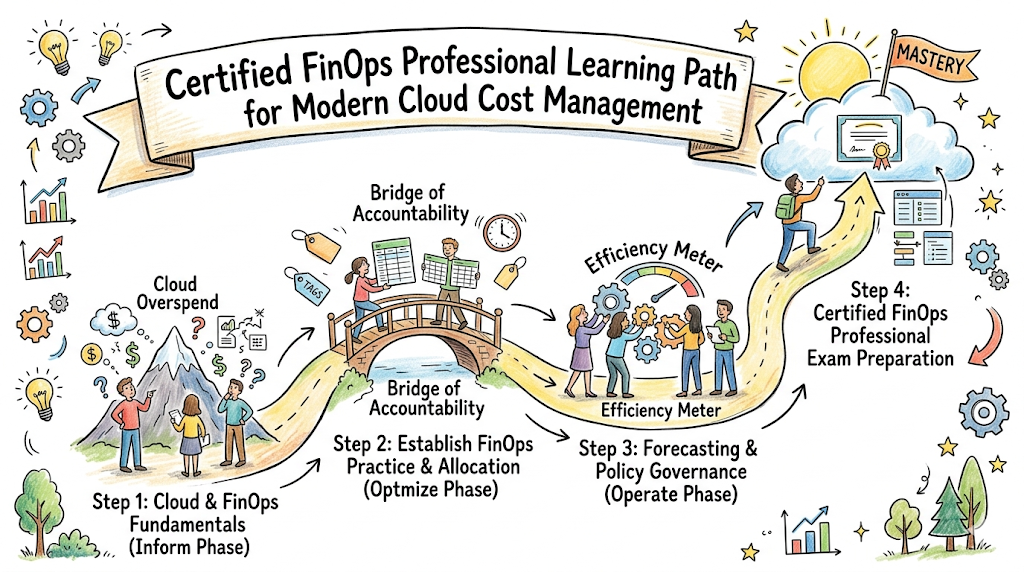
The Certified FinOps Professional represents the gold standard in cloud financial management, focusing on the intersection of people, processes, and technology. It exists to formalize the discipline of FinOps, moving beyond basic cost-tracking tools to focus on a cultural practice that enables teams to manage their own cloud usage. This certification validates an individual’s ability to implement the “Inform, Optimize, and Operate” lifecycle within complex enterprise environments.
Unlike theoretical frameworks, this certification emphasizes production-focused learning and real-world application of unit economics in cloud computing. It aligns perfectly with modern engineering workflows where developers are empowered to make spending decisions as part of their daily coding and deployment activities. For the enterprise, this means moving from static annual budgets to a dynamic model of real-time financial transparency and technical agility.
Who Should Pursue Certified FinOps Professional?
This certification is highly beneficial for cloud architects, SREs, and DevOps engineers who are tasked with scaling infrastructure without ballooning costs. It is equally valuable for finance professionals and procurement officers who need to understand the technical nuances of cloud billing and reserved instances. Managers and technical leaders will find it indispensable for building high-performing teams that respect financial guardrails while maintaining high velocity.
Engineers at all levels can use this track to differentiate themselves in a crowded job market, while seasoned professionals can pivot into specialized FinOps practitioner roles. In both the Indian market and the global landscape, there is a massive talent gap for professionals who can interpret a multi-million dollar cloud bill and provide actionable engineering recommendations. Whether you are managing a small startup’s burn rate or an enterprise’s global cloud footprint, this certification provides the necessary expertise.
Why Certified FinOps Professional is Valuable and Beyond
The demand for cloud financial expertise is skyrocketing as organizations realize that cloud waste often exceeds thirty percent of their total spend. This certification provides longevity because it teaches fundamental principles of cloud economics that remain relevant even as cloud providers change their pricing models or release new services. It helps professionals stay relevant by shifting their focus from simple resource provisioning to strategic resource management and optimization.
Furthermore, the return on time and career investment is substantial, as FinOps practitioners often command higher salaries due to their direct impact on the company’s bottom line. Enterprise adoption of FinOps is no longer optional; it is a requirement for maintaining a competitive edge in a digital-first economy. By mastering these skills, you position yourself as a strategic partner to the business side of the organization, rather than just a cost center in the IT department.
Certified FinOps Professional Certification Overview
The program is delivered via the official training portal and is hosted on the primary platform of the educational provider. The certification approach is grounded in practical assessment, requiring candidates to demonstrate knowledge of cloud billing data, discount mechanisms, and organizational change management. It is structured to provide a clear path from fundamental concepts to advanced mastery of financial operations in a cloud-native context.
The ownership of the learning journey stays with the student, who must navigate through different modules covering visibility, allocation, and forecasting. The assessment is not just a test of memory but a validation of the candidate’s ability to solve real-world financial challenges using technical data. This structured approach ensures that a certified professional can walk into any organization and begin building or improving a FinOps practice immediately.
Certified FinOps Professional Certification Tracks & Levels
The certification hierarchy begins with a foundation level designed to establish a common language across engineering, finance, and business units. This entry point focuses on the core principles of the FinOps framework and the basic lifecycle stages. It is the ideal starting point for anyone new to the discipline, ensuring a solid understanding of why cloud financial management is a necessity in modern business.
The professional and advanced levels are where specialization occurs, focusing on deep-dive topics like automated rightsizing, container cost allocation, and complex commitment modeling. These tracks allow professionals to align their learning with their specific career progression, whether they want to remain in a technical engineering role or move into a strategic leadership position. Each level builds upon the previous one, creating a comprehensive expert profile.
Complete Certified FinOps Professional Certification Table
| Track | Level | Who it’s for | Prerequisites | Skills Covered | Recommended Order |
| Core FinOps | Foundation | New Practitioners | Basic Cloud Knowledge | Lifecycle, Personas, Domains | 1 |
| Technical FinOps | Professional | Cloud/DevOps Engineers | Foundation Cert | Automation, Unit Economics | 2 |
| Strategic FinOps | Professional | Finance/Managers | Foundation Cert | Policy, Governance, KPIs | 2 |
| Platform FinOps | Advanced | Architects/Leads | Professional Cert | Multi-cloud, Containers | 3 |
Detailed Guide for Each Certified FinOps Professional Certification
Certified FinOps Professional – Foundation Level
What it is
This certification validates the candidate’s understanding of the basic FinOps framework and the ability to define the six domains and three phases of the lifecycle.
Who should take it
It is suitable for entry-level cloud engineers, finance analysts, and project managers who need to understand how cloud billing works at a fundamental level.
Skills you’ll gain
- Understanding the FinOps lifecycle: Inform, Optimize, Operate.
- Identifying key FinOps personas and their responsibilities.
- Mastering cloud billing terminology across different providers.
- Basic cost allocation and tagging strategies.
Real-world projects you should be able to do
- Create a basic cloud spend dashboard for a specific team.
- Identify unallocated costs in a monthly cloud invoice.
- Draft a tagging policy for a small development environment.
Preparation plan
- 7–14 days: Review official glossary and framework documentation.
- 30 days: Complete online foundational modules and practice quizzes.
- 60 days: Engage in community forums and apply concepts to a sandbox cloud account.
Common mistakes
- Focusing only on cost-cutting rather than value realization.
- Ignoring the cultural and organizational change aspects of the framework.
Best next certification after this
- Same-track option: Certified FinOps Professional – Professional Level
- Cross-track option: Cloud Practitioner (AWS/Azure/GCP)
- Leadership option: Engineering Management Fundamentals
Certified FinOps Professional – Professional Level
What it is
This level validates a deeper expertise in executing FinOps practices, focusing on data analysis, automated optimization, and complex organizational alignment.
Who should take it
Experienced DevOps engineers, SREs, and FinOps practitioners who are responsible for managing large-scale cloud budgets and driving optimization initiatives.
Skills you’ll gain
- Implementing advanced unit economics and KPI tracking.
- Managing complex cloud commitment models (RIs, Savings Plans).
- Automating waste detection and remediation workflows.
- Facilitating cross-functional collaboration between engineering and finance.
Real-world projects you should be able to do
- Design an automated rightsizing workflow for Kubernetes clusters.
- Calculate the unit cost of a specific business transaction or service.
- Develop a multi-cloud cost allocation engine for a global enterprise.
Preparation plan
- 7–14 days: Deep dive into advanced commitment strategies and discounting.
- 30 days: Hands-on lab work with FinOps tools and billing data exports.
- 60 days: Implement a pilot FinOps project in a production-like environment.
Common mistakes
- Over-automating without proper developer feedback loops.
- Failing to establish a clear baseline for performance before optimizing.
Best next certification after this
- Same-track option: Specialist tracks (Container FinOps)
- Cross-track option: SRE Professional Certification
- Leadership option: ITIL Leader or Digital & IT Strategy
Choose Your Learning Path
DevOps Path
The DevOps path focuses on integrating cost as a first-class citizen in the CI/CD pipeline. Engineers learn to shift-left on cost, enabling developers to see the financial impact of their infrastructure-as-code changes before they are deployed. This path emphasizes automated guardrails and real-time alerts to prevent budget overruns during rapid release cycles.
DevSecOps Path
In this path, the focus is on the “Cost of Security” and ensuring that security tools and logging do not create unnecessary financial bloat. Professionals learn to balance the trade-offs between rigorous security scanning and the associated storage and compute costs. It teaches how to optimize security resource consumption while maintaining a robust defensive posture.
SRE Path
The SRE path maps financial budgets to error budgets, treating cost as a dimension of service reliability and performance. SREs learn to use FinOps data to make informed decisions about over-provisioning for high availability versus cost-effective scaling. This path is essential for those running massive, distributed systems where small inefficiencies scale into large financial burdens.
AIOps Path
This track focuses on the application of artificial intelligence to operational data to drive financial efficiency. Professionals learn to use machine learning models for predictive forecasting and automated anomaly detection in cloud spending. It bridges the gap between traditional operations and intelligent, self-healing financial systems.
MLOps Path
The MLOps path addresses the high costs associated with training and deploying machine learning models, specifically GPU utilization and data egress. Engineers learn to optimize the lifecycle of model training, from data preparation to inference at the edge, ensuring that AI initiatives remain financially viable. This is critical for organizations scaling their data science capabilities.
DataOps Path
DataOps professionals focus on the cost of data gravity, storage tiers, and query optimization in large-scale data warehouses. This path teaches how to manage the lifecycle of data to minimize storage costs while maintaining high performance for analytical workloads. It is vital for teams managing PB-scale data lakes and real-time processing pipelines.
FinOps Path
The core FinOps path is dedicated to those who wish to become full-time practitioners or leads within a FinOps Center of Excellence (CoE). It covers the breadth of the framework, from culture and leadership to deep technical analysis and financial reporting. This path prepares individuals to lead organizational transformations and drive a culture of accountability.
Role → Recommended Certified FinOps Professional Certifications
| Role | Recommended Certifications |
| DevOps Engineer | FinOps Foundation + Technical Professional |
| SRE | FinOps Foundation + SRE Professional |
| Platform Engineer | FinOps Professional + Specialist Advanced |
| Cloud Engineer | FinOps Foundation + Cloud Provider Certs |
| Security Engineer | FinOps Foundation + DevSecOps Specialist |
| Data Engineer | FinOps Foundation + DataOps Professional |
| FinOps Practitioner | Full FinOps Professional Track + Advanced |
| Engineering Manager | FinOps Foundation + Strategic Professional |
Next Certifications to Take After Certified FinOps Professional
Same Track Progression
Once you have achieved the professional level, the next logical step is to dive into niche specializations such as Container FinOps or Multi-Cloud Governance. These certifications allow you to master the nuances of specific technologies like Kubernetes or serverless architectures, which have unique cost structures. Deepening your expertise in these areas makes you an invaluable asset for complex, modern technology stacks.
Cross-Track Expansion
To broaden your skill set, consider moving into SRE or Platform Engineering certifications. Understanding how to build reliable, scalable platforms complements your ability to manage their costs, making you a more well-rounded technical leader. Alternatively, looking into DataOps or MLOps certifications can help you apply FinOps principles to the most resource-intensive areas of modern computing.
Leadership & Management Track
For those looking to transition into executive or management roles, certifications in IT Business Management or Digital Strategy are highly recommended. These programs help you translate technical and financial data into business outcomes that the C-suite cares about. Moving into leadership requires a shift from “doing” FinOps to “leading” the organizational change that makes FinOps successful.
Training & Certification Support Providers for Certified FinOps Professional
DevOpsSchool stands out as a premier global destination for technical training, specifically tailored for those pursuing a career in cloud financial management. Their programs for the Certified FinOps Professional are meticulously crafted by industry experts who bring real-world scenarios into the classroom. The curriculum covers everything from the basics of cloud billing to advanced unit economics and automated optimization strategies. Students gain access to a rich repository of learning assets, including interactive labs and comprehensive video tutorials that simplify complex financial concepts. By fostering a collaborative learning environment, they ensure that every professional can successfully integrate FinOps practices into their existing engineering workflows without friction.
Cotocus provides high-impact, enterprise-grade training solutions designed to accelerate the adoption of FinOps across large organizations. Their approach to the Certified FinOps Professional curriculum is heavily focused on hands-on application and strategic implementation. They offer specialized workshops that help cross-functional teams from finance and engineering work together effectively. The instructors at Cotocus are seasoned veterans who provide deep insights into the cultural shifts required for a successful FinOps practice. Their training is not just about passing an exam; it is about building the internal capability to manage cloud resources at scale while maintaining strict financial control and technical agility.
Scmgalaxy is a community-centric platform that offers an extensive range of resources for software configuration and cloud management professionals. Their support for the Certified FinOps Professional certification includes a massive library of technical blogs, documentation, and expert-led webinars. They focus on the practical tools and techniques needed to gain visibility into cloud spending and implement effective cost allocation strategies. The platform encourages knowledge sharing among practitioners, allowing learners to see how others have solved real-world financial challenges in production environments. Scmgalaxy is an ideal choice for those who value community engagement and peer-to-peer learning as they master the nuances of cloud financial operations.
BestDevOps is dedicated to providing streamlined and effective learning paths for modern IT professionals seeking advanced certifications. Their training for the Certified FinOps Professional is designed to be concise yet comprehensive, focusing on the core competencies that drive immediate career value. They offer personalized mentorship and career coaching to help students navigate the complexities of the FinOps landscape. By emphasizing practical outcomes and real-world projects, BestDevOps ensures that its graduates are ready to lead optimization initiatives from day one. Their programs are highly regarded for their high-yield content and their ability to prepare candidates for the challenges of managing global cloud footprints.
Devsecopsschool.com specializes in the critical intersection of security, development, and financial accountability. Their training for the Certified FinOps Professional is unique in its focus on how security investments can be optimized for better financial performance. They teach practitioners how to evaluate the cost-effectiveness of security tools and how to maintain a high defensive posture without unnecessary cloud spend. The curriculum includes detailed modules on security resource consumption and the financial impact of various compliance strategies. This provider is the top choice for security engineers and architects who want to add financial management to their professional toolkit while ensuring organizational safety.
Sreschool.com provides a dedicated learning environment for Site Reliability Engineers who need to incorporate financial metrics into their reliability practices. Their program for the Certified FinOps Professional emphasizes the relationship between service level objectives and cloud infrastructure costs. Students learn how to make data-driven decisions that balance the need for high availability with the requirement for financial efficiency. The labs and case studies focus on large-scale distributed systems, providing SREs with the tools they need to manage the financial health of complex platforms. Sreschool.com is recognized for its ability to translate technical engineering constraints into actionable financial insights for the business.
Aiopsschool.com leads the way in teaching how artificial intelligence can be leveraged to automate and optimize cloud financial operations. Their support for the Certified FinOps Professional certification includes specialized training on using machine learning for cost forecasting and anomaly detection. They provide engineers with the skills needed to build “intelligent” FinOps systems that can automatically respond to spending trends in real-time. The curriculum covers the use of AI tools for predictive budgeting and advanced data analysis, making it an essential resource for those looking to stay at the cutting edge of operational technology. Aiopsschool.com bridges the gap between traditional manual finance and modern automated operations.
Dataopsschool.com focuses on the unique financial challenges associated with data-intensive applications and large-scale data warehouses. Their training for the Certified FinOps Professional dives deep into the costs of data storage, egress, and processing. They teach data engineers and architects how to implement efficient data lifecycles that minimize expenses while maximizing performance for analytics and reporting. The program includes practical strategies for optimizing query performance and managing the costs of “big data” in the cloud. Dataopsschool.com is the primary provider for professionals who need to manage the massive financial footprints of modern data platforms while maintaining high data velocity.
Finopsschool.com is the primary hosting institution and authority for the Certified FinOps Professional designation, offering the most direct path to mastery. As the creators of the certification standards, they provide an unparalleled level of depth and accuracy in their training materials. Their curriculum is always aligned with the latest developments in the FinOps framework and the evolving pricing models of major cloud providers. Students training here benefit from direct access to the source of the certification, ensuring that their knowledge is authoritative and up-to-date. Finopsschool.com provides a comprehensive learning journey that takes individuals from the foundational principles to the highest levels of strategic financial leadership.
Frequently Asked Questions (General)
- How difficult is the certification exam?The exam is considered moderately difficult, as it requires both theoretical knowledge of the framework and the ability to apply it to practical scenarios. Candidates with a background in cloud computing and basic finance will find it manageable with 30-60 days of focused study.
- What are the prerequisites for the professional level?While not always strictly enforced, it is highly recommended to complete the foundation level first. A minimum of one year of experience in cloud operations or financial management is also advised to fully grasp the advanced concepts.
- How long does it take to get certified?Most professionals can achieve the foundation level within 2 to 4 weeks of study. The professional level typically takes 2 to 3 months, depending on the individual’s prior experience and the amount of time dedicated to hands-on labs.
- What is the ROI of this certification?The return on investment is often immediate, as practitioners are able to identify cost-saving opportunities that far exceed the cost of the training. Career-wise, it opens doors to high-demand roles in FinOps Centers of Excellence.
- Does the certification cover specific cloud providers?The certification is generally cloud-agnostic, focusing on the principles that apply to AWS, Azure, and Google Cloud. However, practitioners are expected to understand how these principles manifest in the billing data of the major providers.
- Is this certification relevant for small businesses?Yes, because the principles of efficiency and accountability are universal. Small businesses often have tighter margins, making the ability to optimize cloud spend even more critical for their survival and growth.
- How often does the certification need to be renewed?The certification typically remains valid for two to three years. Renewal often requires demonstrating continued practice in the field or passing an updated exam to ensure alignment with evolving industry standards.
- Is there a practical lab component?The professional and advanced levels often include practical assignments or case study reviews. While the foundational exam is multiple-choice, higher levels require demonstrating the ability to analyze and interpret real billing data.
- Can finance professionals take this certification?Absolutely. In fact, many of the most successful FinOps practitioners come from a finance background. The program provides the technical context needed to understand cloud infrastructure costs.
- Should I take this before or after a Cloud Architect certification?Taking it after a cloud architect certification is often better, as you will already have a strong understanding of the technical services you are trying to optimize. It adds a financial layer to your existing technical knowledge.
- What tools are covered in the training?The training focuses on the framework rather than specific third-party tools. However, it covers native cloud tools like cost explorers and management consoles, as well as general data analysis techniques.
- Is this certification recognized globally?Yes, it is the most widely recognized certification in the cloud financial management space, used by major enterprises and consulting firms around the world to validate FinOps expertise.
FAQs on Certified FinOps Professional
- How does this certification address multi-cloud environments?The program teaches a unified framework that allows practitioners to apply the same principles across different cloud vendors. It focuses on normalizing data from various billing formats into a consistent specification, which is vital for organizations using more than one cloud provider. This ensures that financial reporting remains consistent and transparent, regardless of where the workloads are running.
- What is the focus on Unit Economics in the curriculum?Unit economics is a core pillar of the professional level, teaching how to measure cloud spend against business value. Instead of just looking at the total bill, you learn to calculate the cost per customer login or cost per transaction. This helps the business understand if cloud costs are scaling linearly with revenue, providing a much more accurate picture of financial health.
- How does the certification help with organizational culture change?A significant part of the training is dedicated to the people aspect of FinOps. It provides strategies for breaking down silos between engineering and finance teams and establishing a culture of shared accountability. You will learn how to communicate the value of FinOps to different stakeholders, from developers who want velocity to executives who want predictability.
- What role does automation play in the professional track?Automation is key to scaling FinOps, and the professional track covers how to implement automated policies for rightsizing and waste deletion. You learn how to use tags and labels to trigger automated actions, reducing the manual burden on engineering teams. This ensures that optimization isn’t a one-time event but a continuous part of the lifecycle.
- Does it cover container and Kubernetes cost management?Yes, the advanced modules specifically address the challenges of allocating costs in shared environments like Kubernetes. You will learn about namespace-level cost attribution, request versus usage analysis, and how to handle the unallocated costs of a cluster. This is essential for modern teams moving toward microservices where traditional billing methods often fail.
- How are commitment-based discounts handled?The curriculum dives deep into the strategy behind Reserved Instances and Savings Plans. You will learn how to build a portfolio of commitments that balances maximum savings with the need for architectural flexibility. This includes understanding coverage and utilization metrics, as well as how to manage the lifecycle of these commitments to minimize risk.
- What is the Inform phase in detail?The Inform phase focuses on visibility and allocation. The certification teaches how to implement a robust tagging strategy and use metadata to ensure that every cent of cloud spend is mapped to a specific owner, team, or project. This phase is the foundation of all other FinOps activities, as you cannot optimize or operate what you cannot measure.
- Can this help in preparing for a Cloud Financial Audit?Yes, the governance and policy sections of the certification are highly relevant for audit readiness. You learn how to establish clear guardrails, document financial decisions, and maintain a clear audit trail of cloud spending and optimization activities. This level of rigor is increasingly required for public companies in highly regulated industries.
Final Thoughts: Is Certified FinOps Professional Worth It?
From the perspective of a mentor who has seen the transition from physical data centers to the cloud, the Certified FinOps Professional is more than just a credential; it is a necessary shift in mindset. In the old world, hardware was a fixed capital expense, but in the cloud, infrastructure is a variable operational expense that can spiral out of control in minutes. If you are an engineer, this certification makes you a more strategic asset because you aren’t just building things—you are building things that are sustainable and profitable.
If you are a manager, this program gives you the language and framework to bring your technical and financial teams together, ending the cycle of budget shock at the end of every month. The industry has moved past the era of cloud at any cost, and we are now in the era of cloud with accountability. This certification is your roadmap for that journey. It is a practical, rigorous, and highly respected path that will serve you well for the rest of your career in the cloud-native ecosystem.
Very insightful explanation of how FinOps practices help organizations optimize cloud spending while maintaining operational efficiency.The learning path breakdown is especially useful for professionals entering cloud financial management.
Excellent learning path for mastering FinOps and modern cloud cost management! The blog clearly explains the skills, concepts, and practical areas professionals should focus on in today’s cloud-driven environments.
This is a very informative guide to Certified FinOps Professional training and cloud cost management workflows. The breakdown of learning stages and career progression adds strong value.